-
-
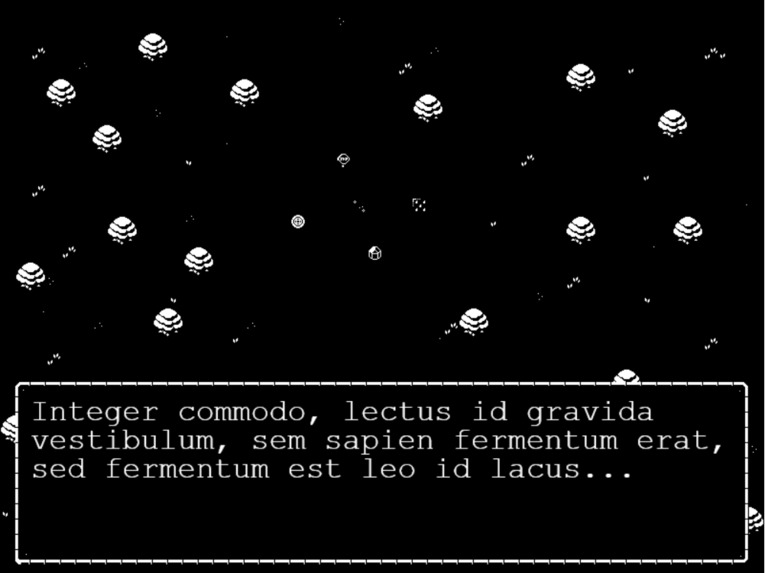
The text display and background tilemap.
-
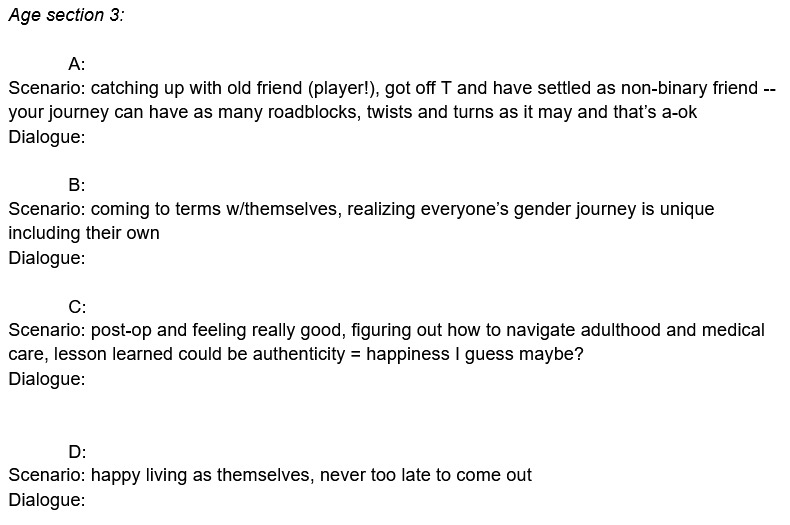
Showcases the concept of the final conversation for each person.
additional team members have been sent the invite, message Amelia on Slack for names
Inspiration
Initially, our team was torn between making a game or another application. After iterating through on some ideas, we settled on making a game that would uplift players, show some of the breadth of trans experiences, and provide resources and/or knowledge. From there it took additional time to settle on the idea of interacting with multiple people as they age. Other ideas included multiple one-off interactions flavored as a person interacting with their past self, or interacting with one person as they matured with a focus on branching paths.
As there was relatively little overlap in our development skillsets, one member suggested working with Javascript and Phaser to make the web game.
What it does
In it's current state, Winding includes very few features. Highlights are setting up a text engine that "types" character by character and using Phaser to importing a JSON map created with Tiled. More information on our plans is included in the final section.
How we built it
The core of the game was created in Javascript using Phaser 3, a game framework. Parcel and Node.js served to host and run the HTML page containing the script.
We used the Tiled map editor to create the map in the application. The sprites used are from Johan Vinet's CanariPack 1BIT TopDown.
Furthermore, we used github for version control.
Challenges we ran into
Our team ran into a number of challenges from the beginning. Initially, we had very few ideas that were eventually narrowed down to "game." Since it took us a bit to settle on the final concept, we were left feeling uncertain for the first part of the hackathon.
Some of our development environment choices also left us with challenges. In particular, most of the team had little experience with Javascript, necessitating time spent onboarding to the language and installing packages. With those installations came a host of technical difficulties and debugging before we had even written a line of code, including a full computer reset. Once code was being written, lack of familiarity with Phaser made debugging more difficult.
Unfortunately, these factors led to a loss of motivation at various points. This was exacerbating by the hassles of working remotely, especially across different timezones and sleep schedules (and tragic oversleeping).
Accomplishments that we're proud of
A good concept: While it may have taken us time to settle on our game concept, we like the direction we were going in and would have loved the finished product.
The code compiled: Our game may not have many (any?) features, but we have a working product that we are able to submit for you today.
Hackathon number one: queer_hack2020 was the first hackathon experience for three out of our four team members, and us newbies had a good time attending. We're happy that we tried something new, and wanted to thank you for including us!
What we learned
Working with something new, whether Javascript or specifically the Phaser libraries, is always a clear indication of learning. Though the time period of 26 hours is not a lot of time to actually learn something, even exposure can be a valuable teacher.
As previously stated, this was the first hackathon for three of us, and we learned some valuable lessons, such as: figuring out a schedule/timeframe, trying to nail down a scope (but being willing to retract or expand it), and scenario permitting reading up on technologies ahead of time.
What's next for Winding (incomplete game)
Ultimately, the stories of the individuals in this game will not be told today. But here's what could have been: the player, upon entering the game, is greeted with a title screen which expands into a group of people of varying ages. Each stage, the player can talk to those people and hear their concerns and stories, but can only encourage a limited number of them. Afterwards, the player moves to the next age stage where the characters have grown a bit older. In total, there are three of these stages, with the number of encouragements decreasing from three to two to one in the final stage. However, despite the player having to choose to not encourage someone, they are on their own journey and will find another path of their own. In the end, the player is unable to encourage anyone, but the characters the player has watched grow will encourage and inspire them in-game and possibly in real life. Throughout the game, the player character's encouragement dialogue will allude to real-life resources, which will be hyperlinked in the text box as well as presented at the end of the game.
Game functionality: selecting a character, waiting for player input to progress dialogue, possibly movement Concept implementation: writing and editing lines of dialog for each person in each age stage, sprites Misc: additional animations, possibly sound
Built With
- git
- github
- javascript
- node.js
- parcel
- phaser.js
- tiled

Log in or sign up for Devpost to join the conversation.