-
Farmer, Life easier!
Willow AI — One Phone Call. A Lifeline for Farmers.
Inspiration
Imagine waking up before sunrise, walking through fields you've spent months caring for, only to discover that your crops are dying.
A drought has destroyed your harvest. Your irrigation system needs replacing. You've invested nearly everything into your farm, but you don't have enough money to recover.
The hardest part? Financial assistance might already exist. You just don't know where to find it.
According to the National Young Farmers Coalition's 2022 survey, 71% of surveyed young farmers were unfamiliar with federal agricultural programs, 59% found the paperwork overwhelming, and 59% didn't have enough time to apply.
These are people who dedicate their lives to feeding our communities, yet struggle to access the very resources designed to support them.
That made us ask:
What if farmers didn't have to search for help? What if finding assistance were as simple as making a phone call?
That's why we built Willow AI.
What it does
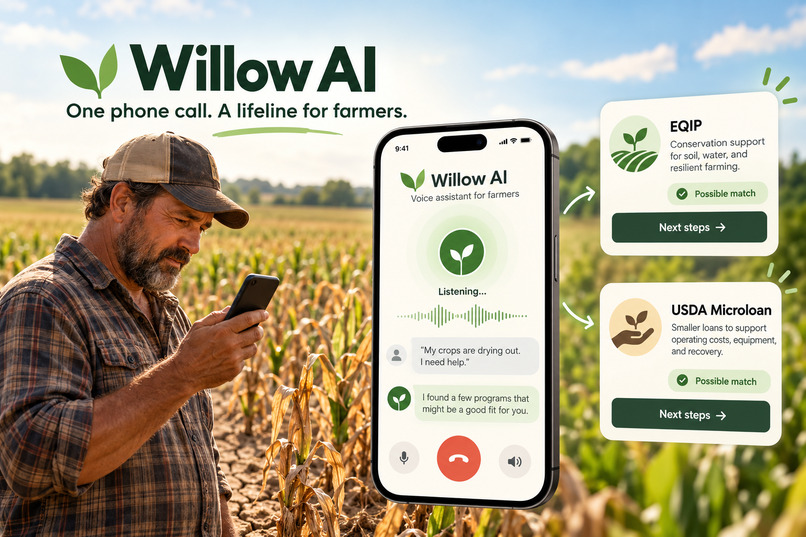
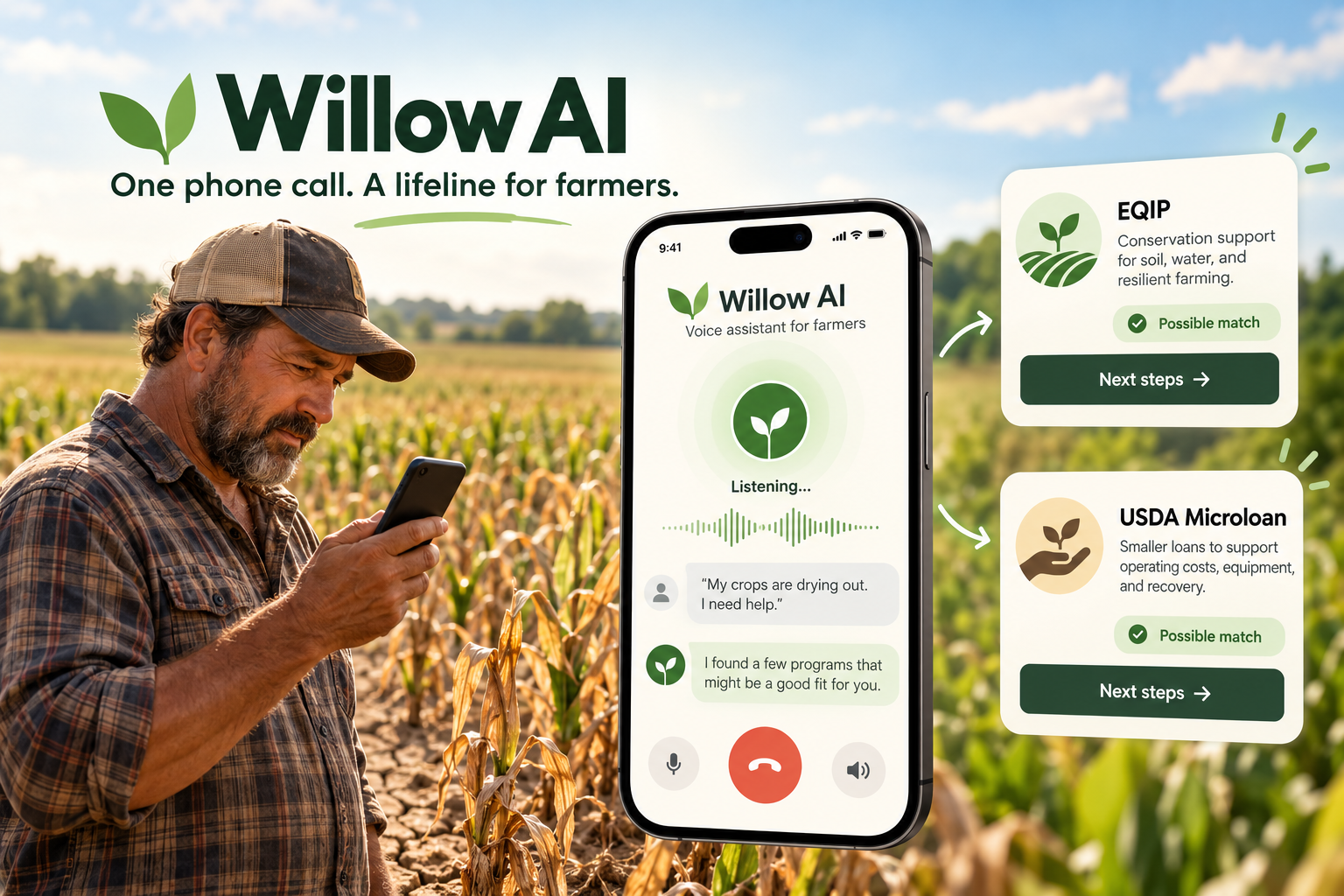
Willow AI is a voice-powered assistant that helps farmers discover financial assistance through a simple phone call.
No complicated websites. No endless searching through government documents. No need to understand confusing financial terminology.
A farmer simply calls Willow and explains their problem.
"My crops are dying because of the drought. I need a better irrigation system, but I can't afford it."
Willow listens, asks follow-up questions, and turns the conversation into useful information.
Our system then searches relevant USDA assistance programs and identifies opportunities that may fit the farmer's situation.
Instead of simply giving farmers a list of websites, Willow explains:
- What financial assistance might be available.
- Why a particular program could help.
- What requirements they may need to meet.
- What they should do next.
Our initial prototype focuses on two USDA assistance options: EQIP, which can provide financial assistance for eligible conservation improvements, and USDA Microloans, which offer financing for qualifying agricultural needs.
But our vision goes beyond finding assistance.
We want Willow to become an AI agent that doesn't just tell farmers where help exists, but helps them take action to receive it.
That means helping collect information, prepare applications, identify urgent deadlines, and eventually submit requests through authorized channels with the farmer's permission.
Because finding help should be the beginning of recovery, not another complicated process.
How we built it
We started with one simple idea: make Willow accessible through something almost every farmer already knows how to use—a phone.
We used Vapi to build Willow's conversational voice assistant, allowing farmers to describe their problems naturally instead of navigating a complicated form.
For our backend, we used Python and FastAPI to process conversations and transform farmers' responses into structured information.
We integrated USDA program information and developed a matching system that compares the farmer's situation with relevant program requirements.
Our workflow connects three important steps:
Phone conversation → Farmer information → Personalized assistance recommendations.
We also explored email follow-ups as an affordable way to deliver assistance information after a call.
Most importantly, we designed Willow to distinguish verified program requirements from AI-generated explanations.
Willow doesn't guarantee funding or invent eligibility decisions. It identifies promising opportunities and explains what still needs to be verified.
Challenges we ran into
One of our biggest challenges wasn't just building Willow. It was making Willow affordable, reliable, and genuinely useful.
Because Willow operates through phone calls, every conversation costs money. We also wanted to send SMS messages so farmers could receive assistance details after hanging up, but those messages came with additional costs.
As students working with a limited hackathon budget, we had to find ways to balance accessibility with affordability. That led us to explore email as a lower-cost alternative for follow-up communication.
On the technical side, connecting Vapi to our backend was difficult. We encountered missing information, inconsistent data formats, and challenges turning natural conversations into accurate program recommendations.
We also discovered how complicated agricultural assistance really is. A farmer's location, crop type, financial situation, or even one missing detail can completely change which programs are suitable.
Our biggest realization was that making AI sound helpful is much easier than making AI farmers can actually depend on.
Accomplishments that we're proud of
We're proud that Willow became more than an idea.
We built a voice-to-matching pipeline that connects real conversations with real agricultural assistance information.
A farmer can explain their situation naturally, Willow can collect relevant information, and our backend can evaluate program requirements to generate personalized recommendations.
But our biggest accomplishment isn't just technical.
It's that we built something with accessibility at its core.
Farmers shouldn't have to become experts in government programs just to discover that financial assistance might be available.
The people who work every day to feed our communities deserve technology that works around their lives—not the other way around.
What we learned
We learned that the value of AI isn't measured by how intelligently it speaks, but by how meaningfully it helps people.
Building Willow taught us how to connect conversational AI, backend systems, structured data, and real-world program requirements into one experience.
We also learned that even the smallest technical decisions matter. Phone calls, SMS costs, missing information, and inaccurate recommendations can all affect whether a farmer can actually benefit from the system.
Most importantly, we learned that technology should not only be powerful. It should be affordable, trustworthy, and accessible.
Innovation isn't always about creating new opportunities. Sometimes it's about helping people reach the opportunities that already exist.
What's next for Willow AI
Willow is only the beginning.
Our next goal is to transform Willow from an assistance discovery tool into an AI agent that helps farmers complete the process of getting help.
We plan to expand in five directions:
- More financial opportunities: Expand beyond our initial USDA programs to include crop insurance, disaster recovery grants, emergency funding, state assistance, and nonprofit support.
- Application assistance: Help farmers collect required information, prepare documents, and eventually submit applications through authorized channels with their approval.
- Emergency crop-loss support: Help farmers understand urgent reporting deadlines and prepare notices for their insurance providers.
- Affordable follow-ups: Develop email and other low-cost communication options so farmers can access their recommendations after the call.
- Multiple languages: Allow farmers from different backgrounds to explain their problems in the language they understand best.
Our vision doesn't stop in the United States.
We imagine a future where a farmer in California, a farmer in Cambodia, or a farmer anywhere in the world can make one phone call and discover support they might otherwise never find.
We can't stop the next drought.
We can't prevent every flood.
And we can't promise that every farmer will receive funding.
But we believe no farmer should miss an opportunity simply because they didn't know it existed.
One farmer. One phone call. One more chance.
That's Willow AI.
Built With
- fastapi
- javascript
- python
- resend
- vapi

Log in or sign up for Devpost to join the conversation.