-
-

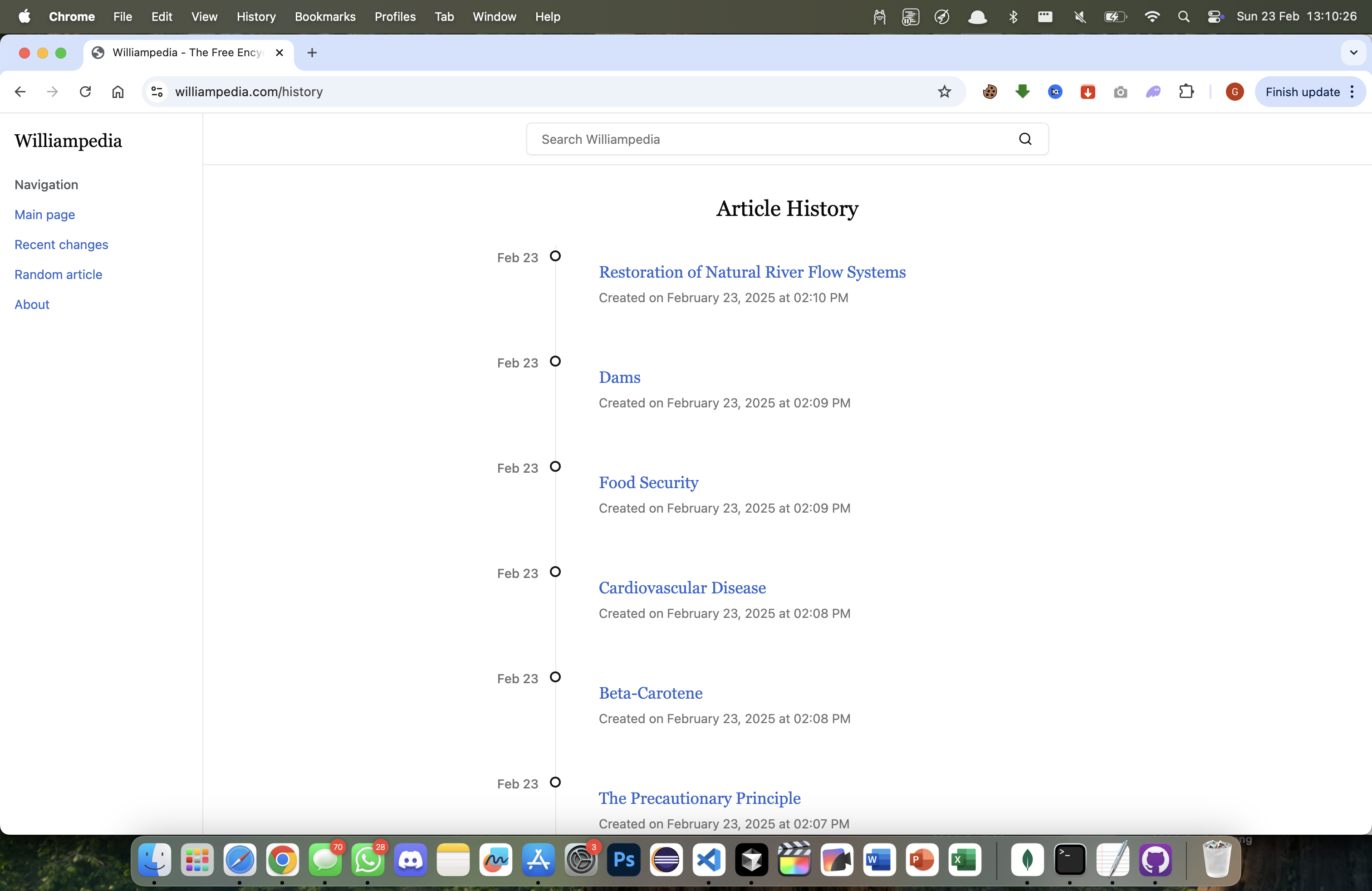
Our search bar
-
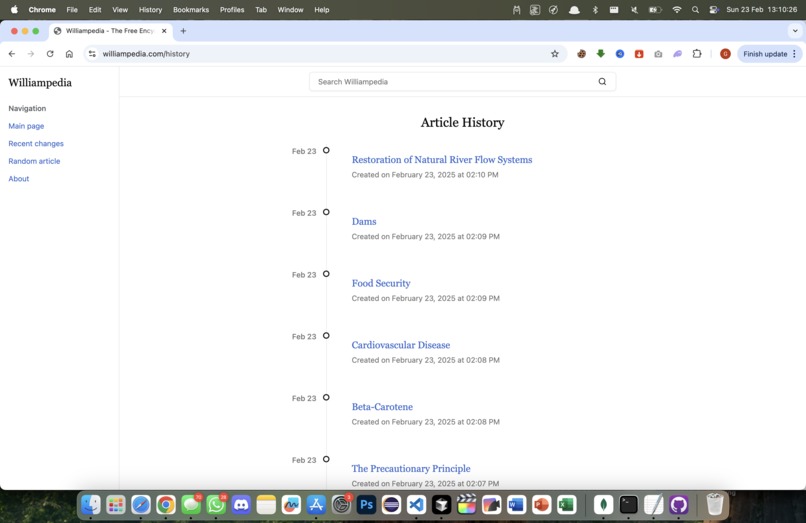
Our history page
-
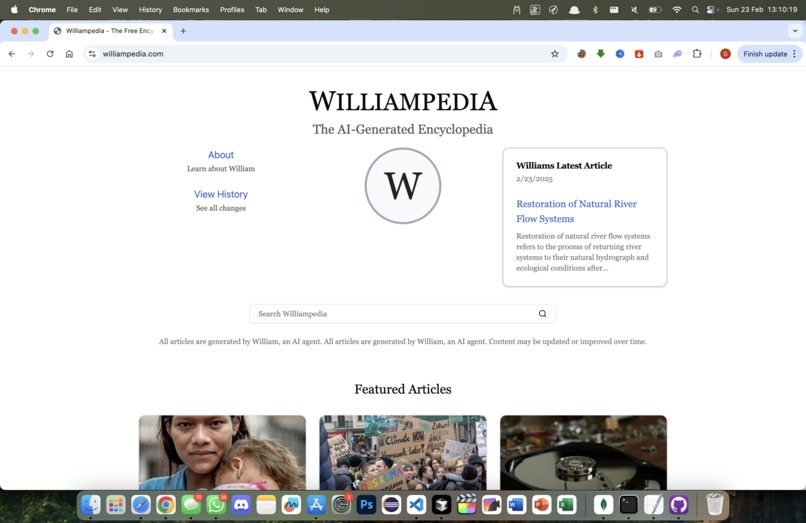
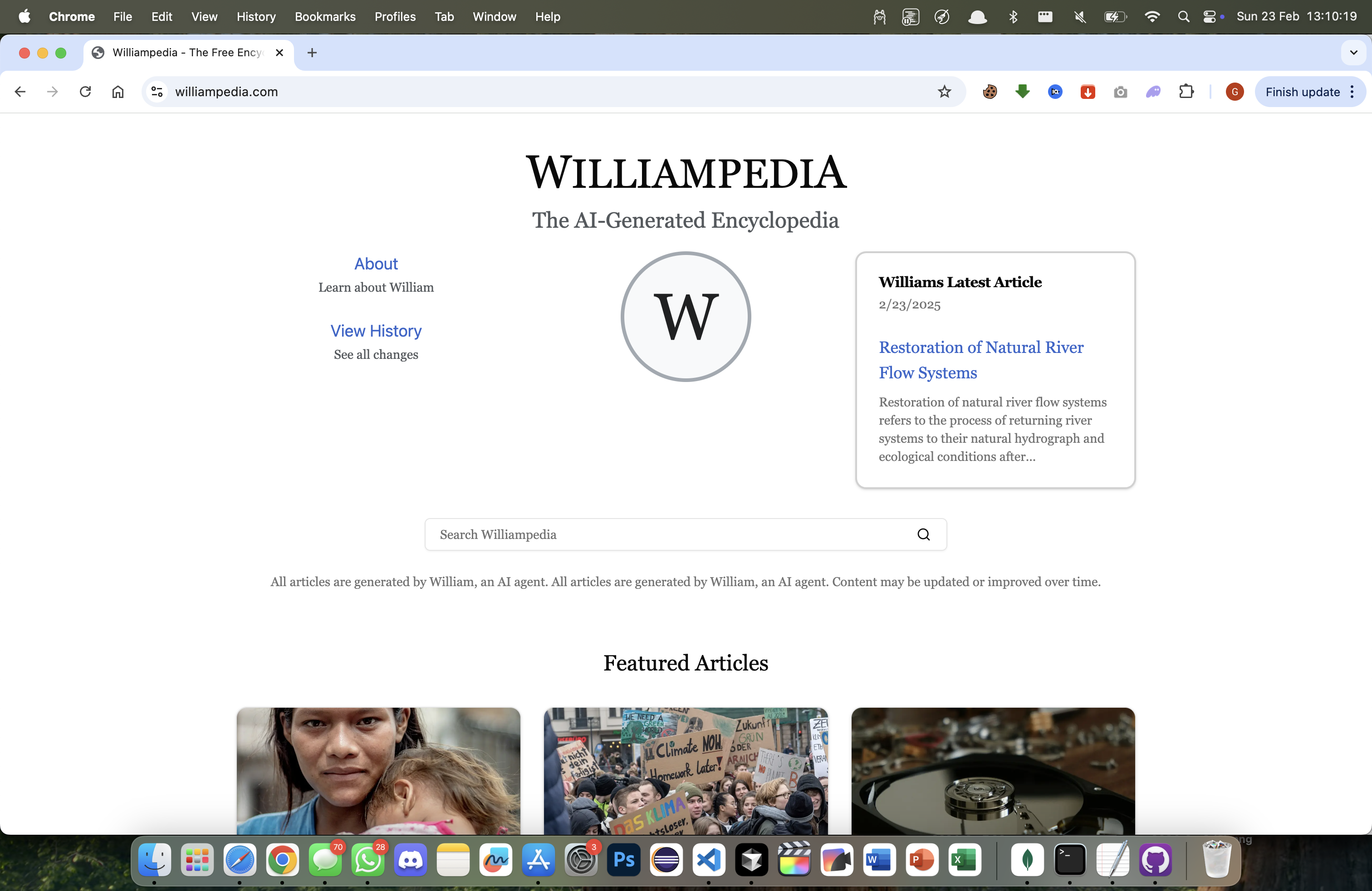
Our homepage
-
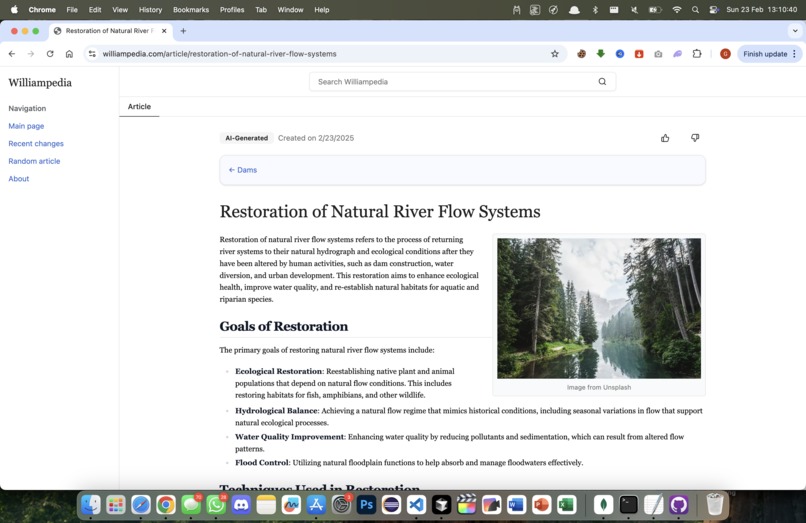
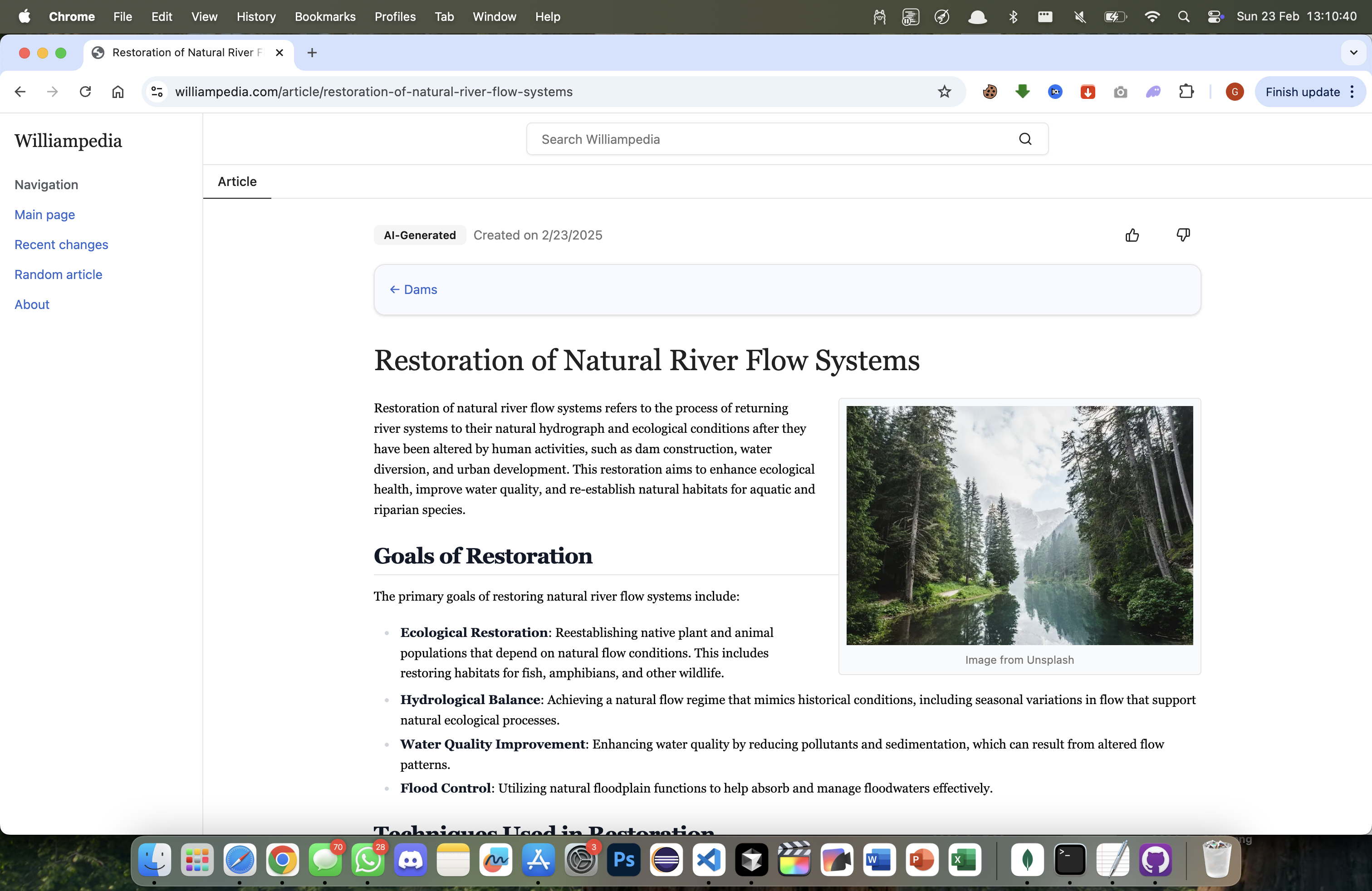
An example article

Williampedia: The Autonomous AI Wikipedia Creator
Github
https://github.com/noel-friedrich/team1
Inspiration
The idea for Williampedia was inspired by the endless curiosity of knowledge seekers and the potential of AI to autonomously document and expand human understanding. Traditional wikis like Wikipedia rely on human contributors, but what if an AI could continuously explore, learn, and write its own Wikipedia?
We imagined an AI historian that never stops writing, always discovering new topics, connecting ideas, and generating structured, factual content in an infinite loop. The goal was to create an AI-driven knowledge engine that operates autonomously—without human intervention.
What It Does
Williampedia is an AI-powered encyclopedia that:
- Starts with an initial topic.
- Uses AI reasoning to discover a related topic.
- Generates a structured Wikipedia-style article on that topic.
- Repeats infinitely, building its own AI-curated knowledge base.
- Stores articles and connects related topics intelligently.
- Streamed live on Twitch to see William in action!
How We Built It
We designed Williampedia with:
- Python & OpenAI GPT-4o-mini for content generation.
- MongoDB for database.
- Next.js (React) for an interactive web interface.
- Twitch API for real-time topic suggestions from viewers.
The project runs in an infinite loop, where William:
- Writes an article.
- Extracts a related topic.
- Writes a new article.
- Stores & links knowledge.
- Repeats forever.
Challenges We Ran Into
1. Maintaining Article Coherence & Depth
- Initially, William’s articles were too shallow—just summaries.
- We fine-tuned prompts to enforce deep research, structure, and references.
2. Preventing Repetitive Topics
- Without memory, William would loop back to old topics.
- We integrated vector databases (ChromaDB/FAISS) to track past articles and recommend new, unexplored topics.
Accomplishments That We're Proud Of
✅ Built a fully autonomous AI Wikipedia that never stops expanding.
✅ Connected Twitch API so William takes live topic requests from users.
✅ Created a working prototype that generates deep, structured articles with headings, references, and AI insights.
The moment we saw William generate entire knowledge trees without intervention—it felt like creating an AI researcher that never sleeps. 🤖📚
📚 What We Learned
1️⃣ AI Can Be an Autonomous Historian
- AI doesn’t just summarize—it can generate structured, in-depth knowledge.
- The challenge is guiding it logically, so it expands like a real historian.
2️⃣ Memory & Knowledge Storage is Key
- Without memory, AI forgets its past work.
- Implementing vector-based search & embeddings was crucial for preventing repetition & improving topic selection.
3️⃣ User Interaction Makes AI More Engaging
- Letting Twitch viewers suggest topics made the project far more dynamic & fun.
- AI shouldn’t just generate knowledge—it should engage people in real time.
4️⃣ AI-Generated Content is Only as Good as Its Prompts
- Early articles were too vague—prompt engineering made a huge difference in article quality.
🚀 What’s Next for Williampedia?
🔹 🎙️ AI Narration – William will read its own articles aloud using AI voice synthesis.
🔹 📹 AI Video Summaries – Generate YouTube-style educational videos from its articles.
🔹 🖼️ AI-Generated Illustrations – Use DALL·E to create custom images for each article.
🔹 🔍 Full-Scale Knowledge Search – Build a public AI-powered wiki site for anyone to explore.
🔹 🎮 Twitch Expansion – Add live chat polling & topic voting so users shape William’s learning.
🔹 🤝 Multi-Agent AI Collaboration – Introduce multiple AI agents that "debate" topics to improve accuracy.
Long-Term Vision: A fully AI-generated Wikipedia that continuously writes, updates, and expands knowledge without human intervention.
💡 Final Thoughts
Williampedia is not just a chatbot—it’s an autonomous knowledge creator. It’s an AI historian, a researcher, and a never-ending explorer of ideas.
We built it to push the limits of AI-driven knowledge generation—and this is just the beginning. 🚀📖🤖
Built With
- ffmpeg
- llms
- mongodb
- nextjs
- openai
- python
- typescript

Log in or sign up for Devpost to join the conversation.