Inspiration
We spent time looking at what people actually brings people back to Reddit.
Two patterns kept showing up.
The first was physics games. Watching a structure almost survive is entertaining whether you understand engineering or not. The moment where physics delivers the verdict is the payoff.
The second was daily community games. One challenge. One shared experience. Everyone plays the same puzzle, then heads to the comments to argue about it.
The problem was that traditional bridge builders ask too much from a Reddit scroll. Building takes time. Reddit gives you seconds.
So we asked a simpler question.
What's the smallest piece of engineering that's still fun?
Looking at a bridge and thinking:
"That thing isn't making it."
That's the entire game.
What it does
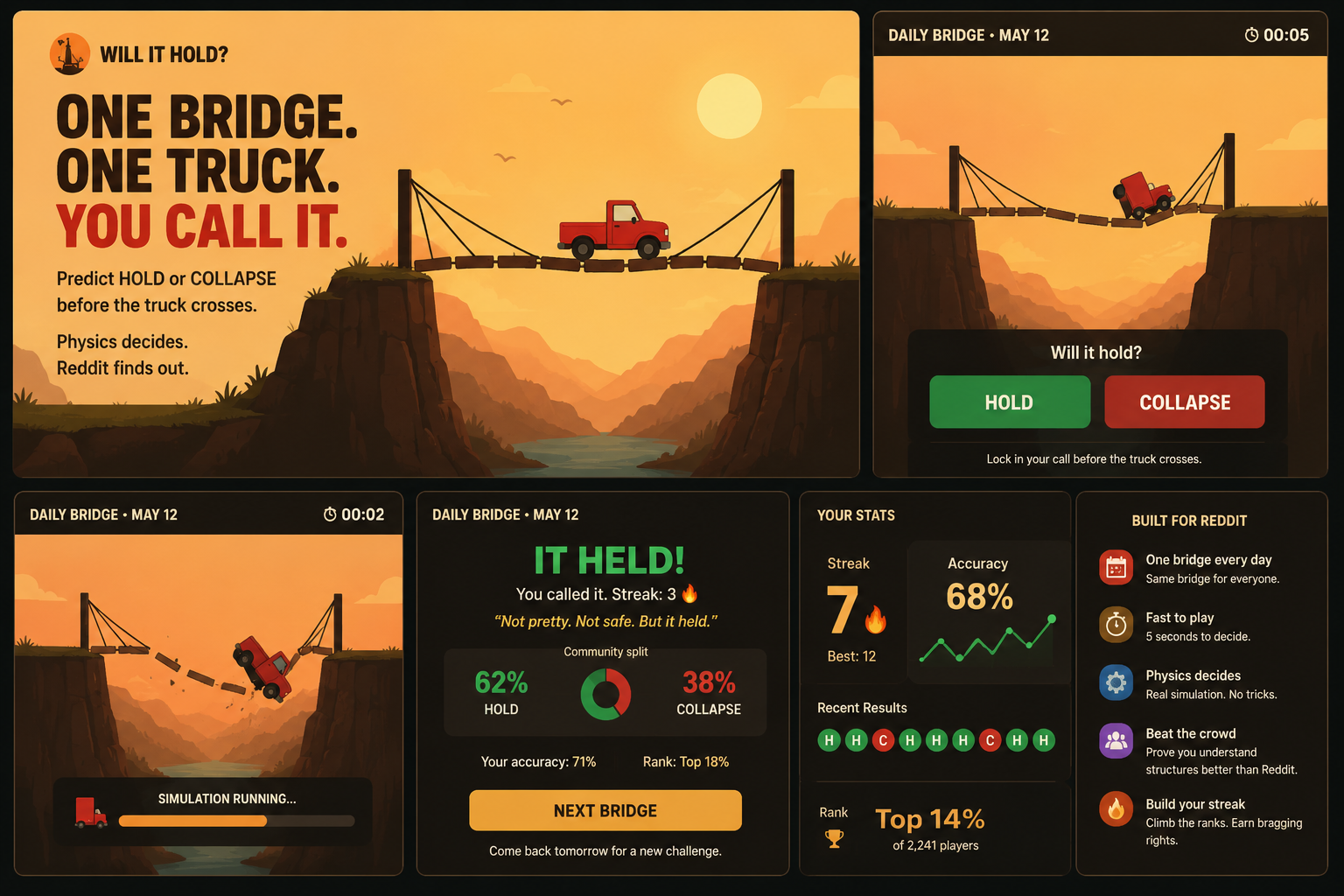
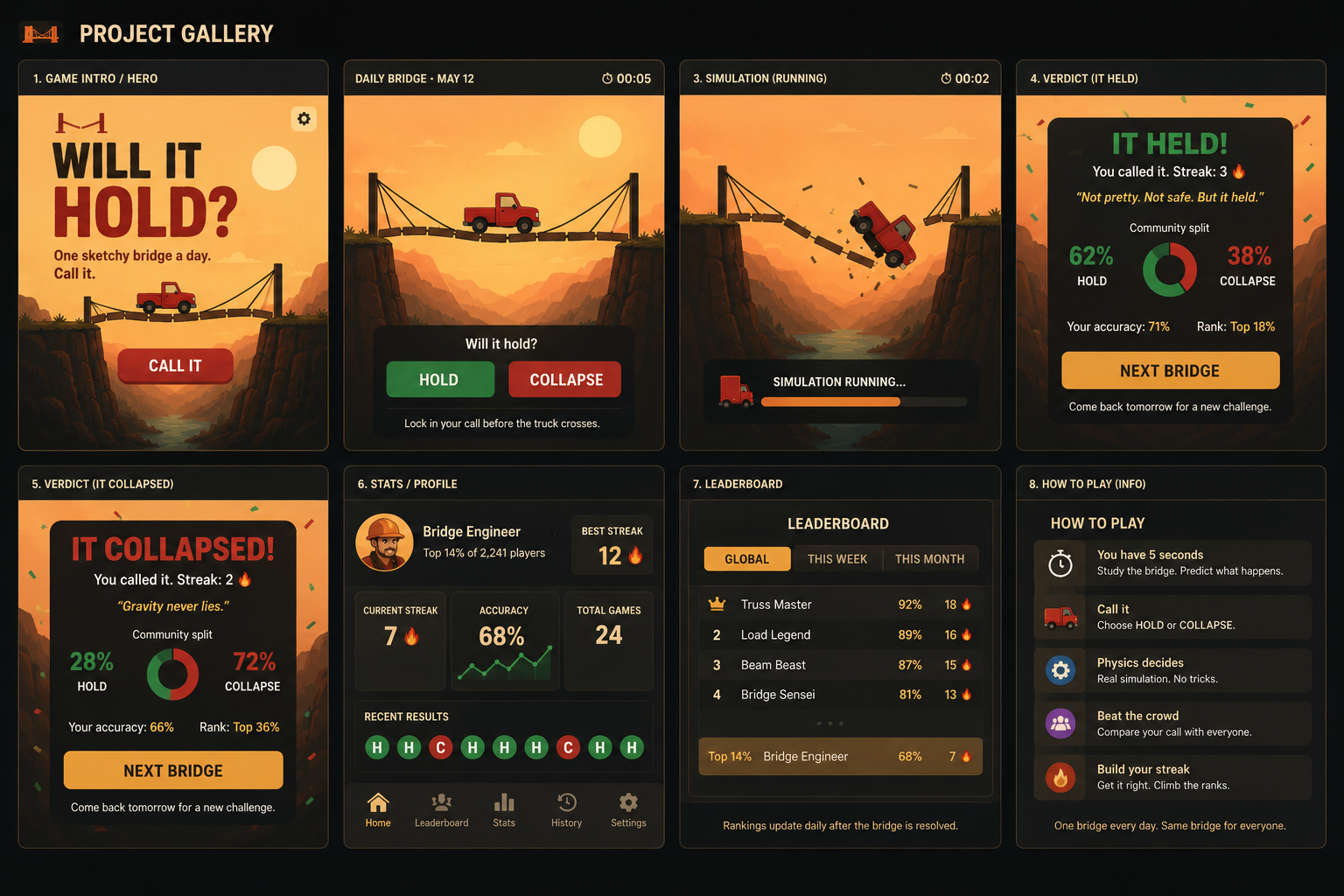
Every day, the game generates one bridge using the current date as its seed.
Everyone sees the exact same bridge.
A truck waits at one end.
The simulation is paused.
You have 5 seconds to choose:
- ✅ HOLD
- 💥 COLLAPSE
Once you lock in your answer, the simulation starts.
Four seconds later you're either celebrating your prediction or watching the bridge disappear into the ravine while the game reminds you how confident you were.
After every run you see:
- Your prediction
- The actual result
- Community split (e.g. 64% picked HOLD)
- Your current streak
- Your prediction accuracy
The comments become part of the game.
Few things generate discussion faster than hundreds of people arguing about why a bridge should have survived.
How we built it
Everything runs inside a Devvit Web post using Phaser 3 and Matter.js.
Nothing is prerecorded.
Every bridge is simulated live.
Daily procedural generation
A seeded PRNG (mulberry32) creates each day's bridge.
The seed determines:
- Deck layout
- Support placement
- Beam stiffness
- Joint strength
- Occasionally... one suspiciously missing support
The same seed always creates the same bridge.
That means everyone plays the exact same challenge.
Deterministic physics
Matter.js runs using a fixed timestep so simulations remain consistent across devices.
Difficulty comes from changing span length, support placement, and joint stiffness.
The goal wasn't to make bridges that were obviously safe or obviously broken.
The interesting bridges make people disagree.
Simplified structural model
Bridge loading roughly follows the standard beam approximation:
$$ M = \frac{wL^2}{8} $$
Where:
- \(w\) = distributed load
- \(L\) = bridge span
Longer spans increase bending moments, while additional supports and stronger joints increase the bridge's chance of surviving.
Around 40% of daily bridges are secretly doomed.
The best ones look impossible but somehow survive.
Backend
The backend uses Devvit + Redis to store:
- Daily puzzle seed
- Player guesses
- Community HOLD/COLLAPSE counts
- Streaks
- Accuracy
The first completed simulation becomes the canonical result, ensuring every player receives the same verdict.
Rendering
Everything on screen is generated procedurally.
No image assets.
The sky, hills, bridge, truck, debris, particles, and screen shake are all drawn in code, keeping the experience lightweight enough to run inside a Reddit post.
Challenges we ran into
Keeping simulations deterministic
Everyone needs to see the same outcome.
Physics engines don't always behave identically across browsers and devices because of floating-point differences.
We solved this using:
- Shared daily seeds
- Fixed timesteps
- Server-side canonicalization of the final result
Designing for Reddit
Every feature had to earn its place.
If it slowed the experience down, it was removed.
The final gameplay loop is simple:
- See the bridge.
- Make a prediction.
- Watch the simulation.
- See the result.
- Compare with everyone else.
All in under 30 seconds.
Building believable bridges
Pure randomness wasn't interesting.
Most generated bridges were obviously safe or obviously broken.
The generator became much better once we optimized for uncertainty instead of randomness.
The most memorable bridges are the ones where the community is almost evenly split.
Giving the game a personality
Without personality, it felt like a physics demo.
The post-run commentary became part of the experience.
A bridge collapsing is entertaining.
Being roasted immediately afterward makes people want to play again.
What we learned
People don't come back because a game has more features.
They come back because there's another interesting decision waiting tomorrow.
The daily bridge, shared prediction, streaks, and community discussion all reinforce that habit.
We also learned something specific to Reddit.
The game creates the moment. The comments make it memorable.
What's next
We're planning a Builder Mode where players can submit their own questionable bridges for future daily challenges.
We also want to add:
- Weekly flair for the longest prediction streaks
- Community awards for the most misleading bridge designs
- Multi-truck challenges that push surviving bridges even further
Because sometimes a bridge holds.
The real question is whether it'll hold again.
Built With
- devvit
- devvit-web
- express.js
- matter-js
- node.js
- phaser.js
- redis
- typescript
- vite

Log in or sign up for Devpost to join the conversation.