Inspiration
AI agents can now call APIs, manage wallets, and initiate payments at machine speed. But possession of a signing key only answers “Can this agent pay?” It does not answer “Should this payment be allowed under the institution’s mandate?”
The Monetary Authority of Singapore’s non binding SAFR paper describes a runtime governance pattern for financial agents which encourages the evaluation of proposed actions before execution, routing ambiguous cases to human oversight, and preserving an audit trail.
In Greek mythology, Cerberus guards a boundary that cannot be crossed unchecked. Our Cerberus guards the boundary between an AI agent’s payment intent and financial execution. Its three heads represent the three possible dispositions: ALLOW, DENY, and ESCALATE.
What it does
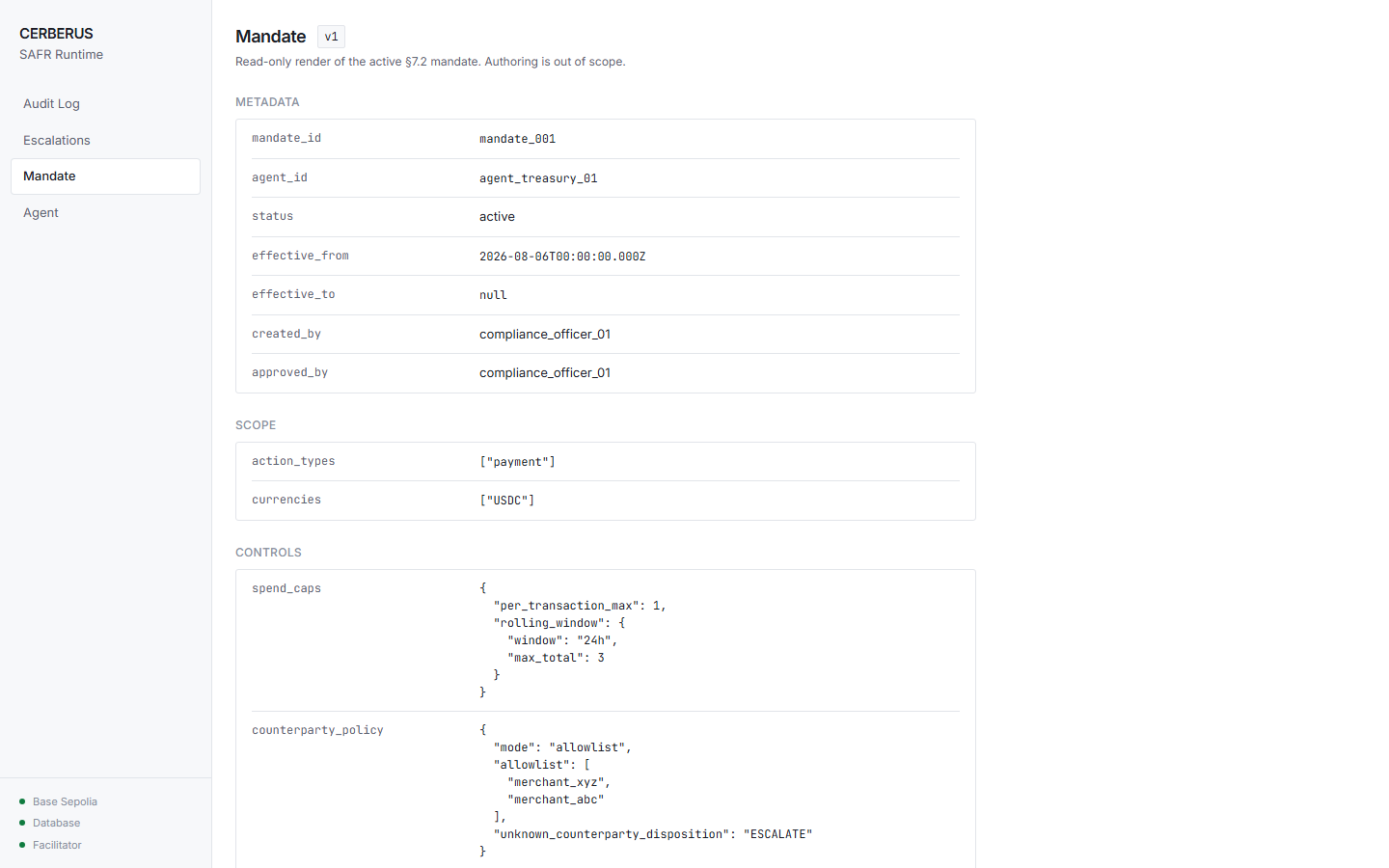
Cerberus is a pre-execution control plane for AI agents that are capable of executing payments. Before an x402 payment request is created, the agent’s proposed action is evaluated against an active mandate stored in a controls repository.
Based on set rules, the Disposition Engine checks the following:
- Permitted action types and currencies
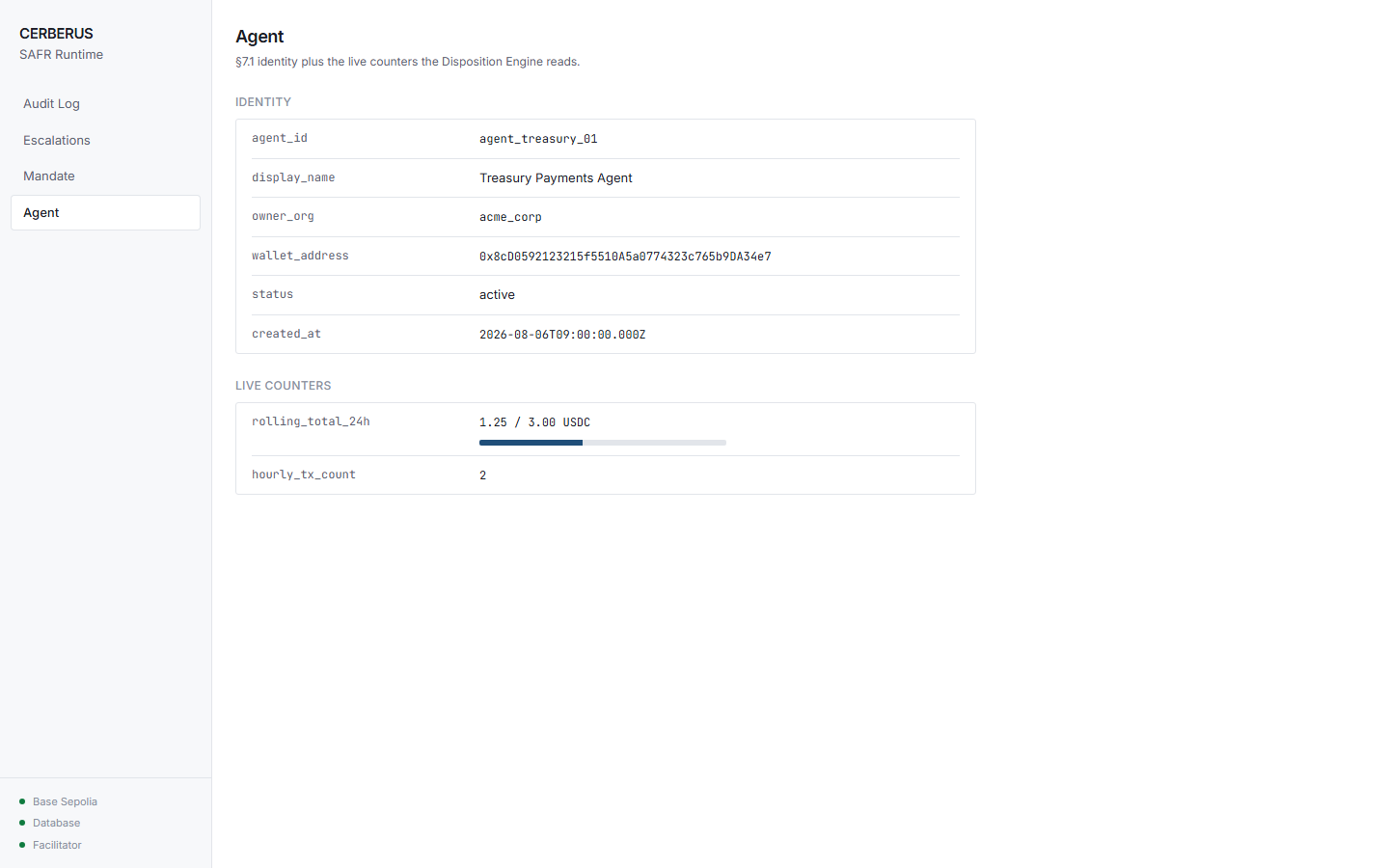
- Per transaction and rolling spend limits
- Counterparty allowlists
- Permitted operating times
- Transaction velocity
The engine then returns one deterministic disposition:
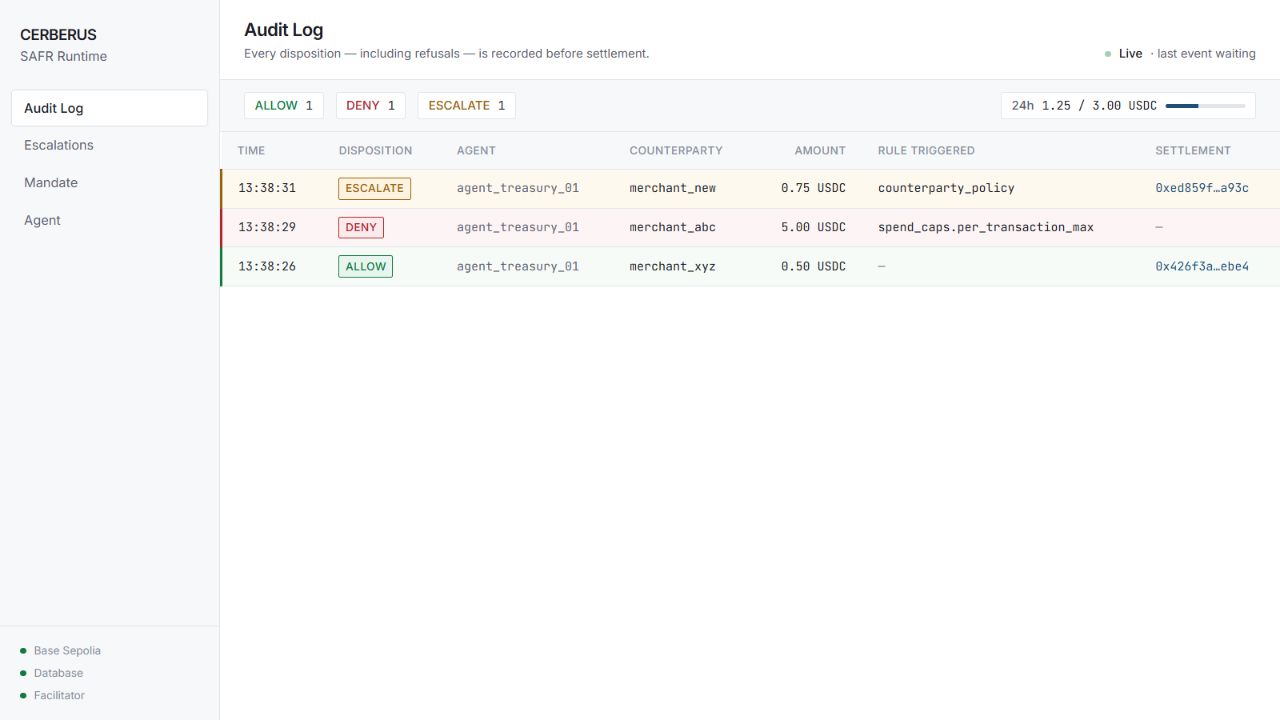
- ALLOW — the agent may construct and execute the x402 payment.
- DENY — execution stops before the payment request is constructed.
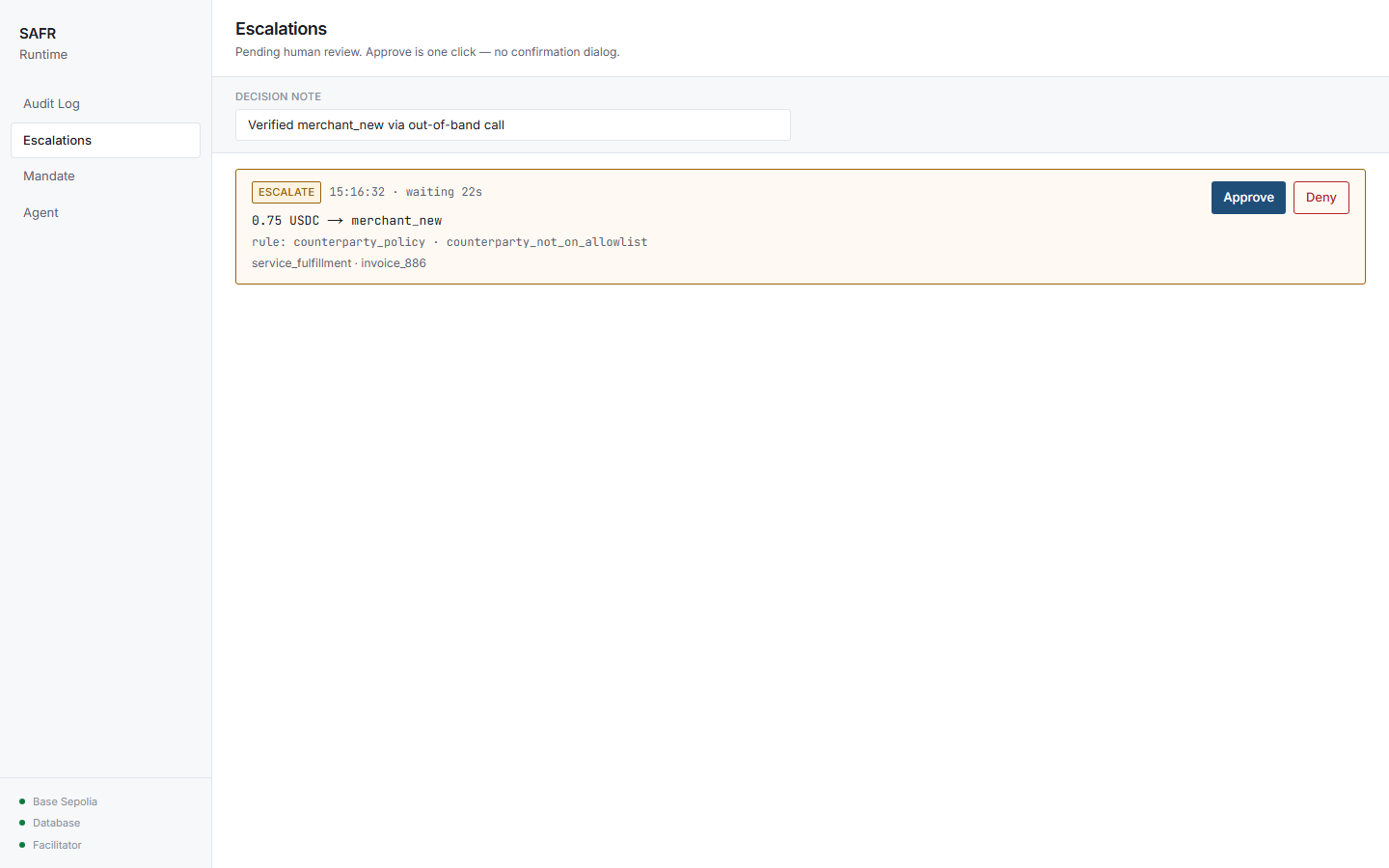
- ESCALATE — execution is suspended until a human reviewer approves or denies it.
Every proposed action produces an audit record containing the agent, mandate version, disposition, triggered rule, reason, human review, settlement result, and timestamps. Compliance officers can inspect these records through a live dashboard.
The AI model is permitted to generate payment intents only. It never decides whether a transaction is compliant; that decision remains deterministic, explainable, and reproducible.
How we built it
Cerberus is a TypeScript monorepo built with:
- Node.js and TypeScript for the agent runtime and services
- PostgreSQL 16 for agent identities, mandates, counters, and audit records
- Zod for strict SAFR-aligned schema validation
- x402 v2 for HTTP-native USDC payments on Base Sepolia
- Express for the merchant resource server and audit API
- Next.js for the compliance dashboard
- viem and Solidity for tamper-evident audit-record hashing and optional on-chain anchoring
- Docker Compose for reproducible local infrastructure
The Disposition Engine is a pure evaluate() function with no database, network, clock, or LLM dependency. The agent’s orchestrator loads the applicable mandate and counters, evaluates the proposed action, writes the audit record, and only then constructs the settlement client when execution is permitted.
This placement is fundamental: Cerberus is not a proxy observing payments after they begin. It governs the action before an x402 request exists.
Challenges we ran into
The hardest challenge was proving that a denied transaction was genuinely prevented, not merely attempted and allowed to fail. We added enforcement tests that confirm the x402 settlement client is never constructed on a DENY path and remains unreachable during ESCALATE until human approval.
Audit integrity introduced another challenge. Records change while an action progresses: an escalation gains a human review, and an allowed payment gains a settlement result. We therefore finalize and hash records only after they reach a terminal state.
We also hardened the live review flow against double clicks and concurrent approvals using an atomic database update. Network failures during settlement are captured as terminal failures so audit rows are never left indefinitely in limbo.
Finally, we preserved the exact SAFR terminology and schema structure while keeping the compliance logic deterministic and independent from the AI generating the intent.
Accomplishments that we're proud of
- Implemented all three dispositions end to end: ALLOW, DENY, and ESCALATE
- Proved that DENY prevents construction of the x402 request
- Built live human approval that resumes a suspended agent payment
- Created a versioned controls repository with spend, counterparty, time, and velocity controls
- Built a compliance dashboard with live audit records, rule explanations, threshold versus actual comparisons, and reviewer actions
- Implemented deterministic audit hashing and asynchronous on-chain anchoring support
- Passed 91 automated tests, full TypeScript validation, database verification, and a production dashboard build
- Reproduced the complete three-scenario demonstration consistently across repeated runs
What we learned
Agent authorization and agent governance are different problems. A wallet permission proves that an agent can sign, but a runtime mandate determines whether a specific action should proceed. We also learned that not every policy breach should have the same outcome. Clear boundary violations should be denied immediately, while uncertain but potentially legitimate actions should be escalated to human judgment. Most importantly, financial governance should not depend on probabilistic model judgment. AI can propose an action, but institutional authority must remain deterministic, explainable, and auditable.
What's next for Cerberus
Next, we plan to add stronger agent identity verification, signed governance envelopes, production authentication for human reviewers, and concurrency controls for multi-agent deployments.
The current prototype implements SAFR’s payments and treasury domain. The same disposition pattern could later govern other SAFR domains, including advisory workflows and controlled client communications.
Built With
- ai-agents
- base-sepolia
- docker
- express.js
- fintech
- next.js
- node.js
- postgresql
- solidity
- typescript
- usdc
- viem
- web3
- x402
- zod


Log in or sign up for Devpost to join the conversation.