-
-
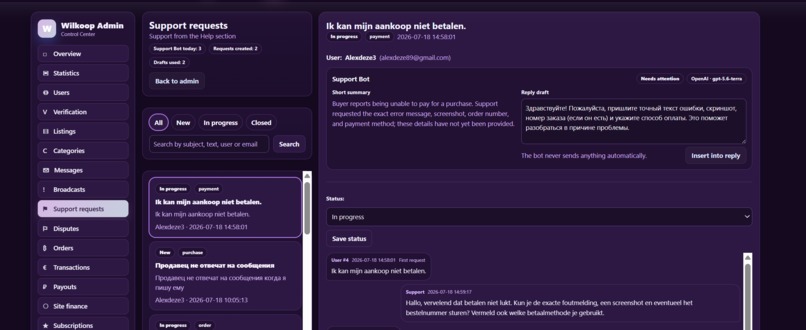
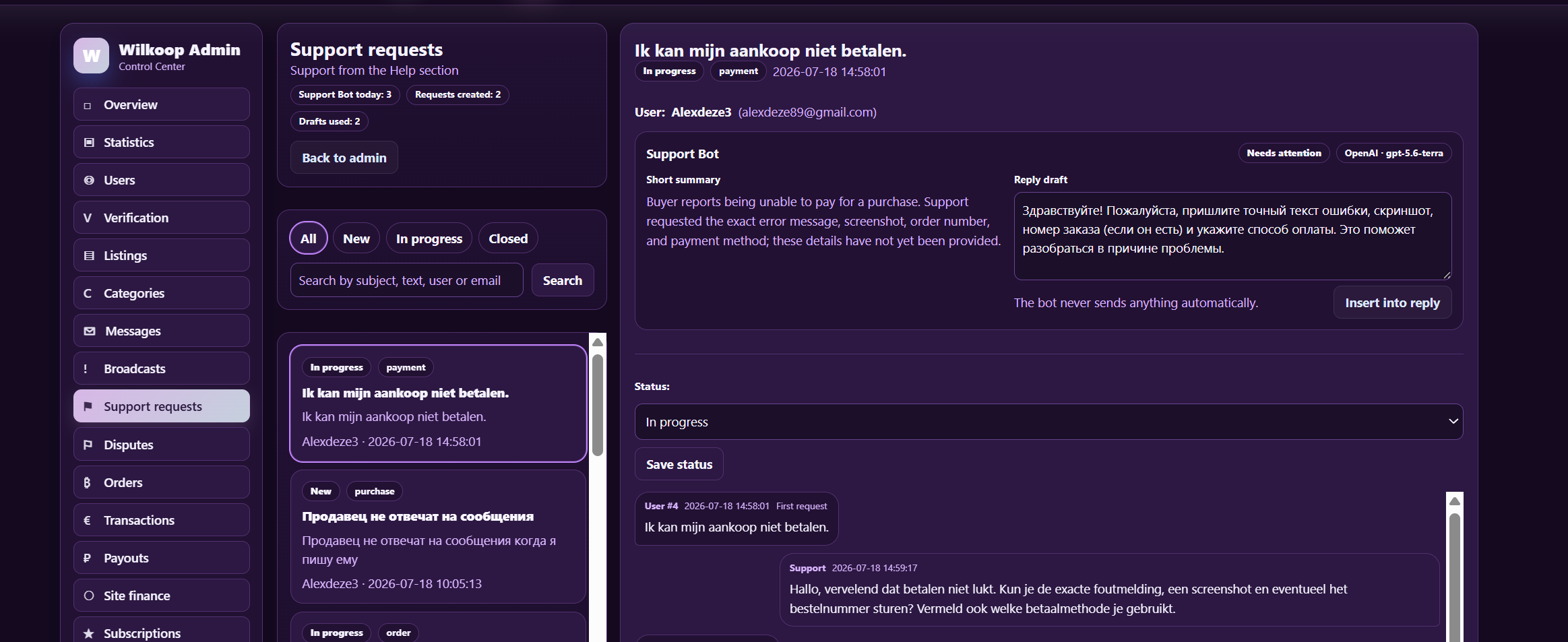
Support Bot summarises the request and prepares a reply draft for staff review.
-
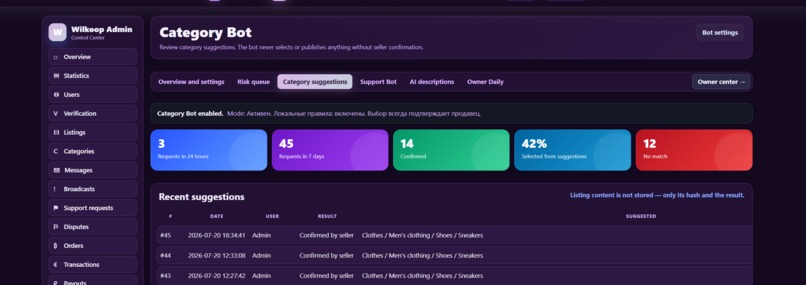
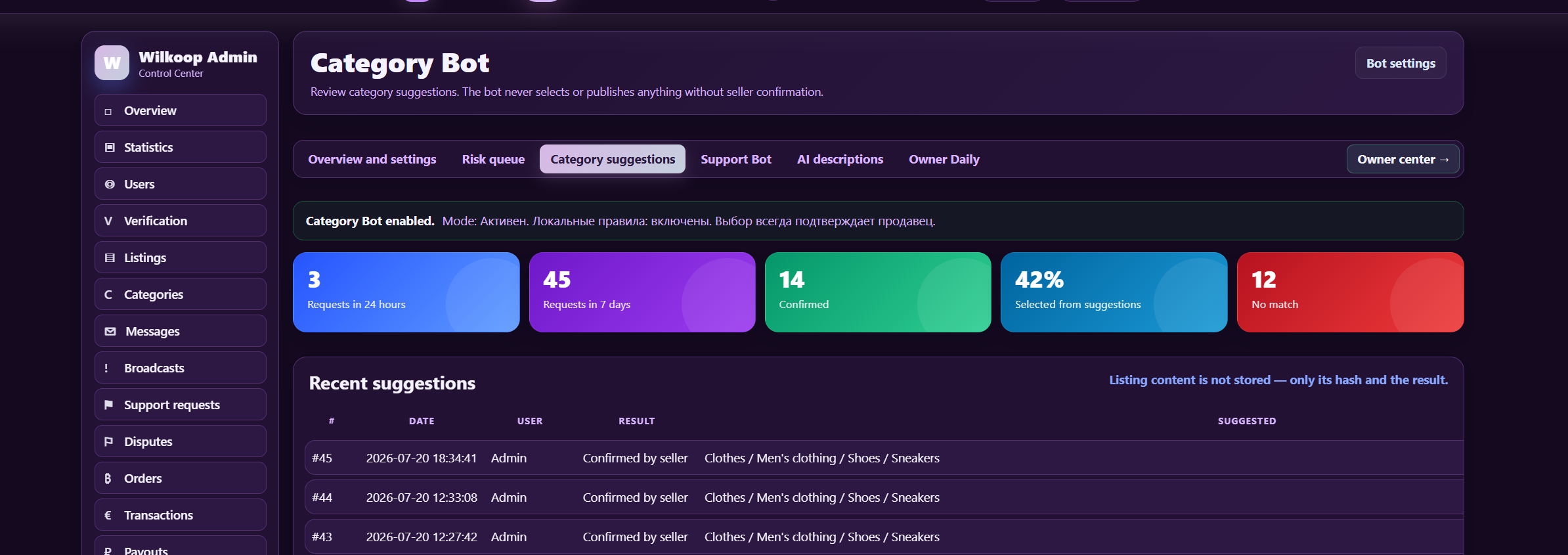
Category Bot analytics showing requests, confirmations, and recent suggestions.
-
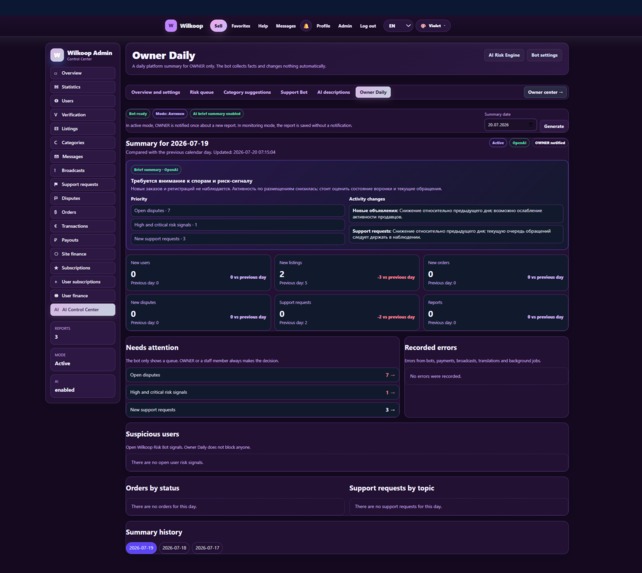
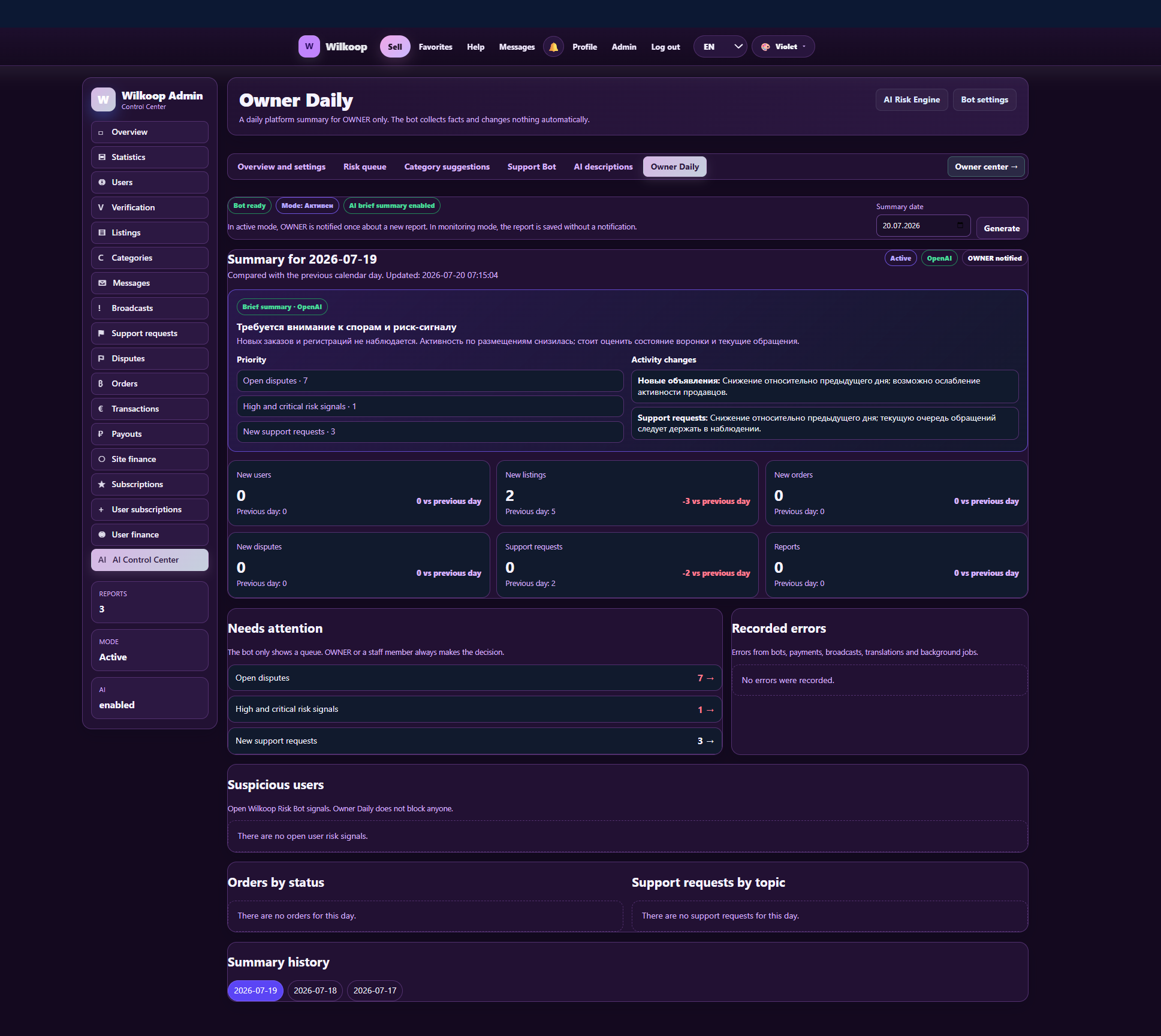
Owner Daily summarises users, listings, orders, disputes, risks, support, and errors.
-
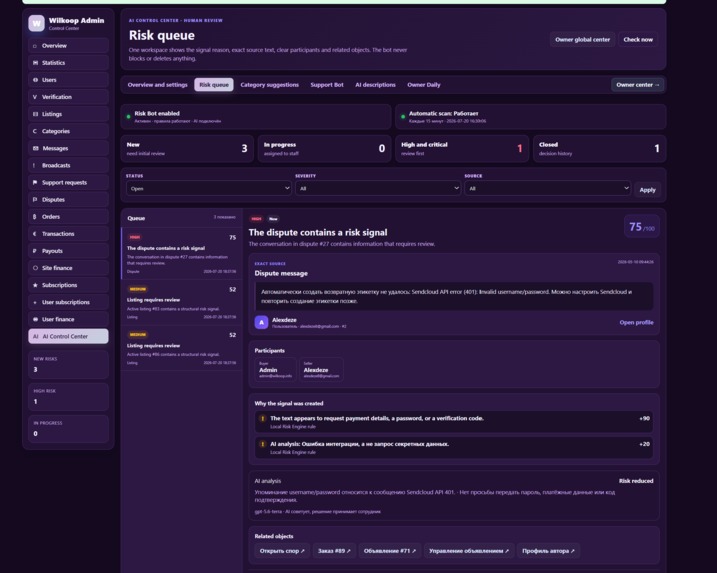
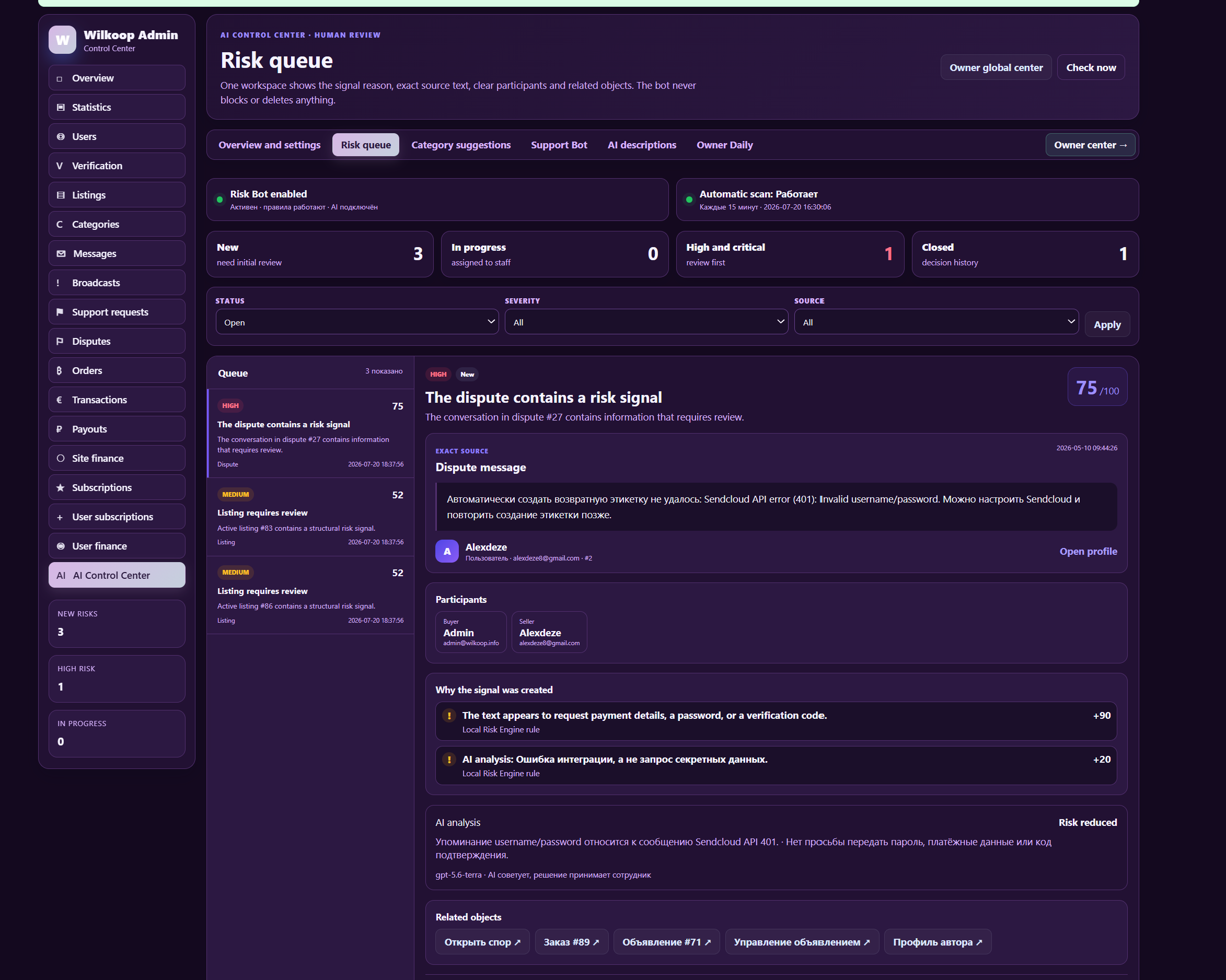
Explainable Risk Engine with score, reasons, original evidence, and related objects.
-
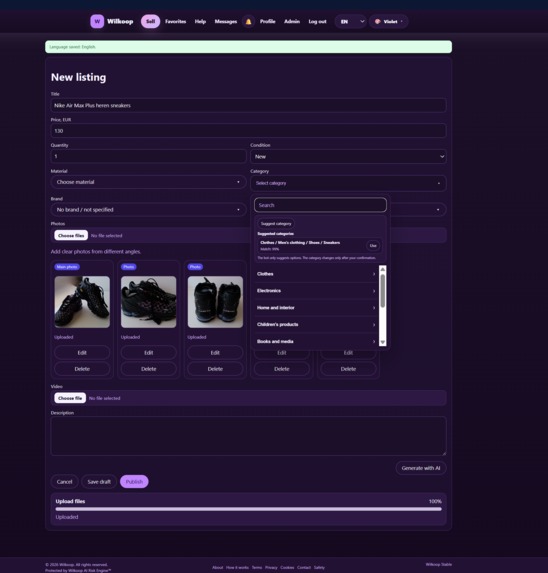
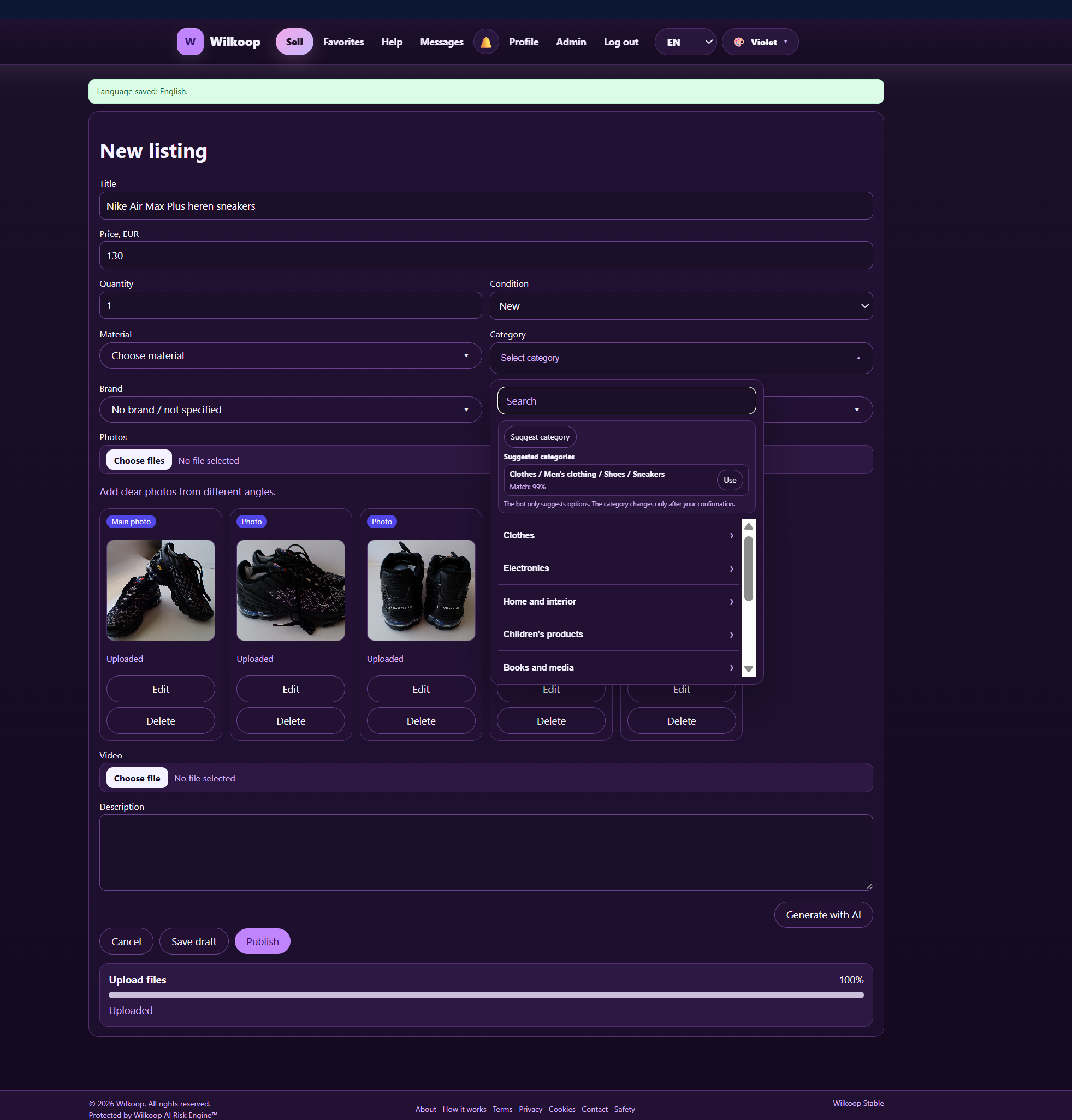
AI category suggestion with confidence score during listing creation.
-
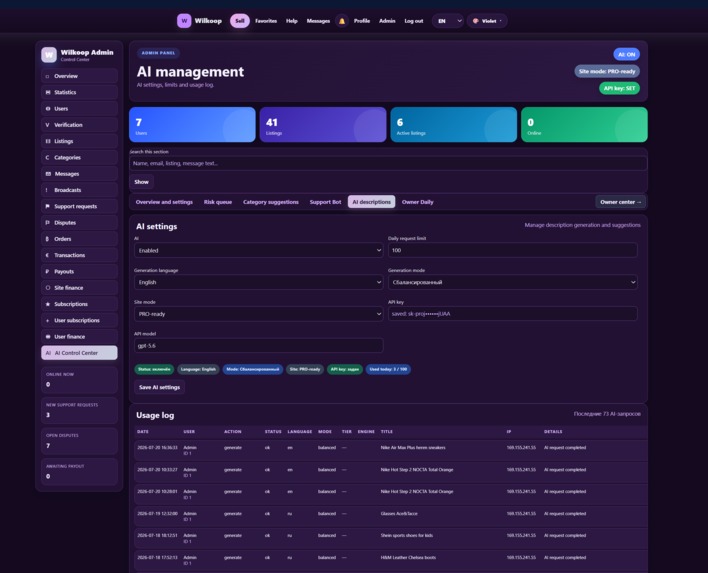
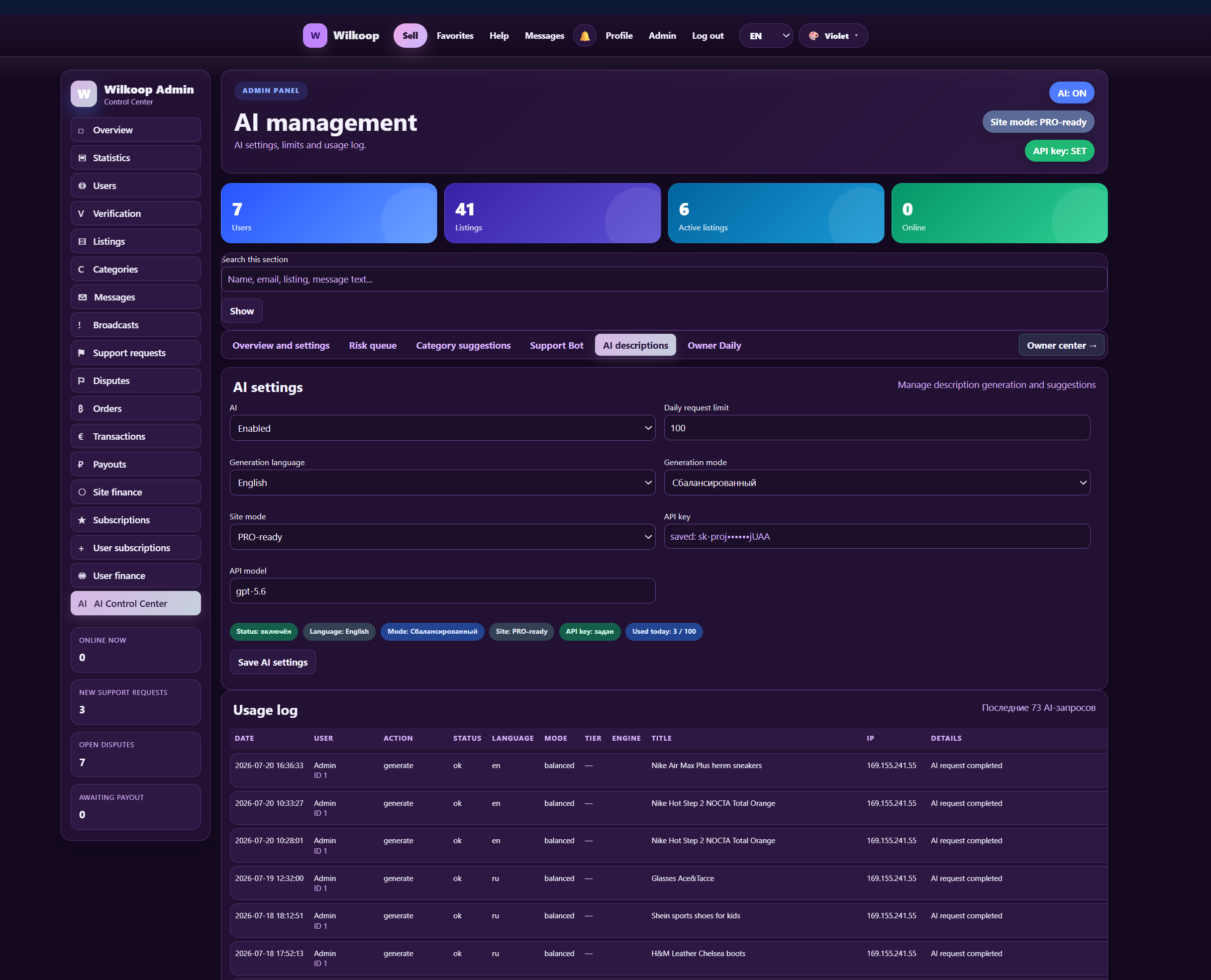
AI description settings with language, mode, daily limits, and usage history.
-
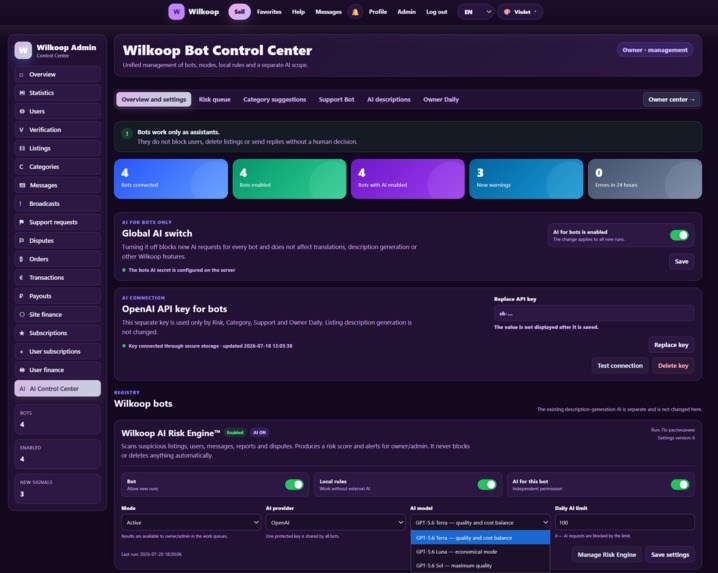
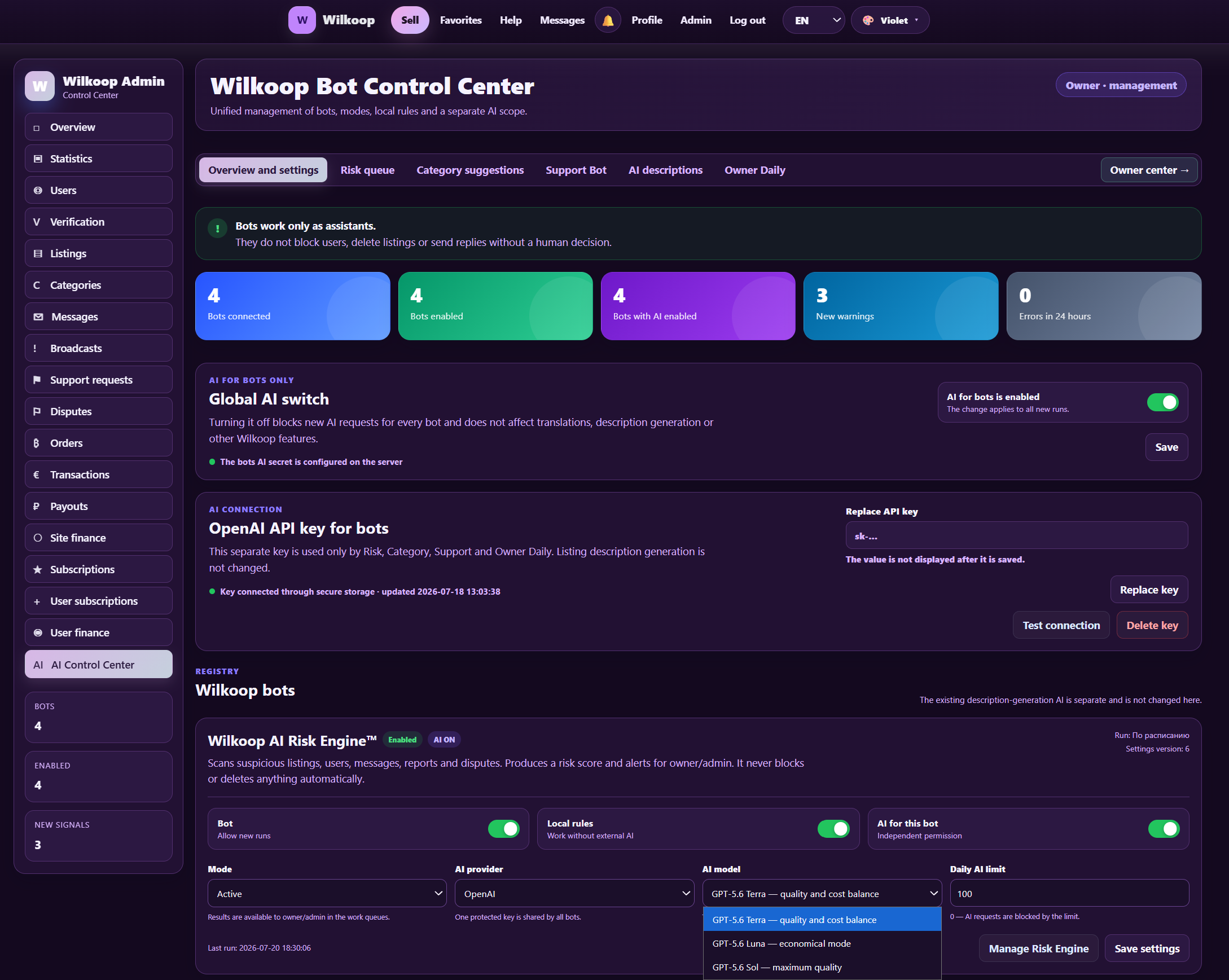
Independent Luna, Terra, and Sol model selection for each Wilkoop bot.
-
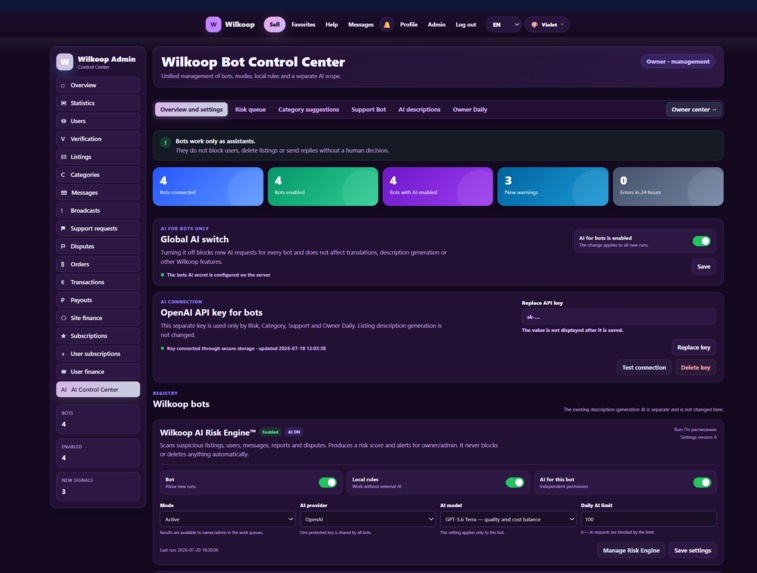
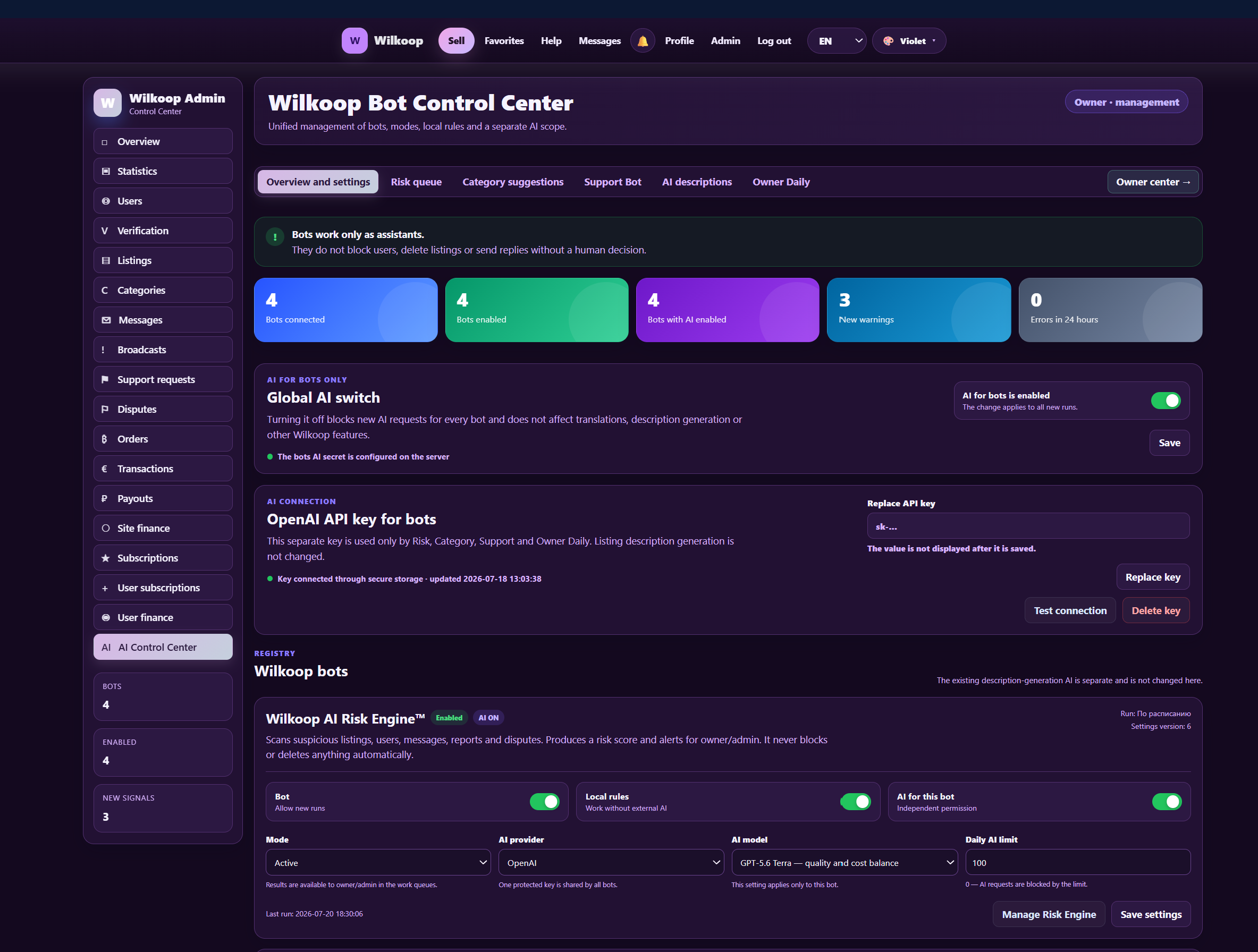
Wilkoop AI Control Center with global controls, bot modes, limits, and status.
-
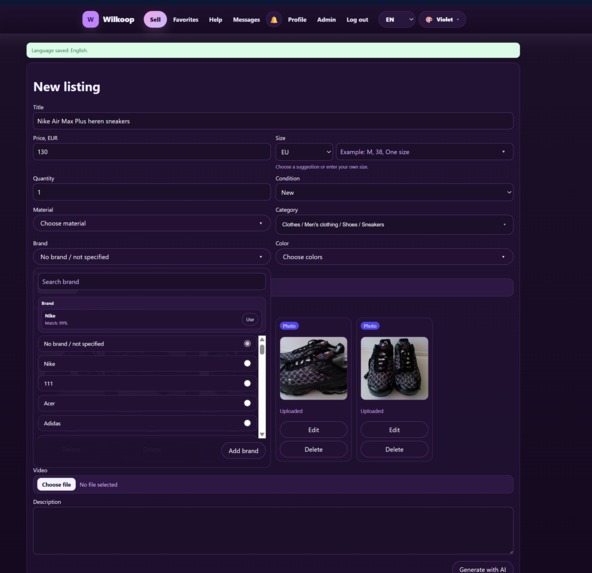
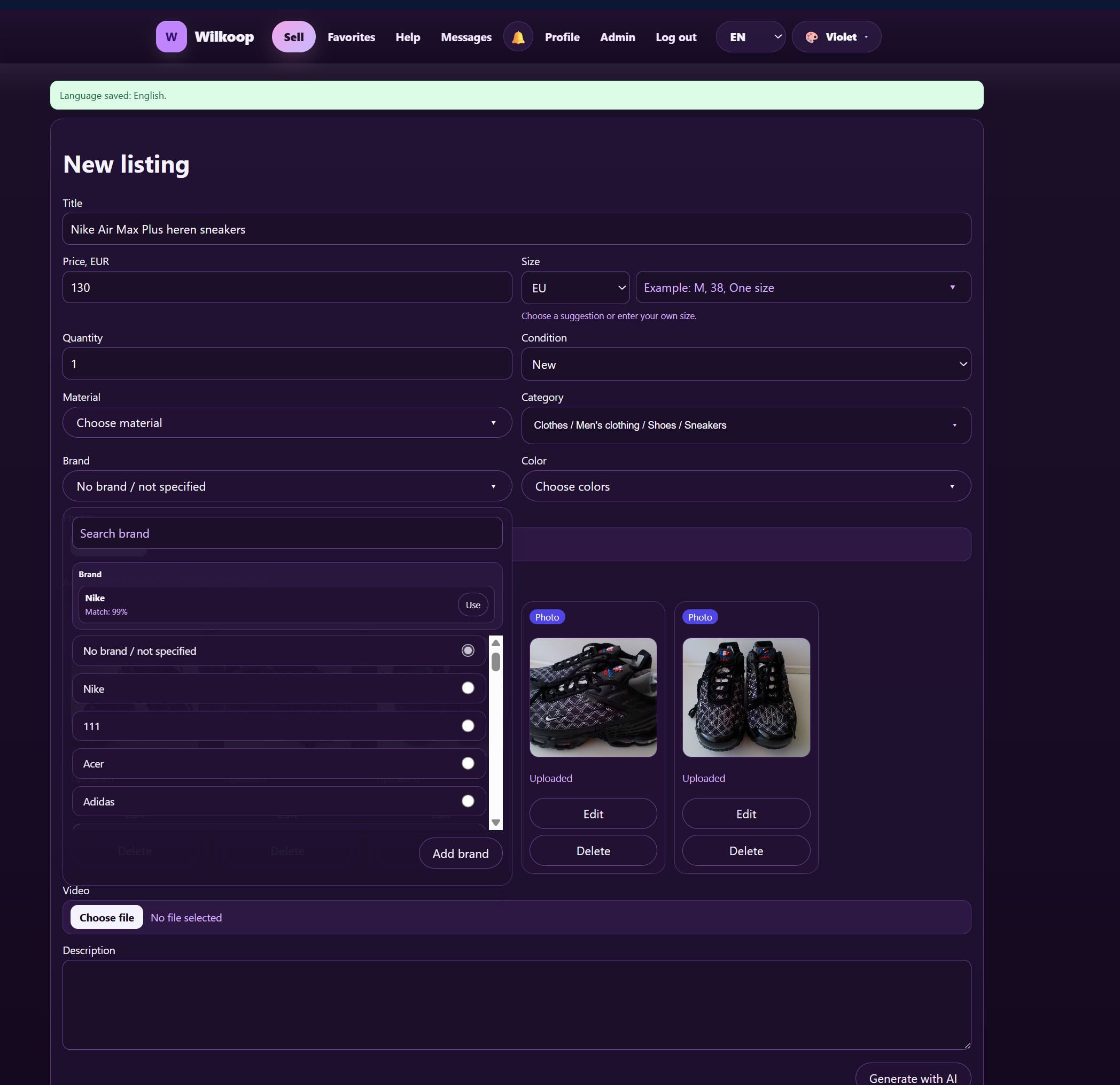
AI-assisted brand suggestion based on listing details and product photos.
-
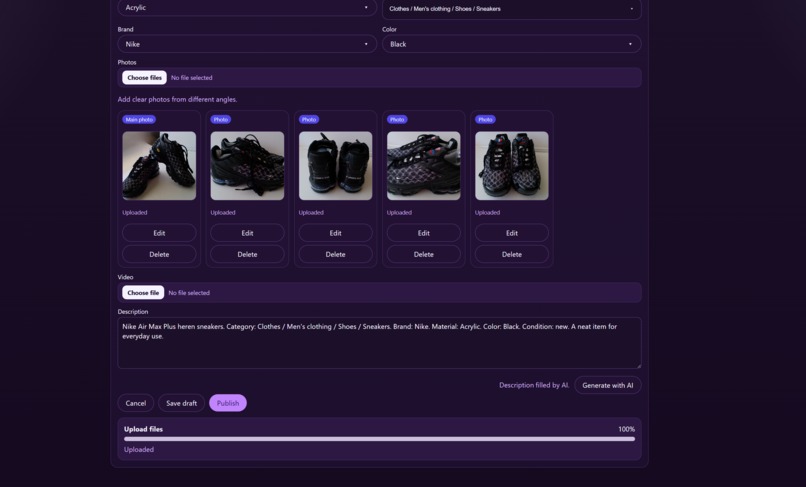
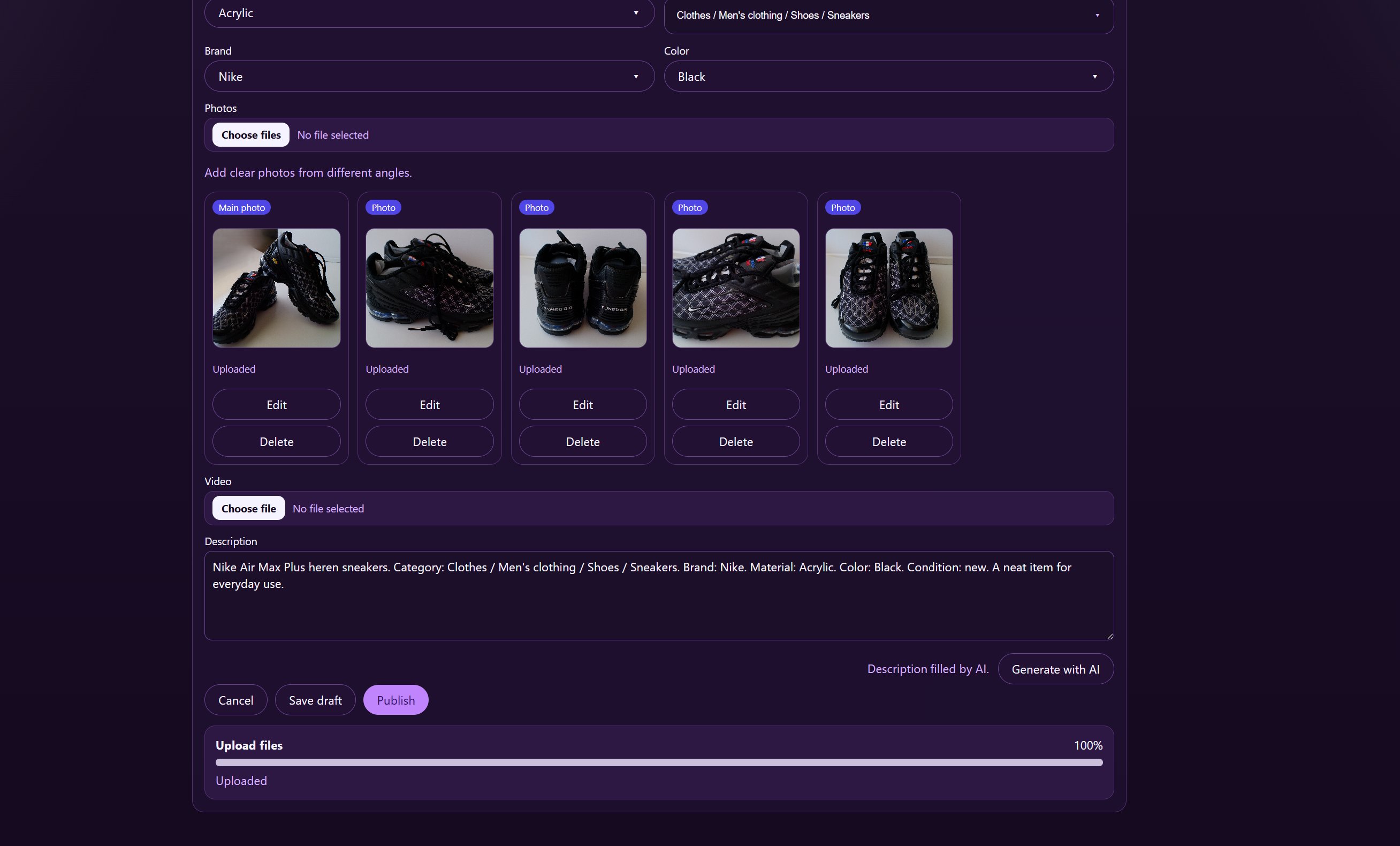
Editable product description generated by AI before publication.
Inspiration
Wilkoop is a multilingual online marketplace developed from practical experience with buying and selling, customer support, disputes, and marketplace administration.
Wilkoop and its development roadmap existed long before OpenAI Build Week. I only learned about the event on July 18, 2026. By that time, the AI integration was already being implemented as part of the project’s existing development plan.
By coincidence, the main implementation phase overlapped with the Build Week period. Because the resulting AI integration was substantial, practical, and deeply connected to a real multilingual marketplace, I decided to submit Wilkoop to the event.
My goal was not to create a temporary AI prototype for a competition. I wanted to integrate a useful AI operations layer directly into the existing PHP and MySQL marketplace.
I am not a professional software developer. My background is practical technical work. I defined the product workflows, marketplace rules, permissions, safety boundaries, and testing requirements, while Codex helped me inspect, extend, debug, and test the existing codebase.
What it does
Wilkoop now includes several connected AI workflows for sellers, administrators, support staff, and the platform owner.
AI Listing Assistant
The Listing Assistant analyses listing information and up to the first two product photos.
It can:
- suggest the most suitable category;
- provide a confidence score;
- suggest a brand;
- suggest a colour;
- suggest a material where relevant;
- generate an editable product description.
The seller reviews every suggestion before applying it. AI does not silently modify or automatically publish a listing.
Wilkoop AI Risk Engine
The Risk Engine analyses signals connected to listings, users, messages, complaints, disputes, orders, and related marketplace objects.
It combines local platform rules with GPT-5.6 contextual analysis and produces:
- a risk score;
- a severity level;
- weighted reasons;
- the exact source of the signal;
- linked evidence;
- related marketplace objects;
- a contextual explanation for the administrator.
The Risk Engine does not automatically block users, delete listings, cancel orders, restrict accounts, or apply sanctions. Administrators review the evidence and make the final decision.
Support Bot
Support Bot analyses a support request and prepares:
- a concise summary;
- a reply draft;
- an attention status.
The reply is reviewed by staff and is never sent automatically.
AI Description Generation
Wilkoop generates editable product descriptions from listing information.
Description generation has independent controls for language, operating mode, daily limits, API connection status, and usage history.
Owner Daily
Owner Daily summarises the previous completed calendar day.
The report includes:
- new users;
- new listings;
- orders;
- disputes;
- support requests;
- complaints;
- risk signals;
- suspicious activity;
- system errors;
- issues requiring attention;
- comparisons with the previous day;
- report history.
AI Control Center
All Wilkoop AI bots are managed from one central interface.
The AI Control Center provides:
- a global emergency AI switch;
- independent settings for every bot;
- local-rule controls;
- separate AI enable and disable controls;
- testing, observation, and active modes;
- per-bot model selection;
- daily request limits;
- API connection status;
- recent-run information;
- bot history;
- risk queues;
- configuration audit records.
Disabling external AI does not stop the core marketplace. Listings, messages, orders, support, disputes, and other ordinary functions continue working independently.
How we built it
Wilkoop is built with PHP, MySQL, JavaScript, HTML, CSS, Apache, Ubuntu Linux, the OpenAI API, and Progressive Web App components.
Codex Desktop with GPT-5.6 Sol was used as the primary development assistant.
Codex helped me:
- inspect the existing PHP and MySQL architecture;
- understand relationships between marketplace modules;
- trace database dependencies;
- implement the AI bot registry;
- build the AI Control Center;
- integrate structured GPT-5.6 responses;
- connect risk signals to listings, users, messages, orders, complaints, and disputes;
- create local-rule fallbacks;
- build administrator and Owner interfaces;
- debug integration and localisation problems;
- run repeated checks;
- prepare separate reviewable deployment patches.
Development was iterative.
Each major function was prepared as a separate patch. I installed it, tested it in the working marketplace, reviewed the result, reported problems, and then continued with corrections or the next feature.
GPT-5.6 is used for:
- multimodal analysis of listing text and product images;
- structured category, brand, colour, and material suggestions;
- editable product-description generation;
- contextual risk review;
- explainable risk reasoning;
- support summaries and reply drafts;
- Owner Daily operational summaries.
Each Wilkoop bot can independently use one of the model profiles available in the interface: Luna, Terra, or Sol.
Primary Codex Session ID:
019f6465-fe08-76d1-9de1-227bfea75555
Codex Desktop automatically compacted part of the visible history during this long development thread. The Session ID identifies the primary session in which most of the AI functionality was developed.
Challenges we ran into
The main challenge was adding AI to a large existing marketplace without breaking the core workflows.
Wilkoop already contained users, listings, messages, offers, orders, disputes, reviews, balances, support tools, administrator panels, and multilingual interfaces. The AI layer had to work with these existing modules instead of operating as an isolated demonstration.
Risk analysis also needed to remain explainable. A risk score alone was not enough. Administrators needed to see:
- the original evidence;
- the exact source;
- weighted reasons;
- related users;
- related listings;
- related orders or disputes;
- the contextual explanation.
Another challenge was fail-safe design. External AI must never stop listing creation, messages, orders, support, disputes, or other ordinary marketplace functions.
The project also required strict separation between administrator access and Owner-only security controls, especially for API settings, emergency switches, and platform-wide configuration.
Multilingual support created an additional challenge because historical user messages and evidence sometimes need to remain in their original language instead of being silently translated or modified.
Accomplishments that we're proud of
I am most proud that the AI implementation became one connected operational system rather than a collection of isolated AI buttons.
The final implementation includes:
- multimodal listing assistance;
- category suggestions with confidence scores;
- brand, colour, and material suggestions;
- editable AI-generated descriptions;
- centralised bot management;
- independent bot operating modes;
- per-bot models and daily limits;
- explainable risk analysis;
- weighted risk reasons;
- linked evidence;
- support summaries;
- reviewable support reply drafts;
- daily operational reporting;
- local-rule fallbacks;
- bot run history;
- configuration auditability;
- staff review before consequential actions.
All of this was integrated into an existing multilingual marketplace.
The implementation is not a separate mock-up. It works with real Wilkoop marketplace structures, administrator workflows, listings, support requests, disputes, and operational data.
Another important accomplishment is that disabling external AI does not disable the marketplace itself. The core platform continues working independently.
What we learned
I learned that useful marketplace AI depends as much on workflow, evidence, permissions, and fail-safe behaviour as it does on model quality.
The most important decisions were not only about prompts. They were also about determining:
- what evidence must remain visible;
- what the model must explain;
- what users must confirm;
- what staff must review;
- which actions AI must never perform automatically;
- what continues working when AI is unavailable;
- which settings must remain Owner-only;
- how usage and configuration changes should be audited.
I also learned how effective Codex can be when development is organised as a sequence of reviewable patches with real testing after every stage.
Codex helped me work with a large existing codebase, but the product direction, marketplace rules, operating modes, safety boundaries, and final implementation decisions remained my responsibility.
What's next for Wilkoop
The next steps for Wilkoop are:
- continue marketplace launch testing;
- improve multilingual administrator localisation;
- expand the library of risk patterns;
- create additional synthetic evaluation scenarios;
- improve AI quality and cost analytics;
- add more detailed Owner Daily drill-downs;
- improve bot performance monitoring;
- test every bot in observation mode;
- connect live payment services after business activation;
- connect live shipping services after business activation;
- gradually expand AI functionality based on real marketplace usage.
Wilkoop will continue using AI to make marketplace operations faster, clearer, safer, and easier to manage while keeping important decisions reviewable by users and staff.

Log in or sign up for Devpost to join the conversation.