-
-
LyraCore logo
-
LyraCore transparent source
-
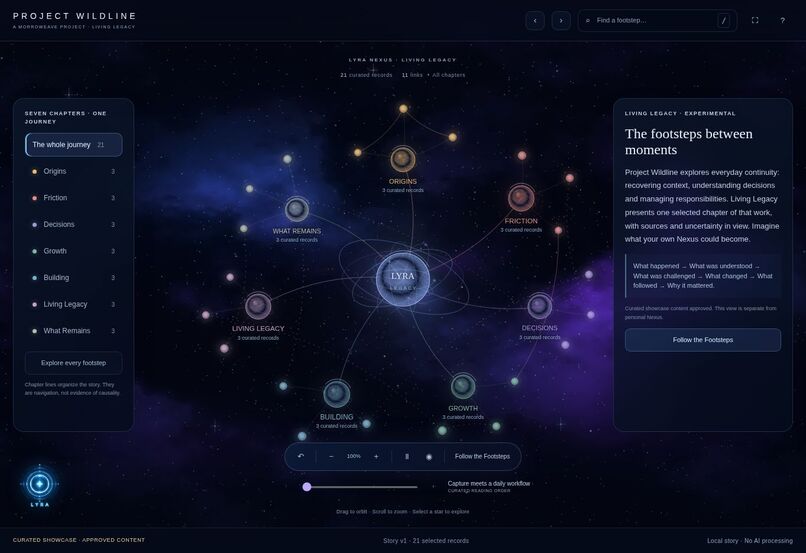
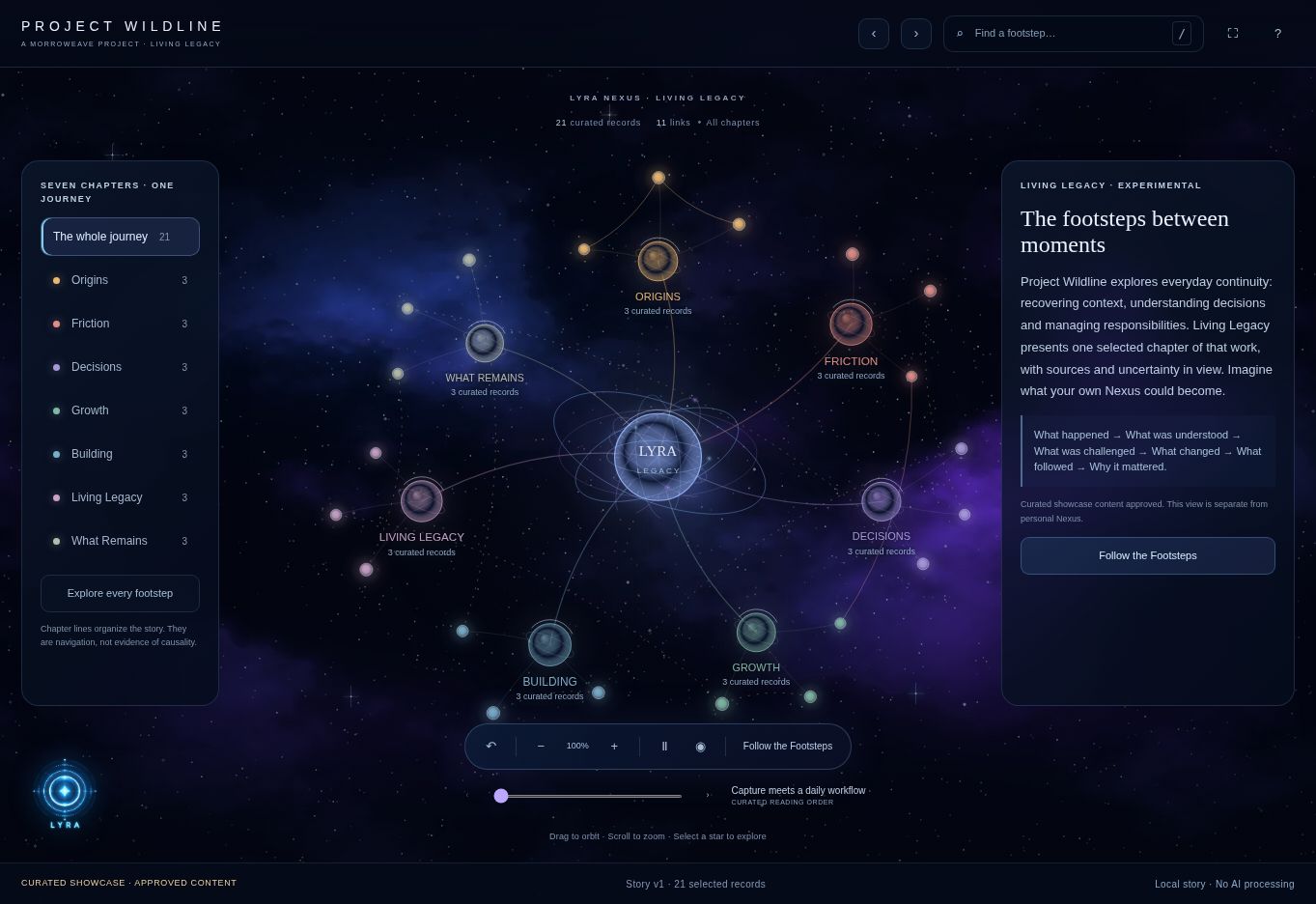
MorrowWeave · Living Legacy Reading Room: explore the Galaxy and the sources behind each footstep.
-
MorrowWeave — the venture behind Project Wildline and Living Legacy.
-
Wildline — the continuity project. Updated wordmark retaining the original flowing W.
Living Legacy: a life you can explore
What if the people you love could understand not only what happened in your life, but why it mattered—and how your understanding changed?
Project Wildline, a MorrowWeave project, connects the practical problem of everyday continuity with the longer-term possibility of a Living Legacy. Bee captures moments. Continuity helps carry their context forward. The Galaxy map offers a way to explore the story those moments become.
Enter the Living Legacy Reading Room — explore the Galaxy map
Start with The whole journey, select a star, or choose Follow the Footsteps. The public Galaxy presents 21 curated records and 11 labeled relationships across seven chapters: Origins, Friction, Decisions, Growth, Building, Living Legacy and What Remains. This selected chapter follows my path from information overload to building Wildline.
Inspiration
I bought an Amazon Bee because I thought it looked cool. Seriously. I am a public-sector security operations administrator, not a professional software developer. I was buried in conversations, commitments, delegated responsibilities and changing priorities. Bee captured my day; I needed clarity about what was mine, what belonged to someone else and what was already finished.
Working with Lyra in ChatGPT, I corrected misunderstandings and refined the answers. That became my Daily Command Center. Then the next conversation would begin, and we could lose the reasoning or correction behind something we had already worked through.
That led to Lyra Core, my private continuity system, and then Lyra Nexus, a visual memory observatory. Project Wildline explores how those continuity mechanisms could become useful to someone else. MorrowWeave is the venture behind that work.
Living Legacy grew from a more personal question: what could I choose to leave the people I love that helps them understand the decisions, struggles, discoveries and changes that shaped me?
What it does
The Reading Room is the Galaxy map. It is an interactive, source-grounded introduction to the Living Legacy model. Explore a chapter, search for a footstep, select a record and inspect the source behind it. Follow the guided sequence to see what happened, what was understood, what was challenged, what changed and why it mattered.
The current public experience is a curated chapter. Its records distinguish sourced paraphrases, interpretation, a documented correction and unknowns. The relationships help readers explore the story; a line between stars does not by itself establish causality. The public map uses approved presentation data and does not connect to my private Bee account or Core.
The Bee Bridge supplies a separate working continuity demonstration. Its optional consent-gated adapter reads a selected Fact through the Bee CLI, captures selected fields privately and recovers a source-qualified answer in a distinct process. The October 12 recorded retrieval shown in the video is separate from the retained October 11 historical validation. A separate historical replay demonstrates recorded correction, partial reconfirmation and deletion handling. These bounded demonstrations do not establish continuous synchronization.
The public Continuity Reader is a separate MIT-licensed contribution: a rule-based, offline component using fictional evidence to recover an answer with source history, uncertainty and no automatic authority.
How we built it
The working experience came first. I defined the problem, challenged the interpretations and directed the product; ChatGPT and Codex helped with implementation, testing and iteration.
The Reader and Bridge use Python, local storage and separate processes. The architecture keeps source evidence, interpretation, correction history, time and permission distinguishable. Our working rhythm became 411 Recover → 413 Challenge → 412 Reconstruct: recover the relevant history, question a favorite interpretation and carry forward what survives while leaving room to change.
The public Galaxy is a static HTML/CSS/JavaScript experience with curated data, search, chapter navigation, source inspection and a guided reading sequence. Its dataset is separate from the private Nexus. The Reader, Bridge and Galaxy have different roles and remain separately inspectable.
Challenges we ran into
Capturing a conversation was easier than preserving what still applied. An AI could identify a commitment and miss its owner, remember a decision and miss its correction, or turn uncertainty into a confident conclusion.
Legacy adds another challenge: preserving a meaningful account without turning an old interpretation into a permanent definition of someone. The author needs to choose the material, correct the interpretation and decide what remains private. The interface needs to make the source and uncertainty understandable.
Portability also exposed practical problems with Windows permissions, process isolation and clean setup. The six-entry Bee friction log records the original developer-tool feedback separately from later Nexus work.
Accomplishments that we're proud of
- A daily-use problem became a working private continuity system and an inspectable public prototype.
- The Living Legacy Reading Room gives visitors an actual Galaxy to explore, with 21 curated records, 11 labeled links and source inspection.
- The public Bee Bridge makes its code available without reviewer invitations. Its retained verification records 107 fictional/mock tests; the Reader separately records 48 fictional-data tests. These counts describe their respective components, not a combined product score.
- The video shows recorded Bee retrieval and distinguishes it from historical replay, fictional Nexus footage and future functionality.
What we learned
Remembering what was said and understanding what still applies are different problems. A useful legacy should preserve room for contradiction, correction, growth and unanswered questions.
The broader question remains open: can sustained human–AI collaboration help people reach useful possibilities that disconnected conversations would miss? My experience motivates that question; these demonstrations do not settle it.
What's next
The longer-term Living Legacy vision is for people to select the experiences, relationships, decisions and changing perspectives they want to preserve—and let authorized loved ones explore them through source-grounded conversational AI. Later family reflections would have their own authorship rather than becoming new words attributed to the original person.
Family access, broader synchronization and conversation grounded in the selected Galaxy context are future capabilities. Today the LYRA button opens ChatGPT separately; Voice starts manually and receives no automatic map context. The current public Reading Room demonstrates exploration of one curated chapter.
MorrowWeave is an independent personal venture, developed in my individual capacity.
Continuity without captivity. Carry forward what matters. Keep the freedom to reconsider.


Log in or sign up for Devpost to join the conversation.