Inspiration
Two years ago, my community was reminded of how close we all are to the devastating impacts of wildfires. A massive fire had broken out near a town just an hour away from us. For days, the air was thick with smoke, evacuation alerts loomed, and my family and neighbors prepared in case we had to leave our homes behind. Although we were fortunate not to evacuate, the fear and uncertainty left a lasting impression on me. Furthermore, the LA wildfires erupted with terrifying intensity, destroying entire neighborhoods, displacing thousands of families, and showing how quickly a spark can lead to a disaster. Seeing these events happen so close to home, I realized that climate change and wildfire risk are not distant issues, but they’re immediate, life-altering threats. This inspired me to act, to use the skills I’m developing in artificial intelligence and data science to create something meaningful. By building a Wildfire Risk Prediction AI, I want to contribute to early detection and prevention, helping communities prepare before it’s too late. My goal is to turn the anxiety and helplessness of those moments into something constructive, with technology that empowers people and protects lives.
What it does
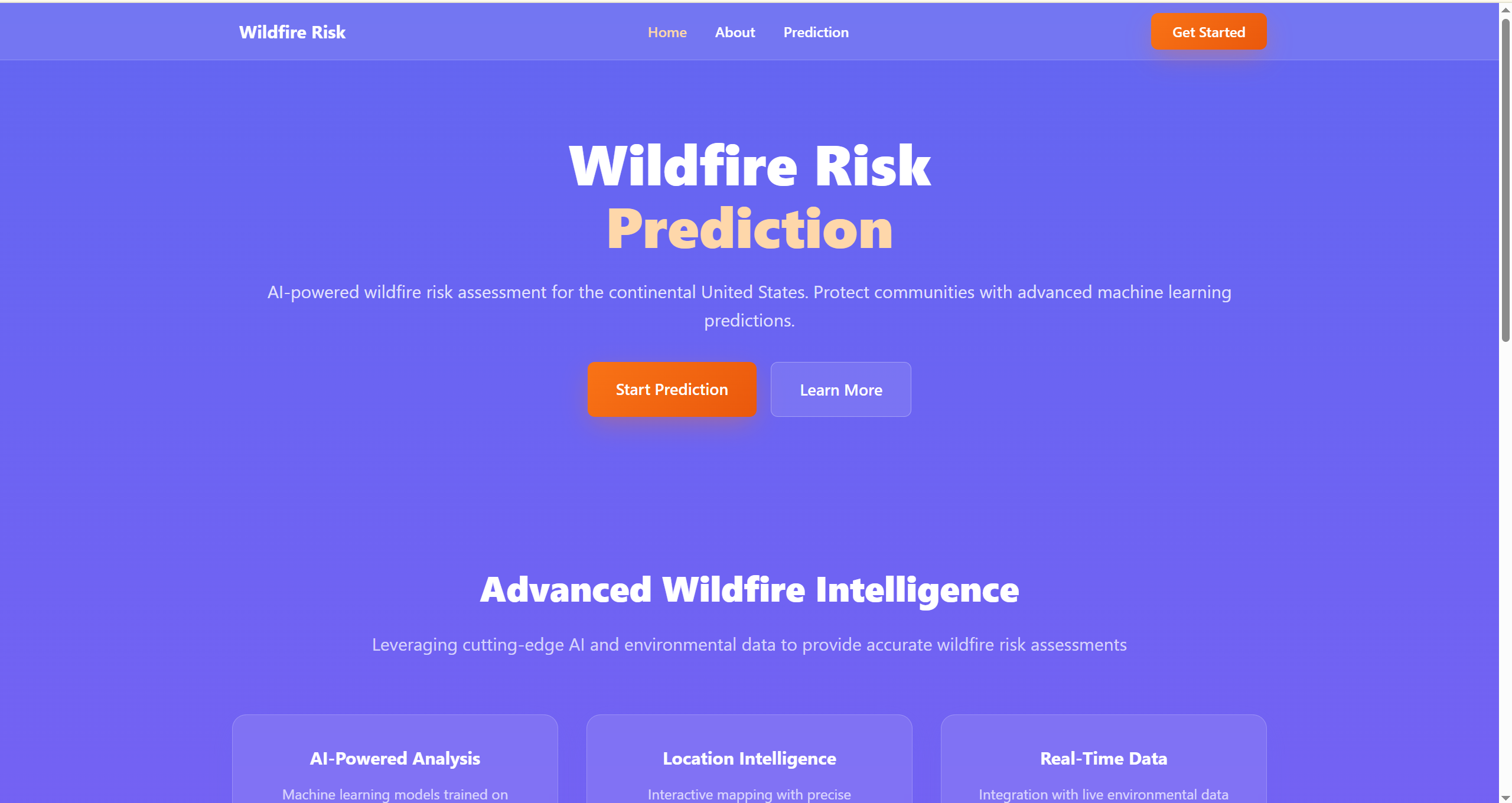
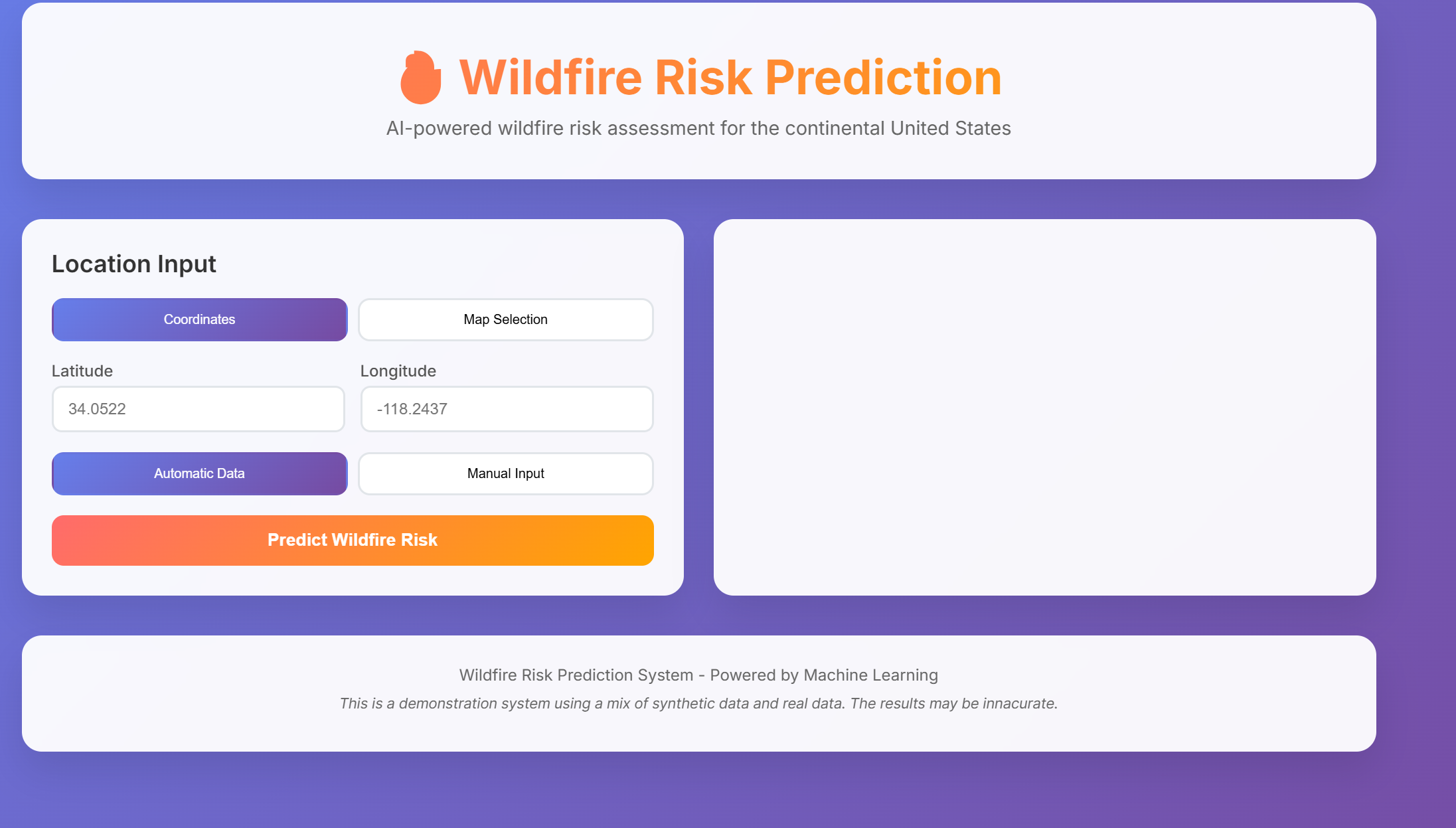
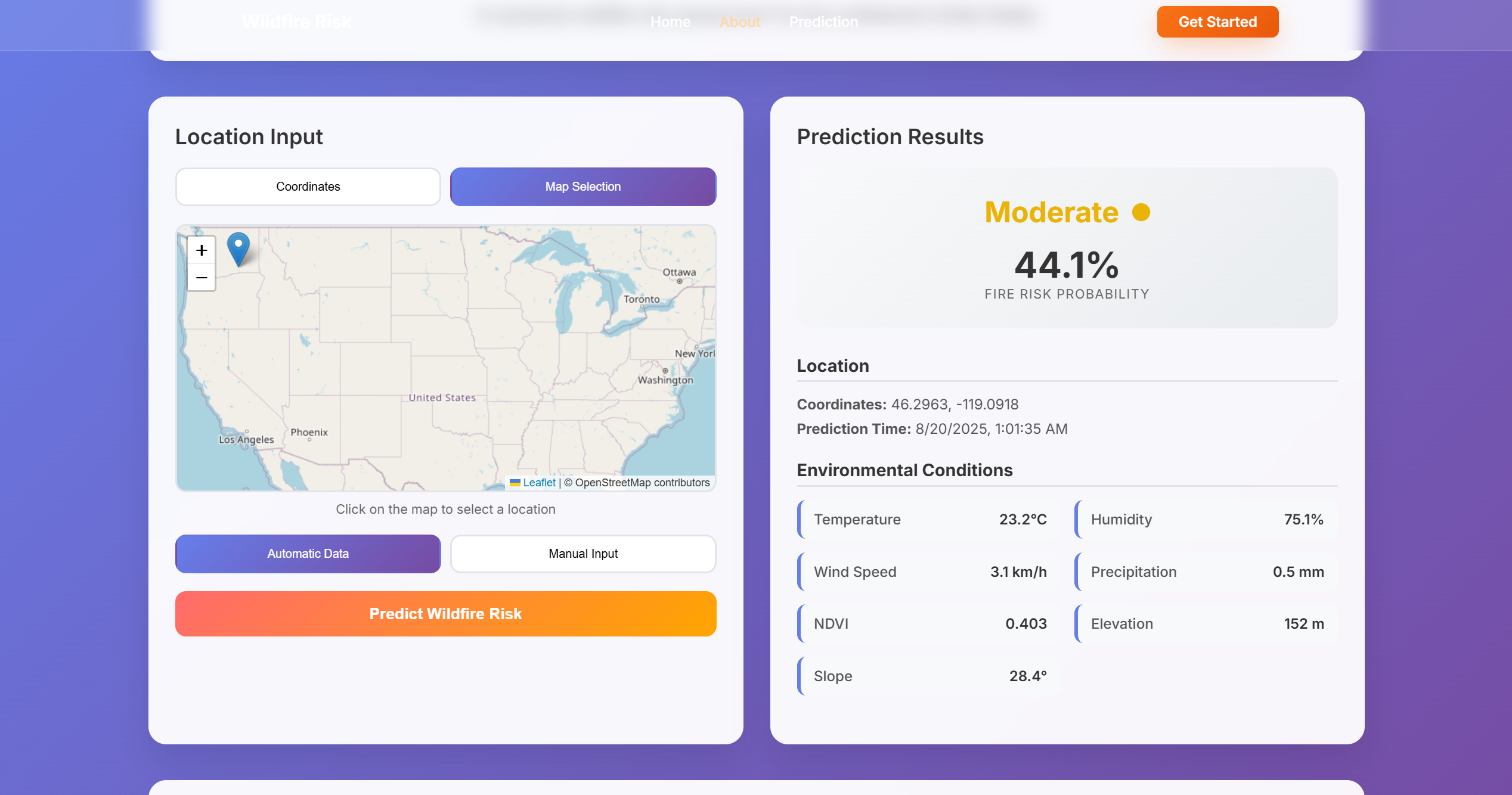
Wildfire Risk Prediction AI combines advanced machine learning and accessible real-time data to assess wildfire risk at a hyper-local level. By integrating environmental factors like temperature, humidity, wind patterns, vegetation density, and elevation, the system processes these inputs through a proprietary model to estimate the likelihood of wildfire ignition and spread with high accuracy. Users simply input their location, either via map or coordinates, and receive an intuitive, color-coded risk assessment. Designed for both individual community members and local decision-makers, the app offers easy-to-read, actionable intelligence without needing specialized hardware or technical expertise.
How we built it
I built the website using HTML, CSS, and JavaScript to create a clean, accessible front-end interface where users can interact with the model. On the back-end, the AI model is developed in Python and is powered by a Random Forest classifier. To train the model, I used a combination of real-world data from NASA’s FIRMS (Fire Information for Resource Management System) along with synthetic data I generated to fill gaps, as the data that I had originally wanted was blocked by a paywall(read more in Challenges). This mix ensured the model could generalize well and avoid bias toward any one region or condition. The Random Forest algorithm was chosen for its robustness in handling noisy data and its ability to capture nonlinear relationships between environmental factors. The final system connects the AI model with the web app so that users can input conditions and receive predictions about the likelihood of wildfire occurrence in a given area.
Challenges we ran into
I ran into several challenges while building this project. At first, I didn’t want to rely on synthetic data, but the weather dataset I needed from the OpenWeatherMap API was locked behind a paywall, forcing me to adjust. Creating synthetic data itself was another challenge, as I had to ensure it was realistic enough to train the model effectively. Another issue came from the model’s behavior; sometimes it would change its decision drastically within seconds, so I had to work on stabilizing its predictions. Finally, connecting the frontend to the backend was a difficult step, as integrating the AI model with the web interface required a lot of debugging and fine-tuning.
Accomplishments that we're proud of
I’m proud of conceptualizing and executing a full-stack AI project, combining Python-based machine learning with a responsive HTML/CSS/JS frontend. The system successfully integrates multiple data sources, including NASA FIRMS datasets and synthetic data, to predict wildfire risk across the continental United States. I was able to implement a Random Forest model that balances accuracy and stability, providing actionable insights in real-time. On the frontend, I designed a clean, user-friendly interface that allows users to explore predictions, view environmental factors, and understand the reasoning behind the AI’s outputs. Beyond technical achievements, I’m proud of creating a tool with tangible social impact, one that could help communities make informed decisions and potentially save lives during wildfire season.
What we learned
Through this project, I gained hands-on experience in full-stack development and AI integration, learning how to connect a Python-based machine learning backend with a dynamic HTML/CSS/JS frontend. I deepened my understanding of Random Forests and how to handle both real and synthetic datasets for predictive modeling, including data preprocessing, feature selection, and ensuring model stability. I also learned about the challenges of working with real-world environmental data, API limitations, and designing user-friendly interfaces that communicate complex information clearly. Beyond technical skills, I developed problem-solving abilities, project planning strategies, and an appreciation for how technology can have a direct, positive impact on society, especially in disaster preparedness and public safety.
What's next for Wildfire Risk Prediction AI
Looking ahead, the next steps for Wildfire Risk Prediction AI include integrating more real-world environmental data to improve prediction accuracy and reliability. Expanding the model to cover regions beyond the United States would make it a global wildfire risk tool. The website can also be enhanced with additional pages that provide detailed safety guidelines, recommendations for evacuation, and actionable steps for communities during wildfire events. Continuous improvement of the AI model, along with better user experience and educational resources, will ensure the system has a broader impact and helps more people stay safe during wildfire seasons.


Log in or sign up for Devpost to join the conversation.