-
-

Logo
-
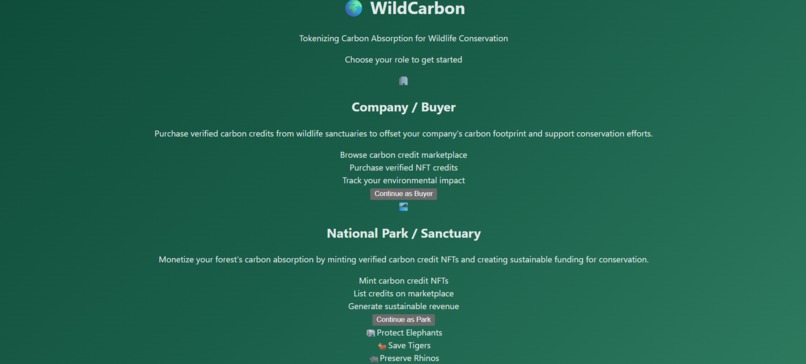
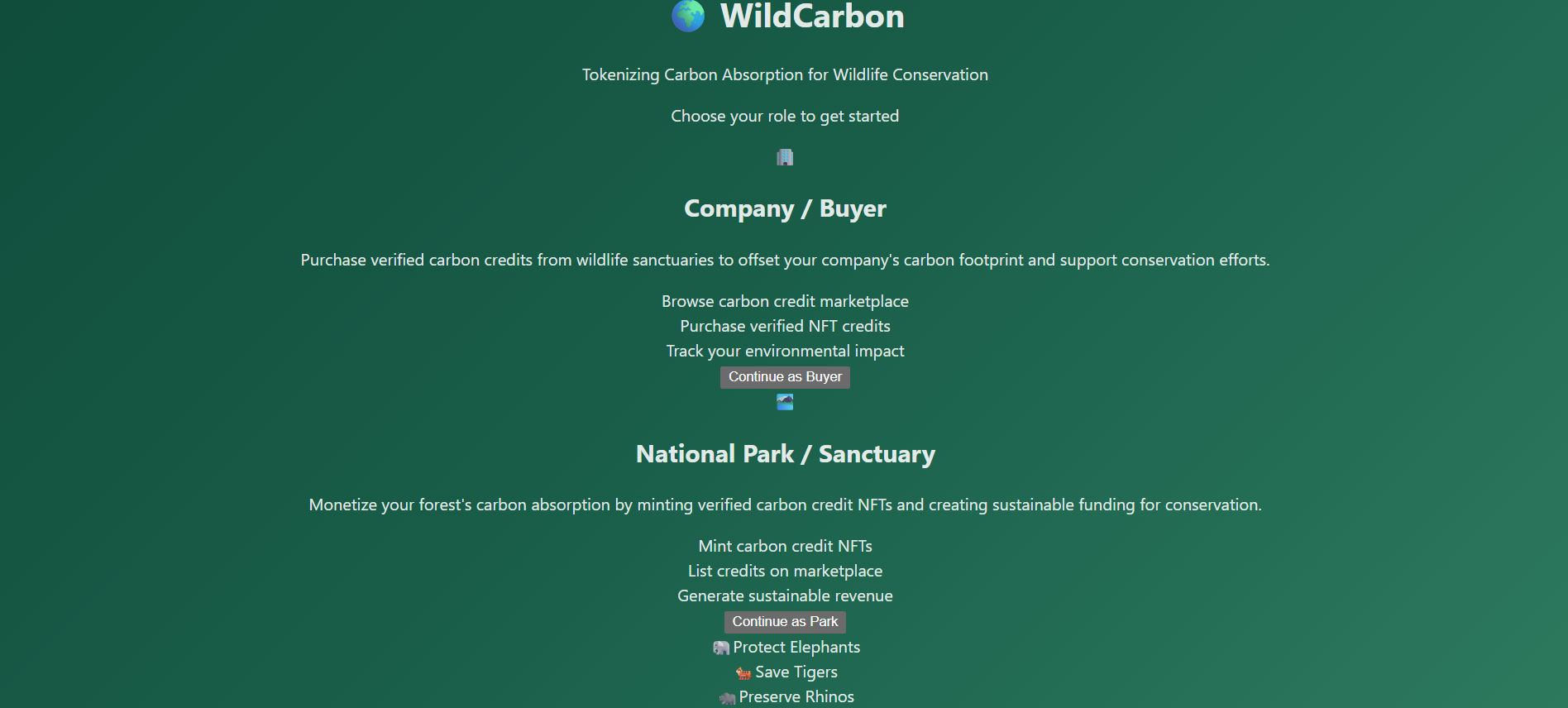
frontpage

WildCarbon – Decentralized Carbon Credit Marketplace ✨ Inspiration The inspiration for WildCarbon came from the pressing global issue of climate change and the inefficiencies in the current carbon credit market.
- Forest parks and conservation organizations often lack transparent and trustworthy platforms to sell their carbon credits.
- Companies, on the other hand, struggle to verify and purchase legitimate credits, leading to fraud and lack of trust. We wanted to leverage blockchain’s transparency, immutability, and decentralization to ensure that carbon credits are real, traceable, and tamper-proof. --- 🛠️ How We Built It We broke the project down into three main parts:
- Smart Contract (Ethereum)
- Written in Solidity and deployed using Remix.
- Implements ERC721 standard for carbon credit NFTs.
- Features:
- Parks can mint NFTs representing verified carbon credits.
- Companies can buy listed NFTs directly via the marketplace.
- Includes security checks (overflow, reentrancy guard, zero-address validation).
Frontend (React + Tailwind + ethers.js)
- Built with a clean UI for both Parks and Companies.
- Parks can list credits for sale; Companies can browse and buy.
- Integrated with smart contracts via MetaMask.
- Deployed on Vercel for free hosting.
Backend / Metadata Storage
- Metadata for NFTs (project name, credits, description) is stored on IPFS.
* Ensures decentralization and immutability of project details.
📚 What We Learned
Smart Contract Security: Handling common pitfalls like reentrancy, overflow, and safe payments.
Decentralized Storage: Using IPFS for immutable metadata storage instead of centralized servers.
Frontend-Blockchain Integration: Connecting contracts with React using ethers.js and managing wallet interactions.
User Experience in Web3:
Designing clear workflows for minting, listing, and purchasing NFTs.
⚡ Challenges We Faced
Smart Contract Vulnerabilities
- Initially had issues with reentrancy and unchecked overflow.
- Fixed by using OpenZeppelin’s
ReentrancyGuardand Solidity’s built-in checks.
Metadata Trust
- Realized if IPFS hashes were mutable, credits could be altered.
- Solved by pinning immutable IPFS hashes for carbon credit data.
Frontend Wallet Integration
- Handling async blockchain calls and providing clear feedback to users was tricky.
- Implemented transaction status indicators and wallet state management.
Time Constraints
* Setting up Sui was too time-consuming, so we pivoted to Ethereum where tooling is mature.
🔮 Future Scope
Verification Layer: Use oracles / third-party verification to ensure carbon credits are genuine.
Secondary Marketplace: Allow credits to be resold with traceability.
Fractionalization: Split NFTs into ERC20 tokens for micro-purchases.
* Cross-chain Deployment: Expand to Polygon / Sui for lower gas fees.
🧮 A Note on Carbon Credits If a forest project sequesters \$C\$ tons of CO₂, and each NFT represents \$x\$ tons, then the number of NFTs minted is: N = \frac{C}{x}
this ensures that the total supply of credits is mathematically bound to the verified environmental impact.
🚀 WildCarbon shows how blockchain can provide transparency, trust, and efficiency to the carbon credit market, aligning financial incentives with environmental sustainability.
Built With
- aistudio
- chatgpt
- css3
- es6+)
- ethereum
- ethers.js
- grok
- html5
- ide
- ipfs
- javascript
- metamask
- openzeppelin
- pinata
- react.js
- remix
- sepolia/goerli)
- solidity
- tailwindcss
- vercel
- web3.js

Log in or sign up for Devpost to join the conversation.