-
-
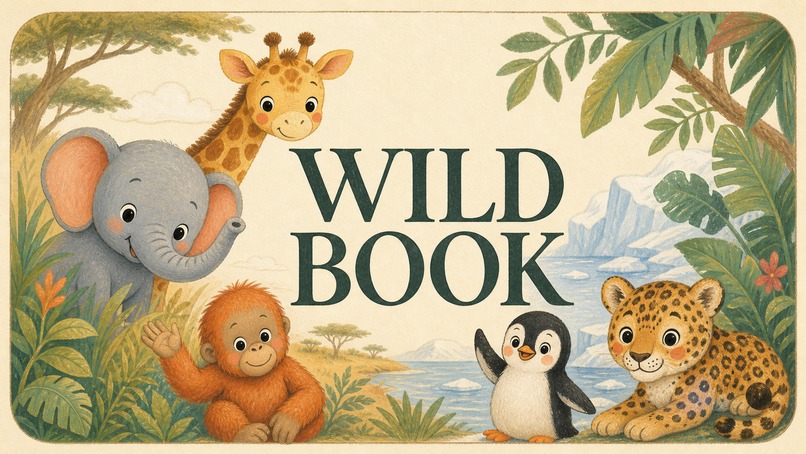
cover
-
-
-
-
Inspiration
Children often meet animals through flash cards, isolated photographs, or short lists of facts. They may remember an animal’s name without understanding how its body, behavior, family, and habitat are connected.
Wildbook began with two questions: How can children learn about real animals through play, and how can that play create meaningful time with a parent or caregiver?
The experience is informed by early-learning research that describes effective digital learning as active, engaging, meaningful, and socially interactive. It also draws on research about learning through play, executive-function practice, parent-child shared media, and early science learning through observation, comparison, prediction, and explanation.
Each Wildbook chapter therefore begins with a picture story that a parent or caregiver can read aloud. The illustrations give them opportunities to pause, point to details, introduce new animal vocabulary, predict what may happen next, and ask the child to explain what they notice. This shared reading is designed to support joint attention, listening comprehension, vocabulary, narrative memory, and spoken explanation.
The activities continue the ideas introduced in the story, but each type of interaction has a different developmental purpose:
- Searching for tracks, coat patterns, camouflage, and animal clues asks children to focus on relevant details, compare visual evidence, and ignore distractions. These activities are designed to support sustained attention, visual discrimination, classification, and evidence-based reasoning.
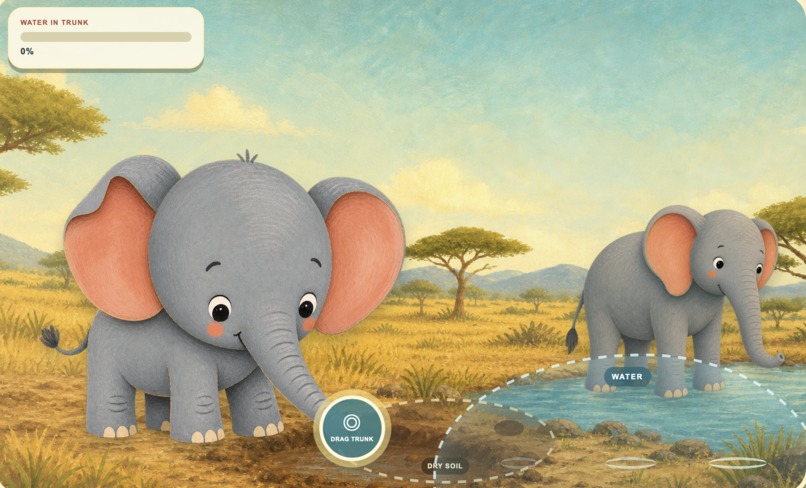
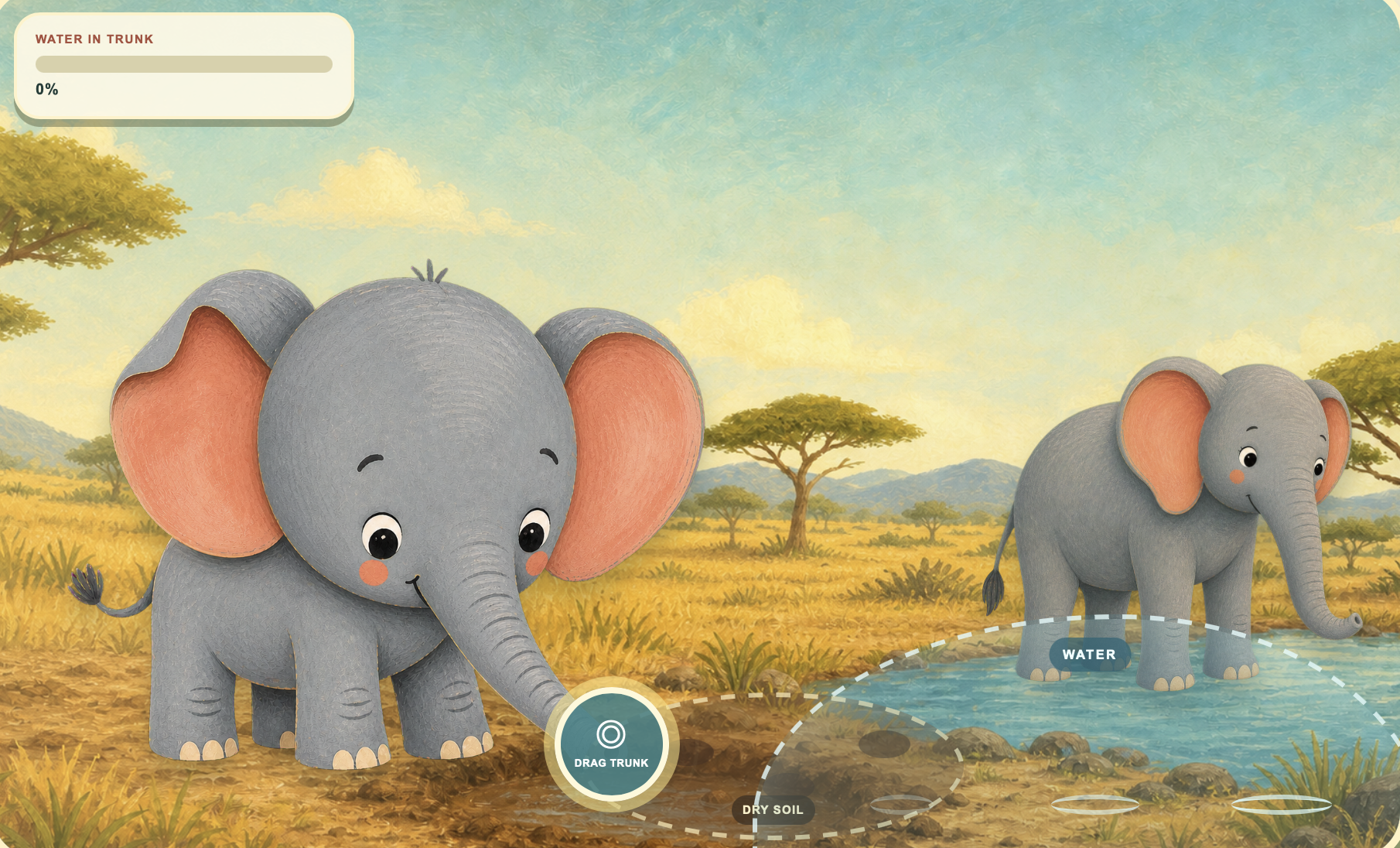
- Completing multi-step animal actions, such as drawing water into an elephant’s trunk before aiming and releasing it, arranging the layers of an orangutan nest, or helping a giraffe lower and raise its body to drink, gives children practice with sequencing, working memory, planning, and self-correction.
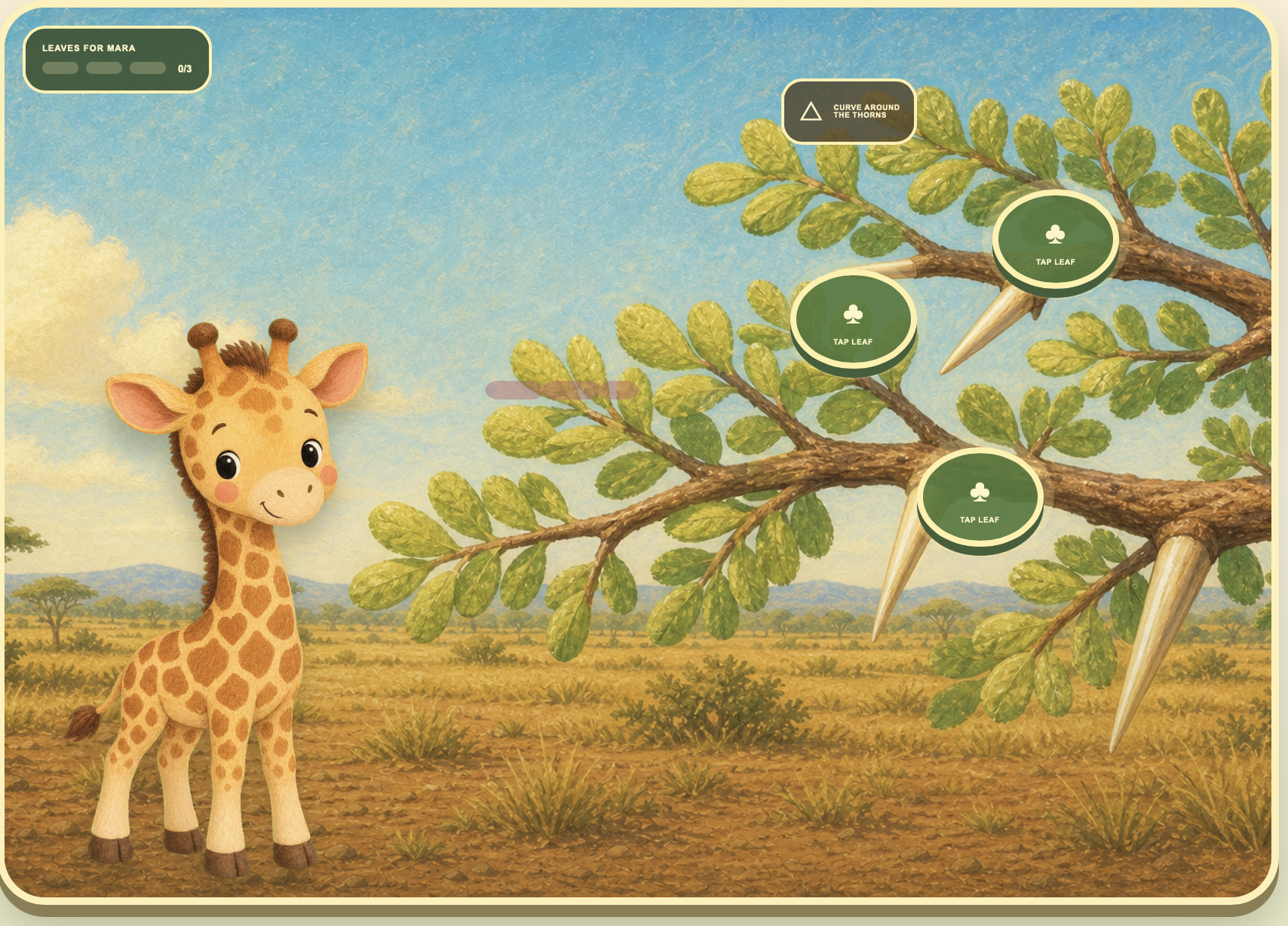
- Guiding tongues, trunks, branches, swimming paths, and river routes connects finger movement with visible changes in the scene. These interactions are designed to support hand-eye coordination, spatial reasoning, route planning, timing, and controlled movement.
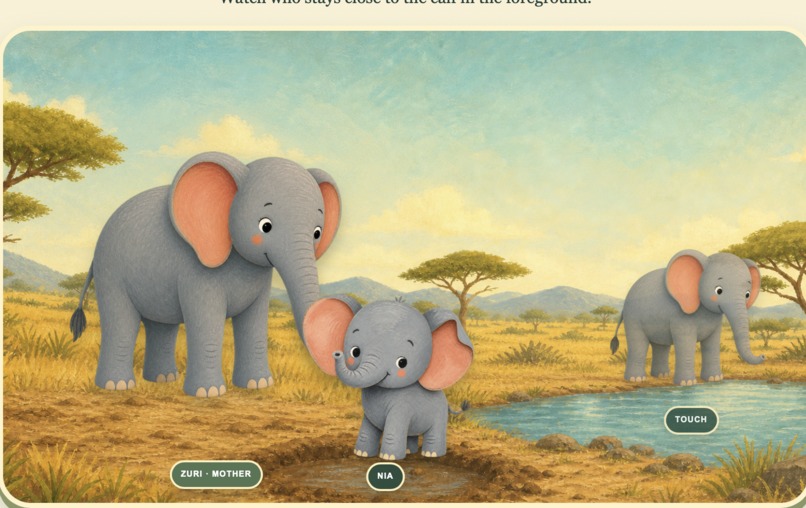
- Listening to penguin calls and observing how herd or family members respond encourages auditory attention, pattern recognition, social observation, and memory for relationships.
- Changing light, rain, water, shade, mud, plants, or cover lets children make a prediction, observe the animal’s response, and change their approach. These small environmental experiments are designed to support cause-and-effect reasoning, cognitive flexibility, comparison, and early scientific thinking.
- Arranging habitats and retelling animal stories with an adult supports decision-making, imagination, narrative language, and the ability to connect an animal’s needs with its environment.
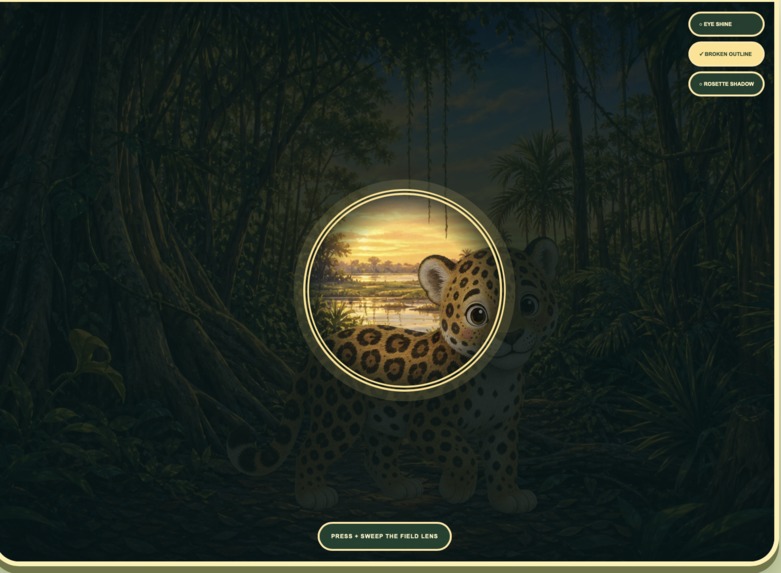
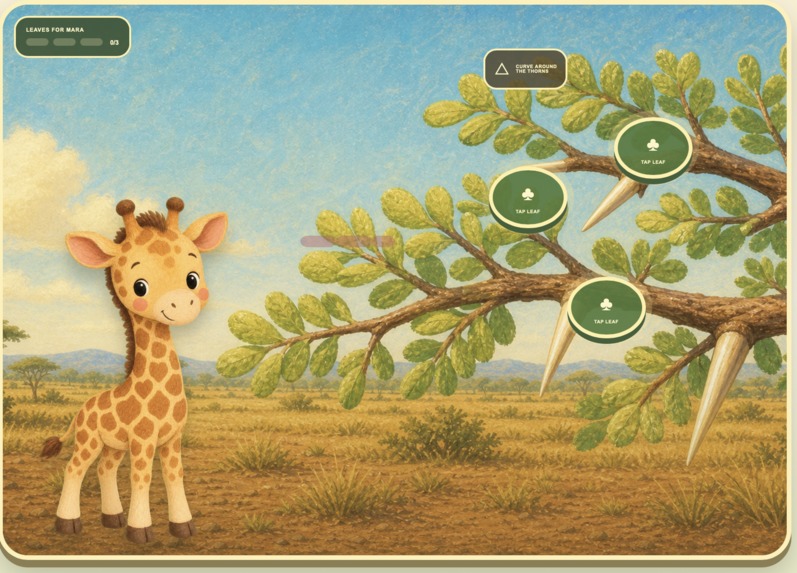
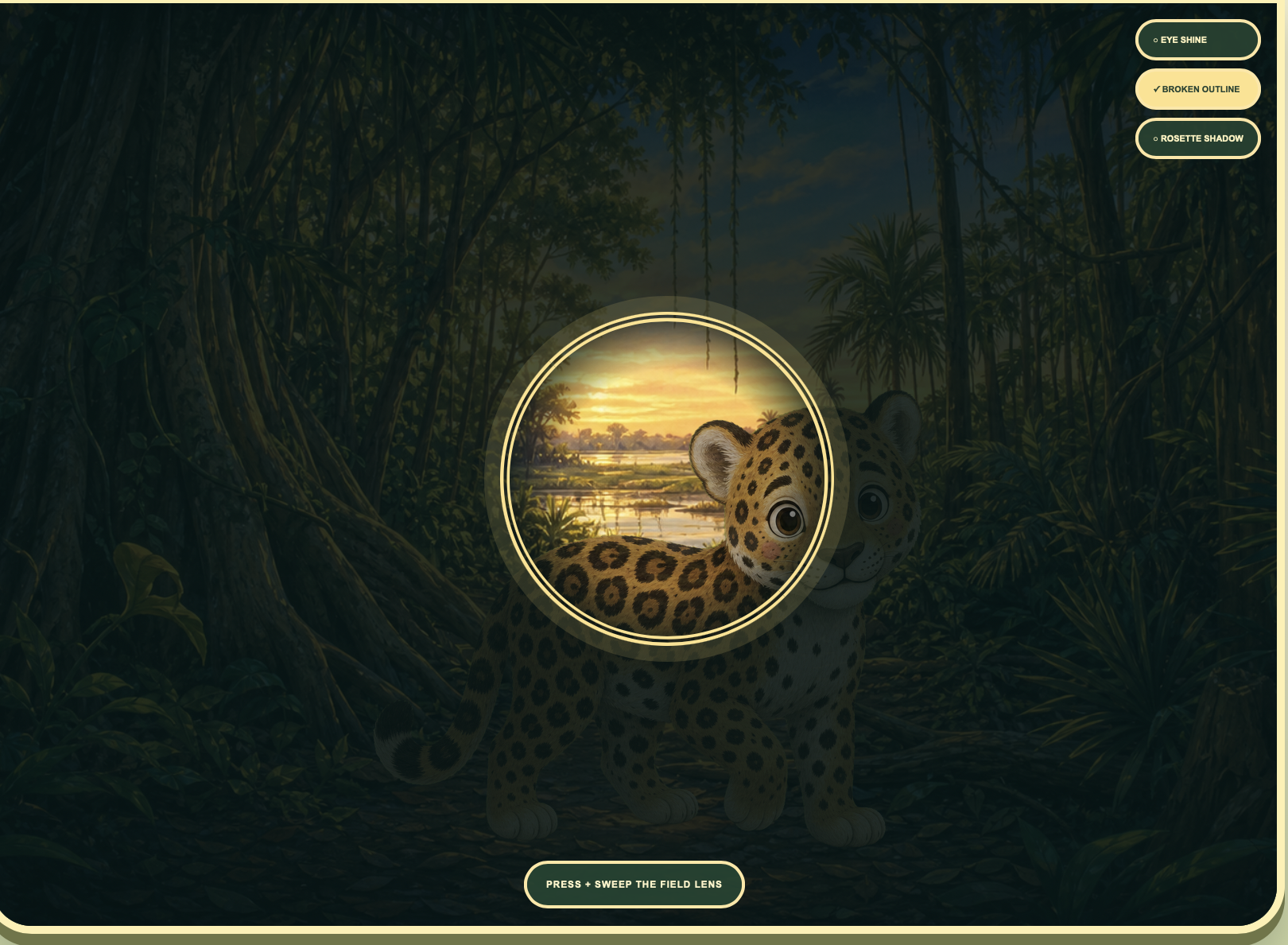
For example, a child does not simply read that elephants use mud to protect their skin. The child moves water, creates mud, applies it, and observes the result. A giraffe’s long tongue is not presented only as a fact; the child plans a route around thorns to reach leaves. An orangutan nest becomes a sequence of flexible branches and leafy layers. A jaguar’s camouflage becomes an experiment with light, cover, movement, and stillness.
The purpose is not to turn play into a hidden test. Wildbook uses forgiving controls, visible animal responses, replay, and open-ended exploration so that children can practice these abilities while enjoying the animal world. There are no scores, streaks, punishment, hunger meters, or failure screens.
Wildbook does not yet claim measured improvements in children’s abilities. These are research-informed design goals that will require future observation and testing with children, parents, early-childhood educators, and animal specialists. The goal of the current prototype is to show how factual animal learning, joyful interaction, and parent-child companionship can exist inside the same digital picture book.
What it does
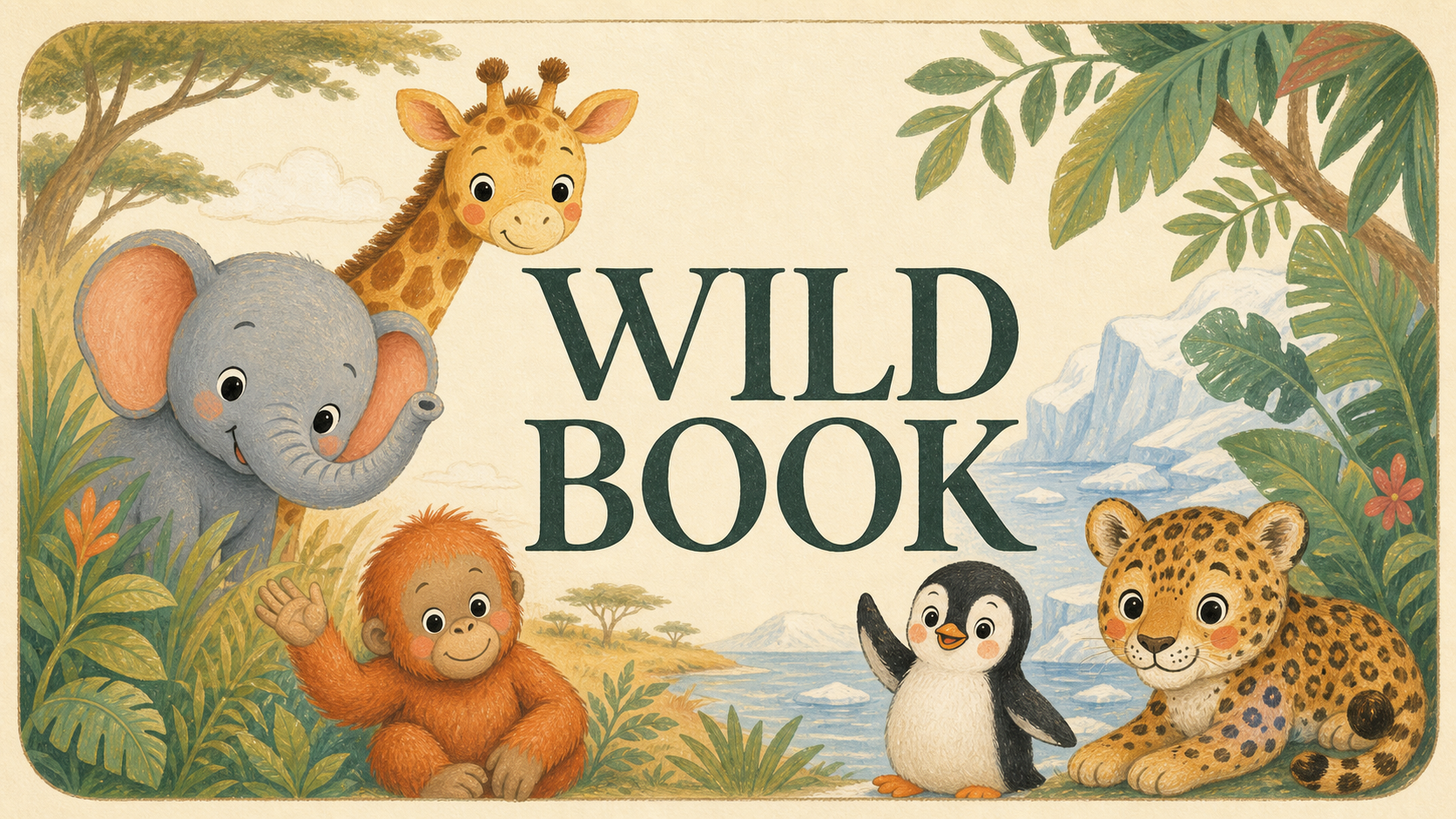
Wildbook is an English-language, touch-first animal picture-book library. Its current prototype contains five completed animal worlds:
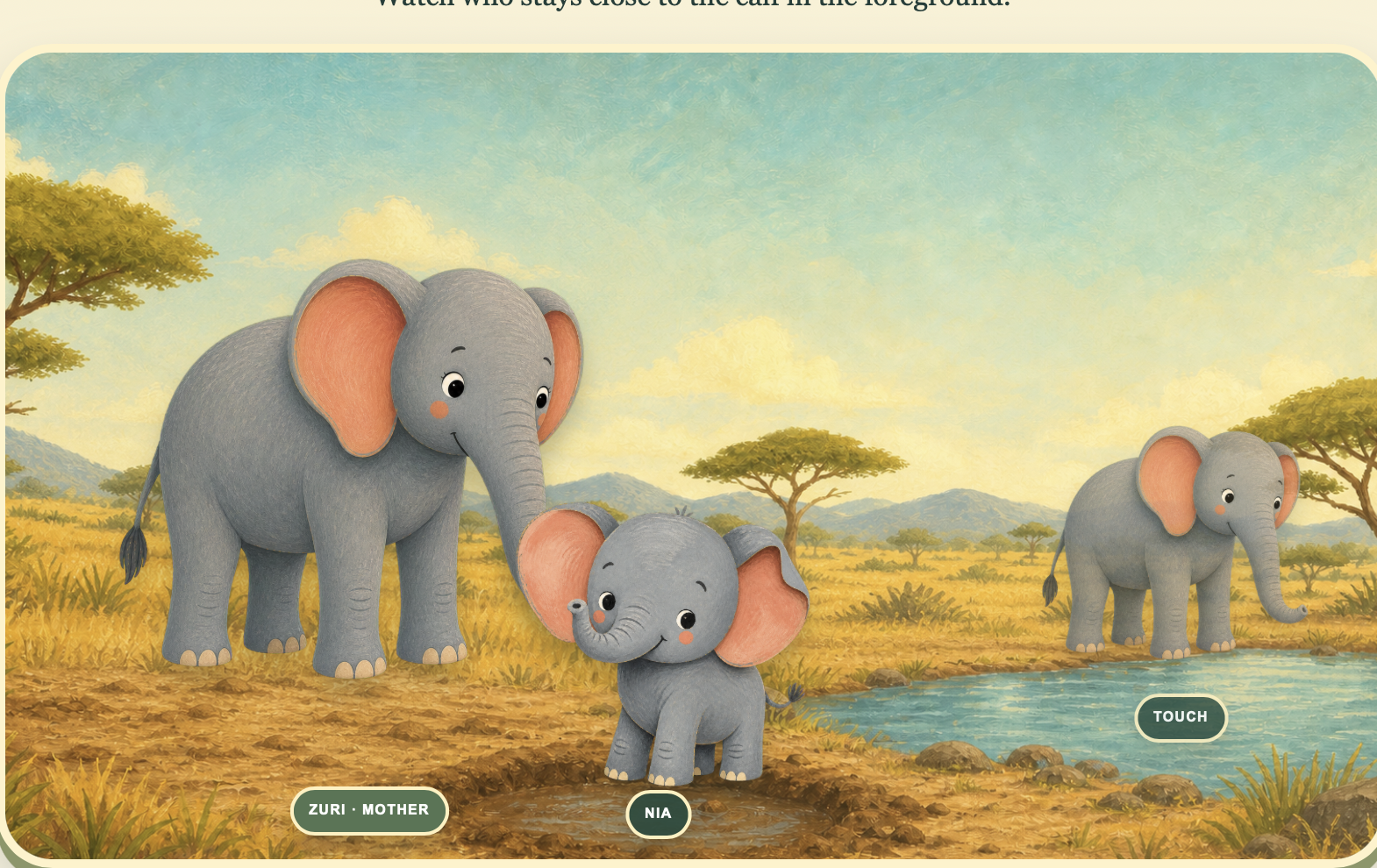
- Nia, an African savanna elephant calf
- Mara, a young giraffe
- Rimba, a young Bornean orangutan
- Pippa, a young gentoo penguin
- Luma, a jaguar cub from the Pantanal
The experience has two parallel parts: the Wildbook Library and My Little Wild Zoo.
The Wildbook Library
The library organizes animals by their real kinds of habitat. Each animal opens into its own illustrated chapter, with a consistent picture-book art style but a different story, environment, behavior set, and interaction system.
Every completed animal chapter begins with a short picture story. A parent or caregiver can read it aloud, pause at the illustrations, introduce animal vocabulary, ask the child what they notice, and talk about what may happen next. The stories connect the animal’s body, family relationships, daily behavior, and habitat instead of presenting these as separate facts.
After reading, children can explore the same animal through species-specific play.
Nia’s elephant chapter contains three connected pathways:
- Nia and the Long, Long Walk, a parent-child picture story;
- Nia’s Habitat, a six-scene observation story about herd life, tracks, cooling, water, mud, and movement;
- Trunk Power, a body-based play experience in which the trunk can draw water, aim, spray, move materials, and help create mud.
The giraffe, orangutan, penguin, and jaguar chapters each combine a picture story with six field activities based on that species’ real adaptations and behavior.
Giraffe activities use coat patterns, feeding height, thorn navigation, drinking posture, changing social groups, and connected habitat routes. Orangutan activities use flexible branches, fruit clues, nest construction, leaf tools, rain cover, mother-infant learning, and seed dispersal. Penguin activities use colony calls, pebble nests, feather care, waves, underwater movement, and parental shifts. Jaguar activities use camouflage, stillness, river movement, rosette patterns, camera traps, and habitat corridors.
The interaction itself carries the learning goal:
- Searching for tracks, coat patterns, and camouflage supports close observation, visual discrimination, comparison, and evidence gathering.
- Remembering the order of trunk actions, drinking movements, nest layers, or parental shifts supports sequencing, working memory, and planning.
- Guiding tongues, trunks, branches, swimming paths, and habitat routes supports hand-eye coordination and spatial reasoning.
- Listening to calls and observing family or group responses supports auditory attention, pattern recognition, social observation, and relationship memory.
- Changing water, light, shade, rain, mud, plants, or cover supports prediction, cause-and-effect reasoning, and cognitive flexibility.
- Reading and discussing the stories with an adult supports vocabulary, listening comprehension, narrative memory, and spoken explanation.
These are research-informed design goals, not claims of measured developmental improvement.
My Little Wild Zoo
My Little Wild Zoo is a separate open-ended play space beside the Wildbook Library. It brings all five animal babies into one child-directed habitat table while keeping them in ecologically appropriate homes.
The table is divided into four habitat zones:
- African savanna for Nia and Mara;
- Bornean rainforest for Rimba;
- Antarctic coast for Pippa;
- Pantanal wetland for Luma.
Children can switch between zones, change weather, add water, shade, mud, plants, nesting materials, or cover, and place the appropriate animal babies into each environment. The animals then display possible responses connected to their habitat needs.
This mode is designed to help children compare habitats, connect an animal’s needs with its environment, make predictions, revise arrangements, and create their own animal stories. A parent can extend the play with open questions such as:
- “Why did Nia choose the mud?”
- “What does Rimba need before the rain arrives?”
- “Where could Luma stay hidden?”
- “Why does Pippa need an ice-free rocky place for her nest?”
How we built it
We built Wildbook through an iterative research, design, implementation, and hands-on testing process with Codex running GPT-5.6.
From animal research to interaction design
We began by researching each species before designing its activities. We used zoo, wildlife, conservation, animal-behavior, and early-learning sources to study:
- habitat and climate;
- body adaptations;
- feeding and movement;
- family and social behavior;
- communication;
- daily care and survival behaviors;
- the kinds of evidence wildlife observers use in the field.
We then translated each research finding into something a child could see or do.
For example, the fact that elephants use their trunks for many different purposes became a multi-stage interaction in which the child lowers the trunk, draws water, aims, sprays different targets, and helps create mud. Giraffe feeding adaptations became a path-planning activity around thorns. Orangutan nest building became an ordered construction sequence using a strong frame, locked branches, and soft leafy lining. Penguin parental care became a changing timeline between the nest and the sea. Jaguar camouflage became an experiment using light, cover, stillness, and visual evidence.
We also mapped each interaction to a specific learning-design goal, such as visual discrimination, sequencing, working memory, spatial planning, cause-and-effect reasoning, auditory pattern recognition, or spoken explanation. These are research-informed design targets rather than claims of measured learning improvement.
Building the product structure
The earliest prototype was a single elephant experience using camera and gesture input. Hands-on prototype testing showed that the camera controls were unreliable, especially when lighting, distance, or hand position changed. The camera also made the animal feel like a background object instead of the center of the experience.
We removed the camera system and rebuilt the project around direct touch and pointer input. The elephant prototype then expanded into two parallel product areas:
- the Wildbook Library, containing animal picture stories and species-specific field activities;
- My Little Wild Zoo, an open-ended habitat table connecting all five animal babies.
Inside the library, every animal chapter is implemented as its own React component with its own characters, backgrounds, story pages, behavior data, activity states, completion paths, and replay controls.
The elephant chapter has a picture story, a six-scene habitat experience, and a separate Trunk Power interaction. The giraffe, orangutan, penguin, and jaguar chapters each combine a picture story with six field activities based on that species.
This structure allowed the chapters to share one visual identity without repeating the same game mechanics.
Building the interactions
We implemented the interface with React 19, Next.js 16, and TypeScript. The project is built through vinext and Vite with a Cloudflare-compatible runtime configuration.
Each activity works like a small state machine. It records what the child is currently doing, what has already been discovered, what visual response should appear, and whether the activity is ready to replay.
We used browser Pointer Events so the same interaction system could support a mouse, touchscreen, and iPad pointer input. Pointer capture keeps drag interactions active even when a child’s finger moves away from the original target. Release and cancellation handlers prevent objects from becoming stuck after the child lets go.
Different interaction patterns include:
- pressing and sweeping an observation lens;
- dragging an animal or tool through a scene;
- drawing and releasing water;
- arranging items in a meaningful sequence;
- alternating left and right movement;
- following sound or visual patterns;
- changing environmental conditions;
- waiting, observing, and responding at the appropriate moment;
- freely placing animals and habitat elements.
CSS transforms, transitions, keyframe animation, layered illustrations, state-based classes, and responsive sizing create the visible animal and environmental responses.
Creating the visual system
We developed a consistent children’s picture-book direction for the animal characters and used AI-assisted image generation to create and refine the illustrated asset set.
Each animal needed to remain recognizable across its library card, picture story, activity scenes, and habitat table. At the same time, the backgrounds needed to represent different moments and ecologically appropriate habitats instead of repeating one generic scene.
We separated character images, habitat backgrounds, and interactive overlays so the interface could move or transform individual elements without requiring full video animation.
Progress, privacy, and replay
Wildbook does not require a backend, account, camera, or microphone.
Completed activities are stored in browser local storage so a child can leave a chapter and return later on the same device. Every chapter also includes replay or reset paths. My Little Wild Zoo keeps its current arrangement in client-side state and provides undo, remove, and reset controls.
We intentionally avoided streaks, hunger meters, absence penalties, advertising, chat, purchasing, and child-data collection.
Testing and iteration
We repeatedly tested the prototype in the browser at desktop and tablet-style sizes. These were product-development tests, not a formal study with children.
The most important iterations included:
- removing unreliable camera gestures;
- replacing repeated quizzes with observable actions;
- increasing touch-target sizes;
- fixing drag interactions that could become stuck;
- adding explicit release and reset behavior;
- replacing generic animal activities with species-specific mechanics;
- adding real local audio where sound was part of the activity;
- separating My Little Wild Zoo from the animal library;
- adding picture stories that parents and caregivers can read aloud.
We also created regression tests for production builds, picture-book availability, local audio files, progress storage, habitat-table behavior, and interaction bugs that had appeared during development.
How we used Codex and GPT-5.6
We made the central product decisions: the parent-child reading direction, the non-punitive learning model, the removal of camera control, the animal and habitat structure, the requirement for species-specific play, and the final visual and interaction standards.
Codex running GPT-5.6 helped us:
- research and compare animal and early-learning sources;
- turn product ideas into React and TypeScript components;
- build and revise interaction state machines;
- create and integrate the illustrated asset system;
- diagnose pointer, layout, progress, and audio problems;
- inspect the running application in the browser;
- identify mechanically repetitive activities;
- write regression tests and submission documentation;
- repeatedly revise the prototype after hands-on review.
The child-facing application does not call an AI model at runtime. Codex and GPT-5.6 were used to help research, design, build, test, and document the product.
Challenges we ran into
Turning animal facts into meaningful play
Our biggest challenge was making each interaction communicate something real about the animal.
Early prototypes often placed a fact beside a button or animation. The child could complete the activity without understanding the animal behavior behind it. We realized that changing the illustration was not enough—the child’s action also needed to represent the scientific idea.
We began redesigning activities around a simple question:
What does the child physically do, what changes in the scene, and what can the child understand from that change?
For example, we did not want to tell children only that elephants use mud on their skin. We created a sequence in which the child adds water to soil, mixes the mud, applies it, and observes the result. Instead of presenting a giraffe’s tongue as a written fact, the child guides it around thorns to reach leaves. An orangutan nest becomes an ordered construction process, while jaguar camouflage becomes an experiment involving light, cover, movement, and stillness.
Avoiding repeated game mechanics
As Wildbook expanded, several activities looked different but behaved in almost the same way. A new background, animal, or button label did not make an interaction genuinely different.
We reviewed the chapters according to their underlying action rather than their appearance. If too many activities were based on tapping three objects, dragging something to a target, or selecting the correct answer, we redesigned them.
The final prototype uses a wider range of interaction patterns:
- sweeping a movable observation lens;
- drawing, aiming, and releasing water;
- arranging materials in a meaningful sequence;
- guiding a path around obstacles;
- alternating left and right movement;
- changing environmental conditions;
- following visual or sound patterns;
- waiting for an observation window;
- comparing evidence across a scene;
- freely arranging animals and habitat elements.
This helped each species develop its own interaction language instead of feeling like the elephant chapter with different artwork.
Making touch controls reliable for children
The project began with camera and gesture input. Hands-on prototype testing showed that the camera system changed too much with lighting, distance, hand position, and device placement. Children would have needed to learn how to satisfy the camera instead of focusing on the animal.
We removed the camera feature and moved to direct touch and pointer input.
Touch interaction introduced a different set of problems. Controls that worked with a mouse could become difficult on an iPad. Dragged objects could become stuck if a finger moved outside the target. Small controls required too much precision, and some activities did not make it clear when the child should press, hold, move, or release.
We addressed these problems by:
- increasing touch-target sizes;
- using Pointer Events for both touch and mouse input;
- capturing the active pointer during drag interactions;
- handling release and cancellation states explicitly;
- using forgiving hit areas and movement thresholds;
- adding visible instructions for press, hold, move, and release;
- providing replay and reset controls;
- adding alternative buttons when a complex gesture could remain difficult.
Balancing education with enjoyment
Another challenge was avoiding two opposite outcomes: a factual encyclopedia with little play, or a collection of entertaining animations with little understanding.
Early versions relied too heavily on quizzes and correct-answer feedback. This made the experience feel like a worksheet. Later versions added more animation, but some of those animations were decorative rather than educational.
We replaced most quiz-style moments with observation, experimentation, sequencing, environmental change, and open-ended arrangement. Instead of showing only “correct” or “incorrect,” the scene responds to what the child does and explains the animal connection.
We also avoided streaks, hunger meters, punishment, simulated neglect, and failure screens. Our goal was to encourage replay through curiosity and variation rather than pressure.
Supporting parent-child participation without interrupting play
Wildbook is designed for children and adults to experience together, but we did not want every page to become a lesson plan.
The picture stories needed enough language and scientific detail for a parent to read aloud, while remaining short enough for a child to follow. The activities needed to work independently, but also create opportunities for questions such as:
- “What changed?”
- “Why did the animal do that?”
- “What do you think will happen next?”
- “What does this animal need in its habitat?”
We treated the story, illustration, interaction, and response text as parts of one conversation rather than separate educational materials.
Keeping the animals visually consistent
Wildbook contains library cards, picture stories, activity scenes, transparent character assets, and habitat-table scenes. Maintaining the same recognizable animal across all of these contexts was difficult.
AI-assisted image generation could change body proportions, markings, facial features, lighting, or illustration texture between images. It could also create attractive backgrounds that were not appropriate for the animal’s actual habitat.
We repeatedly refined and selected assets to keep the characters recognizable. We separated characters from backgrounds where possible and reused established character images across different interfaces. We also created different backgrounds for different story moments while checking that the major habitat features remained appropriate to the species.
Balancing character warmth with wildlife accuracy
The animals needed to feel memorable and emotionally approachable without becoming human-like pets.
We used fictional names and a consistent picture-book style, but grounded the activities in documented feeding, movement, communication, family, and habitat behavior. We avoided mechanics suggesting that a wild animal would become sick, unhappy, or neglected because the child stopped playing.
This balance influenced My Little Wild Zoo as well. Children can care about the animal babies and arrange their environments, but each animal remains connected to an ecologically appropriate habitat.
Managing scope while maintaining quality
Wildbook began with one elephant and eventually expanded into five animal chapters, five picture stories, more than thirty activities, and four habitat zones.
The challenge was not simply producing more content. Every new chapter required animal research, a different visual environment, new interaction logic, responsive behavior, progress storage, replay controls, and testing.
We repeatedly removed or rebuilt features that did not meet the project’s standard. This took more time than copying one successful activity pattern, but it was necessary for the product to feel like a living animal library rather than a collection of reskinned mini-games.
Being honest about what the prototype proves
Wildbook’s activities are informed by early-learning principles and are designed to support observation, sequencing, working memory, spatial reasoning, cause-and-effect thinking, coordination, and explanation.
However, we have not yet conducted a formal study measuring learning outcomes with children. One challenge was communicating the educational intention without overstating the evidence.
We therefore describe these abilities as research-informed design goals, not proven developmental outcomes. Formal testing with children, parents, educators, accessibility specialists, and animal experts remains an important next step.
Accomplishments that we're proud of
Building a complete animal-library structure
We are proud that Wildbook grew from one experimental elephant activity into a coherent animal library with two connected product areas:
- the Wildbook Library, where children can read and explore individual animal chapters;
- My Little Wild Zoo, where children can compare animals and build within ecologically appropriate habitat zones.
The current prototype contains five completed animal worlds: African savanna elephant, giraffe, Bornean orangutan, gentoo penguin, and Pantanal jaguar.
Creating five parent-child picture stories
Every completed animal chapter includes an original illustrated picture story using the same characters and habitats as the activities.
The stories are designed to be read aloud by a parent or caregiver. They introduce real animal behavior through character, sequence, and visual detail while creating opportunities to pause, predict, notice, remember, and talk together.
We are especially proud that the stories are not disconnected rewards or introductory slides. Their events, characters, and animal facts continue into the interactive parts of each chapter.
Developing more than thirty species-specific activities
Wildbook contains more than thirty replayable field activities across its five animal chapters.
Instead of copying one mini-game and replacing the animal artwork, we created different interaction systems based on the body, behavior, and environment of each species.
Children can:
- follow elephant tracks and experiment with water, mud, ears, and trunk movement;
- compare giraffe patterns, navigate around thorns, explore feeding height, and observe changing groups;
- bend orangutan branches, construct nests, make leaf tools, explore fruit, and disperse seeds;
- listen to penguin calls, build pebble nests, care for feathers, time waves, dive, and observe parental shifts;
- reveal jaguar camouflage, practice stillness, cross water, record rosettes, place camera traps, and connect habitat corridors.
We are proud that these interactions feel related to the animal rather than added on top of an animal illustration.
Connecting interaction with developing abilities
Each activity was designed around both an animal-learning goal and a child-development goal.
Across the prototype, children practice actions involving:
- close observation and visual discrimination;
- comparison and classification;
- sequencing and working memory;
- spatial planning and hand-eye coordination;
- auditory attention and pattern recognition;
- prediction and cause-and-effect reasoning;
- cognitive flexibility and self-correction;
- evidence-based explanation;
- imagination and oral storytelling.
These are research-informed design goals rather than claims of measured learning improvement. We are proud that the abilities are embedded inside meaningful animal actions instead of presented as separate drills.
Creating an open-ended habitat experience
My Little Wild Zoo brings all five animal babies into one play space while respecting the kinds of environments their wild relatives need.
The experience contains four habitat zones:
- African savanna;
- Bornean rainforest;
- Antarctic coast;
- Pantanal wetland.
Children can change weather, place habitat elements, move the appropriate animal babies, compare environments, undo decisions, and reset a zone. There is no single required arrangement and no punishment for experimenting.
Designing a non-punitive children’s experience
We deliberately removed mechanics that could create pressure or simulated neglect.
Wildbook has:
- no streaks;
- no hunger meter;
- no absence penalty;
- no care punishment;
- no failure screen;
- no advertising;
- no purchasing;
- no chat or social sharing;
- no child account;
- no camera or microphone permission.
Children can leave, return, replay, and reset without an animal becoming unhappy or losing care. We are proud that replay comes from curiosity and variation rather than anxiety.
Making the experience work with touch and mouse input
We rebuilt the original camera-based prototype around direct touch and Pointer Events.
The finished interactions support both touchscreens and desktop pointers. We added larger controls, forgiving hit areas, pointer capture, explicit release behavior, gesture instructions, replay controls, and alternative buttons for interactions that could otherwise require too much precision.
This made the prototype more suitable for the iPad-centered experience we wanted to create.
Establishing a consistent visual world
We created a unified children’s picture-book art direction across library cards, stories, field activities, animal cutouts, and habitat scenes.
Each animal remains recognizable across different parts of the application, while every chapter receives its own ecologically relevant environment and visual atmosphere.
We are particularly proud that the project no longer depends on one repeated background. Different moments use different light, weather, landscape, plants, water, and observation conditions.
Turning repeated criticism into a stronger product
Many of Wildbook’s best decisions came from removing or rebuilding ideas that were not working.
During development, we removed:
- unreliable camera gestures;
- AI narration;
- repeated quiz loops;
- interactions that were visually different but mechanically identical;
- punitive virtual-pet systems;
- confusing navigation categories;
- animal activities that did not produce a meaningful visual response.
We are proud that we continued revising the prototype instead of protecting early ideas simply because they had already been implemented.
Completing a testable and documented prototype
The repository includes:
- a production build;
- automated regression tests;
- local audio validation;
- picture-story and chapter checks;
- interaction regression checks;
- a judging guide;
- animal and learning references;
- privacy documentation;
- third-party notices;
- a record of how Codex and GPT-5.6 were used.
The final prototype can be explored without an account, API key, camera, microphone, or special hardware.
What we learned
What we learned
The interaction should carry the animal fact
Our most important lesson was that educational interaction should not be decoration around a fact. The child’s action should help communicate the idea.
Reading that elephants use mud is different from adding water to soil, mixing the mud, applying it, and observing the result. Reading that giraffes have long tongues is different from planning a path around thorns to reach leaves. Reading that orangutans build nests is different from arranging a strong frame, locking branches, and adding soft leaves.
When the action, visual response, and animal behavior support the same idea, the activity becomes easier to understand and discuss.
Different animals need different interaction languages
We learned that changing the animal and background does not automatically create a new activity.
During development, several interactions looked different but relied on the same underlying pattern: tap several objects, drag something to a target, or choose an answer. Children would have been repeating the same task under different illustrations.
We began evaluating each activity by what the child physically does. This led us to develop different interaction languages for different animals:
- elephants use water, mud, tracks, herd observation, ears, and multi-purpose trunk movement;
- giraffes use height, pattern, balance, thorns, posture, and changing social groups;
- orangutans use flexible branches, construction sequences, fruit clues, leaf tools, rain cover, and seed movement;
- penguins use sound patterns, pebbles, feather care, waves, underwater movement, and parental timing;
- jaguars use camouflage, stillness, alternating movement, field evidence, camera traps, and habitat connections.
The animal’s real adaptations should determine the interaction—not the other way around.
Parent-child conversation is part of the experience
We learned that the parent or caregiver should not be treated only as someone who helps when the child gets stuck.
A picture story gives the adult and child a shared starting point. They can point to details, introduce new vocabulary, predict what may happen, remember earlier events, and explain why an animal behaves in a certain way.
The activity then gives them something concrete to discuss:
- “What changed?”
- “Why did the animal do that?”
- “What evidence did you notice?”
- “What do you think will happen next?”
- “What does this animal need in its habitat?”
This conversation can connect the story, the child’s action, and the scientific idea without turning the experience into a formal lesson.
Abilities can be practiced inside meaningful play
We learned that observation, memory, planning, coordination, and reasoning do not need to appear as separate exercises.
Searching for tracks or camouflage can involve sustained attention and visual discrimination. Remembering the steps of a nest or trunk action can involve sequencing and working memory. Guiding an animal through a scene can involve spatial planning and hand-eye coordination. Changing light, water, weather, or cover can involve prediction and cause-and-effect reasoning.
The activity becomes more meaningful when the developing ability is connected to something the animal actually does.
These remain research-informed design goals. Formal testing is still needed before claiming that Wildbook measurably improves these abilities.
Enjoyment does not require pressure
We learned that replay does not need to depend on streaks, countdowns, simulated neglect, or fear of losing progress.
Children can return because they want to try another arrangement, discover a different response, hear another call, follow a new route, revisit a story, or show an activity to a parent.
This led us to remove hunger meters, absence penalties, failure screens, and punitive virtual-pet mechanics. The animals never lose care because the child stops playing.
Open-ended play still needs meaningful boundaries
My Little Wild Zoo taught us that “open-ended” does not have to mean “anything goes.”
Children can freely arrange weather, animals, and habitat elements, but each animal remains connected to an appropriate kind of home. Nia and Mara belong in the savanna zone, Rimba in the rainforest, Pippa on the Antarctic coast, and Luma in the Pantanal wetland.
The ecological boundaries give the play meaning while still allowing children to experiment, compare, revise, and create their own stories.
Touch interaction needs to be forgiving
We learned that an interaction working with a mouse does not mean it will work well for a child on an iPad.
Touch input requires larger targets, wider hit areas, clear press-and-hold instructions, reliable pointer capture, explicit release behavior, and easy reset paths. A child should not fail because a finger moved slightly outside an invisible boundary.
We also learned that gestures should have alternative controls when precision could become a barrier.
Removing features can improve the product
Wildbook became clearer when we removed features that did not support its central purpose.
We removed unreliable camera gestures, AI narration, repeated quizzes, confusing navigation, punitive pet-care mechanics, and interactions that produced only small decorative movements.
Each removal helped the product move closer to its central identity: a shared animal picture book where children read, observe, experiment, and play.
Visual consistency requires its own system
We learned that AI-assisted image generation can produce attractive individual pictures without automatically producing a consistent product.
Characters can change proportions, markings, expressions, textures, or lighting between images. Backgrounds can look beautiful while containing habitat details that do not fit the species.
We needed to establish recognizable character references, separate animals from backgrounds where possible, reuse approved assets, and check habitat details across every scene.
Educational warmth and scientific accuracy must coexist
The animals needed names, expressions, and stories that children could remember, but they could not behave like human children wearing animal costumes.
We learned to use fictional characters as guides into real behavior. Their actions remain connected to feeding, movement, communication, family relationships, shelter, water, weather, and habitat.
We also learned to be careful with emotional language. Wild animals can be presented warmly without suggesting that they are pets or that they depend on the child’s continuous attention.
What's next for WildBook
Adding more animals and habitats
Our next goal is to grow Wildbook from a five-animal prototype into a larger living animal library with more species, habitats, stories, and forms of play. We want to introduce animals that expand both the geographic and biological range of the library.
Possible future habitat collections include:
- African grasslands and wetlands;
- Asian tropical forests;
- Amazon rainforest and rivers;
- North American forests and mountains;
- Arctic tundra and sea ice;
- oceans, coral reefs, and coastlines;
- deserts and seasonal drylands;
- freshwater rivers, lakes, and marshes.
New chapters could include lions, zebras, gorillas, sloths, toucans, polar bears, seals, sea turtles, dolphins, red pandas, tigers, beavers, wolves, owls, octopuses, and other animals.
We do not want to add animals only to increase the number of chapters. Each new species should contribute a new body adaptation, habitat relationship, family structure, scientific-observation method, and interaction language.
Creating richer species-specific interactions
Future activities will go beyond tapping and dragging. We want children to interact with animal behavior through movement, sound, time, environmental change, construction, observation, and open-ended experimentation.
Possible interaction systems include:
- drawing rivers and observing how water changes a habitat;
- building nests, burrows, dams, shelters, and migration routes;
- following tracks, feathers, calls, food remains, and camera-trap evidence;
- changing seasons, tides, daylight, temperature, rain, wind, and water depth;
- observing how different animals respond to the same environmental change;
- combining body abilities, such as hearing, smell, camouflage, climbing, swimming, digging, or flight;
- creating food webs and habitat connections without turning them into quizzes;
- comparing animal movement through land, water, trees, ice, and air;
- recording observations in a child-created field book;
- arranging characters and environments to create new picture-book pages.
The goal is for every animal to feel physically and conceptually different to play.
Expanding parent-child reading and conversation
We want to create longer picture-book experiences that remain suitable for shared reading.
Future stories could include optional parent prompts, such as:
- “What do you notice?”
- “What changed since the last page?”
- “Why might the animal choose this place?”
- “Can you remember what happened before?”
- “What do you predict will happen next?”
These prompts would remain optional so they support conversation without interrupting the story.
We also want children and parents to create their own animal story pages by selecting characters, weather, habitat elements, animal behavior, and short English sentences.
Connecting the library and the zoo
As more animals are added, My Little Wild Zoo can grow into a larger habitat-director experience.
Children could:
- unlock new habitat zones by exploring animal chapters;
- bring knowledge from a story into habitat play;
- compare animals that share a habitat;
- observe how different species use water, shade, plants, shelter, or open space;
- create mixed-species environments only when the animals realistically share a region;
- save habitat arrangements as illustrated field pages;
- build a personal animal library based on observations rather than scores.
The zoo will remain non-punitive. Animals will not become hungry, sick, unhappy, or neglected when the child leaves.
Testing with children, parents, and educators
Before making strong claims about learning outcomes, we need to observe how families actually use Wildbook.
We plan to test:
- whether children understand the instructions without adult correction;
- which interactions they choose to replay;
- whether they can explain a connection between an animal’s body, behavior, and habitat;
- which activities create the strongest parent-child conversations;
- where touch controls remain too precise or confusing;
- whether the picture stories hold attention when read aloud;
- how children of different ages approach observation, sequencing, and open-ended play.
We also want feedback from early-childhood educators, accessibility specialists, wildlife educators, and animal-behavior experts.
Improving accessibility
Future versions will include stronger accessibility options, such as:
- reduced-motion modes;
- scalable text;
- clearer focus and keyboard navigation;
- screen-reader descriptions;
- high-contrast controls;
- alternatives to drag gestures;
- captions and visual representations for every sound;
- adjustable reading pace;
- optional professionally recorded narration;
- support for children with different motor, visual, auditory, and learning needs.
Improving animal sound and visual behavior
We plan to add professionally reviewed and properly licensed animal audio. Sound will remain optional, and every sound activity will also have a visual alternative.
We also want to create more detailed animal animation systems so that ears, trunks, tails, wings, paws, bodies, eyes, and environmental objects respond more naturally to the child’s actions.
Instead of playing one repeated animation, animals could respond differently depending on weather, time, habitat arrangement, nearby family members, and the child’s previous action.
Developing a reusable Wildbook system
Technically, we want to turn the current chapters into a reusable content and interaction framework.
Animal facts, story pages, habitat information, learning goals, activity instructions, progress data, and accessibility alternatives could be organized through structured content rather than being defined separately inside every component.
This would make it easier to add new animals while preserving quality, scientific accuracy, interaction variety, privacy, and accessibility.
Our long-term vision
Our long-term vision is for Wildbook to become a growing digital animal library where every animal opens a different world.
Families could choose an animal, read its story together, explore how it moves and lives, experiment with its habitat, and then use what they learned to create their own animal world.
Wildbook should continue growing without losing its central idea:
Children learn about real animals by reading together, observing closely, experimenting joyfully, and playing without pressure.
Built With
- cloudflare-workers
- css-animations
- css3
- eslint
- gpt-5.6
- html5
- javascript
- local-storage
- next.js
- node.js
- npm
- openai-codex
- pointer-events
- react
- responsive-web-design
- tailwind-css
- typescript
- vinext
- vite
- web-apis

Log in or sign up for Devpost to join the conversation.