Inspiration
The inspiration for WikiSearch came from the need for a more efficient way to access and comprehend vast amounts of information available on Wikipedia. While Wikipedia is an invaluable resource, navigating through extensive articles to find relevant information can be time-consuming. By leveraging the advanced language capabilities of Snowflake Arctic, we sought to create a tool that could summarize and present information in a concise, easily digestible format.
What it does
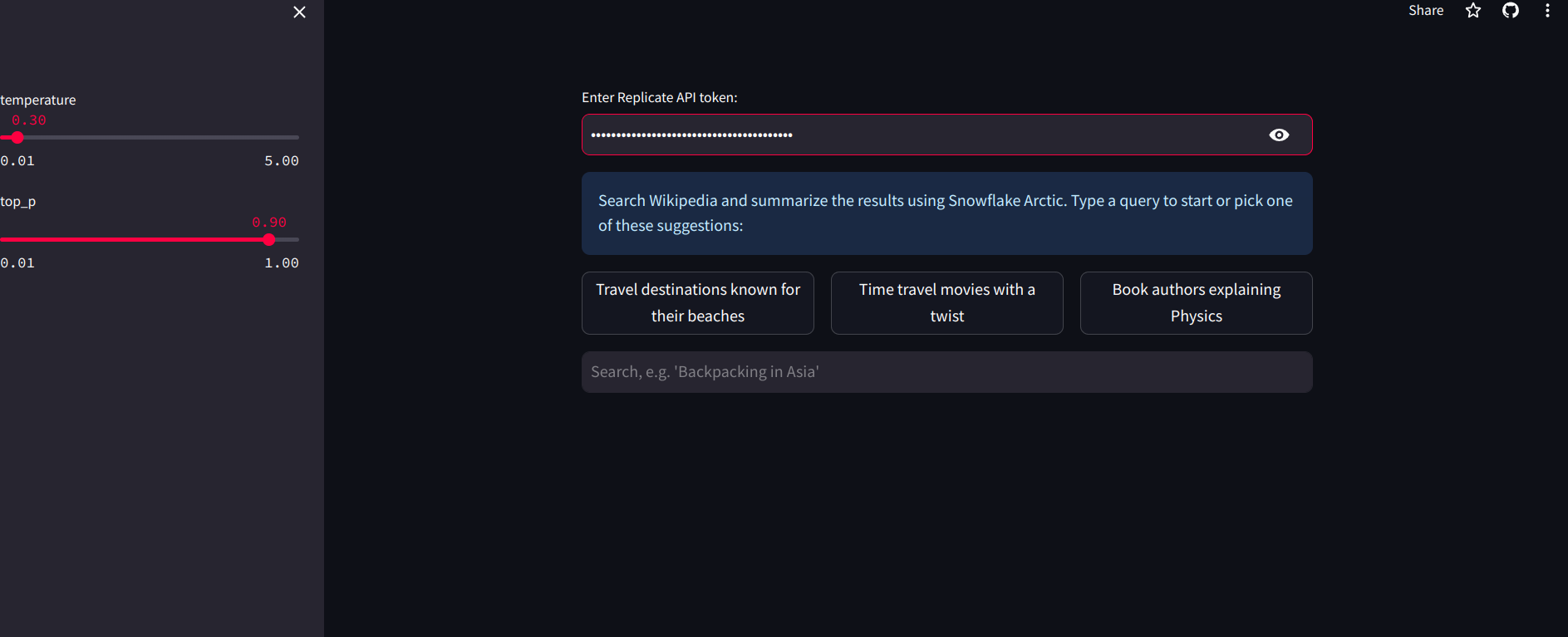
WikiSearch allows users to search for topics on Wikipedia and receive summarized results, making it easier to quickly understand the key points of an article. The application provides a user-friendly interface where users can type in their queries, view suggested topics, and receive brief, coherent summaries of the most relevant Wikipedia entries. This not only saves time but also enhances the user's ability to grasp complex topics efficiently.
How we built it
We built WikiSearch using the following steps:
Language Model Integration: Integrated Snowflake Arctic's language model to process and summarize Wikipedia content. Frontend Development: Developed a user-friendly interface with Streamlit, allowing for easy user interactions and dynamic content display. Backend Development: Implemented backend services to handle user queries, search Wikipedia, and fetch data. Utilized APIs to aggregate and process search results. Summarization Logic: Designed algorithms to aggregate and summarize the text content from Wikipedia, ensuring that the summaries were both accurate and concise. Optimization and Testing: Conducted extensive testing and optimization to ensure the application was responsive, accurate, and provided a seamless user experience.
Challenges we ran into
Data Aggregation: Combining and summarizing data from multiple Wikipedia entries while maintaining coherence and relevance was a significant challenge. API Integration: Ensuring smooth interaction between the language model and Wikipedia's API required careful handling of query limits and data processing. Performance Optimization: Balancing the processing power needed for summarization with the responsiveness of the user interface was a key challenge. Accomplishments that we're proud of Successfully integrating Snowflake Arctic’s language model to deliver concise and relevant summaries. Creating an intuitive and user-friendly interface that enhances the user experience. Efficiently handling and summarizing large amounts of data to provide clear and concise information. Overcoming technical challenges related to API integration and performance optimization.
What we learned
The importance of effective summarization techniques in enhancing information accessibility. How to integrate advanced language models into web applications to solve real-world problems. The value of user-centric design in creating tools that are not only functional but also enjoyable to use. Techniques for optimizing the performance of applications that handle large datasets and complex computations.
What's next for Wiki Search
Feature Expansion: Adding more features such as voice search, multi-language support, and deeper customization options for users. Enhanced Summarization: Improving the summarization algorithms to handle more complex queries and provide even more accurate summaries.
Built With
- api
- replicate
- snowflake
- streamlit

Log in or sign up for Devpost to join the conversation.