-
-
WiFiProof Logo
-
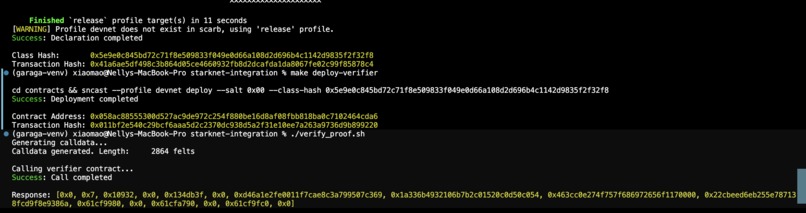
Calling verifier contract success
-
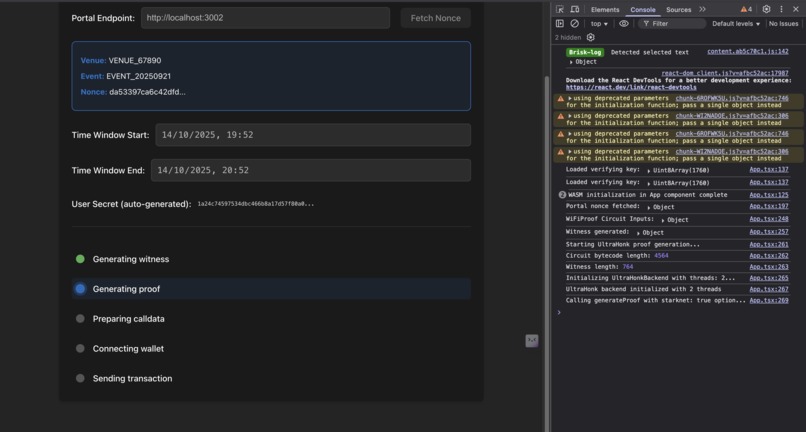
Browser Proof Generation

Inspiration
The inspiration for WiFiProof came from a simple, universal observation at every crypto conference and hackathon: the first thing everyone does is ask for the WiFi password. This shared behavior is a powerful, yet overlooked, signal of physical presence. We realized this common act of connecting to a local network could be transformed into a secure, private, and unforgeable cryptographic proof of attendance, solving a problem that plagues event-based rewards in the Web3 space.
For this Starknet integration, we were specifically inspired by Starknet's vision of scalable, privacy-preserving computation. We saw an opportunity to bring zero-knowledge proofs of physical attendance directly on-chain to Starknet, where they could be verified efficiently and integrated into the broader Cairo ecosystem.
What it does
WiFiProof Starknet is a complete end-to-end system that creates privacy-preserving proof of physical venue attendance verified on Starknet. It allows users to cryptographically prove they were at a specific event during a specific time window, without revealing their personal identity or connection details.
System Architecture
The system works in three stages:
Portal Interaction: Users connect to a venue's WiFi and receive a cryptographically signed, single-use nonce from the portal server
Proof Generation: Users generate a zero-knowledge proof using a Noir circuit, proving they possess the portal nonce and a valid user secret without revealing either
On-Chain Verification: The proof is verified on Starknet by a Cairo verifier contract, providing an immutable, publicly auditable record
Cryptographic Properties
The system maintains privacy by hiding:
- User secret $s \in \mathbb{F}_p$ (private device binding)
- Connection nonce $n \in \mathbb{F}_p$ (session randomness)
- Portal nonce and signature values
While publicly verifying:
- Venue identifier $v \in \mathbb{F}_p$
- Event identifier $e \in \mathbb{F}_p$
- Time window $[t_{start}, t_{end}]$ with proof timestamp $t_{proof}$ where $t_{start} \leq t_{proof} \leq t_{end}$
- Portal nonce hash $H_{nonce}$ and signature hash $H_{sig}$
This enables projects to confidently distribute rewards like airdrops or grant exclusive access only to genuine attendees, preventing fraud from remote participants or shared credentials.
How we built it
We built WiFiProof Starknet using a cutting-edge ZK stack specifically optimized for Starknet:
ZK Circuit (Noir)
The core circuit implements five cryptographic commitments using Pedersen hashing:
User Commitment: Binds proof to user without revealing identity $$C_{user} = H_{Pedersen}(s, v, t_{proof}, n)$$
Nullifier: Prevents proof reuse while maintaining privacy $$N = H_{Pedersen}(s, v, e, t_{start}, H_{nonce})$$
Portal Binding: Ties proof to specific venue interaction $$B_{portal} = H_{Pedersen}(H_{nonce}, H_{sig}, v, e)$$
Proof Output: Final commitment proving all constraints $$O_{proof} = H_{Pedersen}(v, e, N, C_{user}, B_{portal}, t_{proof})$$
The circuit constraints ensure:
- $t_{start} \leq t_{proof} \leq t_{end}$ (time window validation)
- $H_{nonce} \neq 0 \land H_{sig} \neq 0$ (portal data validity)
- All commitments computed correctly
Proving System (Barretenberg Ultra Honk with Starknet Flavor)
- Uses Barretenberg 0.87.4-starknet.1 backend with Starknet-specific optimizations
- Generates Ultra Honk proofs with Poseidon hash instead of standard Keccak256
- Poseidon is a ZK-friendly hash designed for efficient verification in Cairo
- Works over the BN254 elliptic curve: $y^2 = x^3 + 3$
- Proof generation takes approximately 5 seconds on command-line
The Ultra Honk proving system uses polynomial commitments on BN254: $$\text{Commit}(f(X)) = [f(\tau)]_1 \in \mathbb{G}_1$$
where $\tau$ is the trusted setup parameter.
Cairo Verifier Generation (Garaga)
Used Garaga 0.18.1 to automatically convert the Barretenberg verifier to Cairo 2.x:
- Generates a native Cairo contract that verifies Ultra Honk proofs on Starknet
- The verifier accepts calldata of size $n = 2864$ field elements (felts)
- Calldata structure:
- BN254 elliptic curve polynomial commitments $(x, y) \in \mathbb{F}_p^2$
- Evaluation points and openings
- Public inputs: $(v, e, t_{start}, t_{end}, t_{proof}, H_{nonce}, H_{sig})$
- Fiat-Shamir transcript elements for non-interactive verification
The Cairo verifier performs pairing checks in $\mathbb{F}_p$ where $p$ is Starknet's prime field: $$p = 2^{251} + 17 \times 2^{192} + 1$$
Starknet Deployment
- Deployed verifier contract to Starknet devnet using Starknet Foundry (sncast)
- Contract class hash:
0x5e9e0c845bd72c71f8e509833f049e0d66a108d2d696b4c1142d9835f2f32f8 - Contract address:
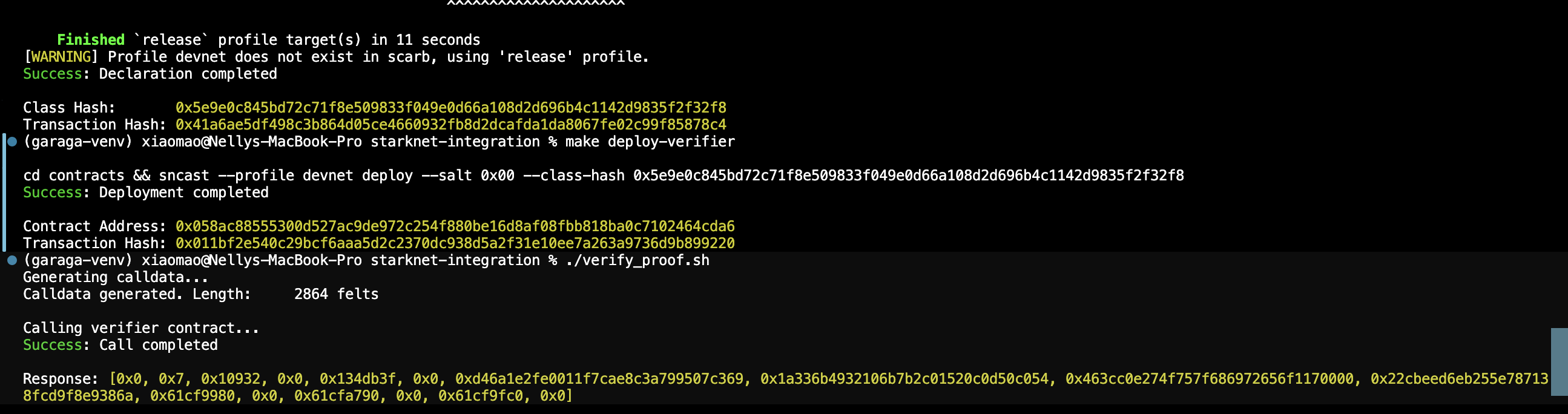
0x058ac88555300d527ac9de972c254f880be16d8af08fbb818ba0c7102464cda6 - Successfully verified proofs on-chain with cryptographic certainty
Web Application (React + TypeScript)
- Built with React and Vite for fast development
- Integrated NoirJS 1.0.0-beta.5 for in-browser circuit execution
- Witness generation works perfectly in browser
- Portal nonce fetching via REST API
- Proof generation optimized for command-line (browser optimization in progress)
Portal Server (Node.js)
- Lightweight server intended for venue's local network
- Issues ECDSA-signed, single-use nonces
- REST API endpoint for nonce requests
- Prevents remote proof generation
Challenges we ran into
Challenge 1: Starknet-Specific Proving System
The biggest technical challenge was configuring the entire toolchain to use the Starknet flavor of Ultra Honk. Standard Barretenberg uses Keccak256 hashing, which is expensive to verify in Cairo. We needed to:
- Install the specific
0.87.4-starknet.1version of Barretenberg - Use
bb prove_ultra_starknet_honkinstead of standardprove_ultra_honk - Pass the
{ starknet: true }option in NoirJS - Ensure Garaga was configured for
ultra_starknet_honksystem
This required deep understanding of the Barretenberg proving system and Starknet's field arithmetic. The key insight was that Poseidon hash operates efficiently in $\mathbb{F}_p$ (Starknet's native field), whereas Keccak256 requires expensive bit operations in Cairo.
Challenge 2: Garaga Integration and Calldata Generation
Converting a Barretenberg verifier to Cairo was complex:
- Understanding how Garaga maps BN254 curve operations to Cairo
- Generating the correct 2864-felt calldata format
- Debugging calldata serialization issues (initially forgot
--public-inputsflag) - Ensuring the Cairo verifier correctly handles polynomial commitments
The challenge was understanding the calldata structure. Each BN254 point $(x, y)$ must be serialized as two field elements in $\mathbb{F}_p$, requiring careful handling of field conversions between BN254's base field and Starknet's field.
Challenge 3: Starknet Devnet Configuration
We encountered multiple configuration issues:
- sncast profile configuration with chain IDs vs network names
- Understanding that devnet defaults to
alpha-sepoliachain ID - Organizing
accounts.jsonby chain ID rather than network name - Resolving "Account not found" errors during contract declaration
The key fix was realizing that sncast uses the chain ID (alpha-sepolia) not the network name (devnet) for account lookup in accounts.json.
Challenge 4: Browser Proof Generation
While witness generation works perfectly in-browser, full proof generation with Ultra Honk currently hangs due to WebAssembly threading constraints:
- SharedArrayBuffer limitations in browser environments
- Multi-threaded WASM requiring specific HTTP headers
- Performance differences between browser and native execution
We successfully implemented command-line proving as the primary method, with browser optimization as future work.
Accomplishments that we're proud of
Complete End-to-End Starknet ZK System
We built a fully functional system that goes from a WiFi portal interaction to verified proof on Starknet. This isn't a mock-up or simulation - it's a real, working implementation that generates actual proofs and verifies them on-chain.
Successful Garaga Integration
We successfully integrated Garaga to automatically convert Barretenberg verifiers to Cairo. The generated verifier contract works flawlessly, accepting $n = 2864$ felts of calldata and returning verified public inputs. This demonstrates the power of Garaga as a bridge between different ZK ecosystems.
Working On-Chain Verification
Our biggest accomplishment is achieving successful on-chain proof verification on Starknet. When you run ./verify_proof.sh, you see:
Calldata generated. Length: 2864 felts
Calling verifier contract...
Success: Call completed
Response: [0x0, 0x7, 0x10932, 0xe4e6c8ae, ...]
This proves the entire system works: $$\text{Noir Circuit} \rightarrow \text{Ultra Honk Proof} \rightarrow \text{Cairo Verifier} \rightarrow \text{Starknet Verification}$$
Efficient Circuit Design
The Noir circuit uses efficient Pedersen hashing (native to Starknet) and implements:
- User commitment: $C_{user} = H(s, v, t_{proof}, n)$
- Nullifier: $N = H(s, v, e, t_{start}, H_{nonce})$ (prevents double-spending)
- Portal binding: $B_{portal} = H(H_{nonce}, H_{sig}, v, e)$ (ties proof to venue)
- Time window validation: $t_{start} \leq t_{proof} \leq t_{end}$
- All without revealing private inputs $(s, n)$
Developer-Friendly Workflow
We created a complete developer experience with:
- Makefile automation for all steps
- Comprehensive documentation (README, demo scripts, app documentation)
- Troubleshooting guides for common issues
- Clear separation of concerns (circuit, contracts, app)
Transparent About Limitations
We're proud of being honest about what works (command-line proving, on-chain verification) and what's in progress (browser proving optimization). This transparency shows maturity and realistic project planning.
What we learned
Lesson 1: Starknet Has a Unique ZK Ecosystem
We learned that Starknet's Cairo VM requires specific proof formats. You can't just use any ZK proof - you need Starknet-compatible proving systems. The Barretenberg Starknet flavor with Poseidon hashing is crucial for efficient verification because:
- Poseidon operates in $\mathbb{F}_p$ (Starknet's native field)
- Keccak256 requires expensive bit operations in Cairo
- Field arithmetic in Cairo is optimized for $p = 2^{251} + 17 \times 2^{192} + 1$
This taught us the importance of choosing cryptographic primitives aligned with your target chain's architecture.
Lesson 2: Garaga is a Game-Changer
Garaga transforms what would be weeks of manual Cairo development into a single command:
garaga gen --system ultra_starknet_honk --vk circuit/target/vk
We learned that:
- Automatic verifier generation is incredibly powerful
- The tool handles complex elliptic curve operations correctly
- Understanding calldata format is essential for debugging
- Version compatibility (Garaga 0.18.1 with Barretenberg 0.87.4-starknet.1) matters
Lesson 3: On-Chain Verification is the North Star
While we encountered many obstacles, keeping focus on on-chain verification helped us prioritize. Browser proving can be optimized later, but proving the system works end-to-end on Starknet was the critical milestone.
What's next for WiFiProof Starknet
Immediate Next Steps (Post-Hackathon)
1. Browser Proof Generation Optimization
- Configure HTTP headers for SharedArrayBuffer support:
Cross-Origin-Opener-Policy: same-origin Cross-Origin-Embedder-Policy: require-corp - Test alternative WASM threading approaches
- Consider proof compression techniques
- Benchmark performance across browsers
2. Starknet Sepolia Testnet Deployment
- Deploy verifier contract to public testnet
- Create public demo environment
- Test with real wallet connections (Argent, Braavos)
- Gather community feedback
3. Wallet Integration
- Integrate Starknet wallet providers (starknet.js)
- Add transaction signing for proof submission
- Implement account abstraction features
- Enable proof verification from user wallets
Medium-Term Roadmap
4. Multiple Venue Support
- Support multiple verifier contracts per deployment
- Venue registry contract for discovery
- Event organizer dashboard
- Batch proof verification for $k$ proofs: verify $O(k)$ instead of $O(k \cdot n)$
5. Proof Aggregation
- Aggregate $k$ attendance proofs into one using proof composition
- Reduce on-chain verification costs from $O(k)$ to $O(1)$
- Enable "attended $n$ events" proofs with single verification
- Implement recursive proof compression
6. Starknet-Specific Features
- Account abstraction for gasless proofs
- Integration with Starknet identity protocols
- Cairo-native portal server
- StarknetID integration for privacy-preserving identity
Long-Term Vision
7. Production Deployment
- Mainnet deployment with security audits
- Real captive portal integration
- Venue operator onboarding
- Partnership with event platforms
8. Enhanced Security Model
The roadmap includes a three-layer security model:
Layer 1: Physical Presence Verification
- Proof-of-Personhood
- Single-use codes distributed at physical check-in
- Prevents remote proof generation
- QR code integration at venue entrance
Layer 2: Device Binding
- WebAuthn/Passkeys integration
- Hardware secure enclaves (TPM, Secure Enclave)
- Non-extractable private keys
- Biometric authentication
Layer 3: Human Uniqueness
- Integration with decentralized identity (WorldID, BrightID)
- Sybil resistance: one proof per verified human
- Privacy-preserving uniqueness checks using ZK proofs
Combined security: $P(\text{forge}) < P(\text{physical bypass}) \times P(\text{device compromise}) \times P(\text{identity fraud})$
9. Ecosystem Integration
- NFT minting for attendance proofs
- Token gating based on venue attendance
- Reputation systems using proof history $R(u) = \sum_{i=1}^{n} w_i \cdot p_i$ where $p_i$ are attendance proofs
- Cross-chain proof verification via Starknet bridges
10. Starknet Privacy Layer
- Position WiFiProof as privacy infrastructure for Starknet
- Enable other projects to build on our verifier contracts
- Create SDK for attendance-based applications
- Contribute to Starknet's privacy primitives
Hackathon Track Alignment
Privacy & Identity Track
WiFiProof Starknet is a perfect fit for the Privacy & Identity track because:
1. Privacy-Preserving by Design
Users prove attendance without revealing:
- User secret $s \in \mathbb{F}_p$ (never leaves device)
- Connection nonce $n \in \mathbb{F}_p$ (session randomness)
- Portal nonce and signature values
- Specific connection details or timing
2. Cryptographic Identity
User commitments bind proofs to individuals without central authority: $$C_{user} = H_{Pedersen}(s, v, t_{proof}, n)$$
This creates a privacy-preserving identity system where users control their secrets.
3. On-Chain Verification
Starknet provides:
- Immutable proof records (cannot be deleted or modified)
- Publicly auditable verification (anyone can verify the contract logic)
- Efficient verification in $O(1)$ time regardless of proof complexity
- Censorship-resistant (no central authority can block verification)
4. Real-World Identity Bridge
Bridges physical presence (WiFi connection) to cryptographic identity:
- Physical: User connects to venue WiFi and receives portal nonce
- Cryptographic: User generates ZK proof binding physical presence to secret
- On-Chain: Starknet verifies and records the attendance proof
5. Nullifiers for Privacy
Prevents proof reuse while maintaining privacy: $$N = H_{Pedersen}(s, v, e, t_{start}, H_{nonce})$$
The nullifier $N$ is unique per (user, venue, event, time window) tuple, preventing double-counting while keeping the user secret $s$ private.
The project bridges three critical domains: physical presence, zero-knowledge cryptography, and Starknet smart contracts - making it a compelling demonstration of what's possible in the Privacy & Identity space on Starknet.
Built With
- cairo
- node.js
- noir
- typescript
- zk


Log in or sign up for Devpost to join the conversation.