Inspiration
What if we could detect a patient falling without ever having to watch them?
Hospitals face the challenge of keeping patients safe while respecting their privacy. Cameras can be intrusive, wearables require constant participation, and emergency call buttons may be inaccessible when a patient falls.
We wanted to solve this problem using something already present in almost every hospital room — Wi-Fi.
This inspired WiCare, a private, contactless patient monitoring system that uses Wi-Fi waves to detect potential falls and connect patients with caregivers.
What it does
WiCare monitors patient activity without cameras, microphones, or wearable devices. It analyzes changes in existing Wi-Fi signals caused by human movement.
When a potentially concerning event is detected:
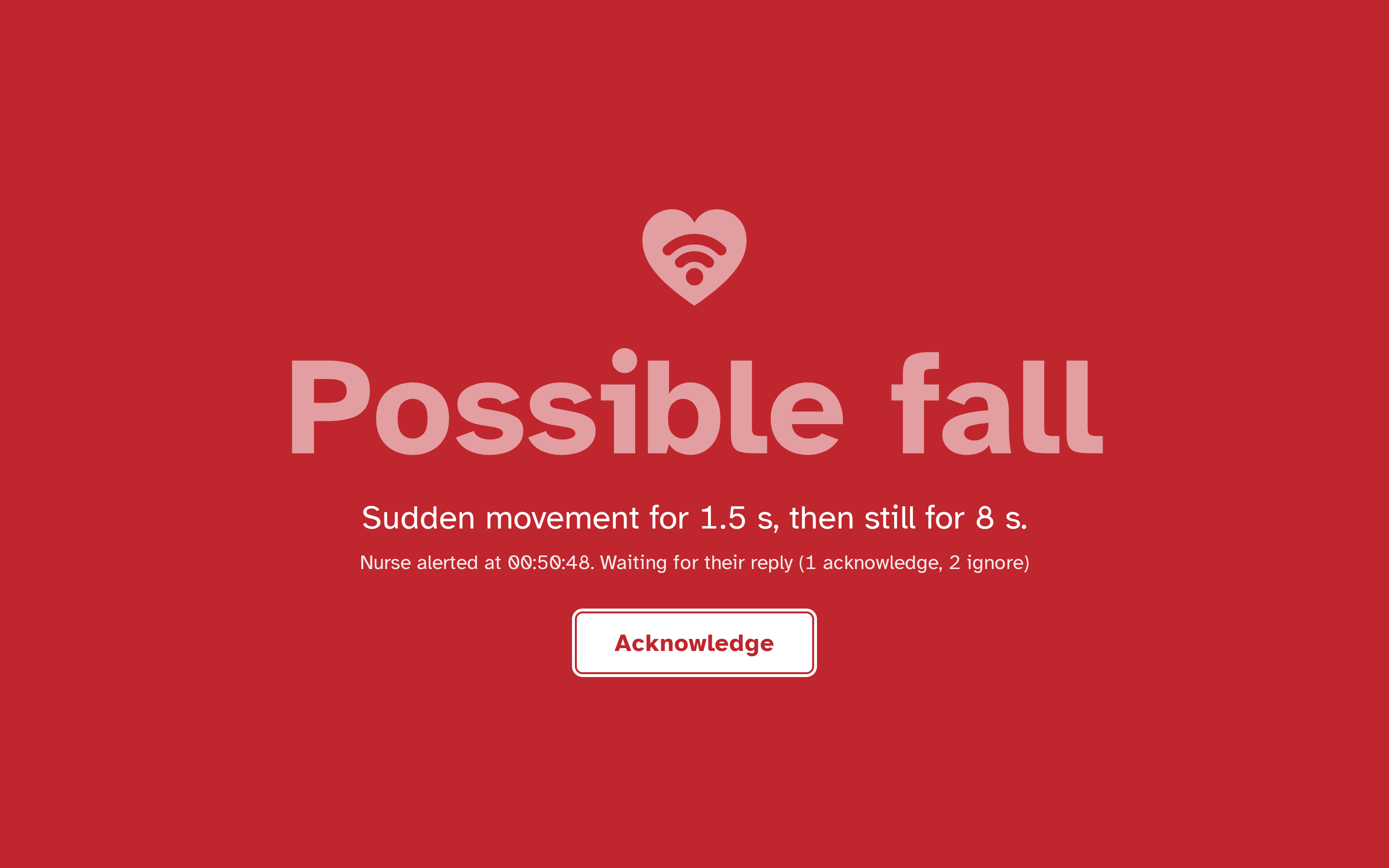
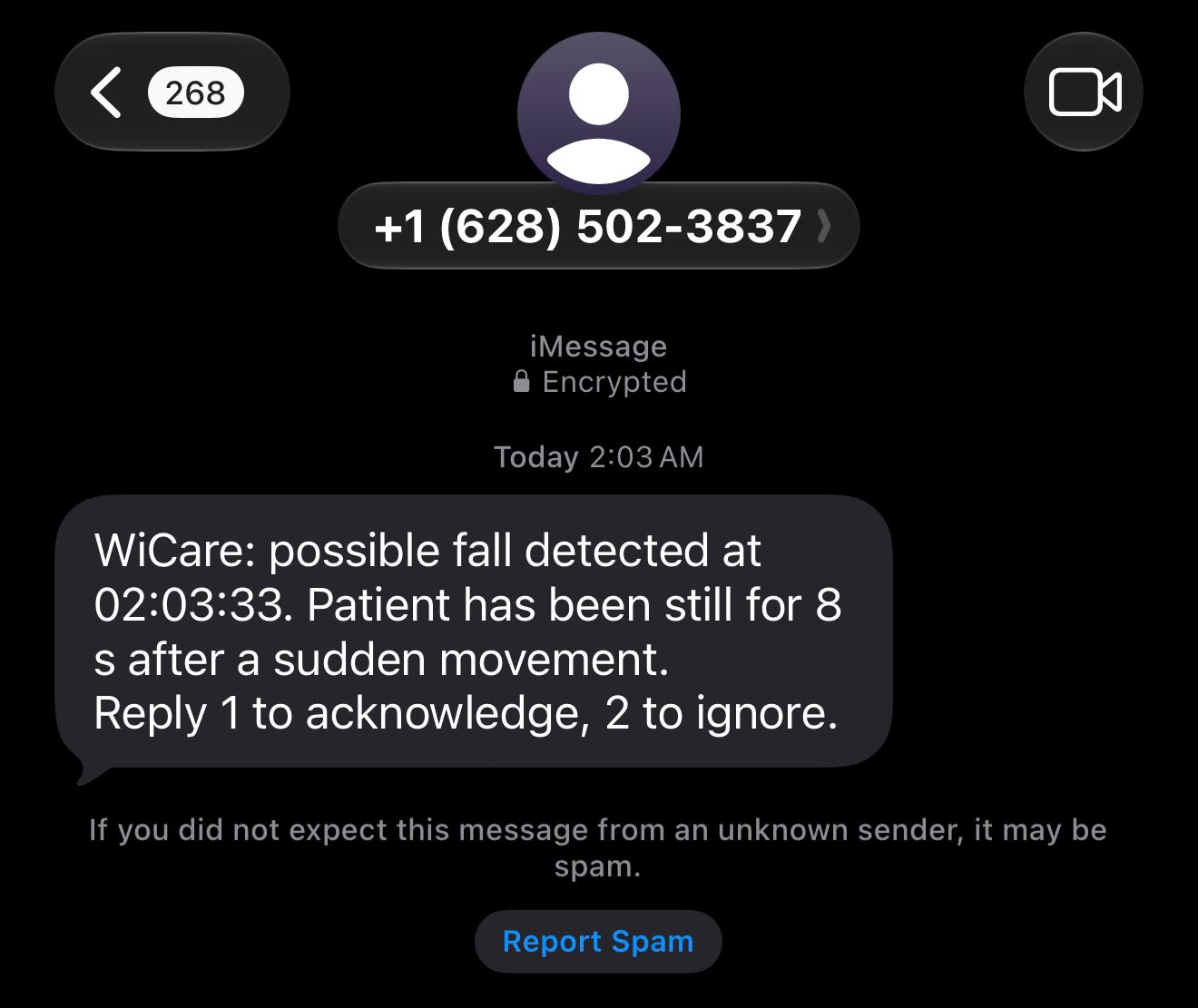
- The nurse receives a notification about the unusual activity.
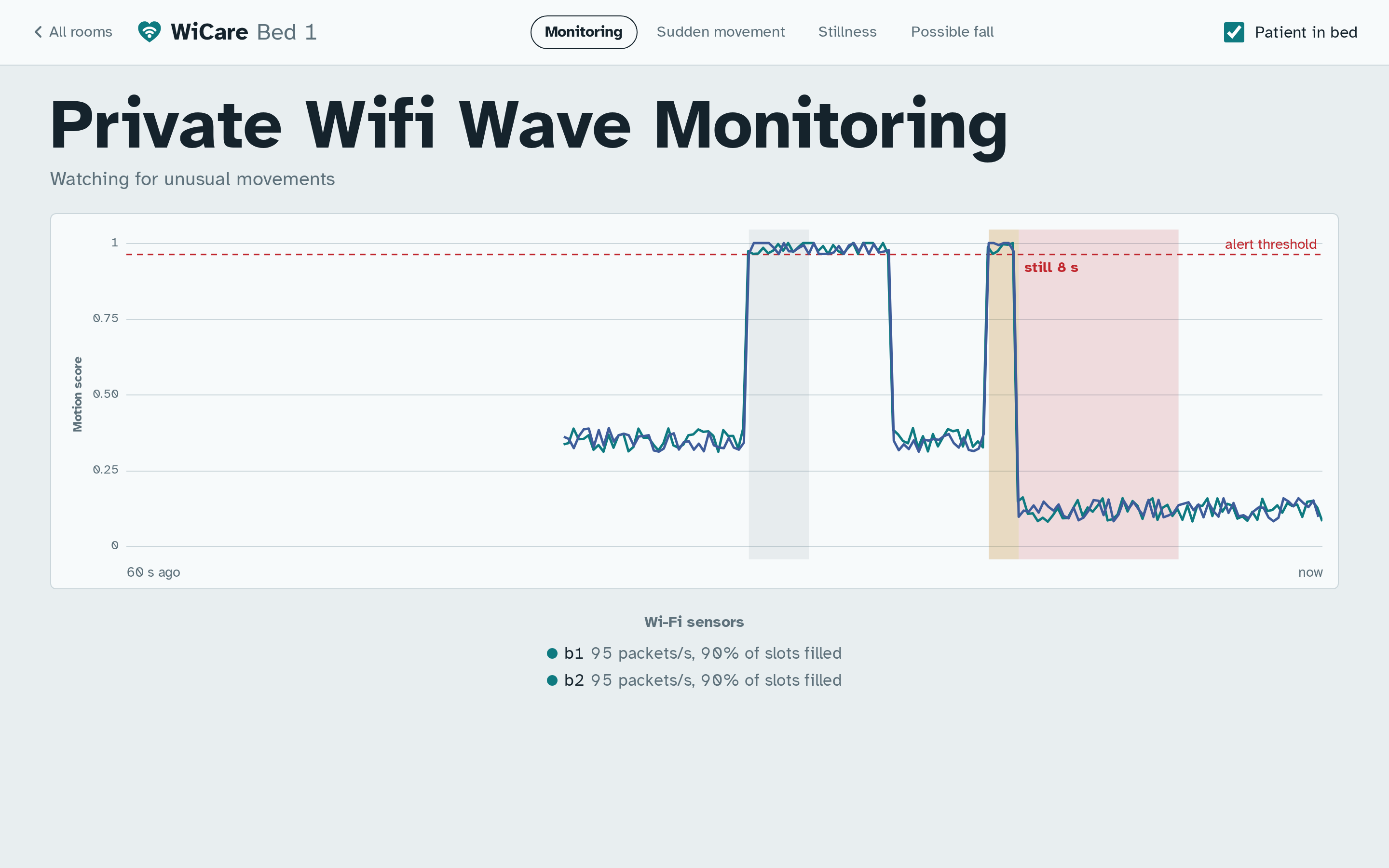
- Caregivers can investigate the event and understand why the alert was triggered.
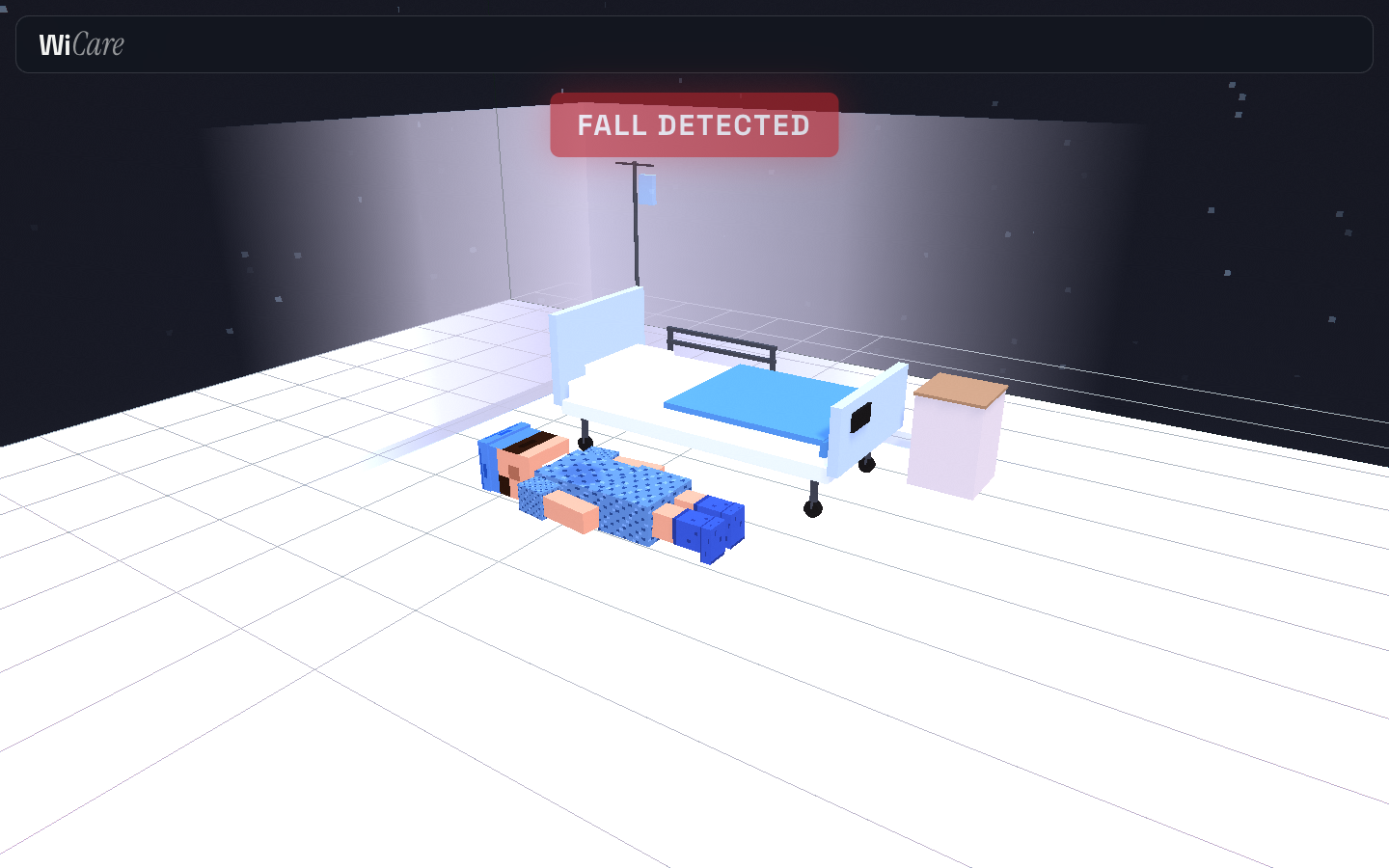
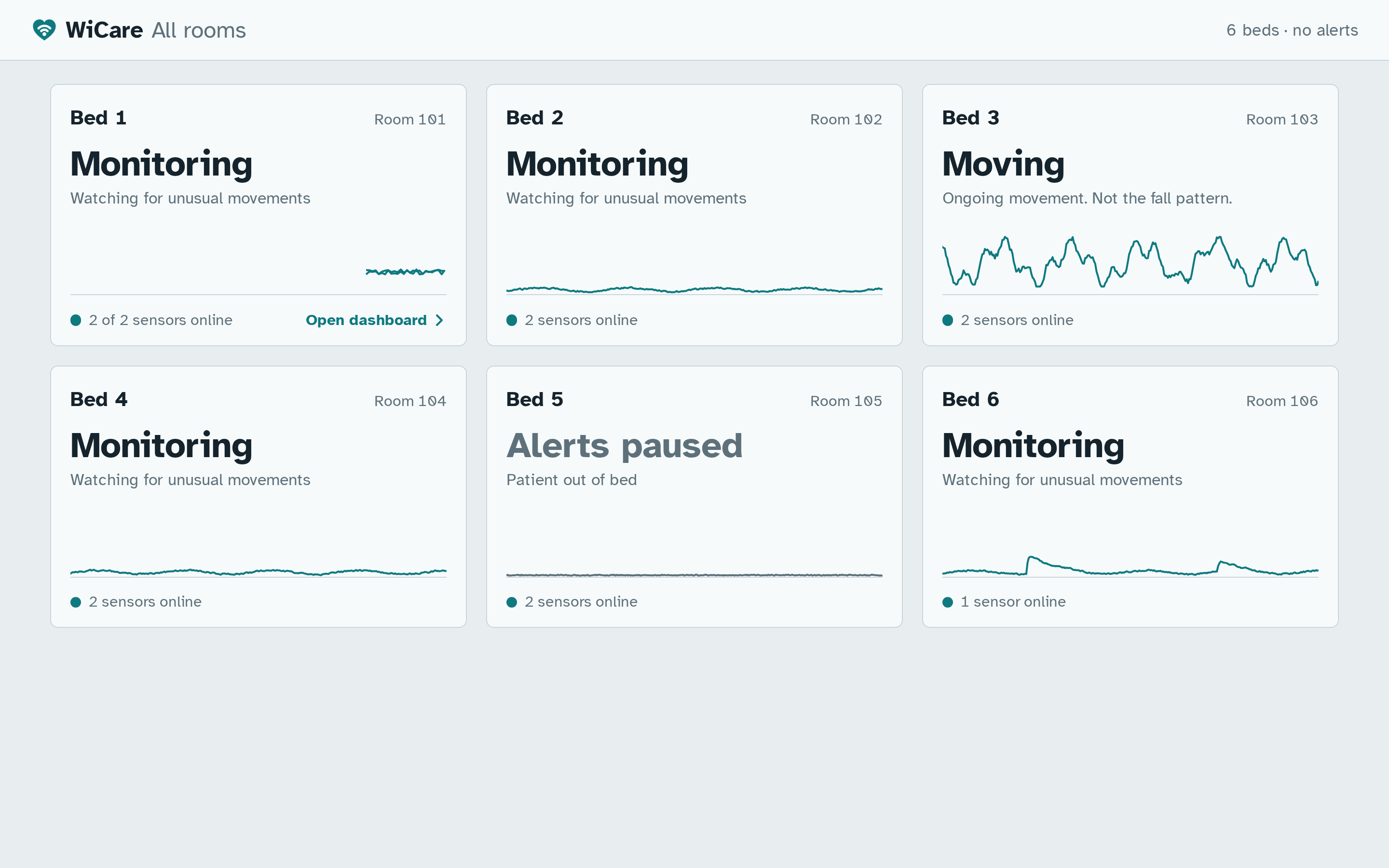
Our interactive 3D ward interface allows nurses to monitor room status while keeping patient rooms visually private during routine monitoring.
WiCare brings together patient safety, privacy, and intelligent care coordination.
How we built it
Hardware: We leveraged existing Wi-Fi infrastructure, including ordinary ISP-provided Wi-Fi networks, using two low-cost wireless sensing modules (ESP32) to capture Wi-Fi Channel State Information (CSI). Human movement changes how wireless signals propagate through a room, allowing us to detect activity without capturing images.
Machine Learning: We trained a Random Forest classifier with 400 decision trees using Wi-Fi CSI data collected from our own physical environment. Our model processes three-second windows and extracts 18 features per sensor, including signal variability, movement intensity, frequency-domain characteristics, and deviations from an empty-room baseline.
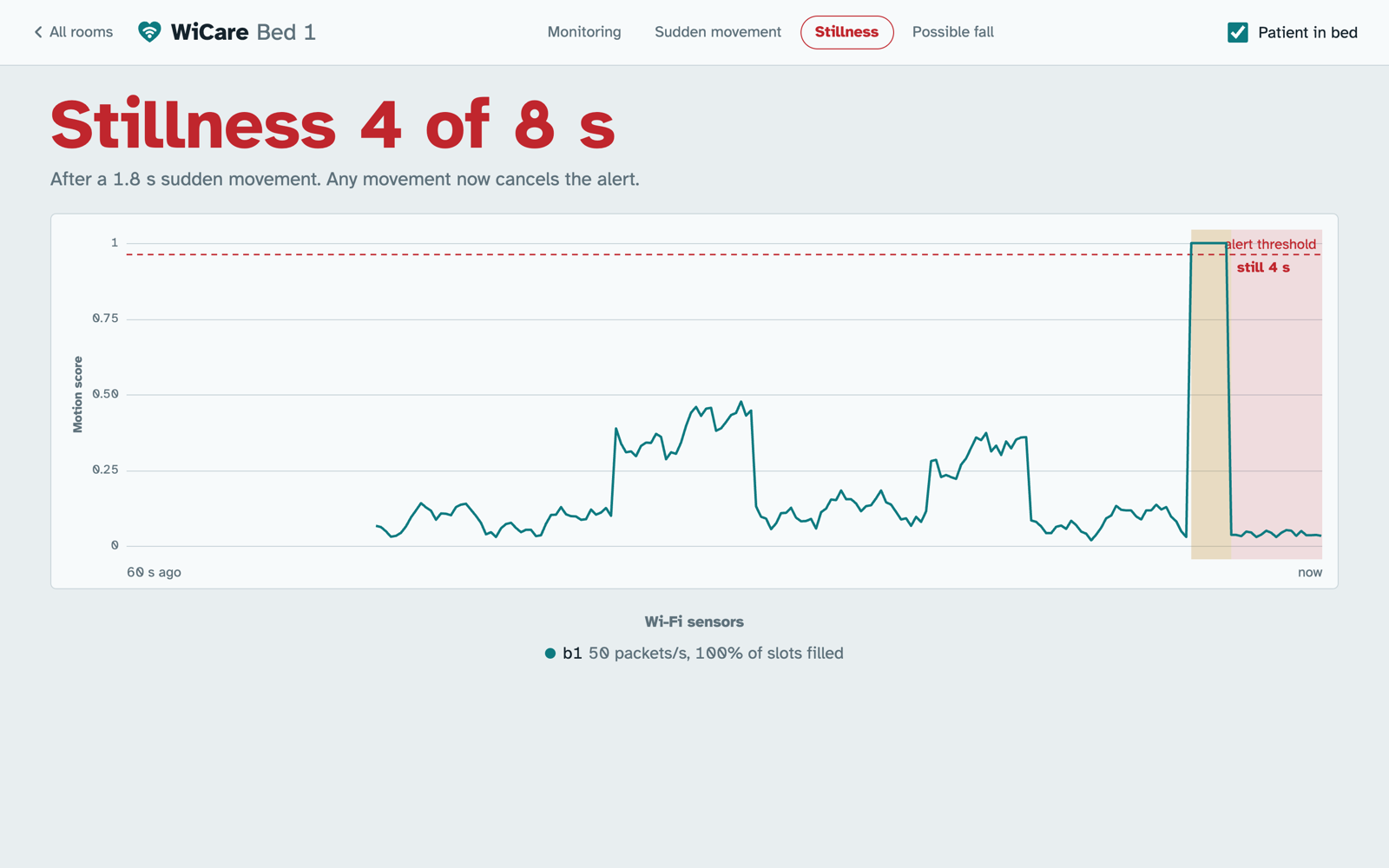
By combining features from both sensors, the model learns to distinguish occupancy and movement states. We also implemented temporal analysis to identify potential fall-like events based on sudden movement followed by sustained stillness.
Backend: We built our backend using Python, FastAPI, and SQLite to manage sensor observations, events, patient check-ins, and investigations.
Photon: We integrated Photon 2.0 and iMessage to enable real-time, two-way communication between patients and nurses, including automated check-ins, response handling, and escalation.
Visualization: We developed an interactive 3D ward interface using Three.js, allowing caregivers to visualize room status and investigate alerts while prioritizing patient privacy.
Challenges we ran into
Our biggest challenge was the unpredictability of real-world Wi-Fi signals. Room geometry, sensor placement, packet loss, and nearby movement all influence the measurements.
We discovered that models trained on public datasets did not generalize reliably to our physical environment. This motivated us to collect our own data and train a room-specific model.
Differentiating falls from ordinary movements, such as quickly sitting down, was another significant challenge. We addressed this through multiple sensing viewpoints, temporal analysis, and patient confirmation rather than relying on a single prediction.
Accomplishments that we're proud of
- Transforming ordinary Wi-Fi into a contactless patient monitoring system without cameras or wearables.
- Training our own machine learning model on locally collected Wi-Fi CSI data.
- Developing a complete pipeline from physical movement detection to patient and nurse communication.
- Integrating Photon for interactive patient check-ins and caregiver notifications.
- Creating a privacy-conscious 3D ward monitoring interface.
We're especially proud of transforming invisible wireless signals into meaningful information that can support patient care.
What we learned
We learned that building a machine learning model is only one part of solving a real-world problem. Making it work reliably with existing wireless infrastructure is equally important.
Through WiCare, we gained experience in wireless sensing, signal processing, feature engineering, machine learning, and real-time communication.
Most importantly, we learned that healthcare technology must balance intelligence with reliability, privacy, and human oversight.
What's next for WiCare
We envision WiCare becoming an additional layer of patient safety across hospitals, assisted-living facilities, and independent-living environments.
Our next steps include:
- Improving fall classification through more diverse training data.
- Making the system robust across different rooms, Wi-Fi environments, and multiple people.
- Expanding the ward interface to support hospital-scale monitoring.
- Developing real-time activity visualization from Wi-Fi signals.
- Conducting further validation in realistic healthcare environments.
WiCare — Invisible sensing. Visible care.
Using Wi-Fi waves for private, contactless patient fall detection.
Built With
- channel-state-information
- cloudflare
- css
- esp32
- espectre
- fastapi
- html
- imessage
- javascript
- machine-learning
- numpy
- pandas
- photon
- pydantic
- python
- random-forest
- ruview
- scikit-learn
- scipy
- signal-processing
- sqlite
- three.js
- uvicorn
- webhooks
- wi-fi


