Inspiration
Most startup ideas die in silence—founders get polite feedback that doesn't reveal fatal flaws until it's too late. We wanted to build something that gives YC-style brutal honesty at scale, combining the grilling intensity of investor due diligence with the speed of AI. The terminal hacker aesthetic emerged naturally: if we're going to "roast" ideas, why not make it feel like a command-line tool that ruthlessly evaluates your startup pitch? Perfect for hackathons where founders need fast, actionable feedback, and for investors who want to quickly screen deals.
What it does
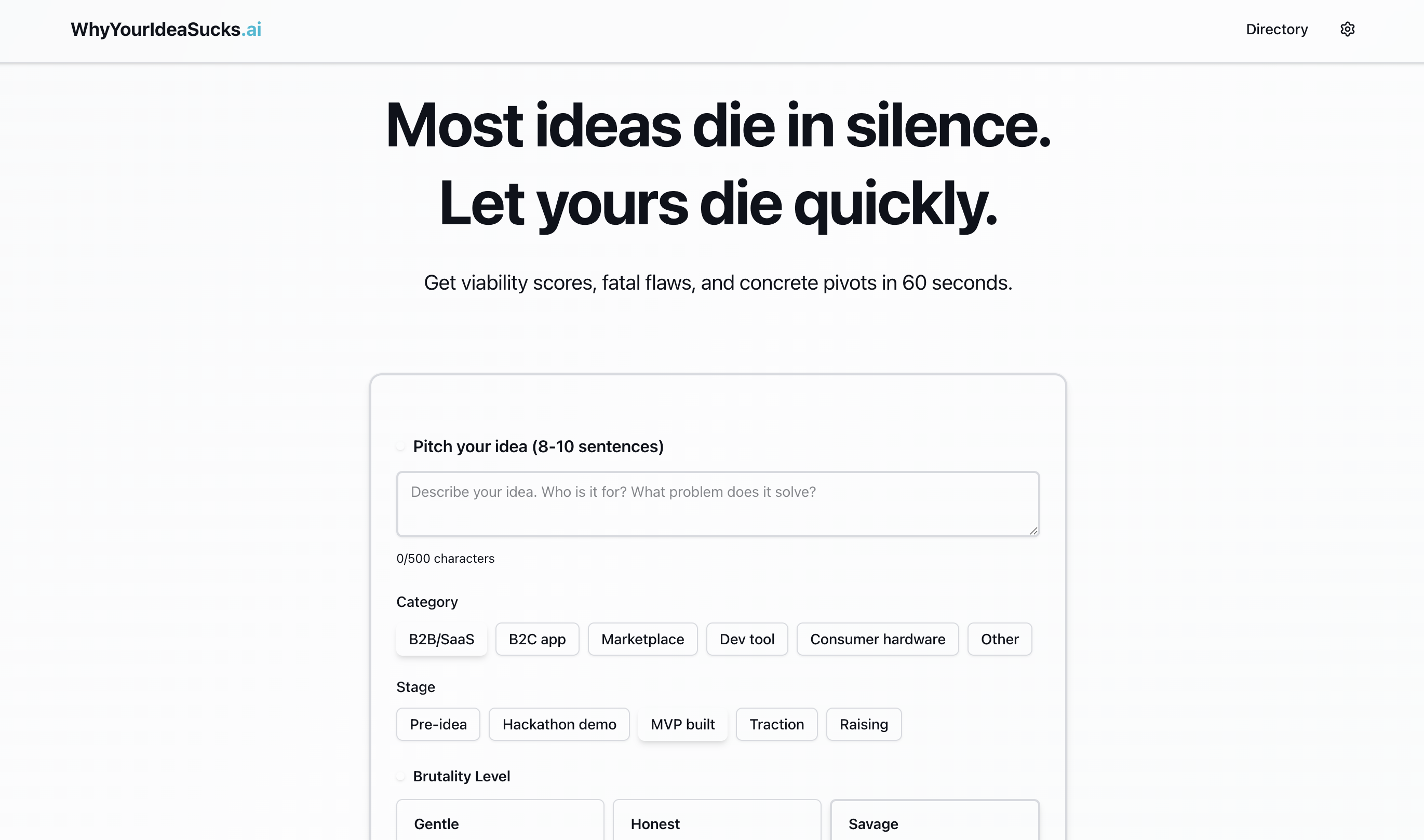
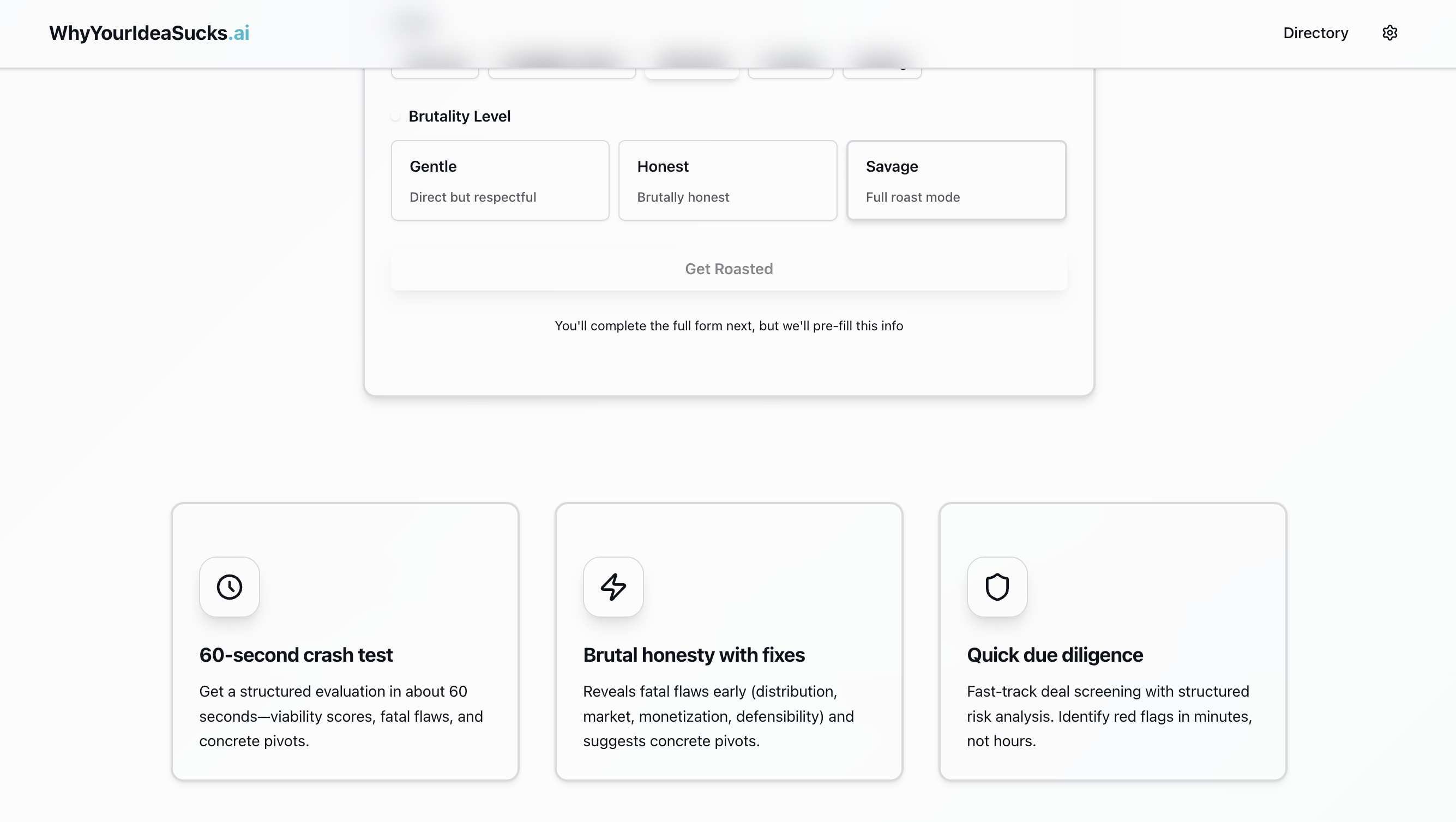
WhyYourIdeaSucks.ai is an AI-powered startup idea crash test that delivers brutal, structured feedback in 60 seconds. Users submit their idea (via quick form or detailed multi-step questionnaire), and the system orchestrates 8 specialized AI agents to evaluate 6 core dimensions: Market, Distribution, Monetization, Defensibility, Founder Fit, and Hackathon Feasibility. Each agent uses native tool calling to fetch real competitor data, pricing benchmarks, and market insights. The output is a comprehensive roast report with scores, "why it sucks" critiques, actionable fixes, suggested pivots, risk warnings, and concrete validation steps—all tuned to your chosen brutality level (Gentle/Honest/Savage).
How we built it
Architecture: Built on Next.js 16 (App Router) with Convex as the backend for real-time data and serverless functions. The frontend uses TypeScript, Tailwind CSS, and shadcn/ui components styled with a terminal hacker theme (Geist Mono font, green-on-black palette).
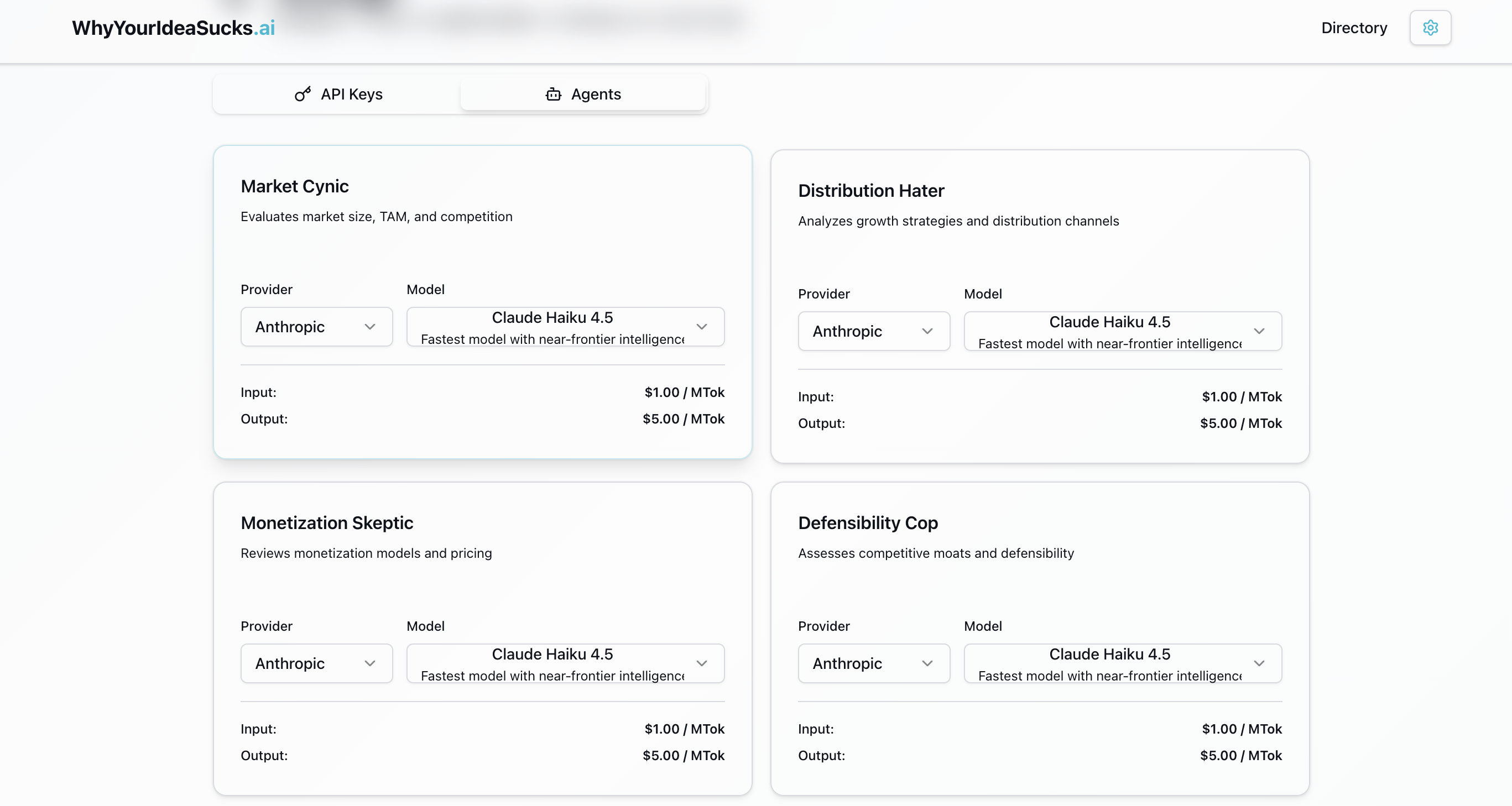
AI System: The core innovation is a multi-agent orchestration system. We built 6 specialized "roaster" agents (Market Cynic, Distribution Hater, Monetization Skeptic, Defensibility Cop, Founder Fit Analyst, Hackathon Reality Check), plus a Mentor agent and a Fix Generator synthesis agent. Each agent uses native LLM tool calling—OpenAI Agents SDK for GPT models and Anthropic SDK for Claude—to fetch real-world data via web search, competitor lookup, and pricing benchmark tools.
Key Technical Decisions:
- Client-side API key management: API keys stored in localStorage, allowing users to bring their own keys without server-side storage
- Per-agent model configuration: Each agent can independently use OpenAI or Anthropic with different models (default: Haiku for roasters, Sonnet for synthesis)
- Parallel agent execution: All roaster agents run concurrently for speed
- Terminal UI theme: Custom CSS with monospace typography and terminal-style borders to match the "brutal honesty" brand
Challenges we ran into
Multi-agent orchestration: Coordinating 8 agents with different prompts, tool requirements, and output formats while maintaining consistent structure. We solved this with a shared base agent class and type-safe output schemas.
Native tool calling: Implementing tool calling with both OpenAI and Anthropic SDKs required different approaches—OpenAI uses Agents SDK with built-in tool execution, while Anthropic requires manual tool result handling. We abstracted this into a unified interface.
Balancing brutality with actionability: Making feedback brutally honest without being demotivating. The brutality meter (Gentle/Honest/Savage) tunes tone while preserving substance, and the Mentor agent provides constructive pivots alongside critiques.
Client-side API key security: Storing API keys in localStorage is convenient but requires careful UX to prevent accidental exposure. We built a settings page with clear warnings and validation.
Performance optimization: Running 8 agents sequentially would take too long. We parallelized roaster agents and optimized prompt lengths to keep total evaluation time under 60 seconds.
Accomplishments that we're proud of
- Working multi-agent system: Successfully orchestrated 8 specialized AI agents with native tool calling, producing coherent, structured evaluations
- Real-world data integration: Agents fetch actual competitor data, pricing benchmarks, and market insights to ground critiques in reality
- Unique brand identity: Terminal hacker aesthetic perfectly matches the "brutal honesty" positioning—users immediately understand what they're getting
- Fast evaluation: Complete roast reports in ~60 seconds, making it practical for hackathon demos and quick idea validation
- Flexible configuration: Per-agent model/provider selection allows users to optimize for cost, speed, or quality
- "Roast my Pivot" feature: Instant re-evaluation of improved ideas creates a feedback loop that helps founders iterate quickly
What we learned
- Multi-agent design patterns: How to structure specialized agents with shared base logic, type-safe outputs, and parallel execution
- Native tool calling: Deep dive into OpenAI Agents SDK and Anthropic SDK differences—OpenAI's agentic approach vs Anthropic's explicit tool handling
- Prompt engineering at scale: Managing 8 different agent prompts while maintaining consistency and avoiding prompt injection
- Client-side API key patterns: Building secure, user-friendly API key management without server-side storage
- Terminal UI design: Creating a cohesive terminal aesthetic with CSS (monospace fonts, green-on-black, terminal borders) that feels authentic without being gimmicky
- Convex serverless architecture: Leveraging Convex actions for long-running AI operations and real-time data updates
What's next for WhyYourIdeaSucks
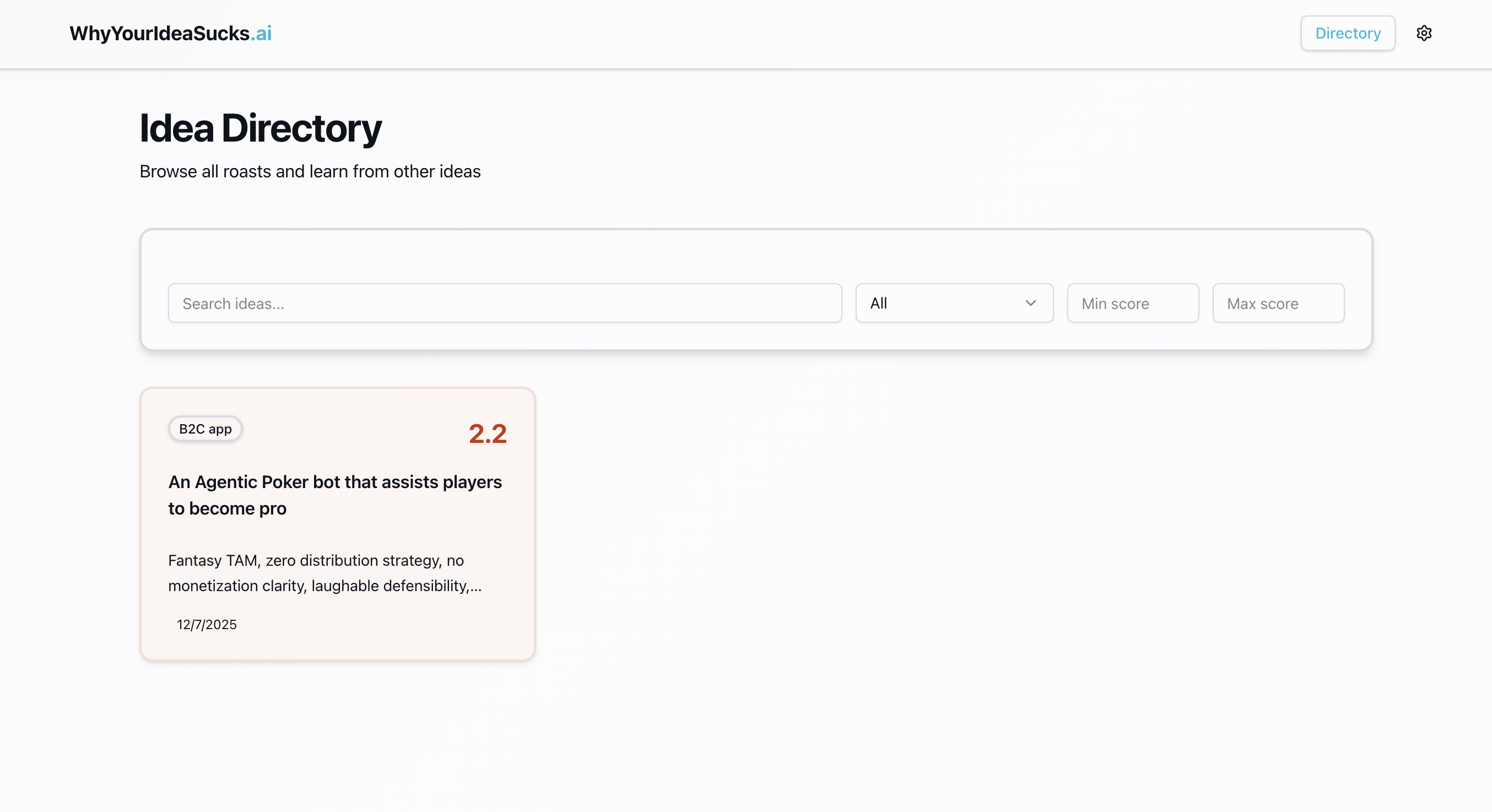
- Search similar failed ideas: Database of past roasts to help users find similar ideas that failed or lost in previous hackathons
- Enhanced tool use: Expand web search capabilities, add more pricing benchmarks, and integrate market research APIs
- Synthesis agent refinement: Self-review and refinement loop to improve output quality without adding more agents
- Investor dashboard: Batch evaluation mode for VCs to quickly screen multiple deals with structured risk analysis
- Community features: Public idea directory with voting, comments, and "most roasted" leaderboards
- Export enhancements: PDF export with customizable branding, shareable roast links with analytics
- API access: Public API for developers to integrate roast evaluations into their own tools
Built With
- claude
- convex
- nextjs
- openai
- typescript


Log in or sign up for Devpost to join the conversation.