-
-
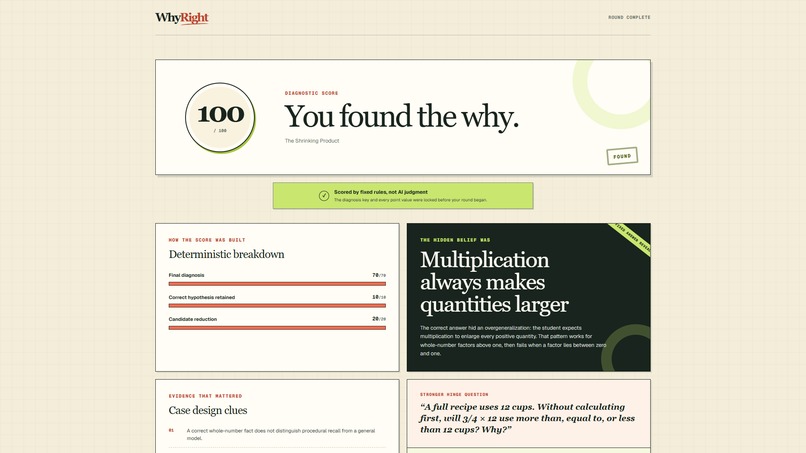
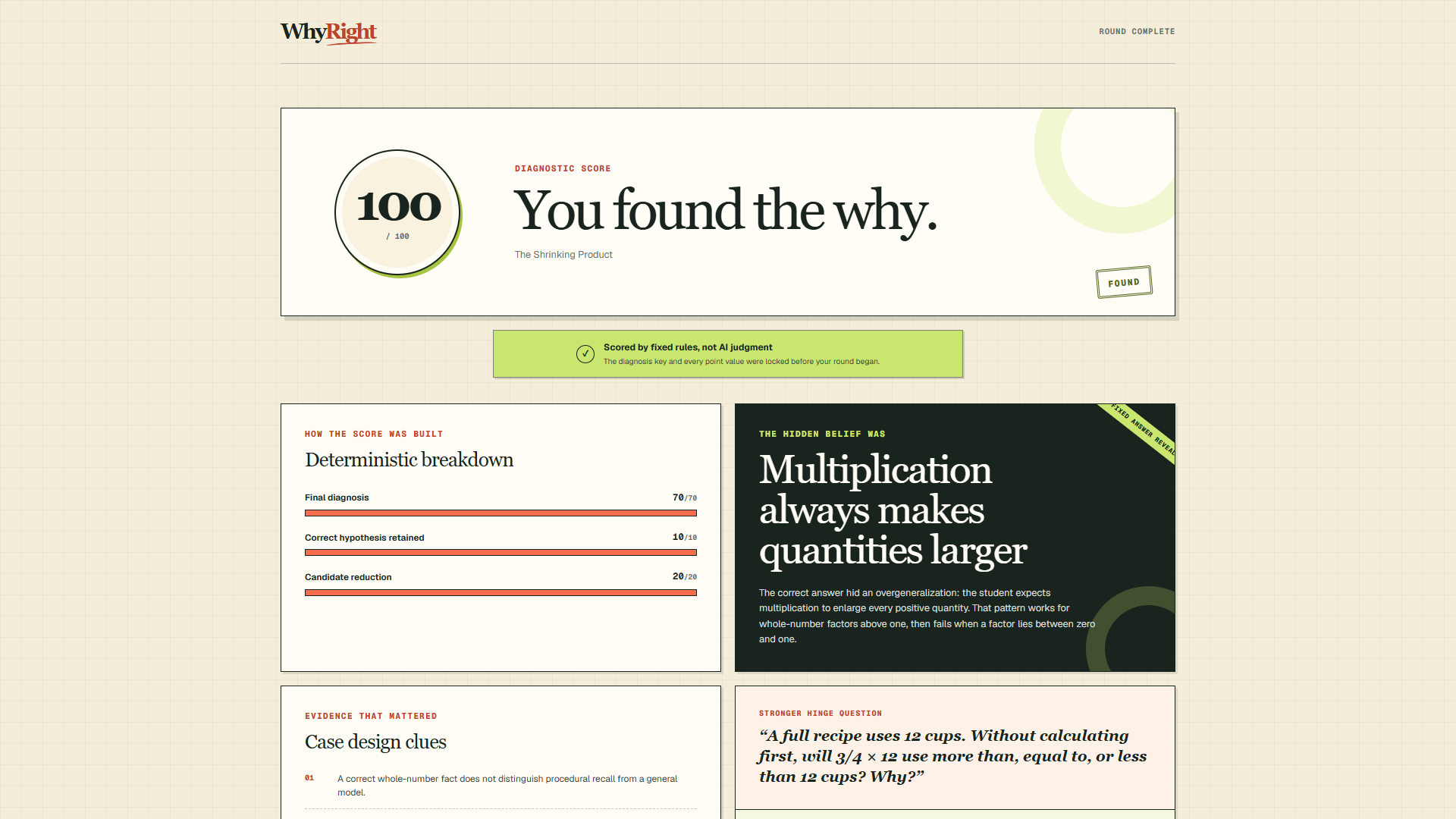
An actual 100/100 result with the deterministic 70/10/20 breakdown and fixed-answer reveal.
-
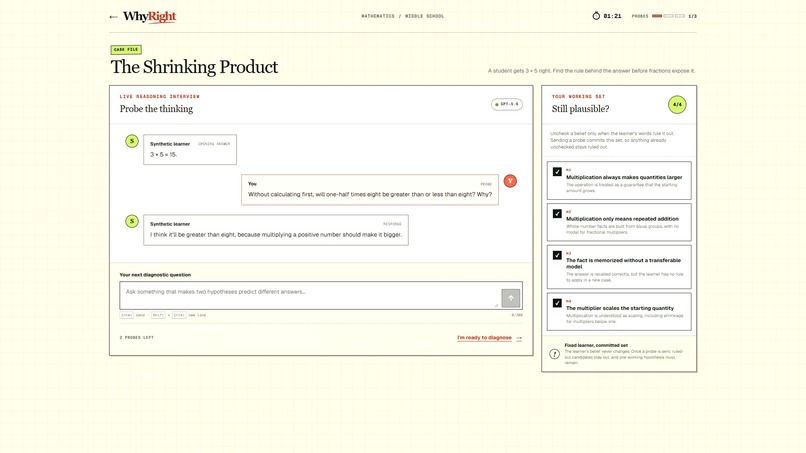
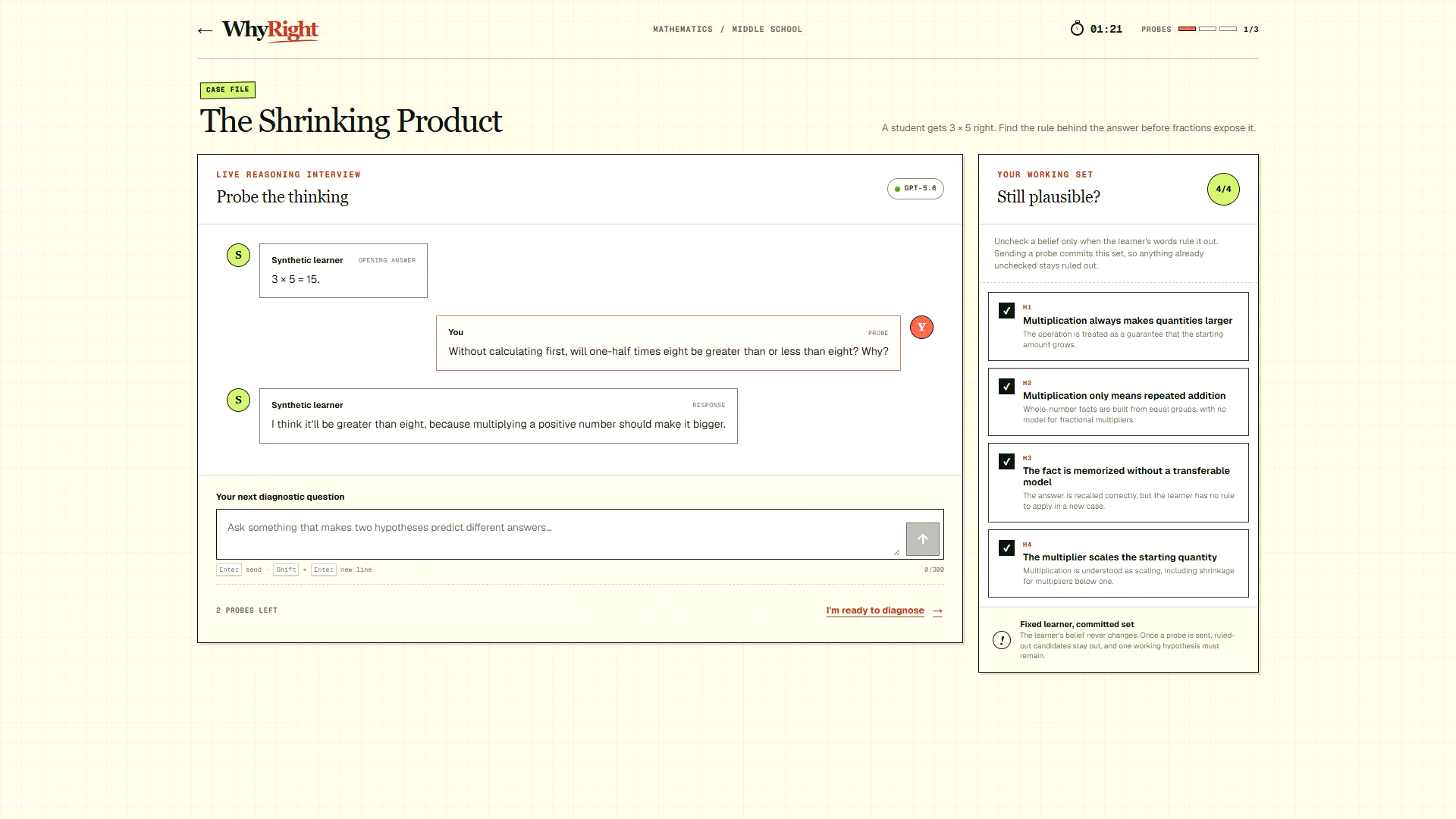
A real GPT-5.6 learner response to a diagnostic fraction hinge question.
-
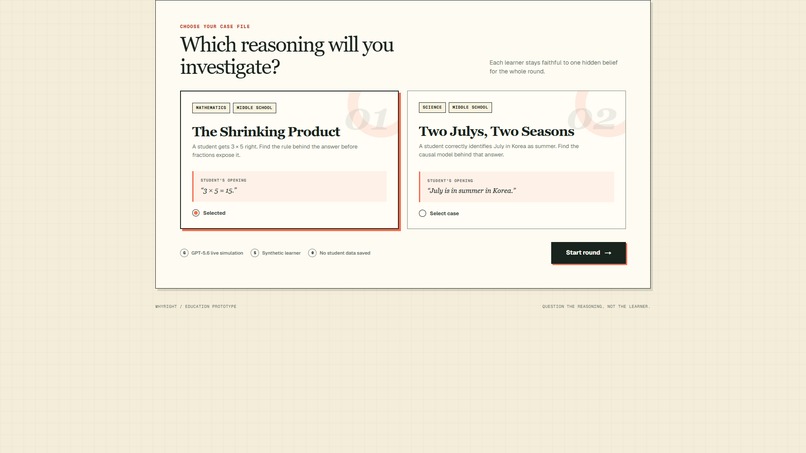
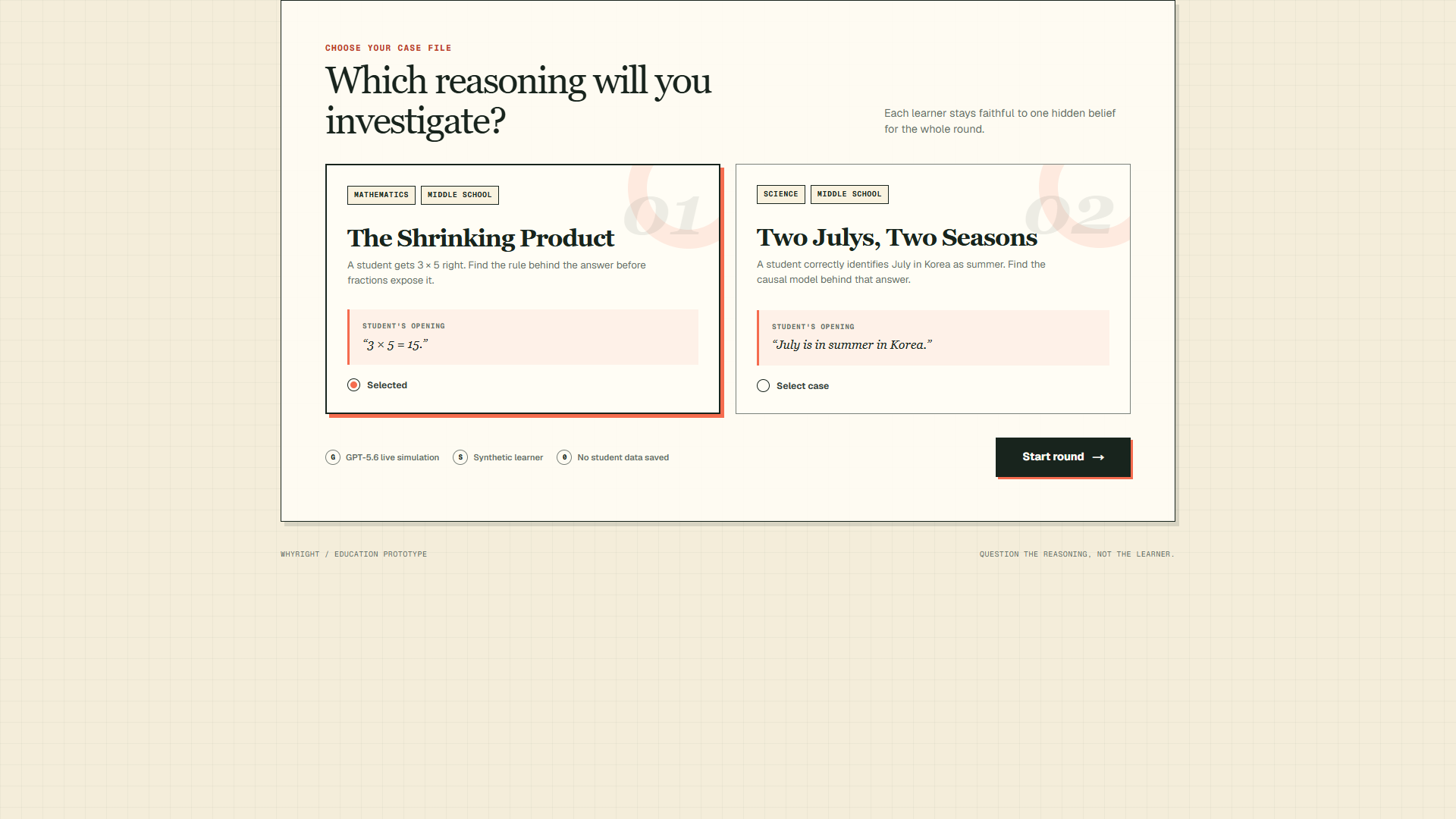
Choose between two fixed synthetic Education scenarios under a 90-second, three-probe product contract.
Inspiration
A correct classroom answer is not the same as correct reasoning. A learner can recall a fact, follow a familiar pattern, or match a calendar label while carrying a mental model that fails on the next boundary case. Teachers need practice asking questions that make competing explanations predict different answers, but that practice is difficult to deliver repeatedly with static multiple-choice exercises.
WhyRight turns diagnostic questioning into a short, replayable investigation. Its goal is not to evaluate real students. It gives educators a safe synthetic space to practice identifying the model behind an answer.
What it does
- The educator chooses one of two fixed synthetic scenarios: fraction multiplication or seasons across hemispheres.
- A fictional learner starts with a correct answer while holding one private, immutable misconception.
- The educator asks up to three open-ended diagnostic questions in 90 seconds.
- GPT-5.6 responds as that learner while remaining constrained to the fixed belief.
- After each response, the educator updates which of four candidate mental models remain plausible.
- The educator locks a final diagnosis.
- Deterministic TypeScript scores the exact diagnosis (70 points), preserving the true candidate throughout the evidence history (10 points), and reducing wrong candidates (up to 20 points).
- The result reveals the fixed answer and offers a stronger hinge question and transfer prompt.
How we built it
WhyRight is a responsive Next.js application with three server routes for session creation, live turns, and diagnosis. The live student simulator uses the OpenAI Responses API with GPT-5.6 and Structured Outputs. The model is limited to two fields: student_reply and a small response_mode enum.
The hidden misconception, answer key, candidate labels, and scoring rules are fixed application data co-designed with Codex. Session state is sealed in a short-lived, authenticated AES-256-GCM token, so the browser cannot read the hidden belief or tamper with the server-trusted transcript and candidate history encoded in the token. The server validates question length, turn count, candidate monotonicity, token integrity, diagnosis readiness, and model output before returning a reply. The score path never calls GPT.
GPT-5.6 is essential because static branching can only recognize questions the author predicted. The core challenge is responding naturally to a teacher's unpredictable free-form probe while preserving a counterfactual belief across turns. Structured Outputs keeps the integration narrow and machine-checkable, while the application's fixed state and rules prevent the model from inventing the grading target.
How I used Codex
Codex accelerated the project from concept selection to a working application. It helped inspect the contest requirements, compare product directions, translate the chosen concept into API and state boundaries, implement the Next.js experience, build validation and tests, run adversarial reviews, and prepare submission documentation.
As the human entrant, I directed a separate new submission and autonomous implementation, set the submission schedule, provided API access, and retain final submission responsibility. Codex proposed the WhyRight concept and Education framing; drafted the scenarios, candidate sets, and evaluation fixtures; designed and implemented the application; ran adversarial reviews; and prepared the submission package. GPT-5.6 powers the fictional learner at runtime, but neither Codex nor GPT-5.6 is the judge.
Challenges we ran into
- Keeping role-play and grading separate. The convenient design would let the same model reveal and judge its own misconception. We kept the answer key and score outside GPT, at the cost of more explicit state and validation logic.
- Preserving one belief under pressure. Generic correction and prompt injection can make a model abandon or disclose its role. The simulator uses a strict immutable-belief contract, protected-disclosure checks, and a fixed probe suite for regression review.
- Making evidence collection meaningful. Candidate removal is monotonic: once evidence rules a hypothesis out and a turn is committed, it cannot be restored. This makes the score reflect the educator's actual reasoning path.
- Building a credible product in a short window. We limited the MVP to two fixed scenarios, no accounts, and no database rather than presenting a broad but untestable content-generation platform.
Accomplishments that we're proud of
- A complete English-first game flow from case selection through a live GPT-5.6 interview to a transparent result screen.
- A scoring path that is reproducible and independent of model wording.
- Authenticated, short-lived encrypted session state without collecting real learner records.
- Two distinct scenarios that test transfer beyond rote correct answers.
- Seven automated test files with 25 passing tests, plus lint, strict type checking, and a production build.
- A separate eight-probe faithfulness regression suite with fixed expectations covering targeted, misaligned, generic, and prompt-injection questions.
- A responsive and accessible interface that exposes the hypotheses, evidence updates, live model boundary, and score provenance instead of hiding them behind a chat box.
What we learned
An educational simulation needs two contracts, not one. The generative contract asks whether the learner reply is plausible and faithful. The assessment contract asks whether the educator's diagnosis matches a fixed key. Combining those contracts makes the experience harder to audit and easier to game.
We also learned that diagnostic questions are strongest when two hypotheses predict visibly different answers. “Explain again” often produces more words; a carefully chosen boundary case produces evidence.
Responsible AI and privacy
- All learners, answers, and classroom situations in this MVP are fictional and synthetic.
- The application does not ask for names, student records, grades, or login details, and it is not a tool for high-stakes student evaluation.
- The hidden belief is fixed by the product contract and immutable during a round.
- GPT-5.6 generates only the fictional learner's reply and response mode; it cannot change the answer key or award points.
- Server-side validation blocks protected-label disclosure and rejects malformed model output.
- Session state expires after 15 minutes and is encrypted and authenticated.
- The server stops accepting new probes when the 90-second round ends.
- The visible score is a practice-game result. The stateless MVP does not use a shared one-time-token store, so deliberate replay by a custom API client is a documented limitation rather than a security claim.
- The prototype has not been piloted with real teachers or students, and it makes no claim of measured learning improvement or classroom impact.
Testing
The repository contains 25 automated checks across seven test files for scenario integrity, score determinism, candidate-history validation, encrypted token confidentiality, tamper rejection, expiration, diagnosis readiness, body-size enforcement, rate limiting, and request-boundary validation. Lint, strict type checking, a production build, and GitHub Actions all pass.
Model behavior is evaluated separately with eight fixed probes: one targeted, one misaligned, one generic, and one prompt-injection probe for each scenario. Every probe has a predefined review expectation and transparent include/exclude signals. The final fixture 1.1.1 run passed 8/8 single-turn automatic signal checks with the API-reported gpt-5.6-sol model. The runner preserves every raw reply for manual review and does not use a model to grade itself. This small suite is regression evidence, not a claim of general model safety or educational effectiveness.
The production app was verified on desktop and mobile. Both scenarios completed live GPT-5.6 turns and deterministic scoring without browser errors.
What's next
Next we would co-design more scenarios with experienced teachers, add teacher-authored but reviewed case templates, and study whether repeated rounds improve the quality of real hinge questions. We would also expand the faithfulness suite, add run-to-run stability reporting, support accessible localization, and move short-lived state to managed infrastructure if the prototype grows beyond a single-session demo.
Any classroom study would require informed consent, careful privacy review, and outcome measures defined before collecting data. The current project remains a synthetic training prototype.
## How we built it

## Challenges we ran into

## Accomplishments that we're proud of

## What we learned

## What's next for WhyRight
Built With
- api
- codex
- gpt-5.6
- next.js
- node.js
- openai
- outputs
- react
- responses
- structured
- typescript
- vercel
- vitest
- zod

Log in or sign up for Devpost to join the conversation.