-
-
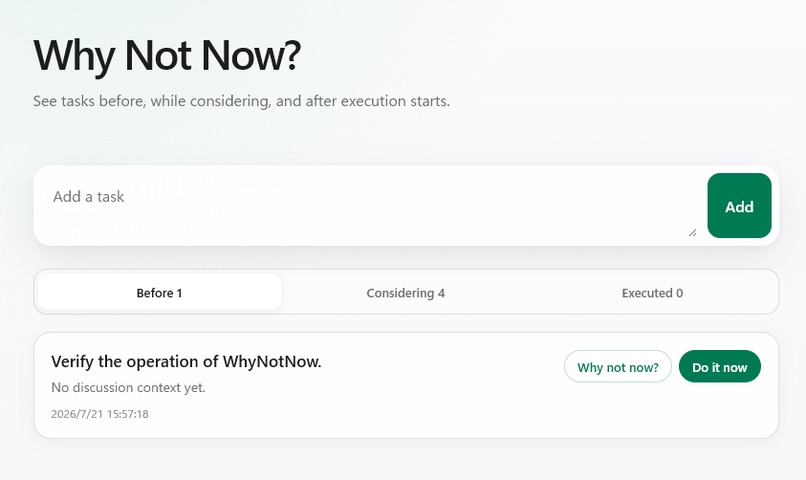
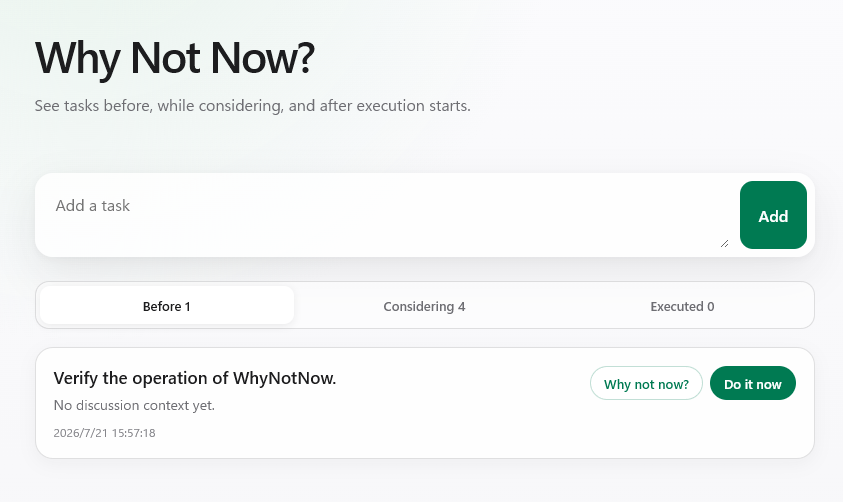
WhyNotNow Dashboard
Inspiration
Many postponed tasks have valid reasons behind them—missing context, unclear value, dependencies, or limited time—but ordinary task lists lose those reasons. We wanted to make “not now” an intentional decision rather than a forgotten item.
What it does
WhyNotNow lets users capture a task, discuss why it should wait with Codex, and later start it with the collected context. Its dashboard uses three states: Before, Considering, and Executed.
How we built it
We built a Codex plugin with a Node.js MCP server, local structured storage, and a lightweight local dashboard. Codex organizes goals, blockers, constraints, and completion conditions; the dashboard handles task states and launches new Codex tasks.
Challenges we ran into
The biggest challenge was ensuring reflection never accidentally became execution. We separated “Why not now?” conversations from “Do it now” execution sessions, so work starts only after an explicit user action. We also had to coordinate the dashboard, persistence, and Codex sessions without exposing internal details.
Accomplishments that we're proud of
We created a focused, privacy-first workflow that keeps all data on the device. It stores useful structured context without retaining full transcripts, credentials, or session links. The three-state flow keeps the experience simple and understandable.
What we learned
We learned that helpful AI should respect intentional delay instead of always pushing toward immediate action. Clear boundaries between reflection, decision-making, and execution make AI assistance safer and more trustworthy.
What's next for WhyNotNow
We plan to refine the reflection experience, improve task review, and explore richer ways to help users recognize when a deferred task is ready to begin—while keeping the product local, private, and deliberately simple.
Built With
- codex
- css
- esbuild
- html
- javascript
- mcp
- node.js
- npm

Log in or sign up for Devpost to join the conversation.