Inspiration
Children ask endless “why?” questions.
- Why do volcanoes erupt?
- Why does it rain?
- Why does lightning happen?
Most educational tools answer these questions with text, videos, or static diagrams.
I wanted to create something different.
Instead of simply giving learners the answer, I wanted them to discover it for themselves by changing the conditions and observing what happens.
That idea became WhyMorph.
What it does
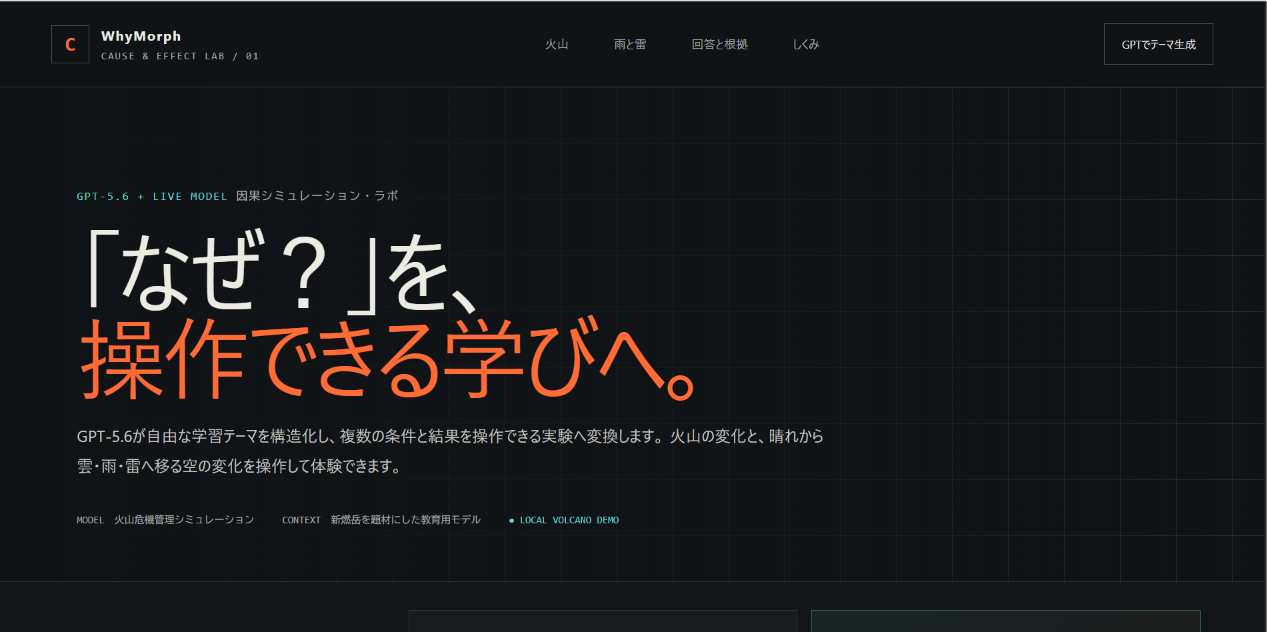
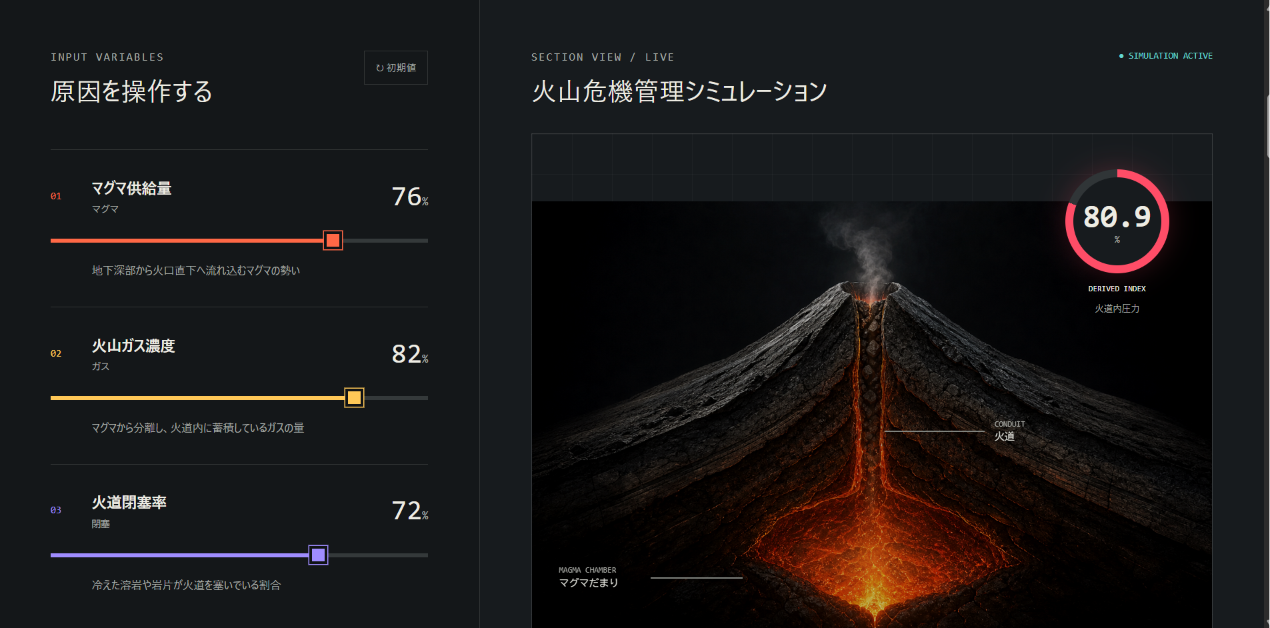
WhyMorph transforms a simple “why?” question into an interactive cause-and-effect learning simulation.
Instead of memorizing explanations, learners manipulate scientific conditions and immediately observe how the results change.
For example, learners can:
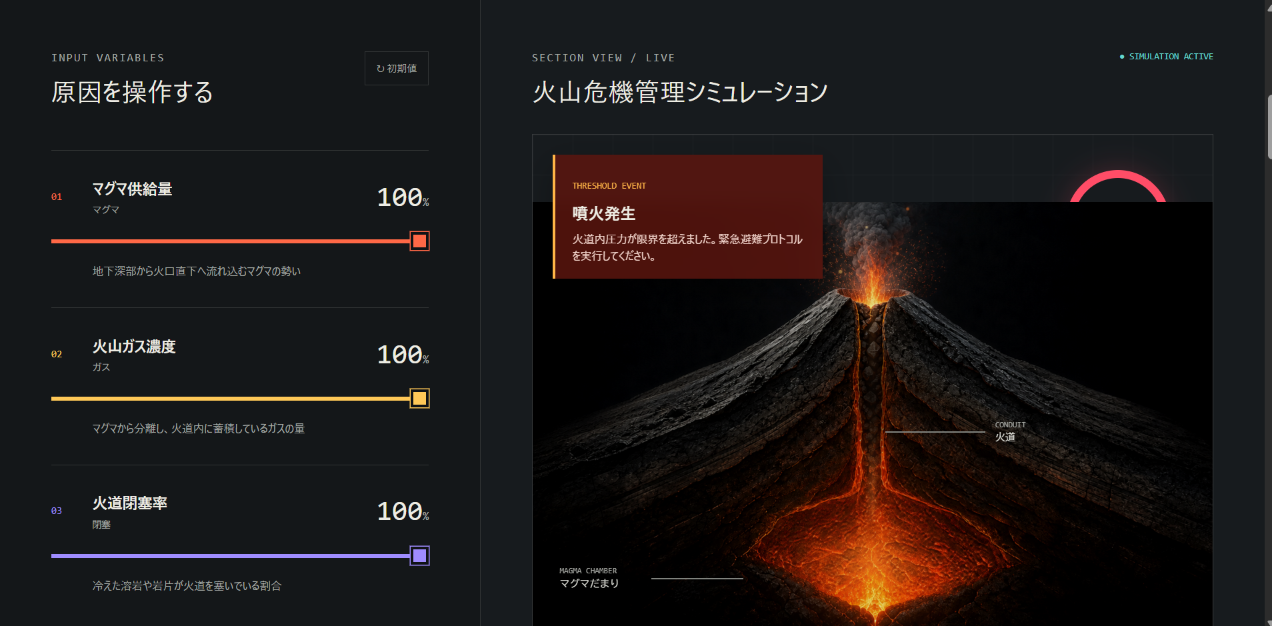
- Adjust magma amount, gas pressure, and vent blockage to understand why volcanoes erupt.
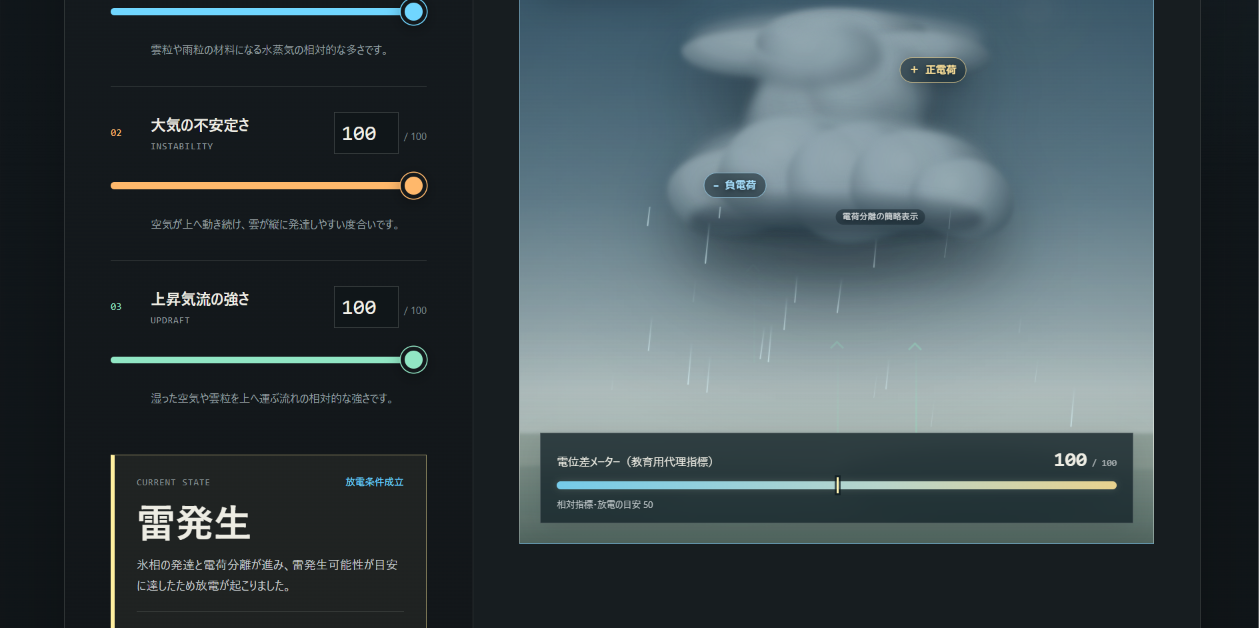
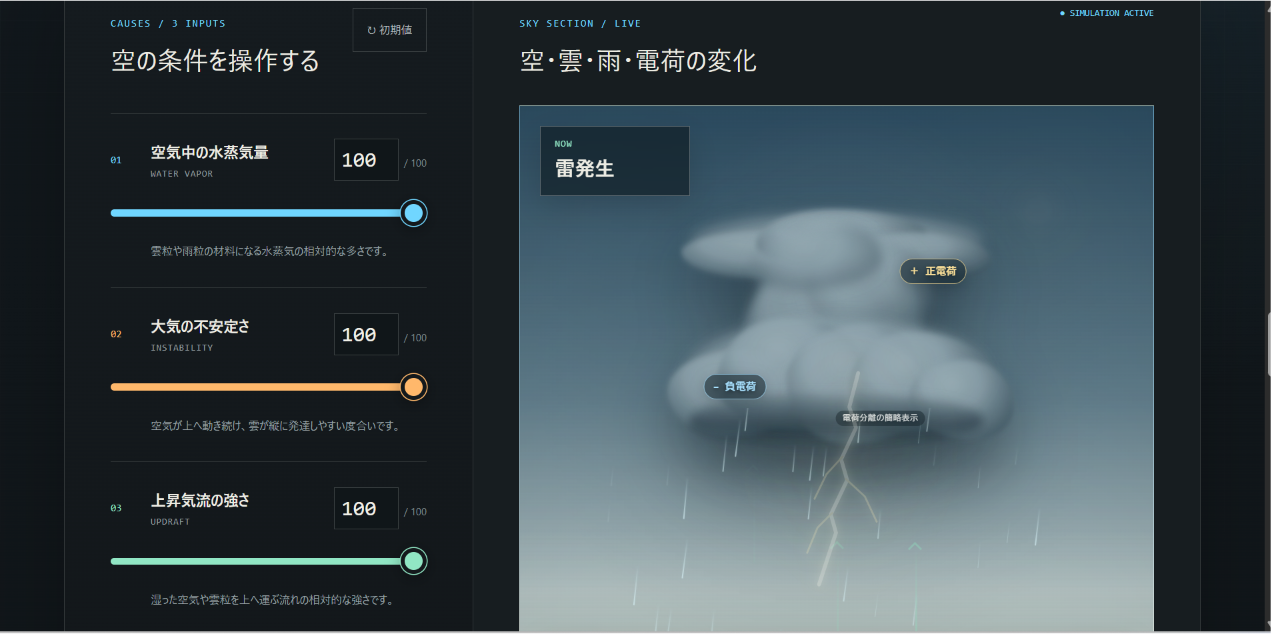
- Change atmospheric moisture, instability, and updraft strength to observe clouds forming, rain beginning, and lightning occurring only when the necessary conditions are met.
Every simulation is built around one important scientific idea:
Natural phenomena rarely happen because of a single cause. They emerge from multiple interacting conditions.
WhyMorph changes learning from:
“Read the answer.”
to:
“Change the causes and discover the answer.”
How I built it
I built WhyMorph using React, TypeScript, GPT-5.6, Codex, and the OpenAI API.
I did not use GPT-5.6 simply to generate explanations.
Instead, I used GPT-5.6 to help analyze scientific questions and organize them into structured simulation designs.
For each “why?” question, GPT-5.6 helped me identify:
- The key variables learners should manipulate
- The causal relationships between those variables
- The conditions required for state transitions
- Scientific assumptions and limitations
- Age-appropriate learning explanations
For example, the question “Why does lightning happen?” can be organized into interacting concepts such as atmospheric instability, strong updrafts, cloud development, collisions between ice particles and water droplets, charge separation, and electrical discharge.
Rather than simply generating text, GPT-5.6 helped me translate complex scientific cause-and-effect relationships into reusable simulation designs that learners can explore interactively.
Codex then helped me transform those structured designs into working application code, reusable components, responsive visual interactions, and automated tests.
The application is powered by a reusable simulation architecture that separates:
- Input variables
- Derived values
- State-transition rules
- Visual effects
- Educational explanations
- Safety constraints
This architecture makes it possible to expand WhyMorph with many additional scientific topics without redesigning the entire application.
Challenges I ran into
The biggest challenge was balancing scientific accuracy, clarity, and interactivity.
Real volcanic eruptions and weather systems involve far more variables than a classroom simulation can represent.
Rather than pretending to reproduce reality perfectly, I built simplified educational models that focus on the most important cause-and-effect relationships while clearly communicating their assumptions and limitations.
Another challenge was making every visual change meaningful.
Clouds, rainfall, volcanic activity, warning levels, and lightning are not decorative animations—they change only when the underlying simulation conditions change.
I also worked to ensure the experience remains responsive, accessible, and easy to understand on both desktop and mobile devices.
Accomplishments that I'm proud of
I am proud that WhyMorph uses AI to do more than answer questions.
It transforms questions into interactive learning experiences.
Learners can:
- Change scientific conditions
- Form hypotheses
- Observe the results
- Identify which conditions are still missing
- Reverse the conditions and observe how the outcome changes
- Build an intuitive understanding of cause and effect
I am also proud that the project combines AI-assisted reasoning with explicit, transparent, and testable simulation rules.
Simulation outcomes are never determined by unrestricted AI responses alone.
Inputs are validated, simulation rules are clearly defined, and educational assumptions remain visible and reviewable.
This creates a learning experience that is interactive, explainable, reusable, and scientifically responsible.
What I learned
This project taught me that AI becomes far more valuable in education when it encourages curiosity instead of immediately ending it with an answer.
GPT-5.6 was especially valuable because it helped me move between different levels of abstraction.
Starting with a child’s simple “Why?” question, GPT-5.6 helped me organize scientific concepts into variables, causal relationships, state-transition rules, and learner-friendly explanations that could be implemented as interactive simulations.
I also learned that effective educational simulations require much more than attractive visuals.
Scientific models, simulation behavior, visual feedback, and educational explanations all need to remain consistent with one another.
What's next for WhyMorph
I plan to expand WhyMorph with many more scientific topics, including:
- Earthquakes
- Tsunamis
- Ecosystems
- Astronomy
- Climate and environmental science
My long-term vision is to enable teachers and educators to use GPT-5.6 to transform scientific questions into transparent simulation specifications.
Rather than generating finished applications automatically, GPT-5.6 could help organize:
- Suggested variables
- Cause-and-effect relationships
- State-transition rules
- Scientific assumptions
- Educational explanations
- Validation and safety constraints
Those specifications could then be reviewed, refined, and implemented as interactive learning simulations.
My goal is for WhyMorph to become a platform where every “Why?” becomes something learners can investigate, experiment with, and truly understand.
I believe curiosity grows strongest when learners are free to ask “Why?” and discover the answer for themselves.
Built With
- cloudflare-workers
- codex
- gpt-5.6
- openai-api
- react
- sites
- typescript
- vinext
- zod


Log in or sign up for Devpost to join the conversation.