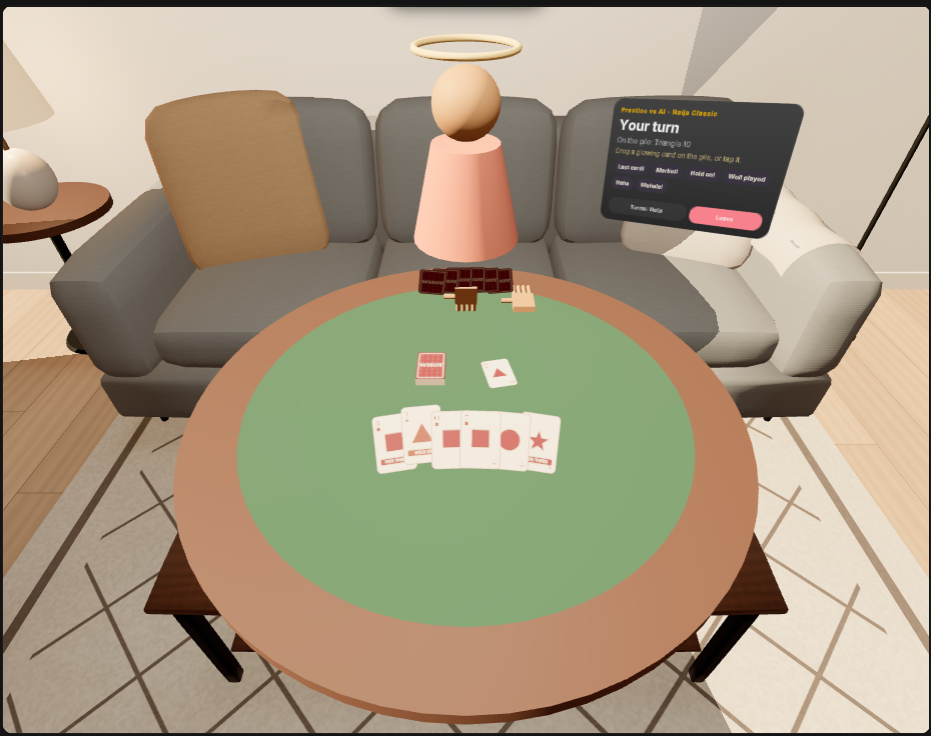
Inspiration Whot is the card game Nigerians grow up playing — in hostels, at family gatherings, at owambe parties — but no digital version has ever put the table in your own room. With mixed reality on Quest, we saw the chance to recreate that feeling: a shared card table that sits on your real table, where friends join from anywhere and it still feels like the same game night.
What it does Whot Anywhere is a mixed-reality Nigerian Whot game for Meta Quest and the browser. A virtual card table anchors to a real surface in your room; you hold your cards fanned in your left palm and pinch them out to play, or pull cards off the market deck. Online rooms support 2–4 players with 4-digit room codes and spectator watch links; a built-in AI fills practice and coaching modes. House-rule presets (Naija Classic, Quick Play, Family Friendly), a see-through mode, stats, streaks and a leaderboard keep players coming back.
How we built it Meta Immersive Web SDK (IWSDK) on Three.js, with an ECS architecture — hand tracking, distance grabbing, plane-snapped table placement, passthrough. UIKitML for the spatial lobby, HUD and leaderboard panels, plus DOM fallbacks so flat-web players always have buttons. A pure TypeScript rules engine (deck of 54, Pick Two/Three, Hold On, General Market, Whot wilds, market-out counting with star cards doubling and Whot worth 20) shared unchanged by client, bots and server. A Node + WebSocket authoritative room server — hands stay hidden server-side; Supabase handles anonymous identity, profiles, stats and room persistence, deliberately kept out of the live play path for zero lag. Deployed on a Vultr VPS behind Caddy HTTPS. Challenges we ran into Making hands-first play work everywhere: the same pinch-and-drop gesture had to feel right on Quest hands, emulated controllers and a mouse — we built a palm-held fan with drop-to-play plus a "cards on table" fallback. Keeping the lobby usable on flat browsers where XR entry prompts are meaningless — we learned xr.enabled is a config flag, not capability detection. Designing for browsers with no isSessionSupported — the emulator implements requestSession but not the check, so we show opt-in entry everywhere. Accomplishments that we're proud of A culturally specific game brought to mixed reality for the first time, with an authentic rules engine. Hands that visibly hold and pinch cards — yours and your opponents' — streaming real head/hand poses in multiplayer. A guided "Learn Whot" first hand that teaches the game inside a live match. The full loop shipped and hosted: practice, rooms, spectators, rematches, stats — playable today on a public URL. What we learned IWSDK's grabbing system, UIKitML panels and scene composition; how much of "it works in the emulator" means nothing for real hands on Quest; and that cultural specificity is a feature — the naija rules, names and feel are the point.
What's next for Whot Real avatars for remote players, voice lines and reactions, saved table anchors so your table returns where you left it, tournaments and ranked play on the leaderboard, and submitting to the Horizon Store as a packaged PWA.
Built With
- devin
- iwsdk
- muse

