-
-
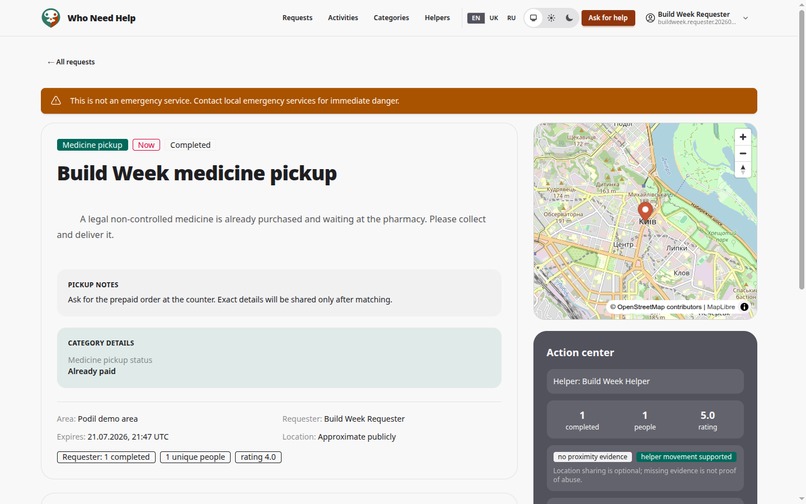
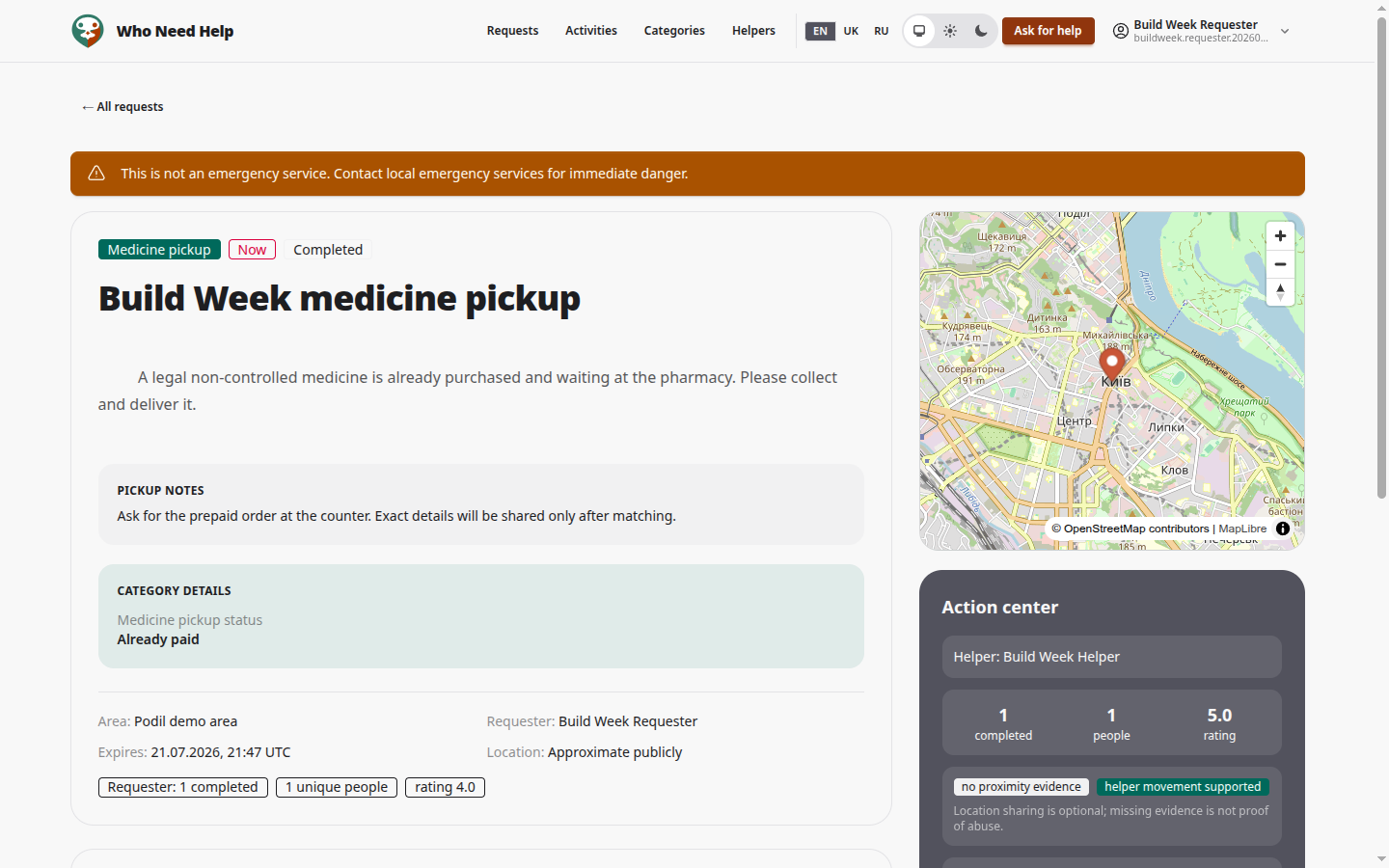
Completed medicine pickup with map and trust summary
-
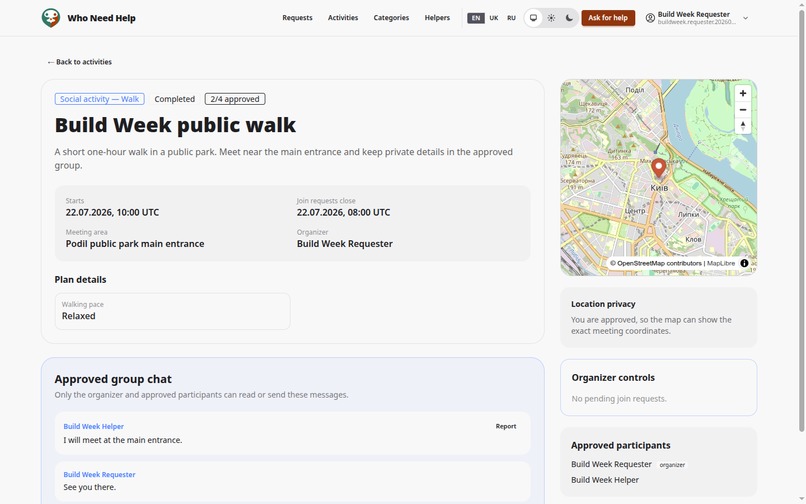
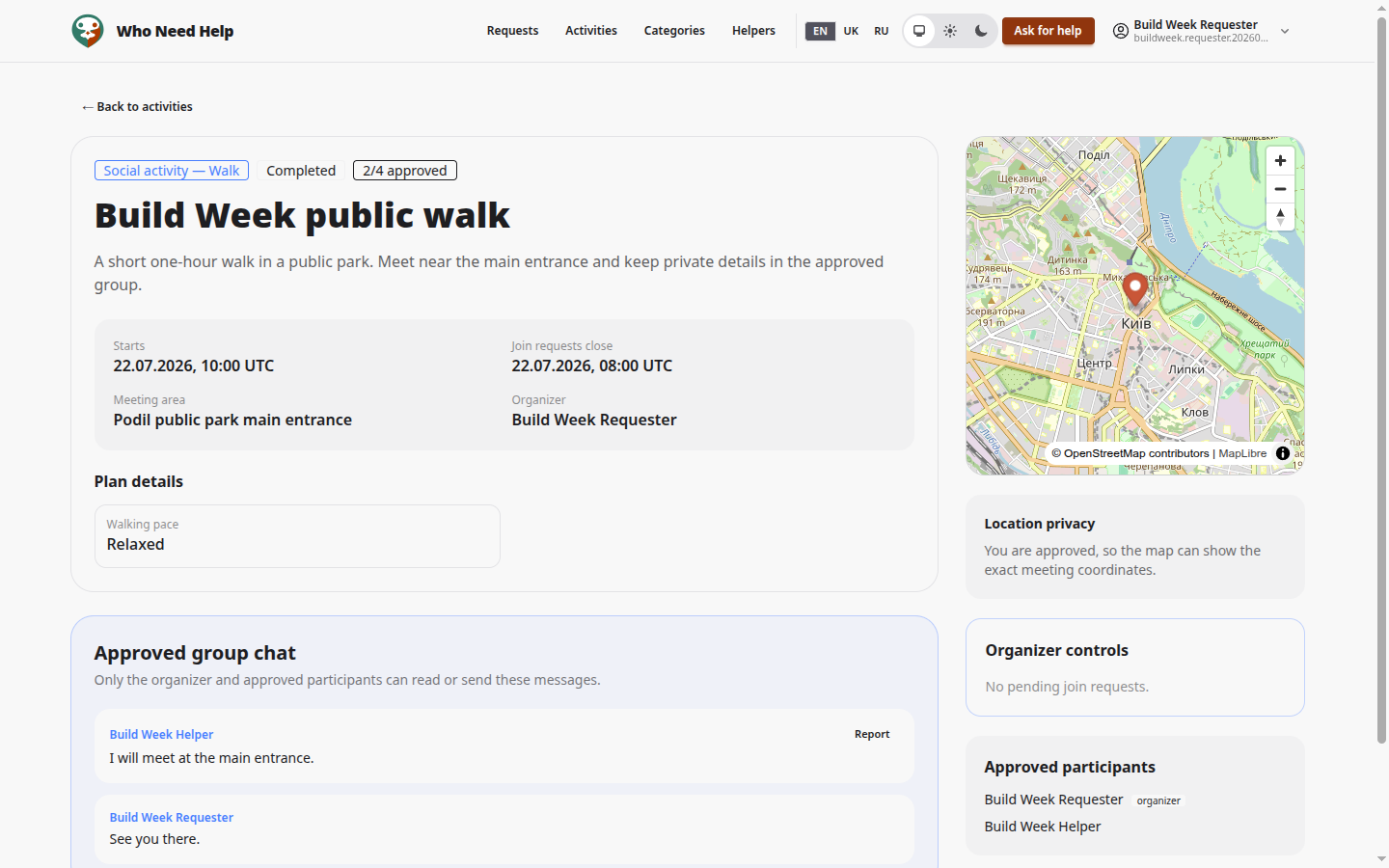
Approved community activity with map and participant chat
Inspiration
Who Need Help began with a real problem: a friend in another city became ill, but ordinary delivery services could no longer bring medicine that evening. We wanted a safe way for nearby people to provide urgent, voluntary, non-emergency help.
What it does
A requester publishes a categorized request while initially exposing only an approximate area. A nearby volunteer can accept it, coordinate through private real-time chat, and optionally share live location with consent.
The medicine flow supports pickup of legal medicine that has already been purchased or reserved. The same extensible system supports fuel, wheel, bicycle, motorcycle, breakdown, and secured roadside help.
A one-time handover code and confirmation from both parties complete the request. Double-blind reviews, reputation based on unique counterparts, blocking, reporting, movement evidence, and privacy controls reduce abuse and rating manipulation.
The platform is free and does not process payments. Optional thanks happen directly between users.
How we built it
The backend uses Elixir, Phoenix 1.8, LiveView, PostgreSQL/PostGIS, Oban, Phoenix PubSub and Presence. MapLibre provides maps. Docker Compose supports a compact single-server deployment, while separate web and worker replicas and Helm provide a path to later Kubernetes scaling. The Android companion is a Java 17 WebView-based client with a native foreground service for consent-based live location sharing.
How Codex and GPT-5.6 helped
Codex running GPT-5.6 helped turn the product decisions into Phoenix contexts, LiveViews, database schemas, real-time messaging, location handling, Android integration, Docker and Helm deployment tooling, automated tests, and documentation.
Codex was also used as an engineering reviewer: it inspected code and queries, ran security and performance checks, drove real browser workflows, verified database effects, and fixed defects found during end-to-end testing.
The deployed application itself does not call the OpenAI API. Optional category review runs only through a local ChatGPT-authenticated Codex CLI with a PII-free export.
Challenges we ran into
The hardest parts were protecting exact locations, coordinating state across multiple web and worker replicas, preventing trivial reputation manipulation, and making the full requester-to-helper workflow understandable under urgent conditions.
Accomplishments that we're proud of
We completed a working requester-to-helper flow: registration, categorized requests, matching, real-time chat, optional tracking, handover verification, both-party completion, blind reviews, moderation, and Android interoperability. The Phoenix suite passed 284 tests, and headed browser verification exercised the core two-person flow.
What we learned
Trust cannot be represented by one score. Consent, limited disclosure, two-party confirmation, scoped moderation, and transparent evidence are more useful together.
What's next for Who Need Help
Next steps include production Android signing, more verified social providers, broader category moderation, accessibility improvements, and careful jurisdiction-specific launch policies.
Built With
- android
- codex
- docker
- elixir
- gpt-5.6
- java
- kubernetes
- maplibre
- phoenix
- playwright
- postgresql


Log in or sign up for Devpost to join the conversation.