-
-
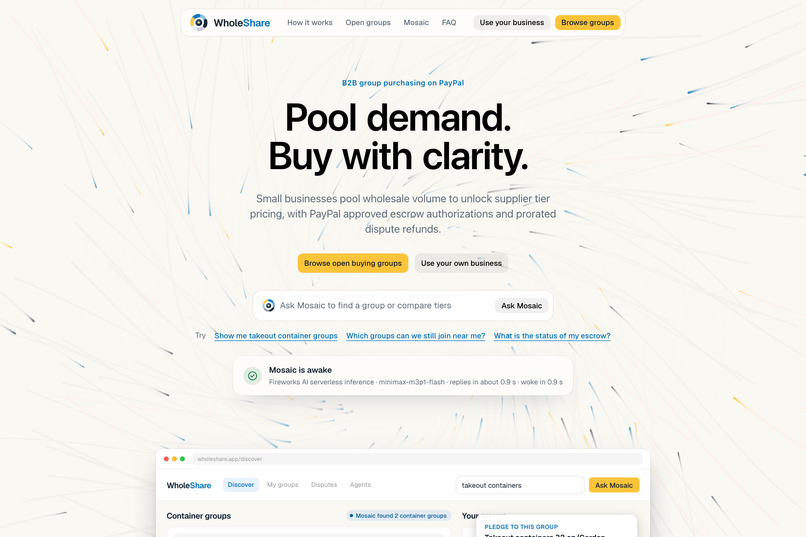
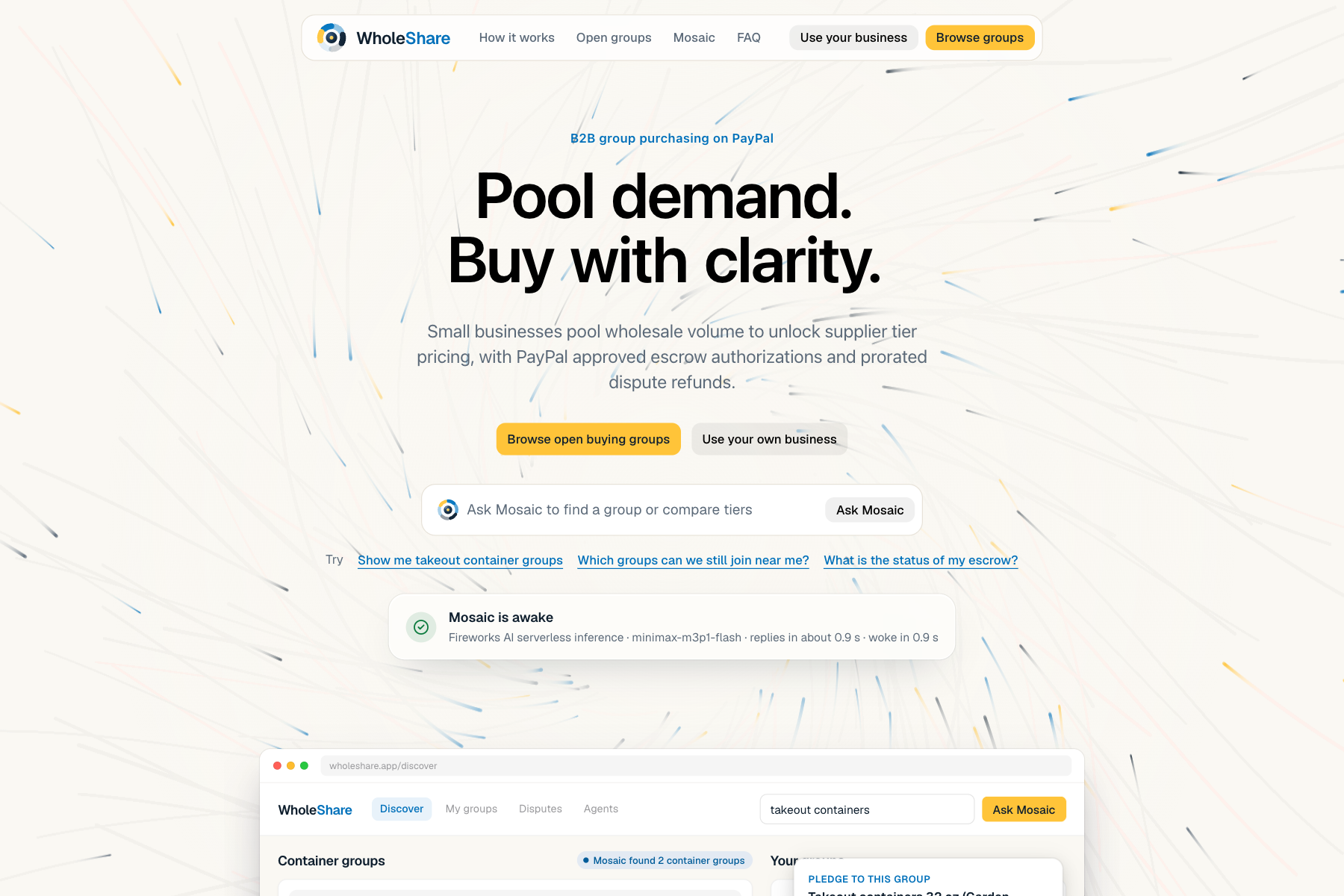
Pool demand. Buy with clarity. Mosaic is awake on Fireworks.
-
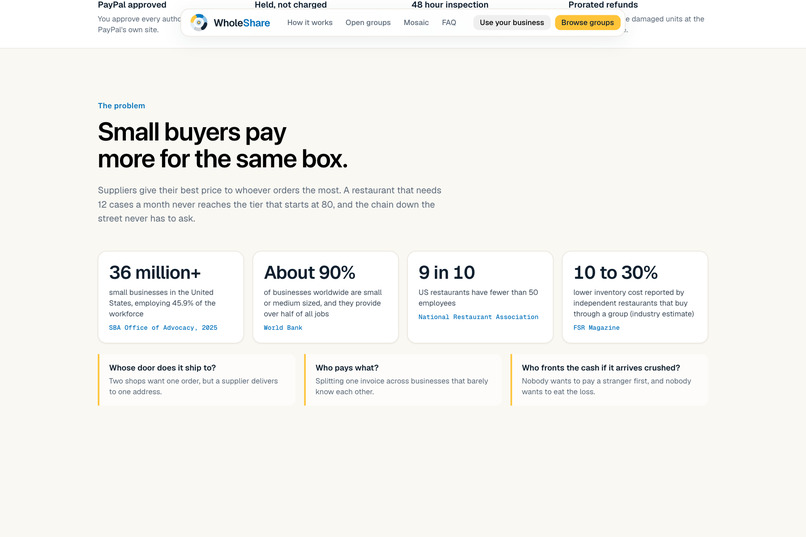
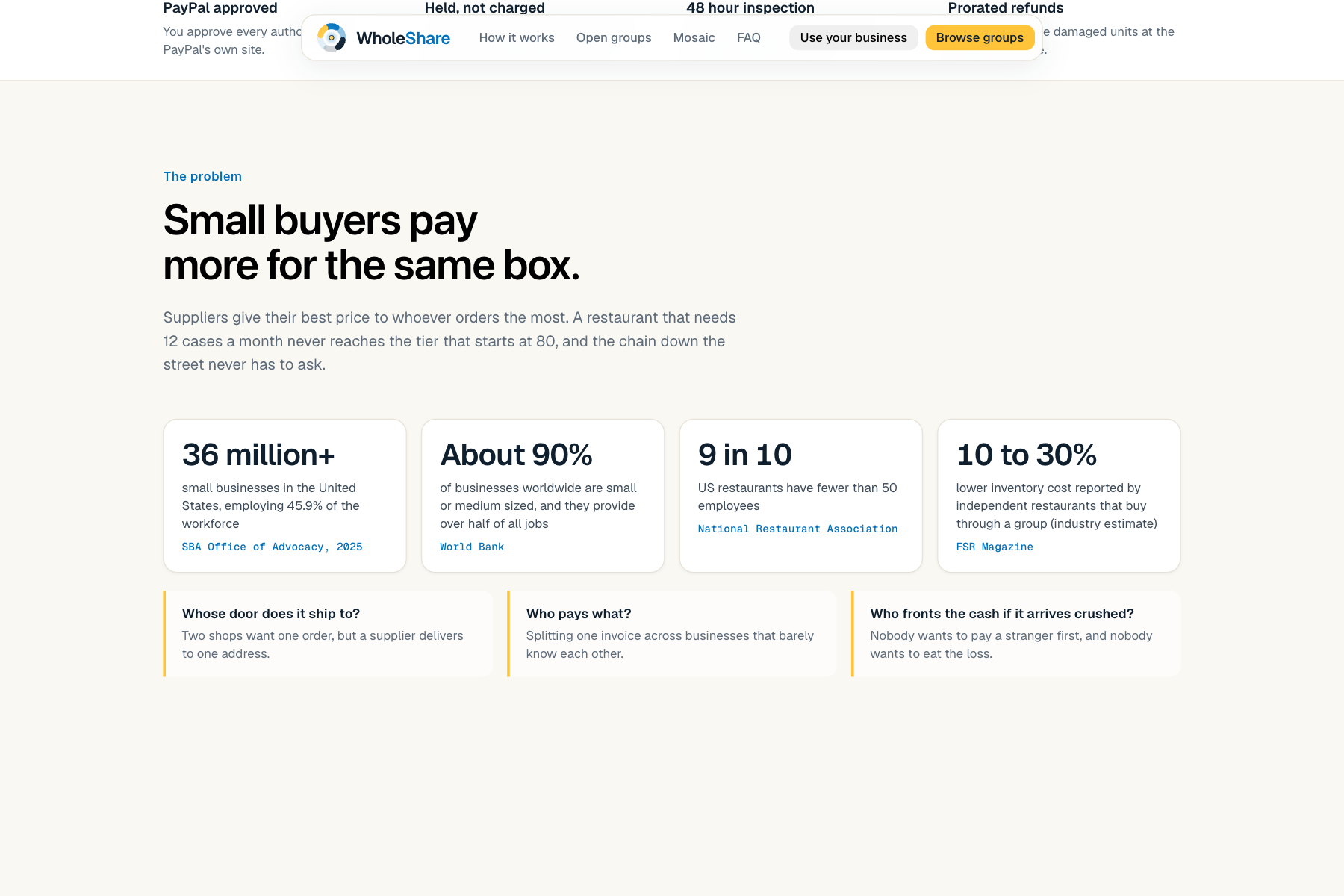
Why small buyers pay more
-
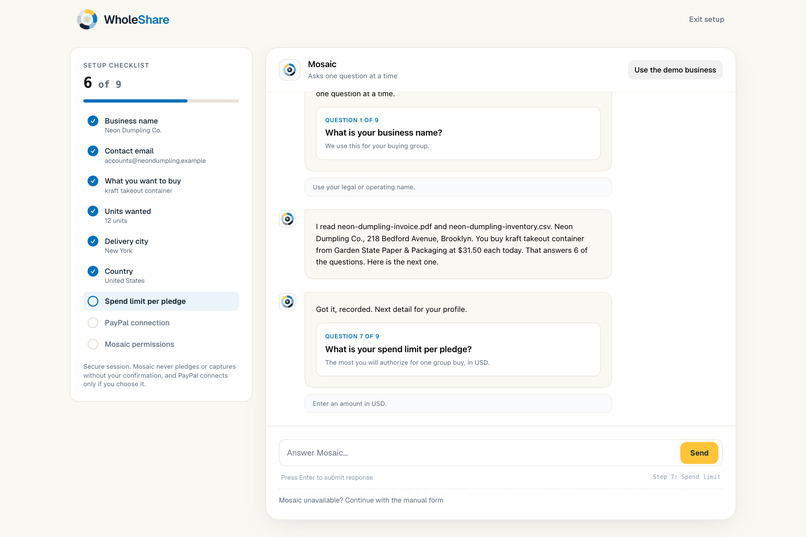
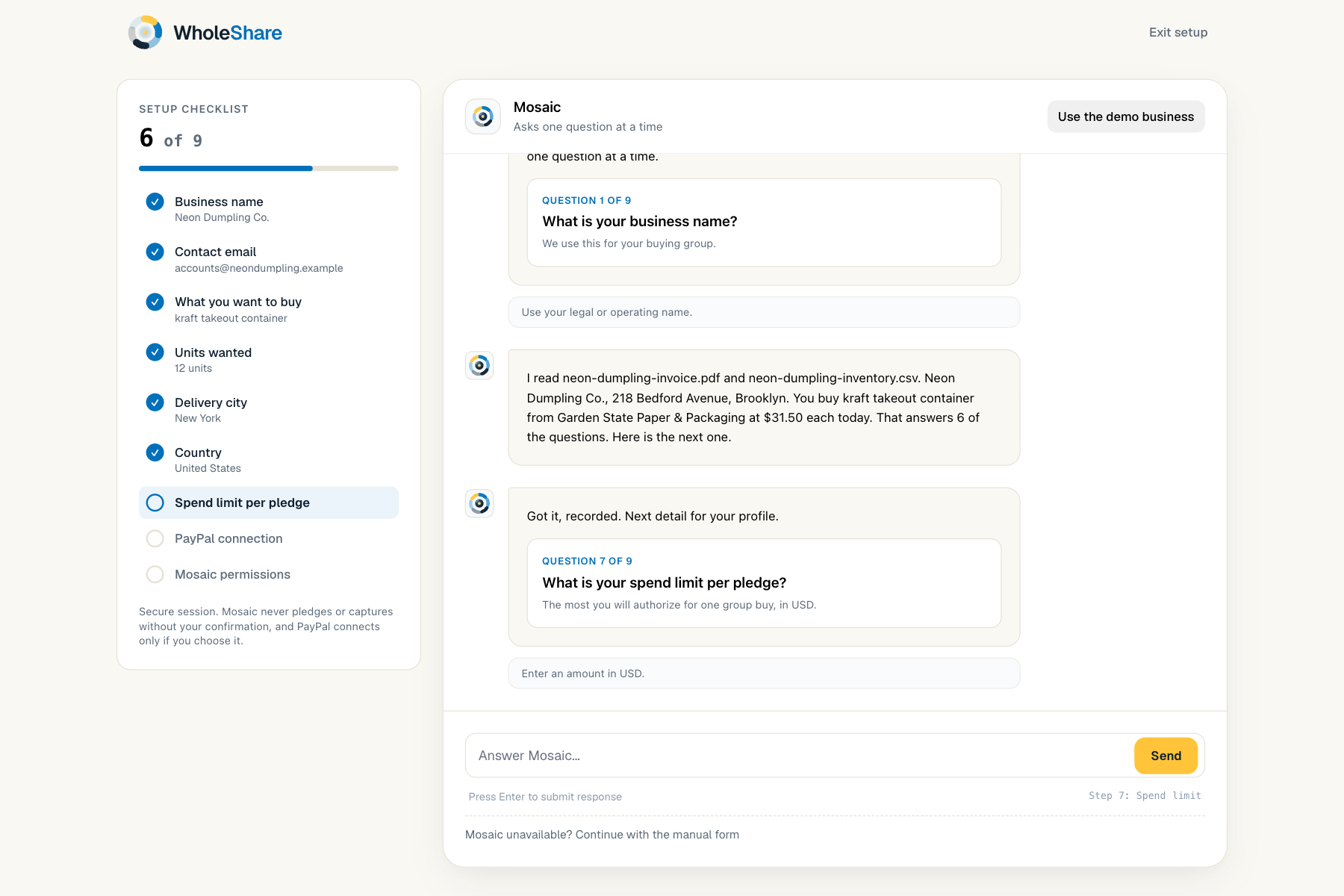
Onboarding reads an invoice and inventory sheet and fills the checklist.
-
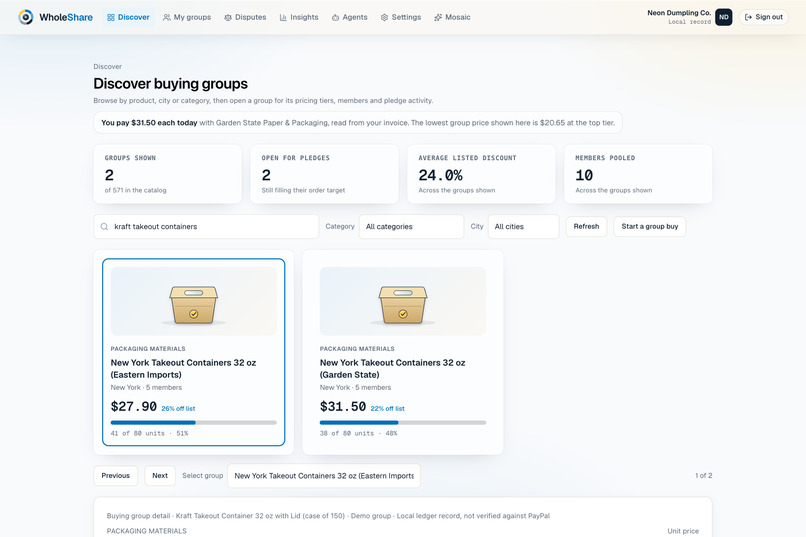
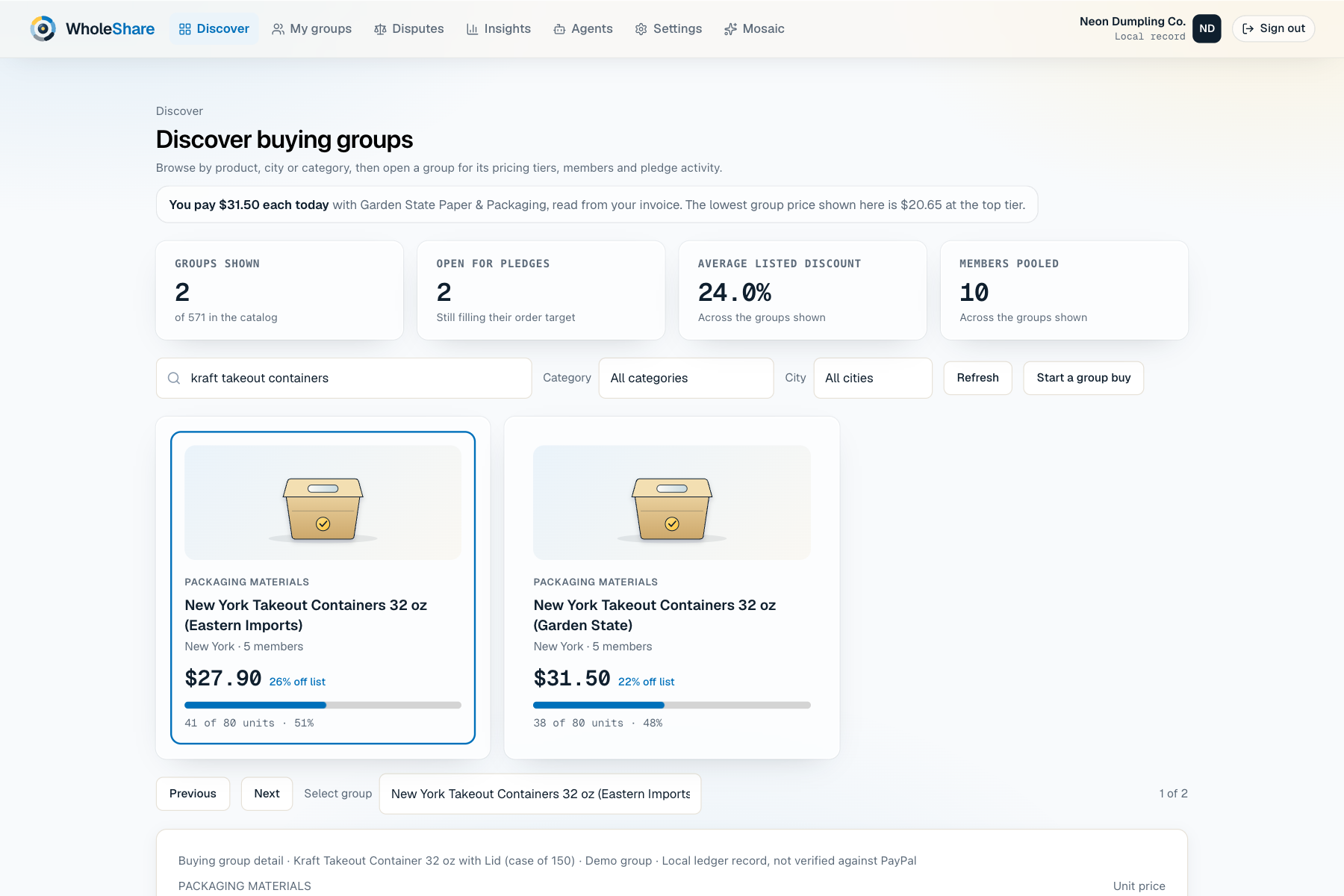
Matching groups, already filtered to what the business buys, with a saving banner against today's price.
-
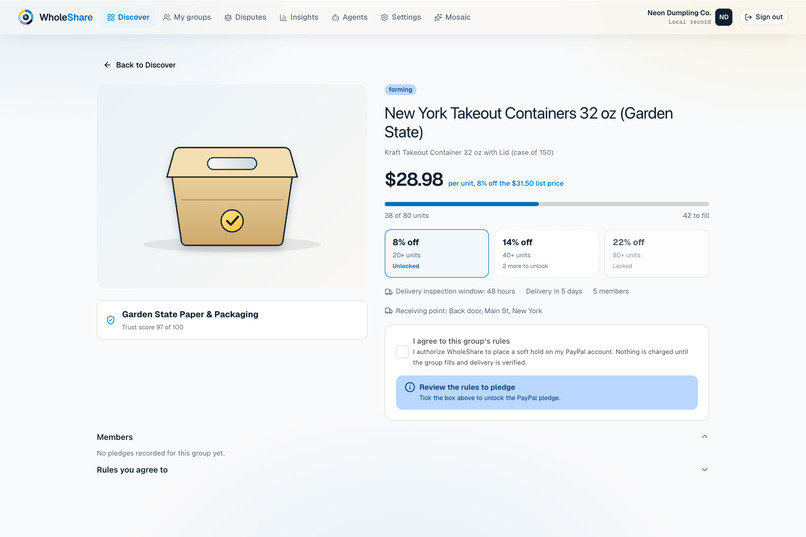
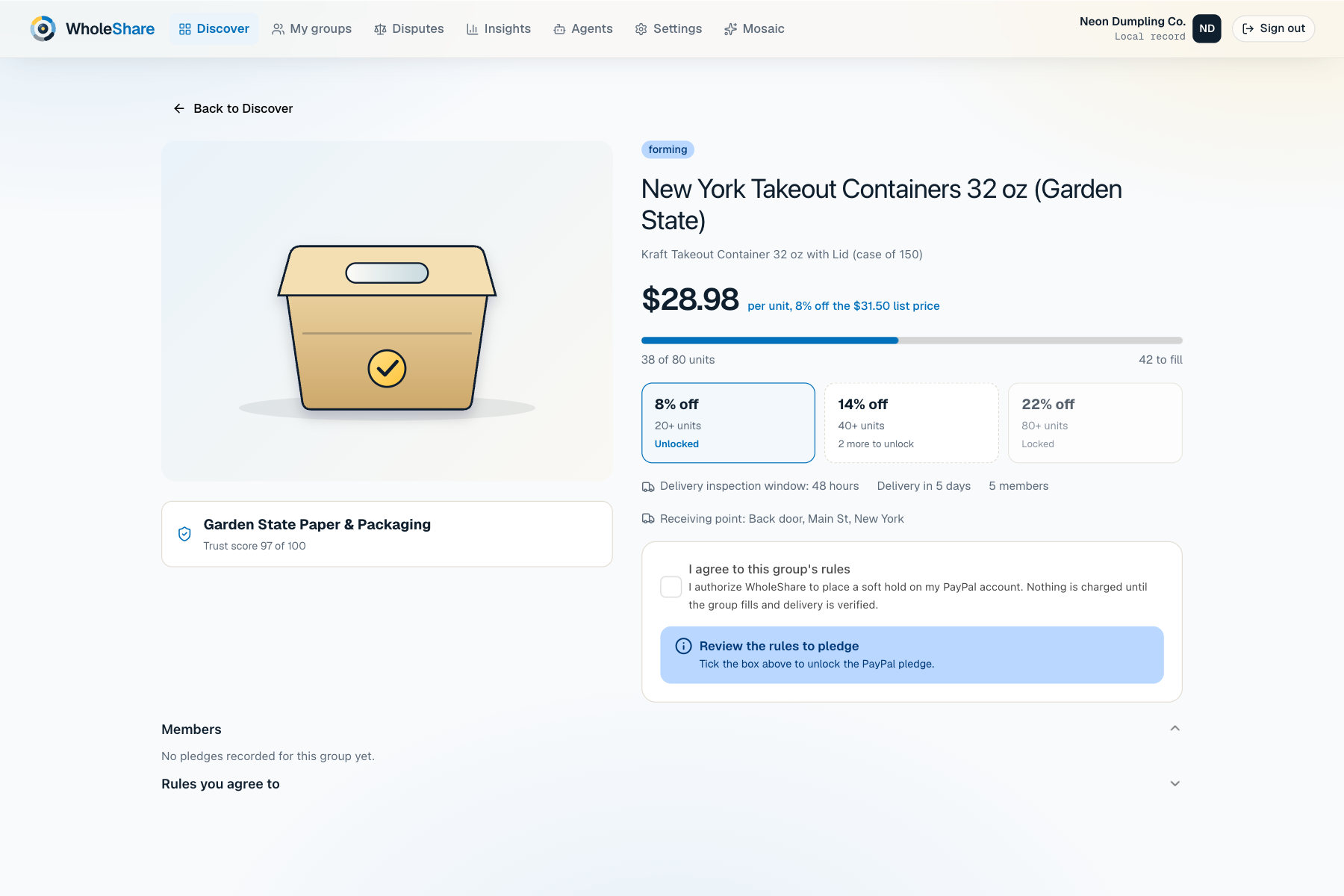
A group page: discount tiers, supplier trust, delivery in five days, and the receiving point.
-
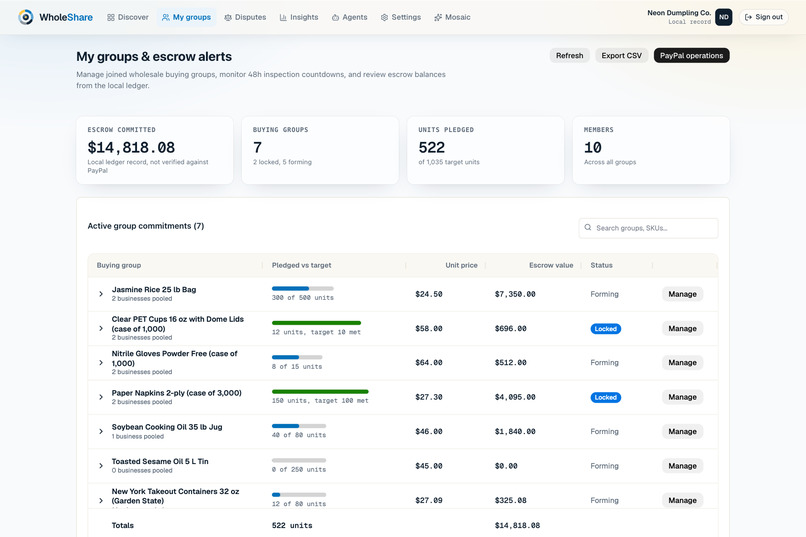
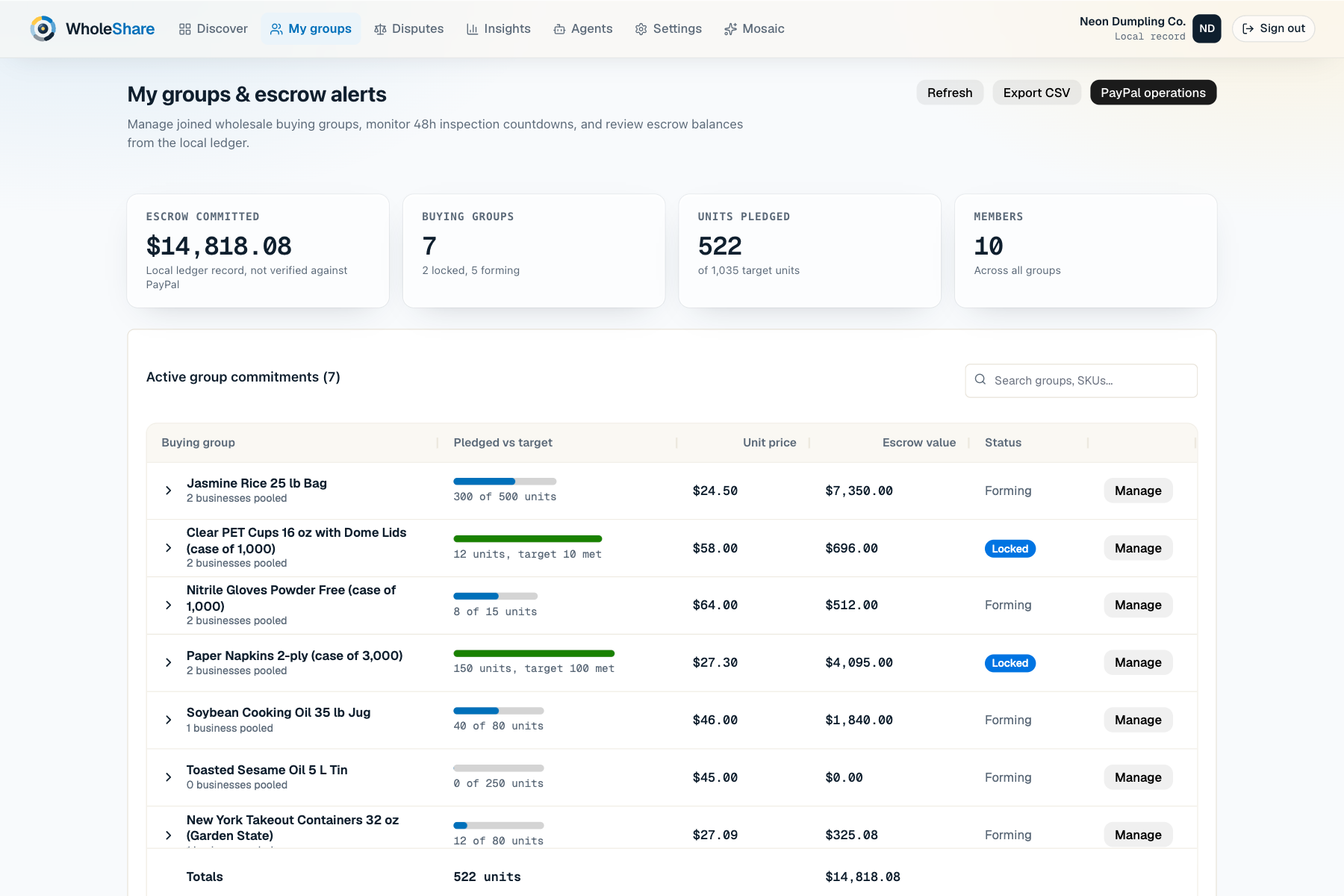
My groups: AG Grid with money held on PayPal.
-
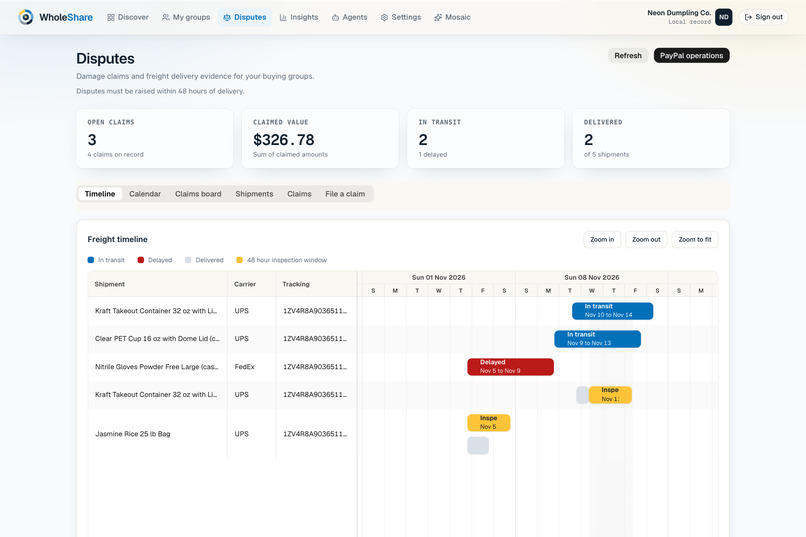
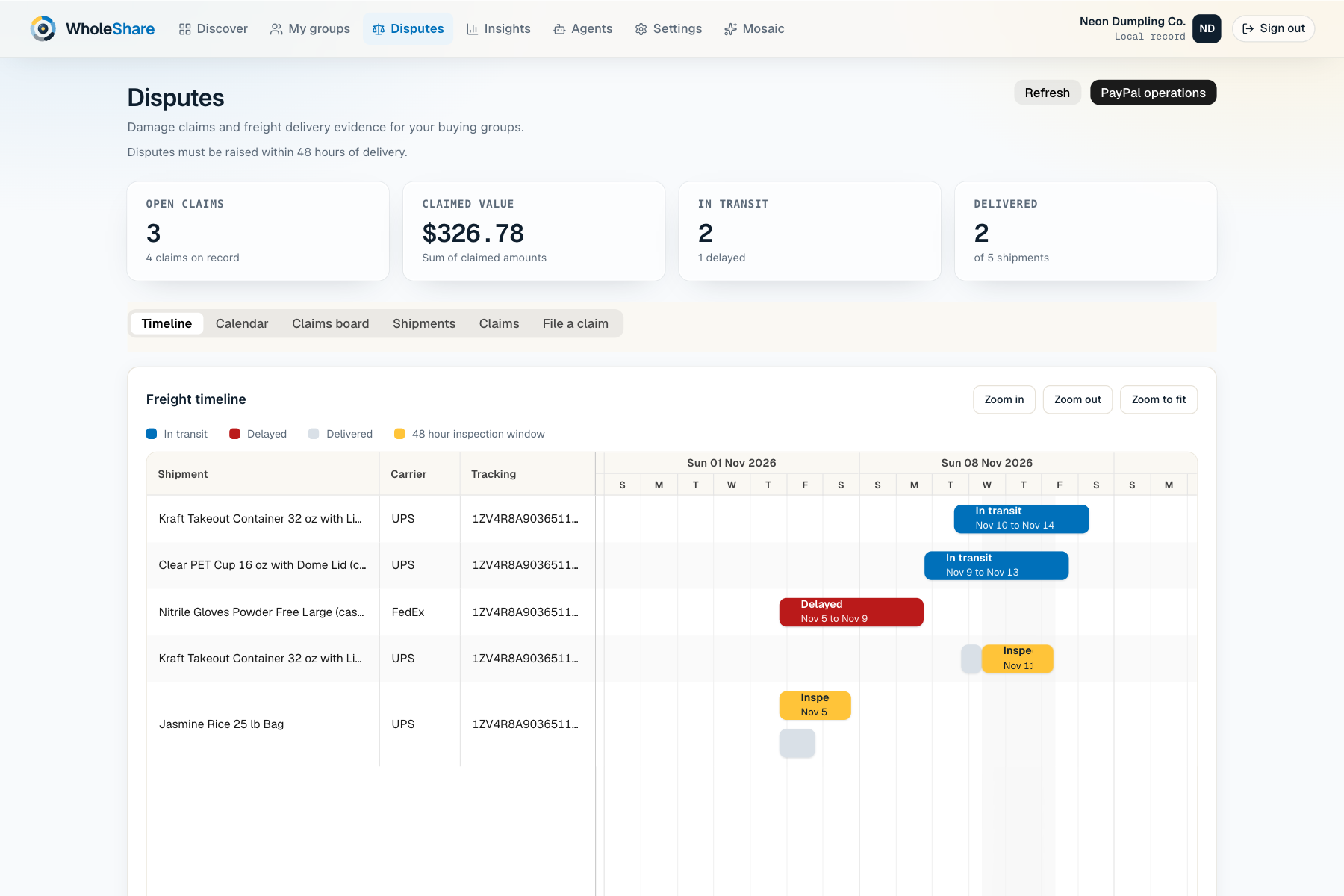
Bryntum Scheduler: shipments in transit, delayed and in the inspection window.
-
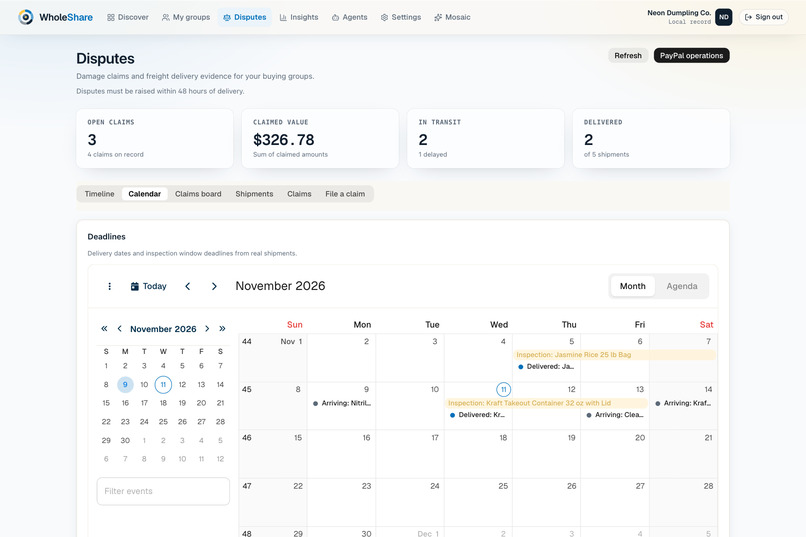
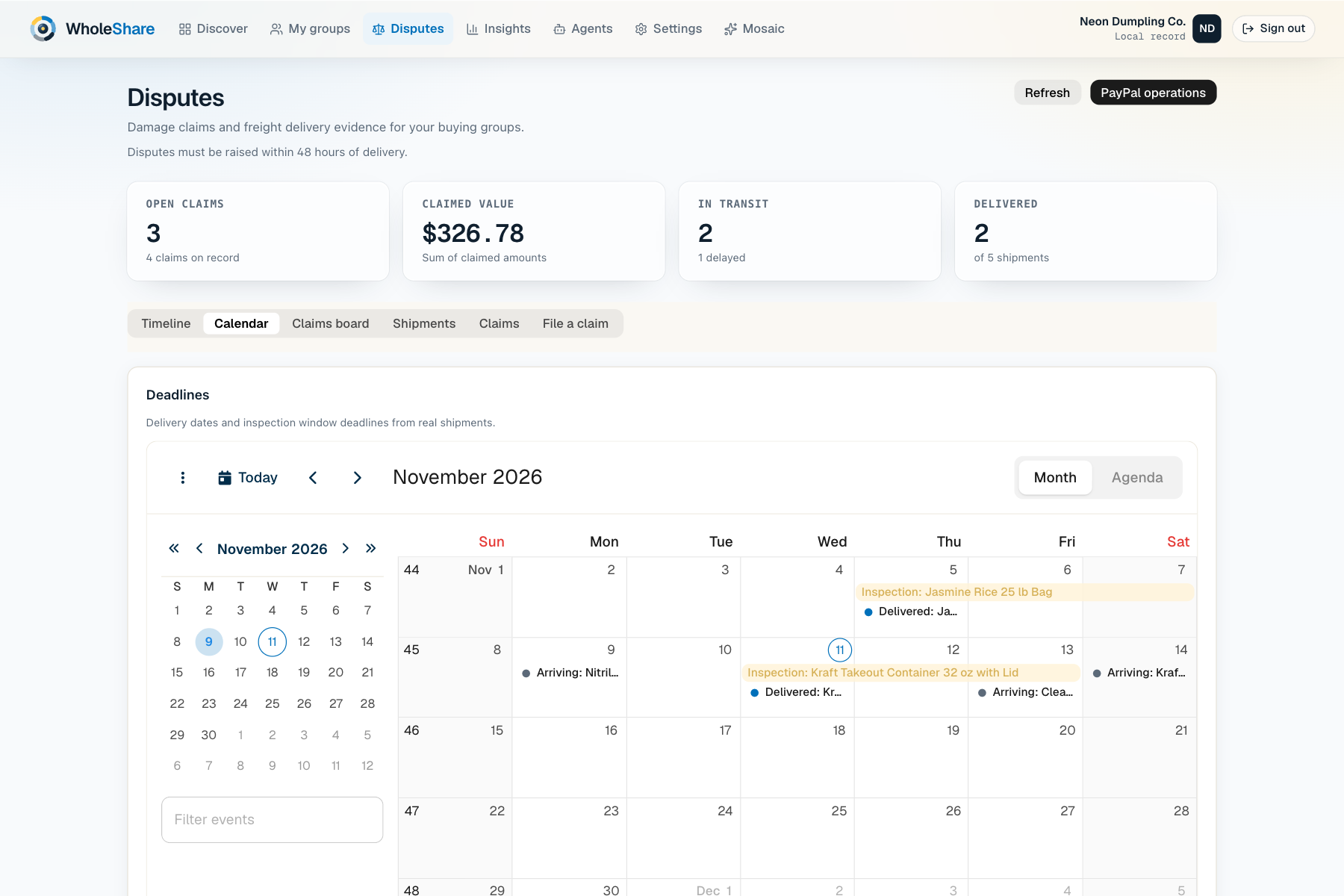
Bryntum Calendar: arrivals and 48 hour inspection windows.
-
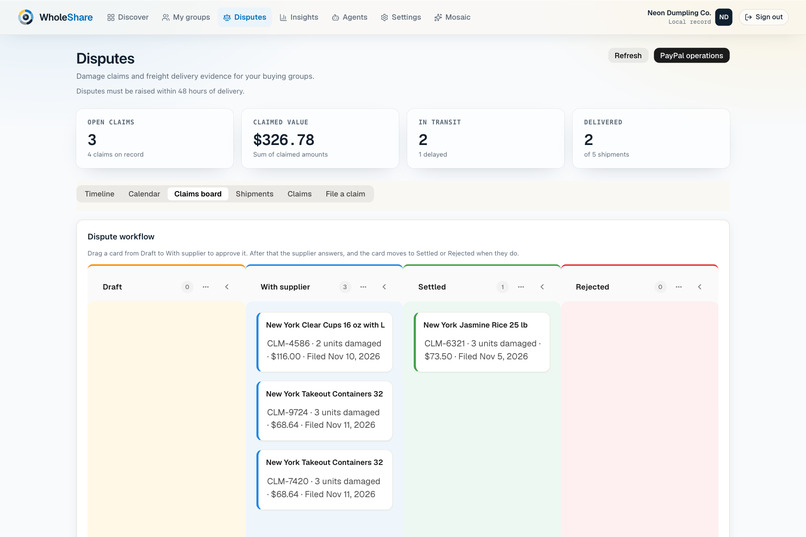
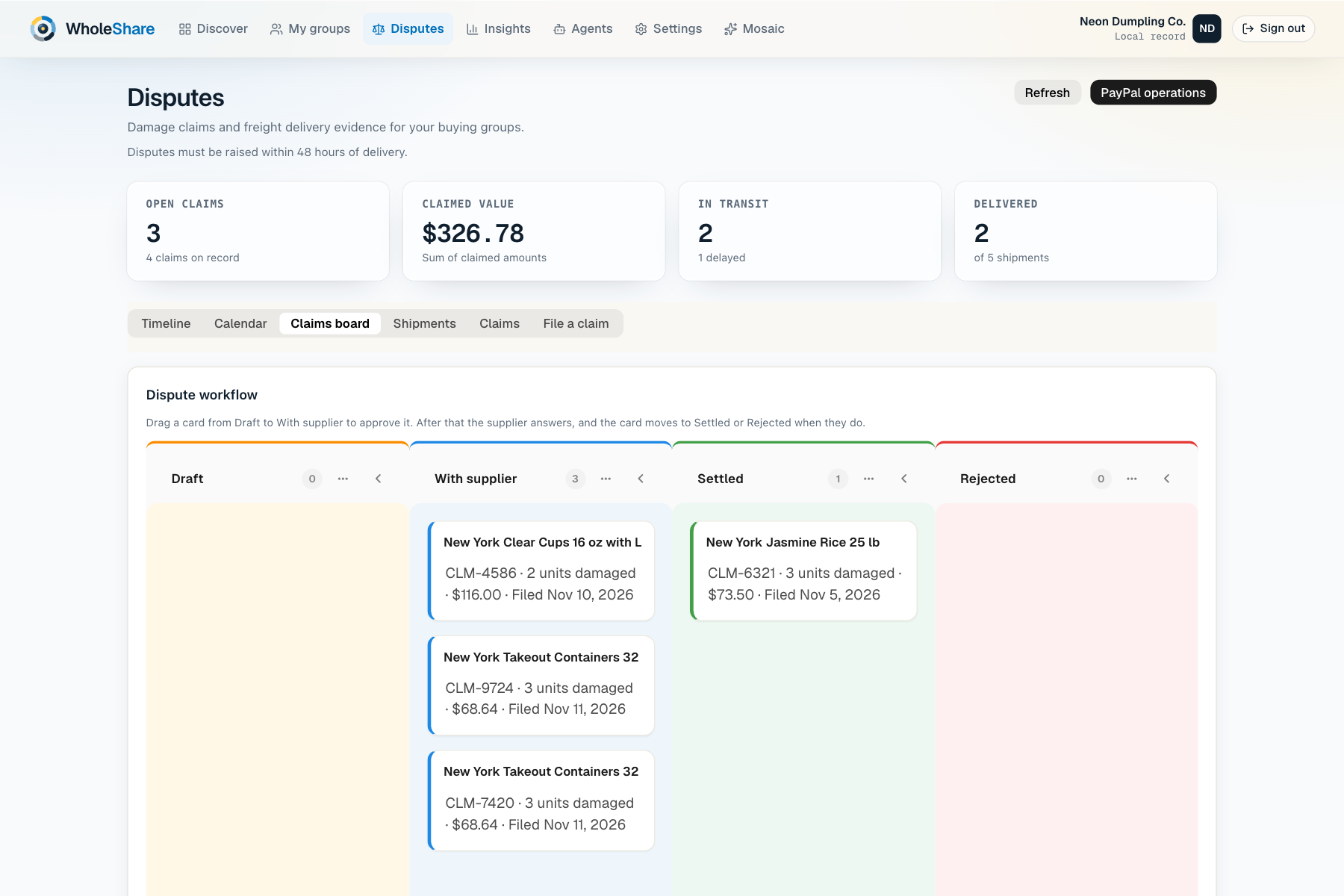
Bryntum TaskBoard: claims from Draft to With supplier to Settled.
-
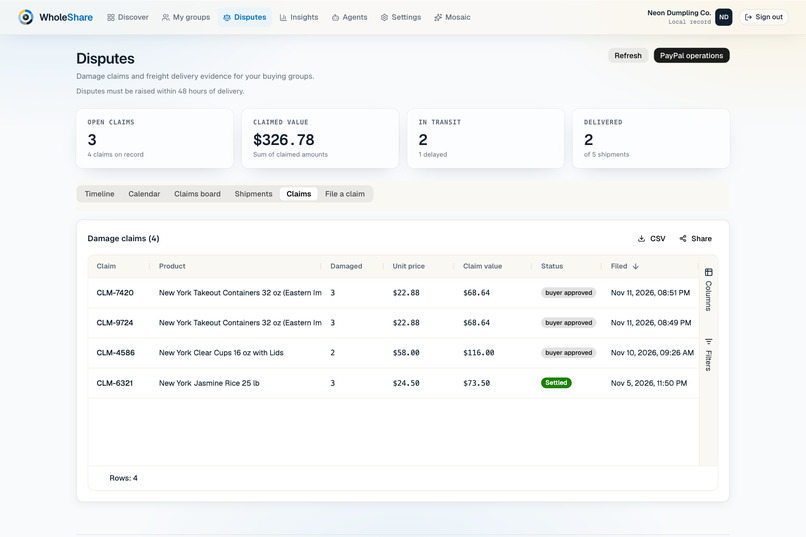
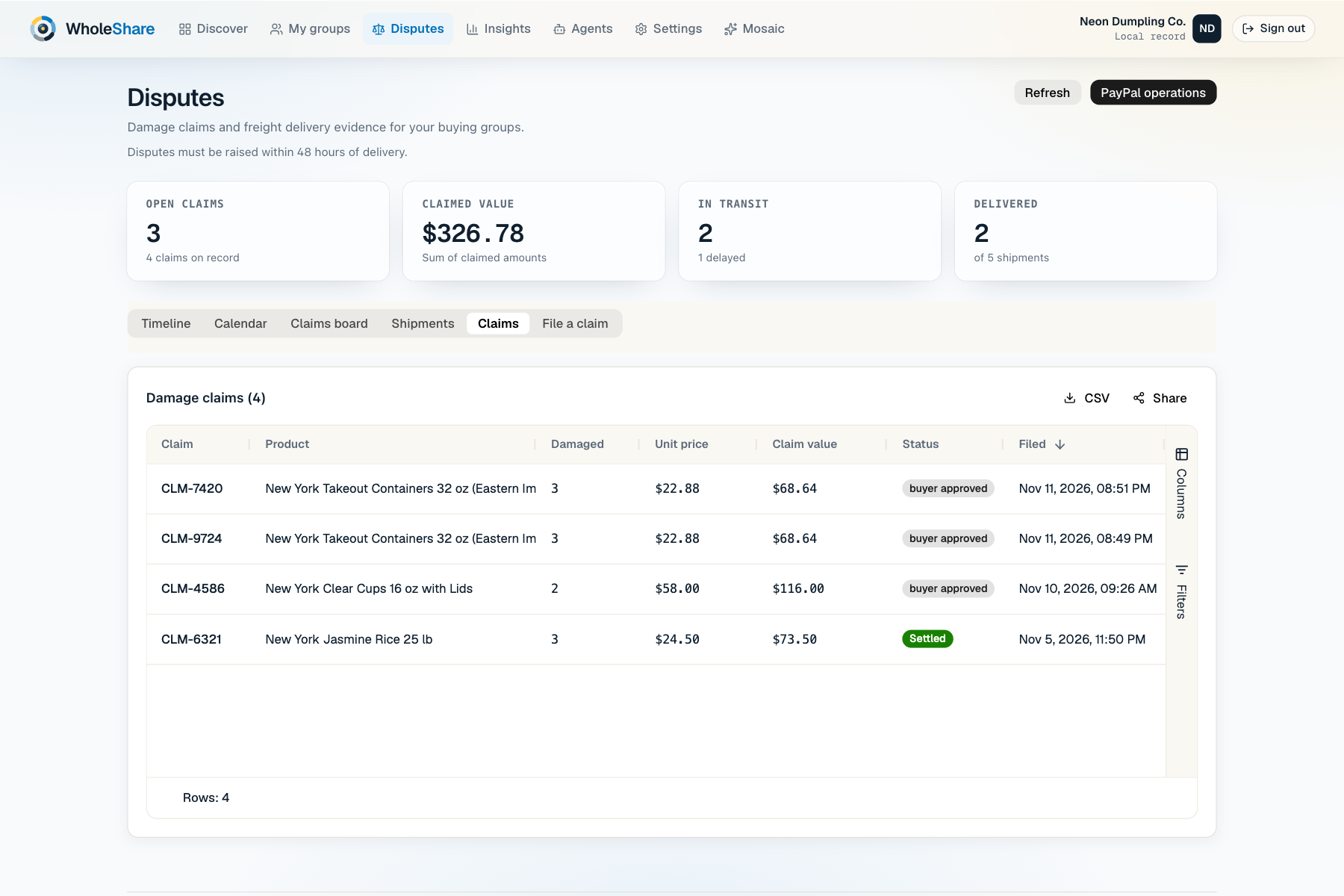
Damage claims in AG Grid with readable references, not ids.
-
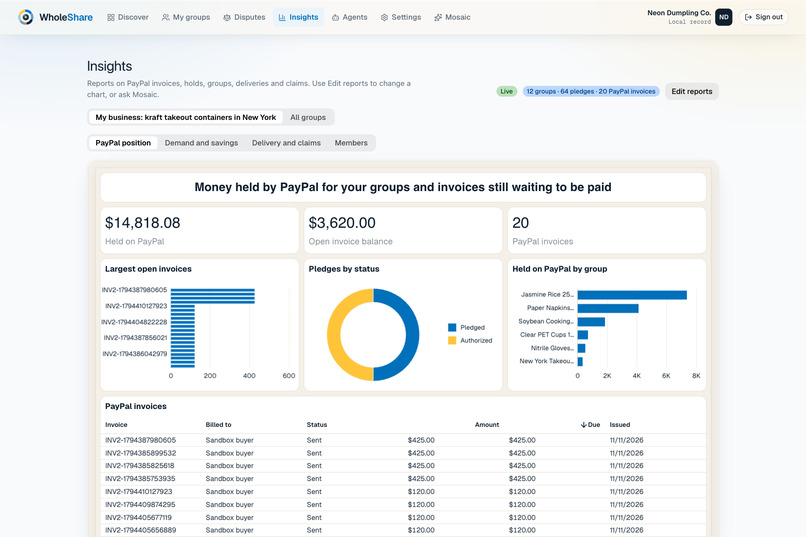
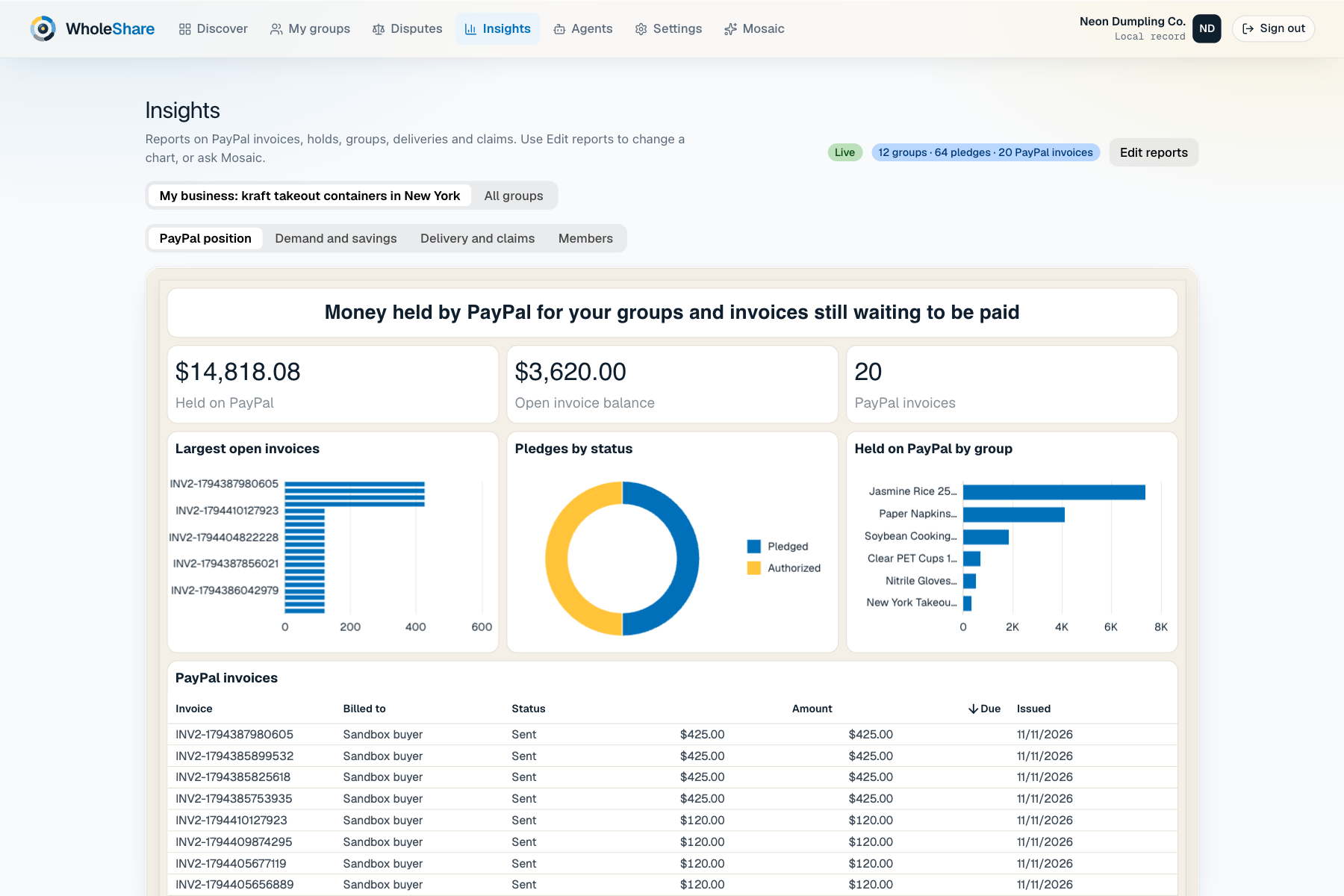
AG Studio: money held on PayPal, open invoices and held by group.
-
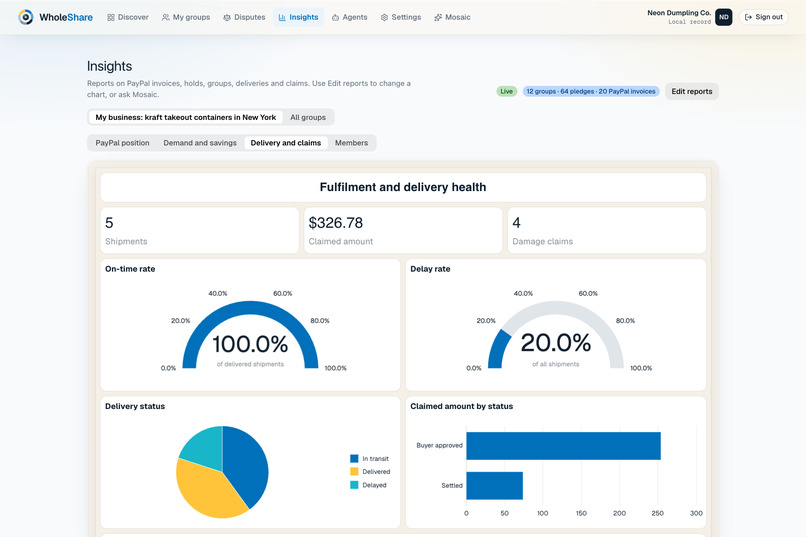
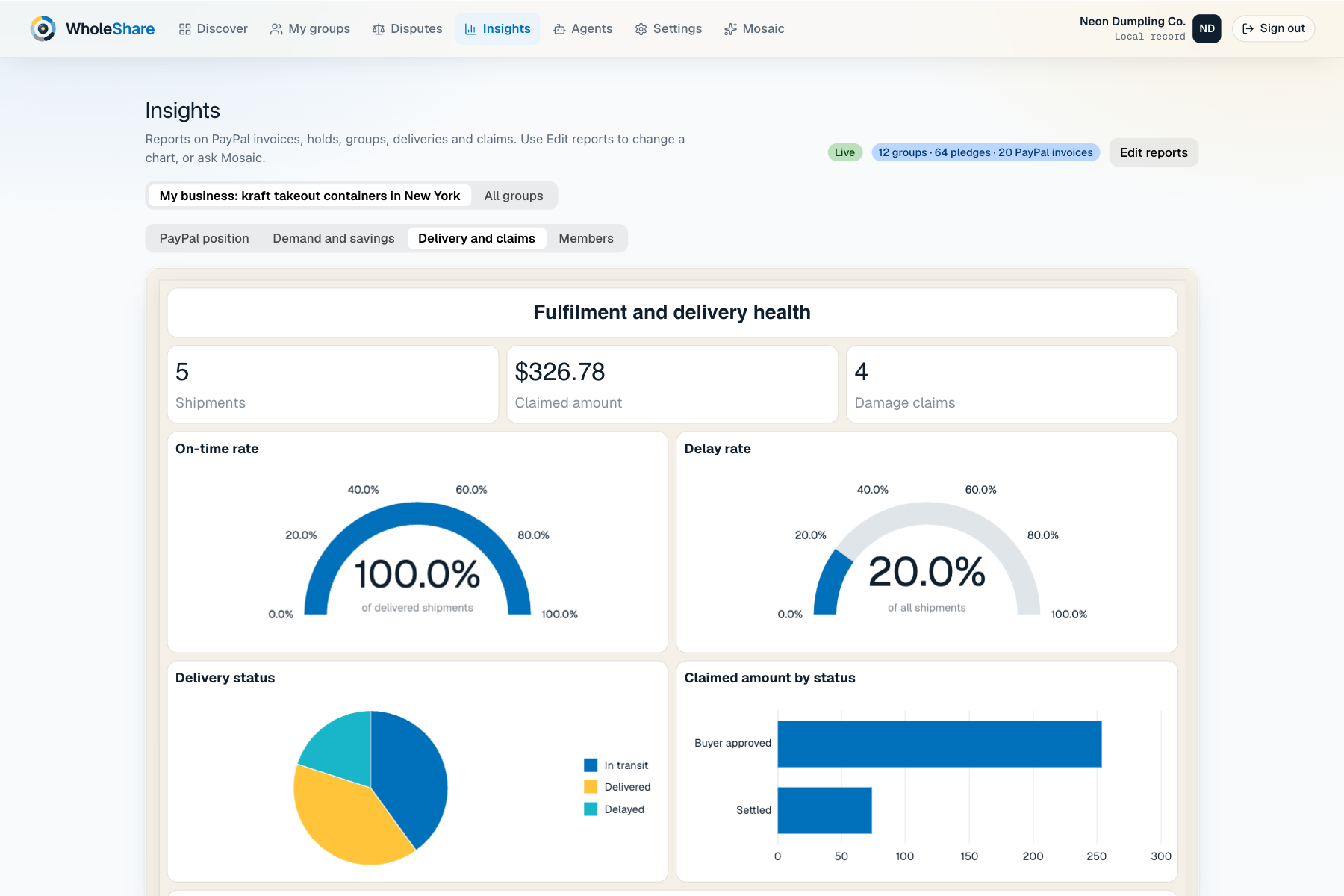
AG Studio: on-time rate, delay rate and claimed amount.
-
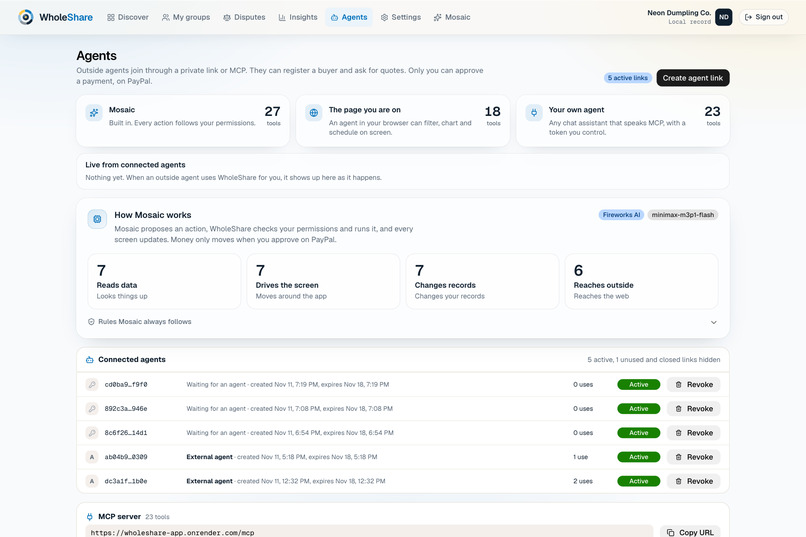
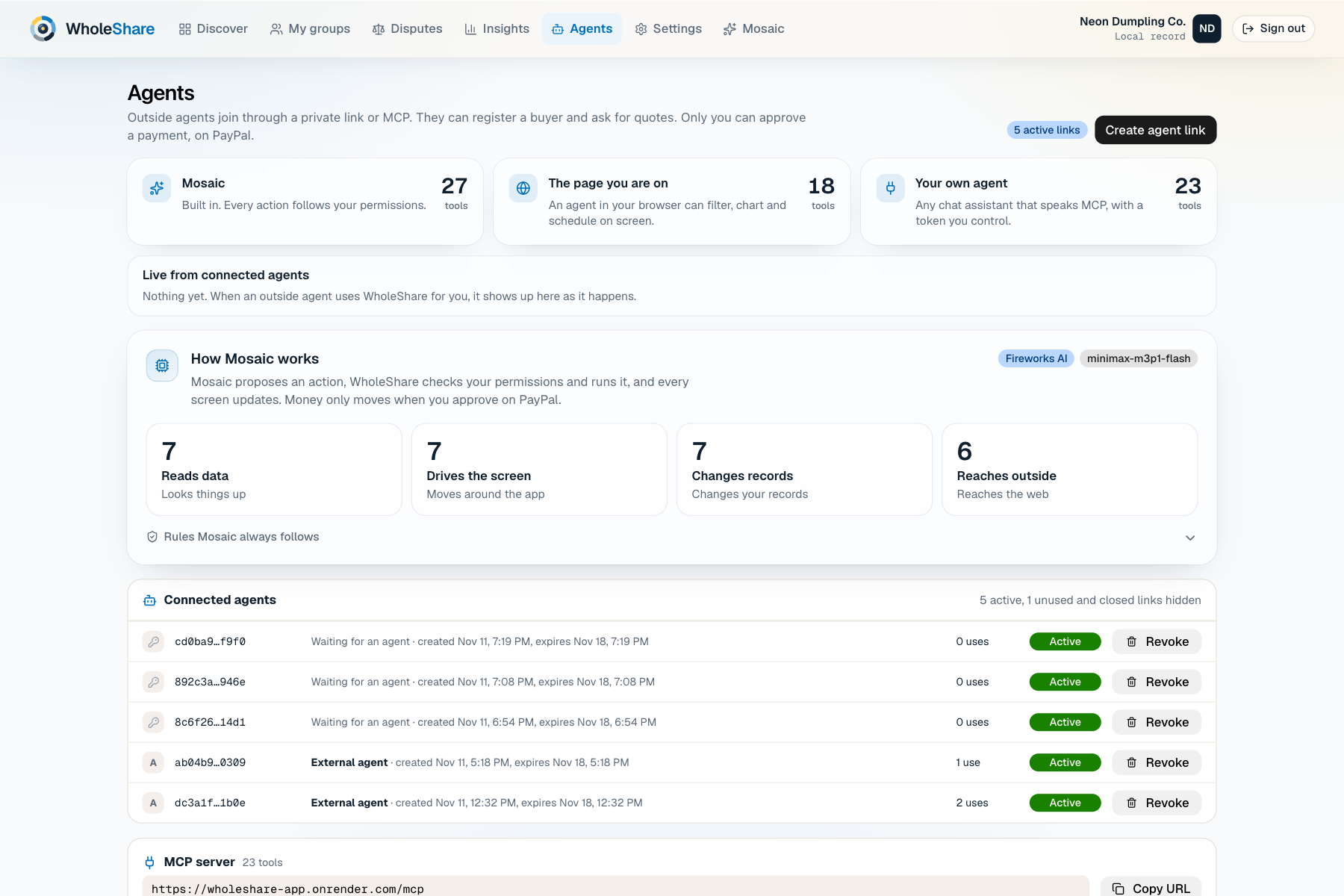
Agents page: the assistant, the in-page tools, the MCP server and a live feed of outside agents.
-
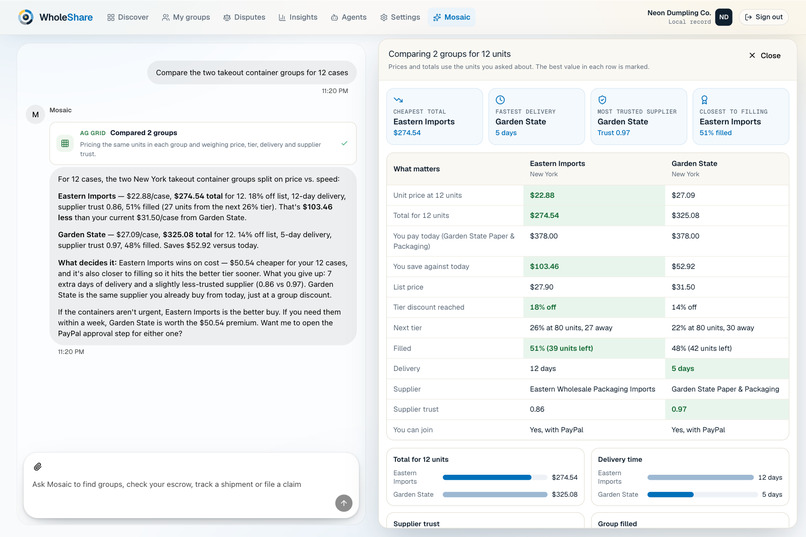
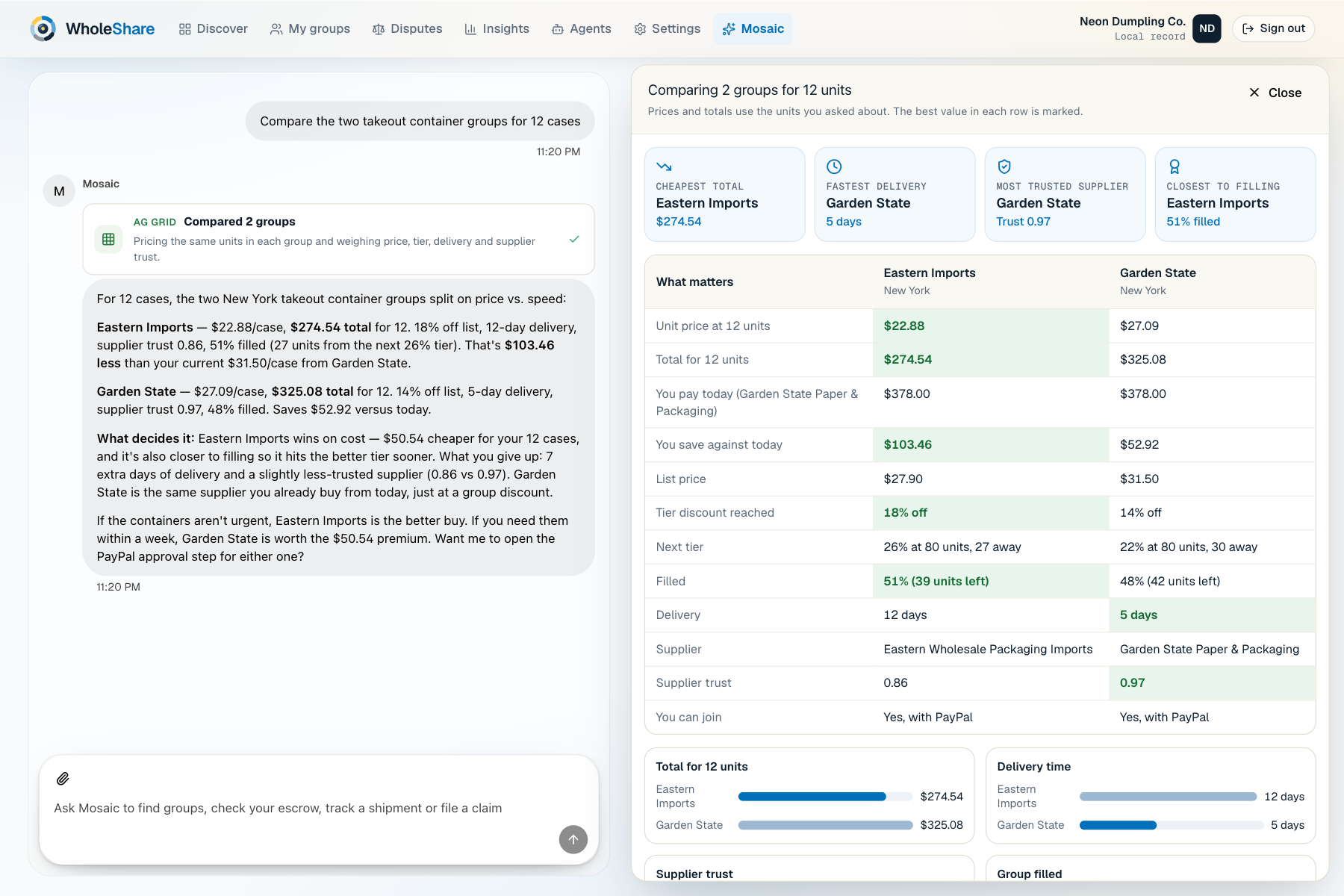
Mosaic: one sentence opens a full comparison with verdicts, savings and charts.
-
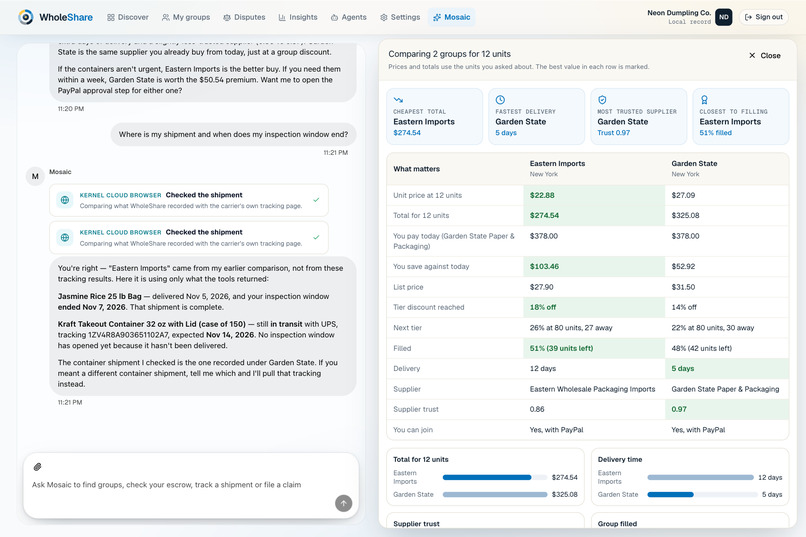
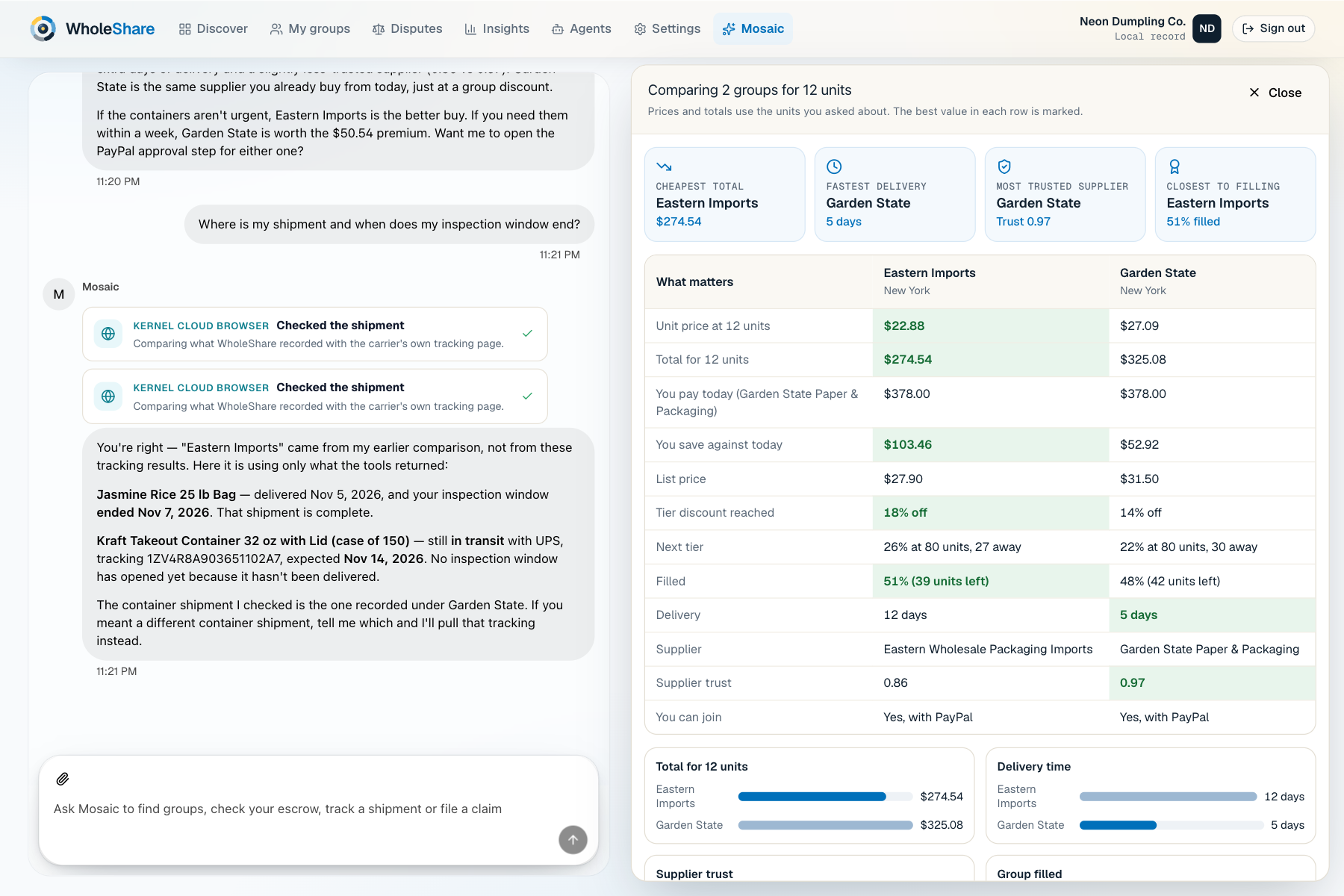
Mosaic answering about shipments from real records, with the browser source shown.
Inspiration
Picture two restaurants across the street from each other. One makes dumplings. The other sells bubble tea. Both buy the same takeout boxes from the same supplier, and both pay $31.50 a case.
The supplier's price drops by up to 22% at 80 cases. Neither shop will ever order 80 cases alone. So they both overpay.
The obvious fix is to order together. It almost never happens, because of three questions. Whose door does the order go to? Who pays what? And who covers the loss if half the boxes show up crushed? Nobody wants to pay a stranger first.
That is a trust problem, and PayPal is built for exactly that. So we made WholeShare.
The problem is huge. Small buyers pay more per box simply because they order less. SMEs can work together on our platform increase cooperation and punch way above their weight with regards to what is possible when they do not do so
What it does
WholeShare is a group buying app for small businesses.
- You start with your paperwork. Drop in a supplier invoice and an inventory sheet. WholeShare reads them and fills in your business, your supplier and what you pay today. A value is only kept if it is written in your documents. Nothing is made up.
- You find a group to join. The app already knows what you buy, so the matching groups are right there, with the price at your volume, the discount tier, the delivery time and how much the supplier can be trusted.
- You pledge through PayPal. You approve on PayPal's own screen. PayPal places a hold. Nothing is charged.
- Mosaic does the legwork. Mosaic is the assistant inside the app. Ask it to compare two groups and it opens a full comparison with the cheapest, the fastest and the most trusted, and what you would save against what you pay today. Ask it to find new suppliers and it reads their real websites in a cloud browser. Ask it to start a group and it fills in the form from one sentence.
- You check the goods when they arrive. Deliveries show on a timeline and a calendar, with a 48 hour inspection window. Accept the goods and the held money is released to the supplier.
- If something is wrong, you file a claim. Say what happened, attach a photo, and the claim goes to the supplier with the evidence. The refund is only for the damaged units.
- Any chatbot can plug in. Our assistant app, Instinct, on WhatsApp, can use WholeShare through a plain link. It can search, compare and prepare a pledge, and it sends you a PayPal approval link. It can never approve money itself.
The rule behind all of it: the assistant can prepare everything, but only the person can approve a payment.
How we built it
PayPal is the trust layer. The whole design leans on PayPal's authorize-then-capture flow, so the money waits until the goods are right.
- Orders v2: each pledge creates an order with intent AUTHORIZE. The buyer approves on PayPal, and we authorize it. That is the hold.
- PayPal JavaScript SDK v6: the real PayPal button and approval window on the group page.
- Payments v2: capture the hold when the goods are accepted, capture only the undamaged part for a partial claim, void or refund when a claim is settled.
- Invoicing v2: big pledges get a PayPal invoice with a QR code first. We have 20 sandbox invoices showing in the app.
- Log in with PayPal: connects the business's PayPal identity during onboarding.
- Disputes webhook: we verify PayPal's signature before any dispute event changes anything.
- Plus Shipment Tracking and Payouts, which are in the code.
Mosaic and the harness. Mosaic runs on Fireworks AI. The main model is MiniMax M3.1 Flash, running serverless with its thinking turned off so it answers fast. DeepSeek V4.1 Flash is the backup if the first one is slow. Around the model we built our own harness. It decides which tools the model may use, checks every argument on the server, limits each turn to five tool calls, and checks every number and name in the reply against what the tools actually returned. Mosaic has 27 tools. The person controls five permission switches: search and filter, prepare quotes, draft claims, research suppliers, change schedules. Everything starts off.
WebMCP and MCP. The same tools are exposed three ways. Inside the app, an in-page tool set lets the assistant filter, sort, chart and reschedule what is on the screen, in the spirit of WebMCP. Outside the app, an MCP server lets other agents connect with an invite token. For assistants that can only open a link, there is a plain link version. Instinct uses that one.
AG Grid, AG Charts and AG Studio run the tables, charts and reports. Bryntum runs the delivery timeline, the calendar and the claims board. Mosaic can open these beside the chat and change them, and so can the person.
Kernel runs the cloud browsers that read supplier websites for real prices. JuiceFS holds uploaded documents when its drive is mounted. The app runs on Render.
Each business gets its own workspace. When you finish onboarding, WholeShare builds your groups, shipments and reports from what you buy and where you are. A restaurant never sees another business's shipments.
The model we trained ourselves
Fireworks AI with MiniMax and DeepSeek is what powers the live app today. We also trained and open sourced our own model, so you do not have to depend on anyone's servers.
- What it is: LoRA adapters on Qwen3.5 (4B and 9B), trained to use WholeShare's tools correctly. Link: [model link].
- How we trained it: with a method called on-policy self-distillation. In plain words: the model tries a task. A strict rule checker looks at what it did and flags mistakes, like going over a spend limit or an impossible claim step. A teacher copy of the model then reads the mistake and explains the fix, without seeing any private data. The corrected answer becomes new training data.
- The dataset: the Kaggle dataset
wholeshare-opsd-dataset. Link: [Kaggle dataset link]. It is ordered like a course: sourcing first, then escrow, then disputes. Every amount is a whole number of cents. We mixed in 15% of general finance questions (FinQA and TAT-QA) so the model does not forget how to do ordinary money math. It sits on a data lake of 1.64 million records, about 905 thousand of them from public Kaggle datasets. - Training: 4-bit QLoRA, run on free Kaggle GPUs.
Challenges
- Making group buying feel safe. Nobody wants to pay a stranger first. So we built it so money is only ever held, never taken, until the goods arrive. Everyone approves on PayPal's own screen. The assistant can prepare a pledge, but it cannot approve one.
- Testing the real PayPal hold. Our first real sandbox approval failed. PayPal reports a successful hold with a status we were not expecting, so our app turned down a good payment. Only a real approval showed us this. We fixed it, and the hold now goes through.
- Starting a new business without making things up. A new business has no data. We read its invoice and inventory sheet, and keep a value only if it is written in the documents. Then we build a workspace around what it buys and where it is.
- Every business sees only its own world. Early on, a restaurant could see another company's shipments, and screens showed raw ids and codes. We cleaned it up so each business sees its own groups, deliveries and claims, with real names and plain words.
- Deliveries and disputes are the hard middle. Goods arrive late, or crushed. We built a 48 hour inspection window, a claim with a photo, and a refund for just the damaged units. A claim shows its real status and waits for their answer.
- Reading documents on a server. The tools we first used only existed on our laptops. We switched to ones that run anywhere, and check every value against the document.
- Making the assistant dependable. Our first assistant only worked on the exact sentences we tested. We rebuilt it and tried it on 100 new prompts, with 30 held back that we never tuned against. It got 97% on all of them, and 97% on the held back set. Answers take 5 to 8 seconds, and Fireworks AI makes that fast enough to feel live.
What we are proud of
- A real PayPal hold from a button inside our app. The buyer approves on PayPal's own screen and a hold appears in the sandbox. Nothing is charged until the goods are accepted.
- The assistant can prepare everything, and approve nothing. Only the person can approve a payment. That rule is built into how the app works, not just a promise.
- A comparison that speaks in your own money. It shows what each group would cost you and what you save against what you pay today. For 12 cases of containers, that is $103.46 saved with one group and $52.92 with the other.
- Setting up a business from its own paperwork. Drop in an invoice and an inventory sheet, and the app fills in the rest. A value is only kept if it is written in the documents.
- Any outside assistant can plug in. Any agent can connect through MCP, or through a plain link. Our assistant app, Instinct, on WhatsApp, asks WholeShare questions and sends the owner a PayPal approval link.
- Our own LoRA open source model and dataset, open to anyone. A business can run the whole assistant on its own machine, with no outside service in the middle.
What we learned
- Trust is the product. People will pool orders with strangers once they know their money is only held, and released when the goods are right.
- Show people their own numbers. "You pay $31.50 a case today" beats any chart about the market.
- Test with the real thing early. A real PayPal approval caught a bug that our practice runs never would.
- Do not fake the other side. A claim should show its real status and wait for the supplier, not hand the buyer buttons that pretend to be the supplier.
- Check every number the assistant says against the data. And give it tools that match the business, such as compare, join and file a claim, not the screens.
What's next
- Finish the money steps live in the sandbox. Run capture, refund and payouts with the same care as the hold.
- Let suppliers join. Suppliers answer claims and confirm shipments themselves, so nothing on that side is a sample.
- Help neighbors find each other. When one restaurant starts a group, WholeShare finds nearby businesses that buy the same thing and invites them, so groups fill faster.
- Orders that repeat. A restaurant buys containers every month. A standing group would come back each cycle, with a fresh PayPal approval every time.
- Trust scores earned from real orders. A supplier's score would come from real deliveries, damage claims and how fast they answer, so the best suppliers stand out.
Built With
- ag-charts
- ag-grid
- ag-studio
- astryx
- brytnum
- fireworks-ai
- juicefs
- kernel
- log-in-with-paypal
- minimax
- node.js
- paypal
- paypal-js-sdk-v6
- paypal-orders-v2
- paypal-payments
- paypal-sandbox
- python
- qwen3.5
- react
- render
- stageshow
- typescript
- webmcp


