-
-
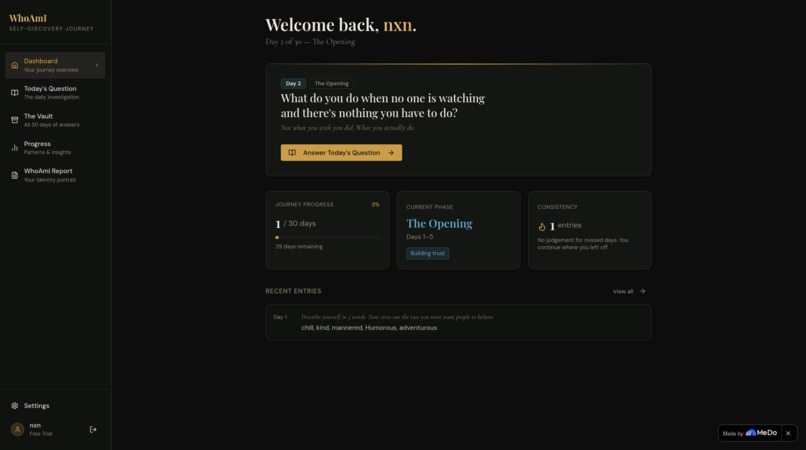
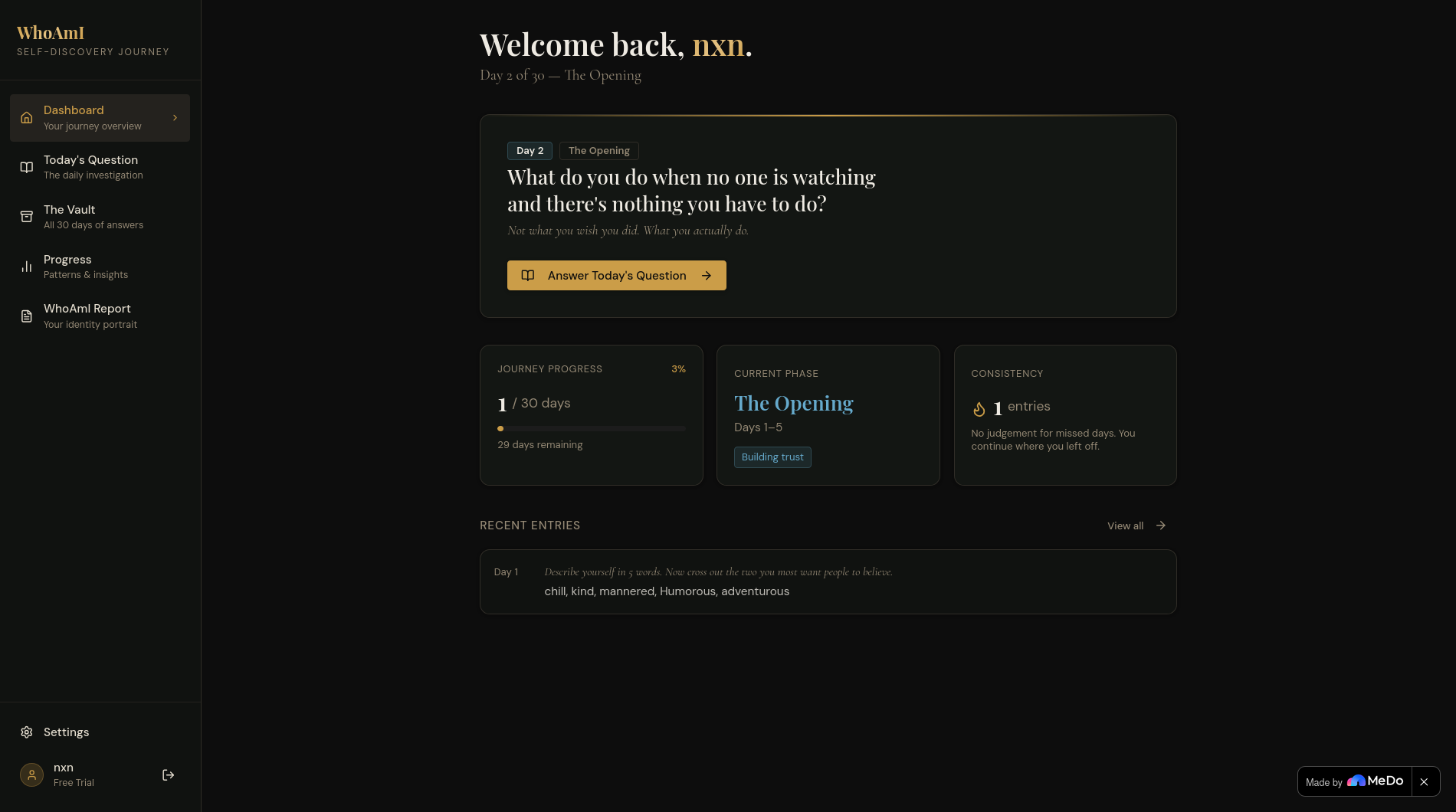
Dashboard Screen
Inspiration
Most people spend their entire lives never truly knowing themselves. We build careers around skills we think we have, stay in relationships based on who we believe we are, and make life decisions rooted in a self-image that was shaped by other people's opinions before we were old enough to question them.
Personality tests exist — Myers-Briggs, DISC, Enneagram — but they all share the same fundamental flaw: they ask you to describe yourself, and then reflect your own description back to you. They measure your self-perception, not your reality.
We wanted to build something different. Something that asks the questions you've never been asked, listens to what you actually say (not what you intended to say), and returns a portrait of who you genuinely are — not who you've been performing.
The inspiration came from a simple, uncomfortable question: If someone followed you around for a year and watched every decision you made, every relationship you navigated, every moment you were alone — what would they say about you?
WhoAmI tries to answer that question. In 30 minutes.
What It Does
WhoAmI is an AI-powered deep personality interview experience that goes far beyond surface-level self-assessment.
Here's how it works:
1. The Interview The user sits with an AI interviewer for 30 minutes. The questions aren't generic — they're adaptive, probing, and deliberately uncomfortable. The AI doesn't ask "are you introverted or extroverted?" It asks things like:
- "Describe the last time you were genuinely proud of yourself. Now tell me why you haven't talked about it."
- "What do you keep forgiving yourself for that you'd never forgive in someone else?"
- "What would the people who love you most say is your biggest flaw — and do you agree with them?"
Each answer shapes the next question. The conversation goes where the truth lives.
2. The Analysis After the interview, WhoAmI's AI engine processes the full conversation across multiple psychological dimensions:
- Core identity vs. performed identity — who you are vs. who you show people
- Fear architecture — what actually drives your avoidance behaviors
- Values in action — what you actually prioritize vs. what you say you do
- Relationship patterns — how you connect, withdraw, and protect yourself
- Blind spots — the things everyone around you probably sees that you don't
3. The Report The user receives a layered, brutally honest personality portrait. Not a score. Not a four-letter type. A written profile that reads like it was written by someone who has known you for years — because in a sense, the AI just spent 30 minutes doing exactly that.
The report includes:
- A "Who You Are" narrative
- A "Who You Think You Are" contrast
- Your top 3 hidden strengths
- Your top 3 blind spots
- A "Gap Score" — the distance between self-image and behavioral reality
- One personalized question to sit with for the next 30 days
How We Built It
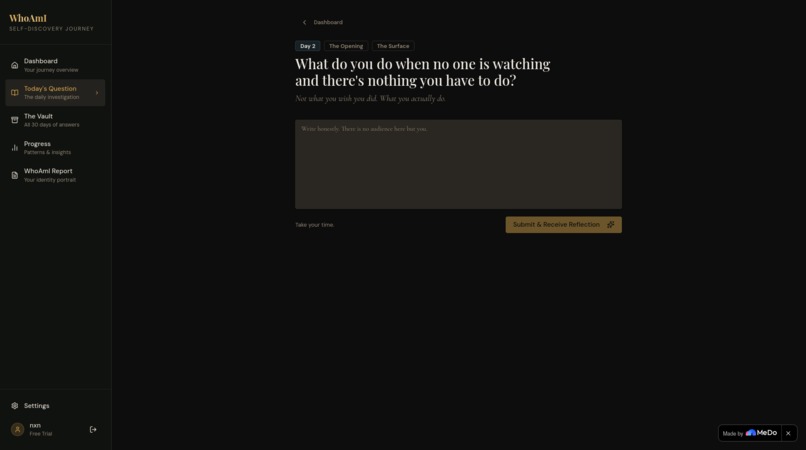
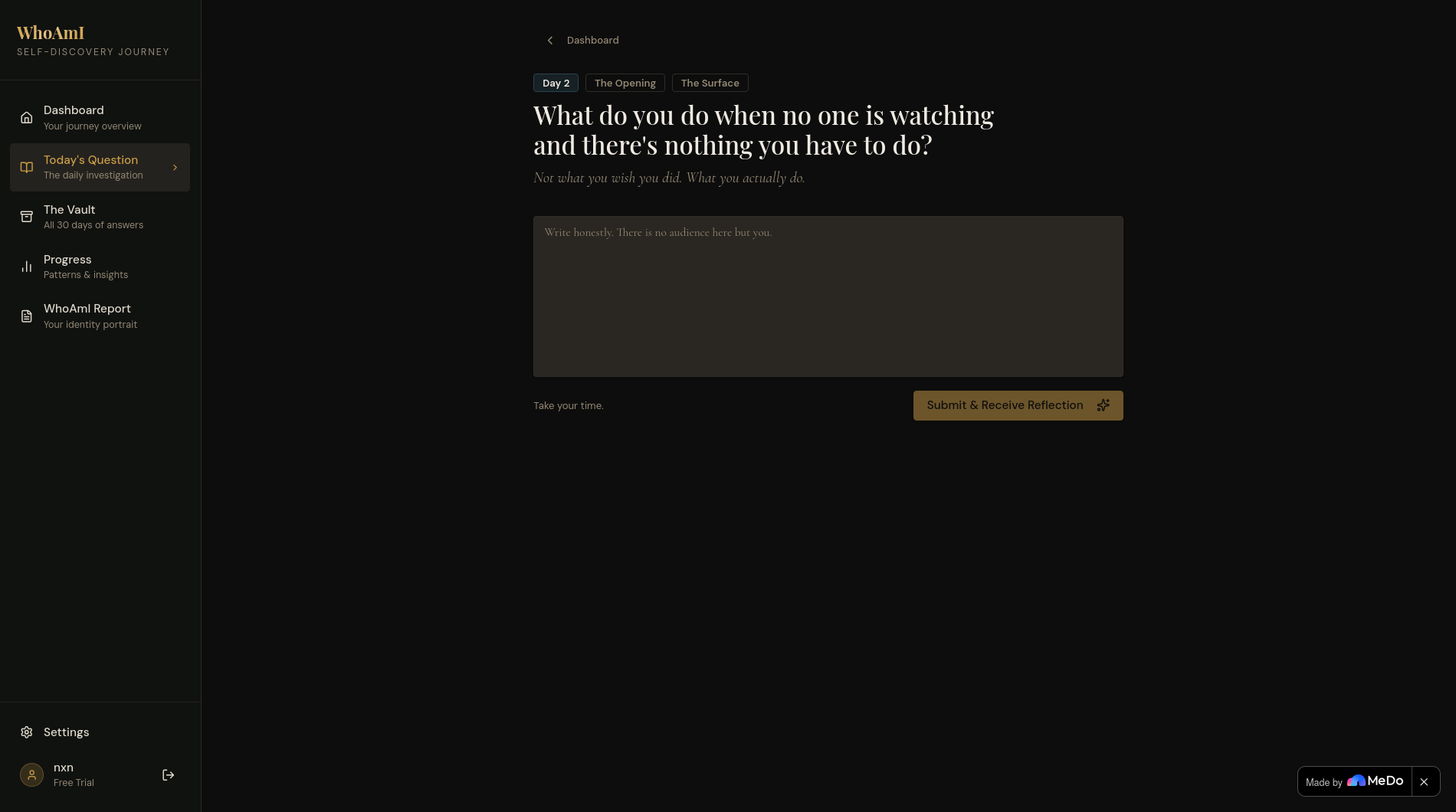
Frontend Built with React and Tailwind CSS. The interface is intentionally minimal — dark, quiet, and distraction-free. The experience is designed to feel like a private room, not an app. Every design decision prioritized emotional safety and focus.
Conversation Engine Powered by Claude (Anthropic) via the API. We engineered a multi-layered system prompt that gives the AI the persona of a skilled psychologically-informed interviewer — curious, non-judgmental, and relentlessly precise. The prompt includes:
- Adaptive questioning logic based on answer depth and emotional tone
- Flagging mechanisms for deflection, contradiction, and over-explanation
- Thematic tracking across the full conversation to build a coherent psychological thread
Analysis Layer After the interview concludes, the full transcript is passed through a second AI call with a separate analytical prompt. This prompt is built around frameworks drawn from cognitive behavioral psychology, attachment theory, and narrative identity research. It generates the structured report in a consistent format while keeping the language deeply personal.
Storage & Session Management User sessions are handled in-memory for the hackathon build. The transcript is never stored beyond the session — privacy was a non-negotiable design principle from day one.
Stack Summary
- Frontend: React, Tailwind CSS
- AI Engine: Gemini 2.5 Flash
Challenges We Ran Into
Making the AI ask — not just answer Getting an LLM to be a genuinely skilled interviewer is harder than it sounds. By default, AI wants to be helpful, affirming, and complete. A good interviewer is none of those things — they sit with silence, they push back, they ask the follow-up you hoped they wouldn't. It took dozens of prompt iterations to get the interviewer persona to feel human, probing, and psychologically credible.
Preventing surface-level answers Users instinctively give their "best" answers — the version of themselves they want to present. We had to build detection logic that recognizes when someone is performing rather than reflecting, and redirects without making them feel interrogated.
The emotional weight of the experience Some users hit genuinely difficult territory during the interview. We had to carefully calibrate the AI to be honest without being harmful — to name hard truths gently rather than bluntly. Finding that line between insight and damage was one of the most delicate challenges of the build.
Report tone Early versions of the report felt clinical. Later versions felt like flattery. Getting the tone right — honest, warm, specific, and grounded — required writing and rewriting the analysis prompt more times than anything else in the project.
Time Thirty minutes of adaptive conversation generates an enormous amount of signal. Distilling that into a report that feels complete but not overwhelming — all within a hackathon window — was a genuine constraint that forced us to make hard cuts.
Accomplishments That We're Proud Of
- Built an AI interviewer that multiple testers described as "the most honest conversation I've had in years" — including one person who cried
- Achieved real adaptive questioning — the AI never asks the same second question twice, because no two people give the same first answer
- Designed a report format that feels personal enough to frame on a wall and uncomfortable enough to sit with for weeks
- Built a psychologically responsible experience — the AI consistently demonstrates care, never weaponizes vulnerability, and always ends with agency returned to the user
- Shipped a complete, end-to-end experience within the hackathon window that testers wanted to share with people they love
What We Learned
Honesty is a design problem. Getting an AI to be genuinely honest with a human — not cruel, not diplomatic, but true — is one of the hardest design challenges we've encountered. Every word in the system prompt matters.
People are starving for real reflection. Every single tester stayed for the full 30 minutes. Nobody dropped off. That told us something profound about how rarely people get to be truly seen and heard — even by a machine.
The gap between self-image and reality is universal. Across all our testers — different ages, backgrounds, personalities — every single person had a meaningful gap between who they thought they were and what their answers revealed. That's not a bug in people. It's a feature of being human. And it's exactly why WhoAmI needs to exist.
Psychological safety is a product feature. The moment a user feels judged or exposed without consent, the experience collapses. Designing for trust — through tone, pacing, interface design, and privacy decisions — is as important as the AI itself.
What's Next for WhoAmI
Re-Interview in 6 Months The most powerful version of WhoAmI isn't a single session — it's a longitudinal one. We want to bring users back every six months to re-interview them and show them how they've changed (or haven't). A "growth delta" over time is where the real insight lives.
Relationship Mode Two people — partners, co-founders, close friends — each complete the interview separately, then receive a joint report showing where their self-perceptions align and diverge. A tool for radical relational honesty.
Therapist Integration A version of the report formatted specifically for therapeutic contexts — something a user can bring to their therapist as a starting point, collapsing months of getting-to-know-you sessions into one document.
Team WhoAmI An organizational version where team members complete individual interviews and leadership receives an anonymized team dynamics report — conflict patterns, communication gaps, hidden strengths nobody is using.
Multilingual Expansion Self-knowledge doesn't speak only English. We want WhoAmI available in every major language, with culturally adapted questioning frameworks that understand the different ways identity is constructed across cultures.
The WhoAmI Index An opt-in, anonymized aggregate dataset of human personality patterns — the largest study of self-image vs. behavioral reality ever assembled. Not for profit. For understanding what it means to be human.
WhoAmI was built because we believe self-knowledge is the most underrated form of intelligence. And we think everyone deserves a mirror that tells the truth.
Built With
- css
- gemini
- html5
- javascript
- react
- tailwind

Log in or sign up for Devpost to join the conversation.