-
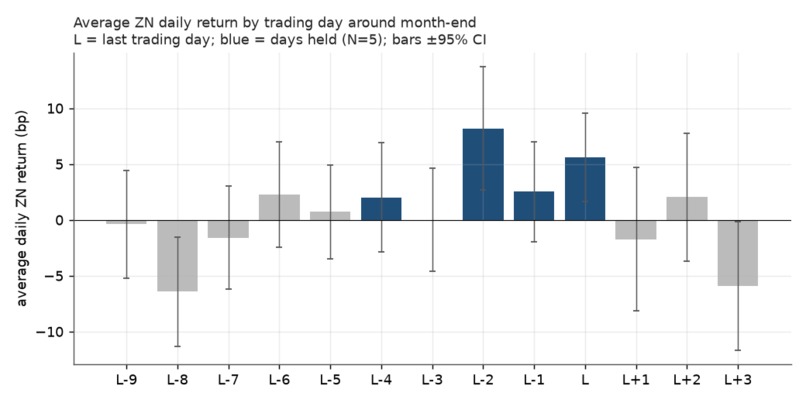
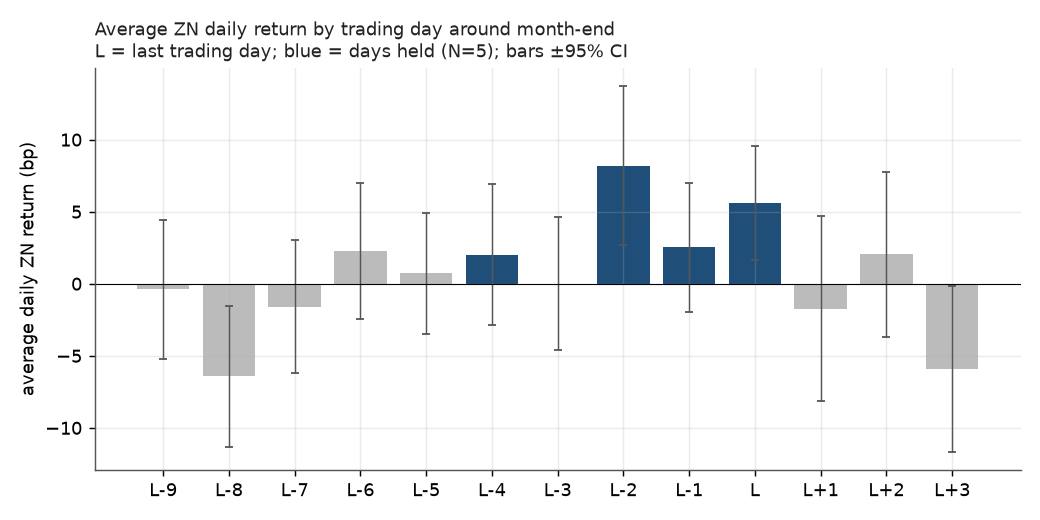
Avg 10-yr Treasury future return by day around month-end, 2010–24. The 5 days we hold (blue) carry the gains.
-
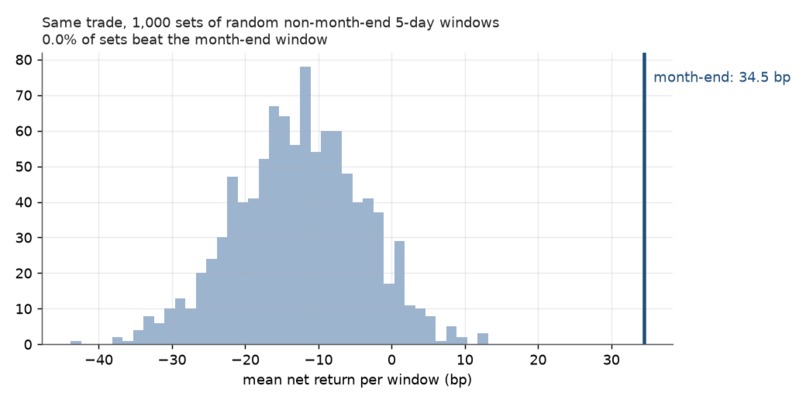
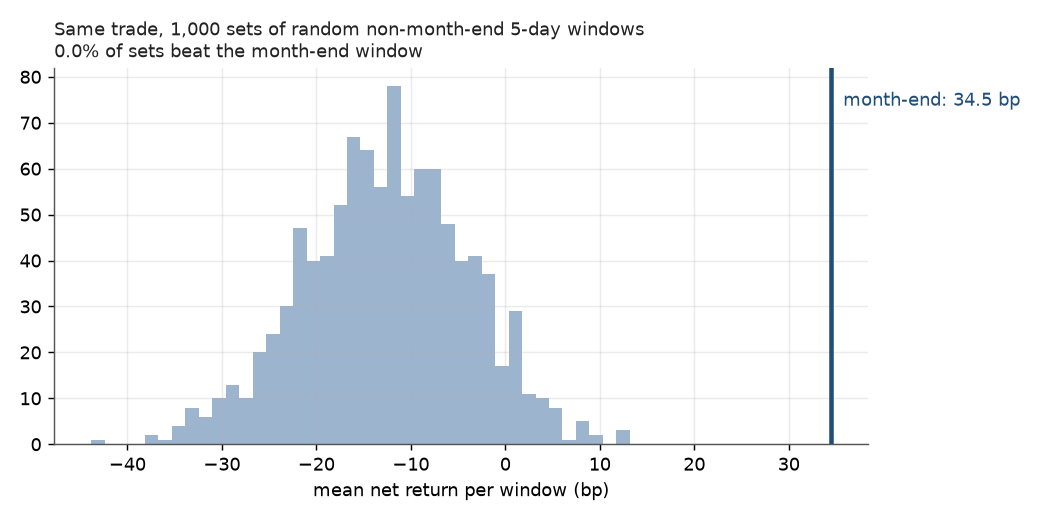
Same trade on 1,000 sets of random non-month-end windows. None beat the month-end average of +34.5 bp.
-
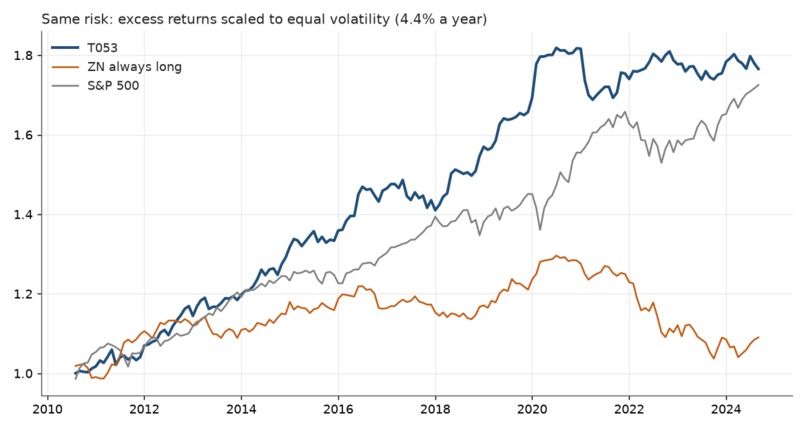
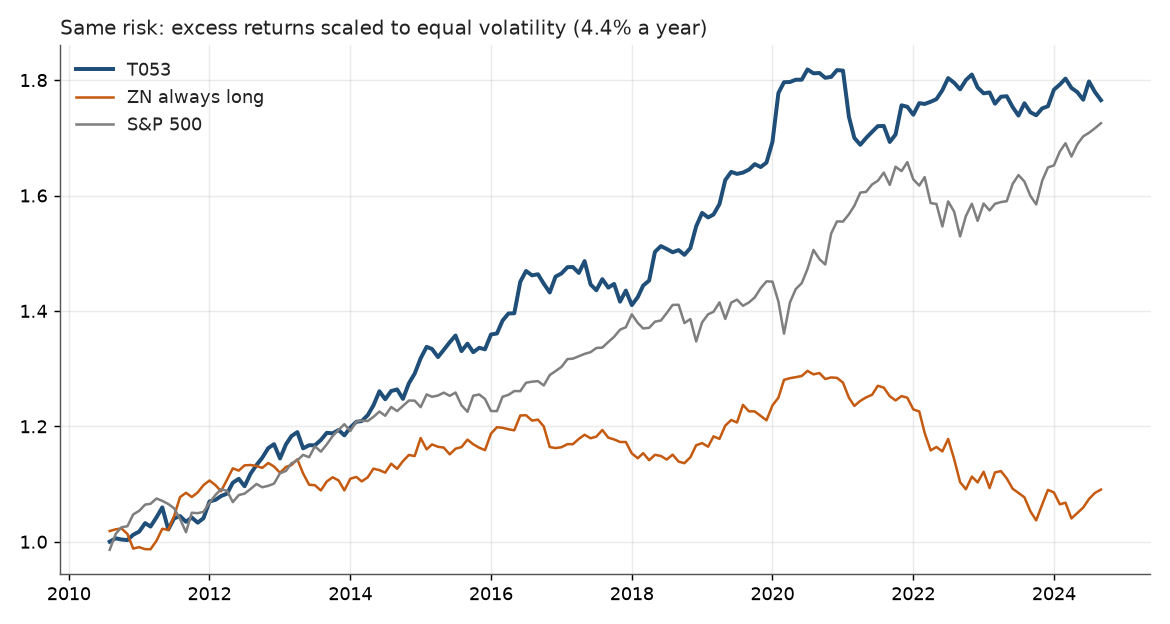
At equal risk, the month-end strategy (blue) beat holding Treasury futures all the time and the S&P 500, 2010–24.
-
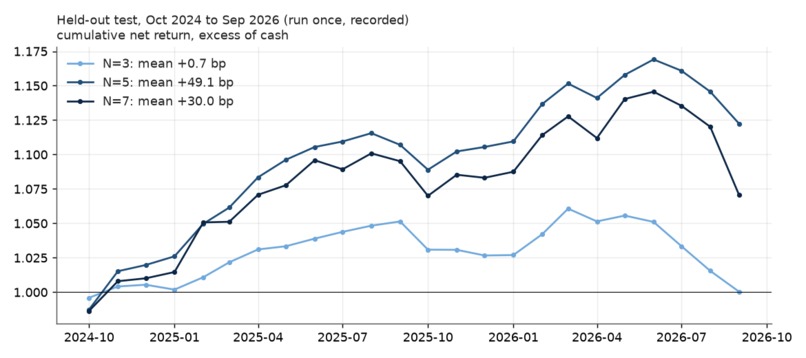
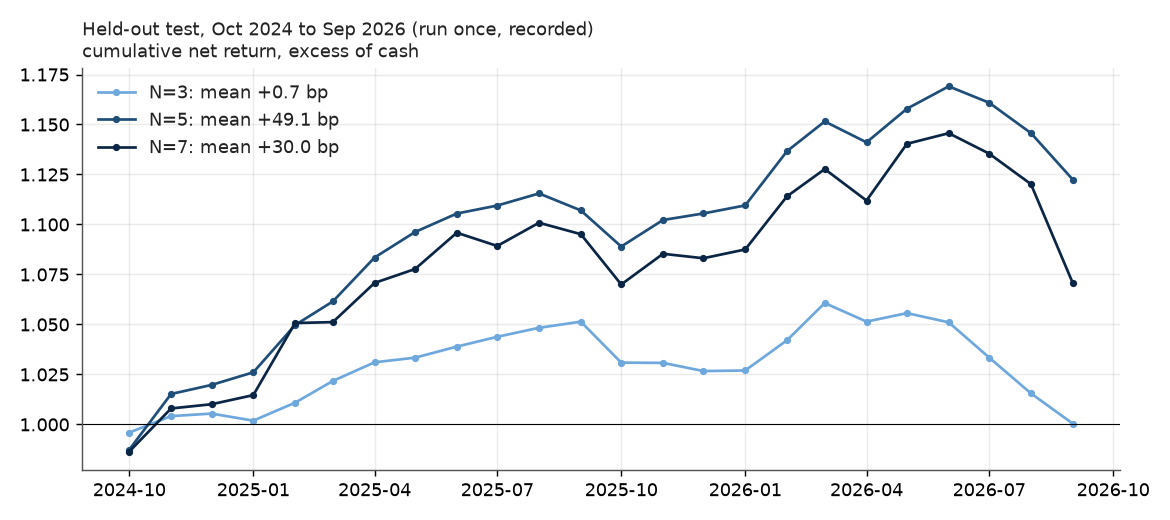
Held-out 2 years, run once: 5-day version averaged +49 bp per month-end.
Inspiration
Bond index funds have a strange monthly chore. On the last business day of each month their index gets longer: new long bonds come in, anything under a year drops out. The funds have to buy duration that day to keep tracking. That's billions of dollars of buying on a known date. We wanted to know if the futures market still lets you see it coming.
What it does
The rule is simple. Buy the 10-year Treasury future five trading days before month-end, sell at the last settle, size to 10% volatility.
From 2010 to 2024, after costs, that earned a Sharpe of 0.94. Holding the same future all month earned 0.16. The average trade made +34 bp (t 3.5 over 169 month-ends) and stayed above +31 bp with costs doubled. The return comes from the timing, not from owning bonds. In 2022, when the 10-year future lost 13.8%, the strategy was up 1.9%.
We held back the last two years and ran them once at the end. All three window lengths stayed positive, but 24 months is too short to confirm it.
How we built it
We wrote the hypothesis down and committed it before running any backtest. Every idea after that got the same treatment: pre-register, check the data, try to break the result, log it either way. By Sunday morning that was 303 counted trials, and almost all of them failed. They're all in the repo.
The part we're proudest of is the "why":
- Who buys: CFTC positioning data shows asset managers adding Treasury futures longs in month-end week, with leveraged funds on the other side.
- Before index funds: in 1990–2009, before bond index funds were large, month-end yields moved the other way.
- What doesn't matter: hedging out the rate move leaves nothing, so this is a duration trade, not a curve trade.
The weather detour
Halfway through we got curious about something else. The fastest trading firms send CME prices to Europe by shortwave radio, because it beats fibre by about 10 milliseconds. Solar flares black out shortwave. So we asked whether you can see a flare in the order book.
What we found:
- The radio shows up in public prices. S&P futures in Chicago lead Euro Stoxx futures in Frankfurt by 25 ms. Light needs 23.4 ms, and fibre can't do better than about 35.
- It's one-way. Prices go Chicago to Frankfurt at radio speed but come back at fibre speed, a 10 ms gap. A blind re-run by the other half of the team reproduced it. A trading simulation explains why nobody built the return link: it wouldn't pay.
- Flares mostly don't break it. Amateur radio on the same path went completely dark during a big flare, from 202 signals down to zero. The HFT link barely moved. We saw a hint in the strongest flares (p 0.06 on flares we hadn't looked at), but couldn't confirm it.
- Rain on microwave didn't hold up either. A 2020 paper found rain slows the Chicago–New Jersey microwave link. We saw it in one sample (p 0.0004), then failed to replicate it on 102 fresh hours(p 0.82).
None of it became a strategy. But we learned more about how the market physically moves information than anything else this weekend taught us.
Challenges
The hardest part was not fooling ourselves. Our first flare test came back flat, and only an audit showed it couldn't have seen a partial outage anyway. A rain result that looked great died on replication. Keeping honest trial counts with two people and a lot of AI help took real discipline.
What we learned
A lot of edges disappear once you test them on data you haven't seen. A test that comes back empty proves nothing until you've checked it could have found the effect. And the boring calendar trade with a clear buyer beat every exotic idea we tried.
What's next
Rerun the frozen flare test on the next big X-class flares as they happen, and keep scoring the month-end trade live.

Log in or sign up for Devpost to join the conversation.