-
-
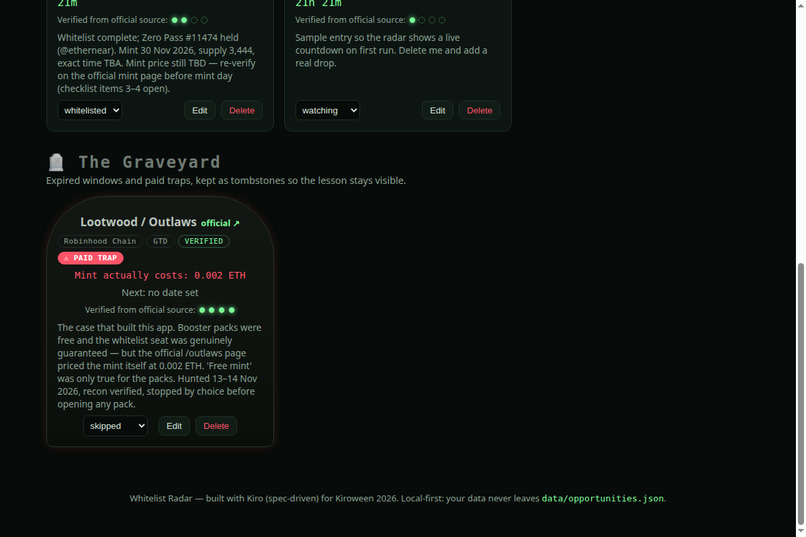
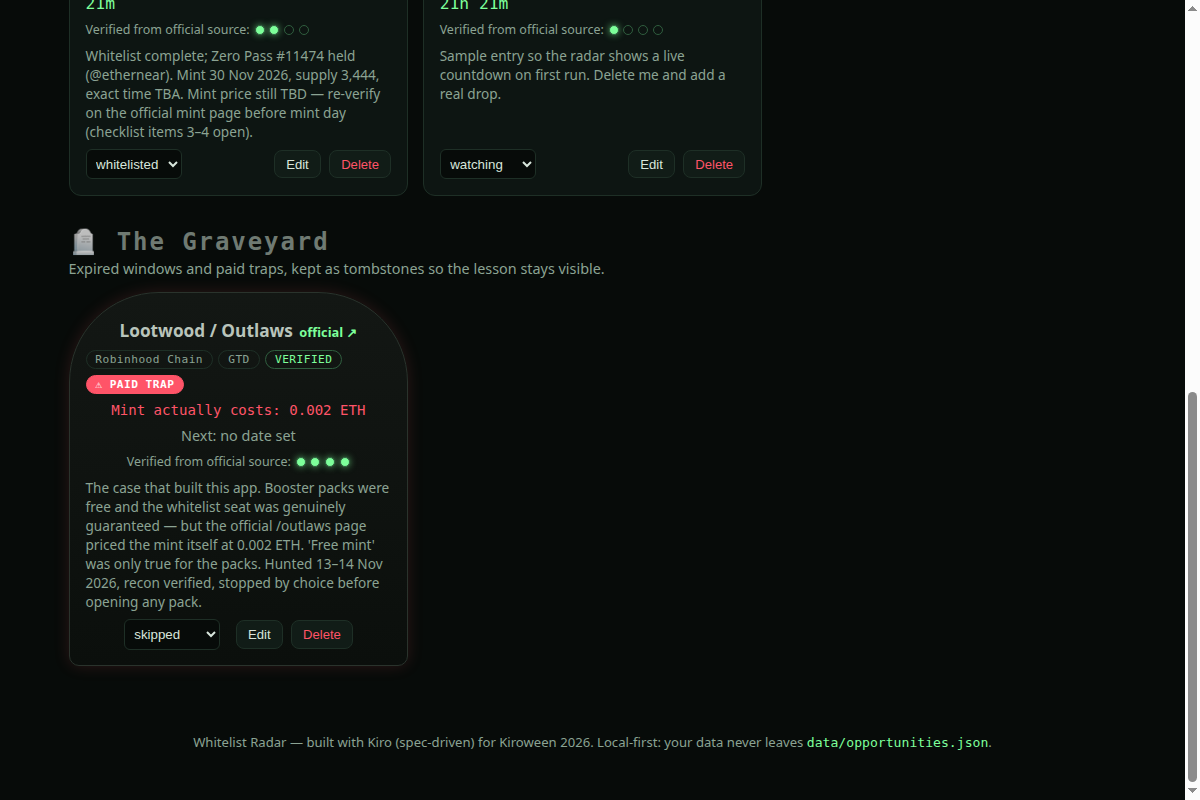
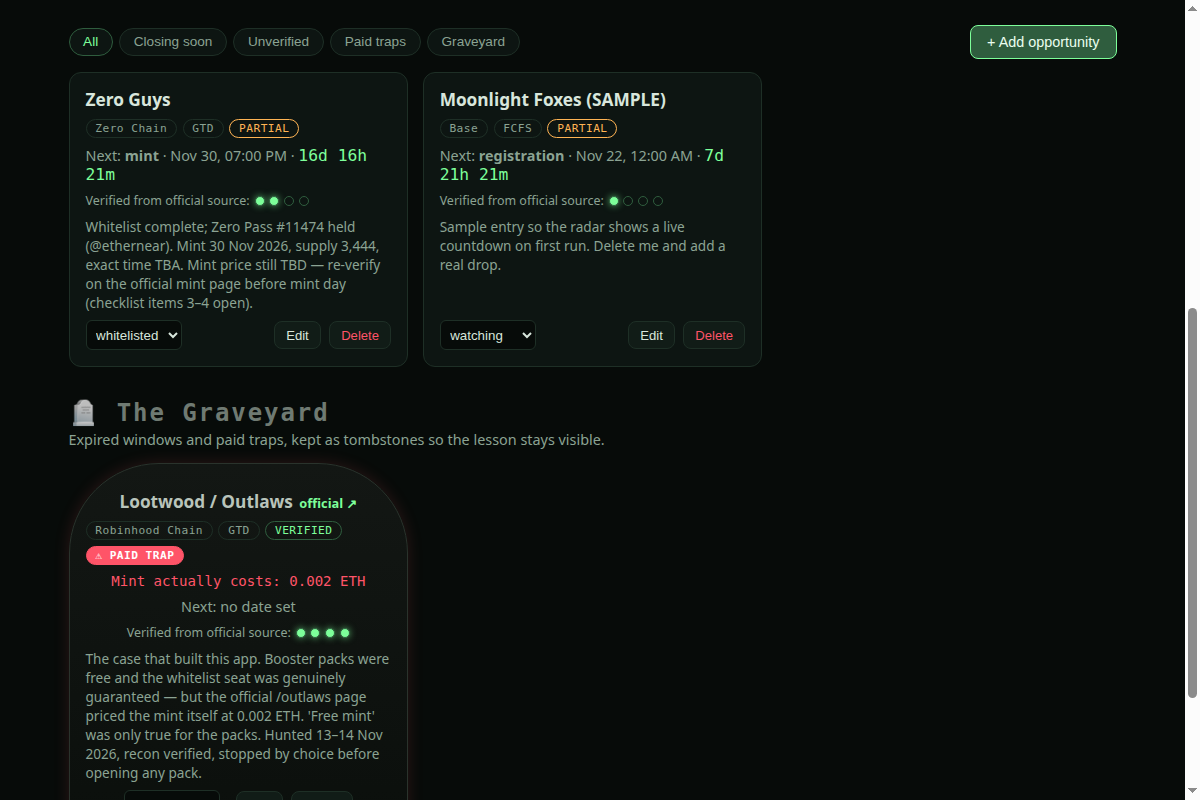
The Graveyard keeps paid traps as tombstones. Lootwood's "free" mint actually costs 0.002 ETH — the case that built this app.
-
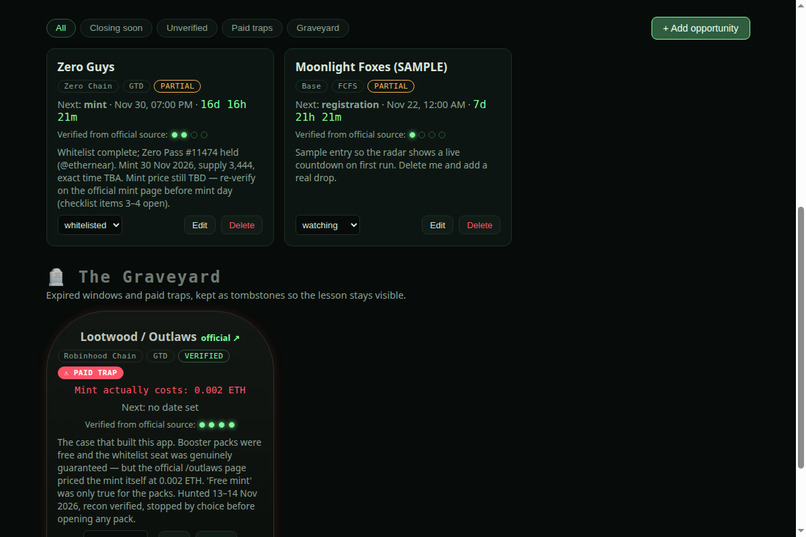
Verification checklists — an opportunity stays UNVERIFIED until all four checks are confirmed against official sources.
-
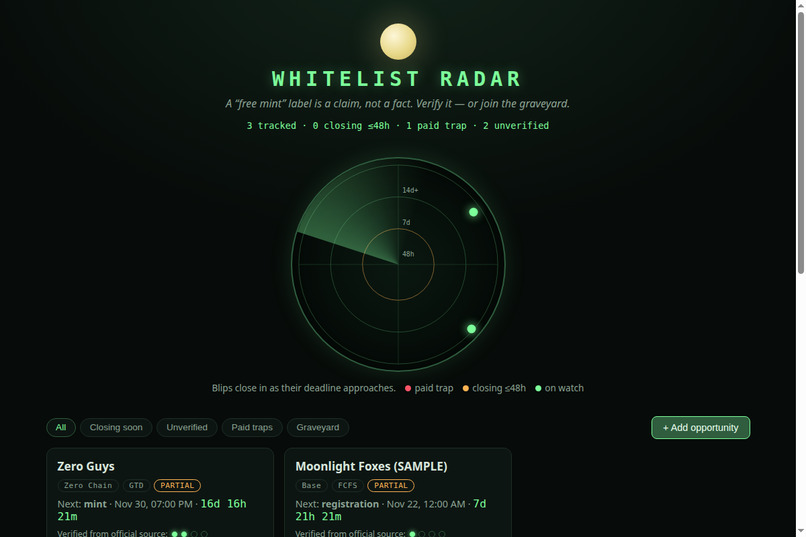
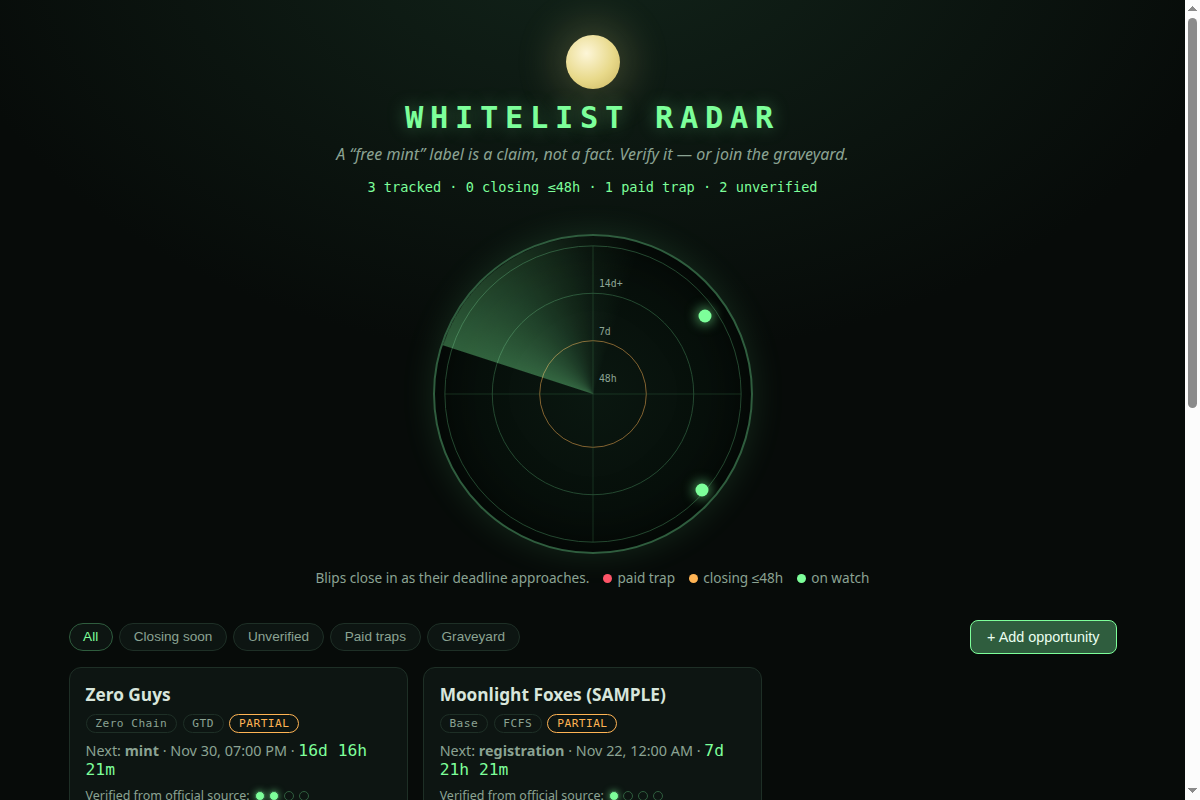
The deadline radar — every whitelist deadline and mint date is a blip; the closer it gets, the closer to the center it creeps.
Inspiration
What it does
How we built it
Challenges we ran into
Accomplishments that we're proud of
What we learned
What's next for Whitelist Radar
Inspiration Whitelist Radar was born from a real near-miss. While hunting free-mint whitelist spots, I found a project offering free booster packs and a genuinely guaranteed whitelist seat — while its official mint page quietly priced the mint at 0.002 ETH. The packs were free. The seat was guaranteed. The mint was not free. I stopped in time, but the lesson stuck: in Web3, a "free mint" label is a claim, not a fact. I built the tool I needed that night. What it does Whitelist Radar is a haunted tracker for NFT whitelist and free-mint opportunities: • Deadline radar — every registration deadline and mint date is a blip on the radar; the closer it gets, the closer to the center it creeps (inner ring = 48 hours). Paid traps glow red. • Verification checklist — an opportunity stays UNVERIFIED until four checks are confirmed against official sources: official site, official X account, mint price read on the official mint page, and contract/mint terms. • Paid-trap flag — if a "free" mint turns out to cost money, the flag overrides everything else on the card, with the real price attached. • The Graveyard — expired windows and paid traps are kept as tombstones instead of being deleted, so past mistakes stay visible. • Live countdowns, filters (closing soon / unverified / paid traps / graveyard), and full add-edit-delete. How I built it Spec-first with Kiro. The repo began as .kiro/specs/whitelist-radar/ — EARS requirements with explicit correctness properties, a design doc, and a task plan — guided by three always-on steering files (product, tech, structure). The app itself is deliberately boring tech: a zero-dependency Python standard-library server plus vanilla JS, runnable with one command (python3 server.py), with a JSON file store. The second iteration was driven through live Kiro CLI sessions: the spec's properties were formalized (CP1–CP5), the core derive() function was refactored for deterministic testing, agent hooks were converted to the current v1 format, and the AWS Knowledge MCP server was used in-session to research the hooks schema. Session transcripts are committed in the repo (docs/kiro-sessions/). Challenges I ran into My pre-written agent hooks used an obsolete .kiro.hook schema that current Kiro no longer recognizes — they would never have fired. The live Kiro session caught this via MCP documentation research and rewrote both hooks to v1 JSON. I also learned that agent hooks and command hooks behave differently in the CLI's non-interactive mode; I documented that asymmetry honestly in the write-up instead of claiming both fired. Accomplishments that I'm proud of The spec is an executable contract, not documentation theater: a property-based test suite checks the five correctness properties over 2,000 seeded random cases plus boundary cases — 11,058 assertions, 0 failures — and the end-to-end smoke suite passes 26/26. The spec-sync agent hook fired three times during the live sessions, forcing a spec-consistency review on every server save. And the radar's first real entry is the very trap that inspired it, flagged at its real 0.002 ETH price. What I learned Spec-driven development pays for itself the moment something drifts: the two decisions that make this app trustworthy — deriving all state in one server-side function, and giving the paid-trap flag precedence over "verified" — were forced by writing the spec before the code. I also learned to verify tooling claims empirically: hooks, MCP, and property tests are all described in the write-up exactly as they behaved, including the parts that didn't fire. What's next for Whitelist Radar A public deployment with shareable radar views, optional X-post monitoring so new drops land on the radar automatically, and a community graveyard: a shared, verifiable record of paid traps so other hunters stop learning the same lesson the expensive way.
Built With
- javascript
- kiro
- mcp
- python
