Inspiration
There's a scene in Kingsman where Eggsy gets fed the right answers through his earpiece. We wanted that for everyday life, for the moment you say you love an artist and a real fan asks, "Wait, you saw him live? Which show?"
What it does
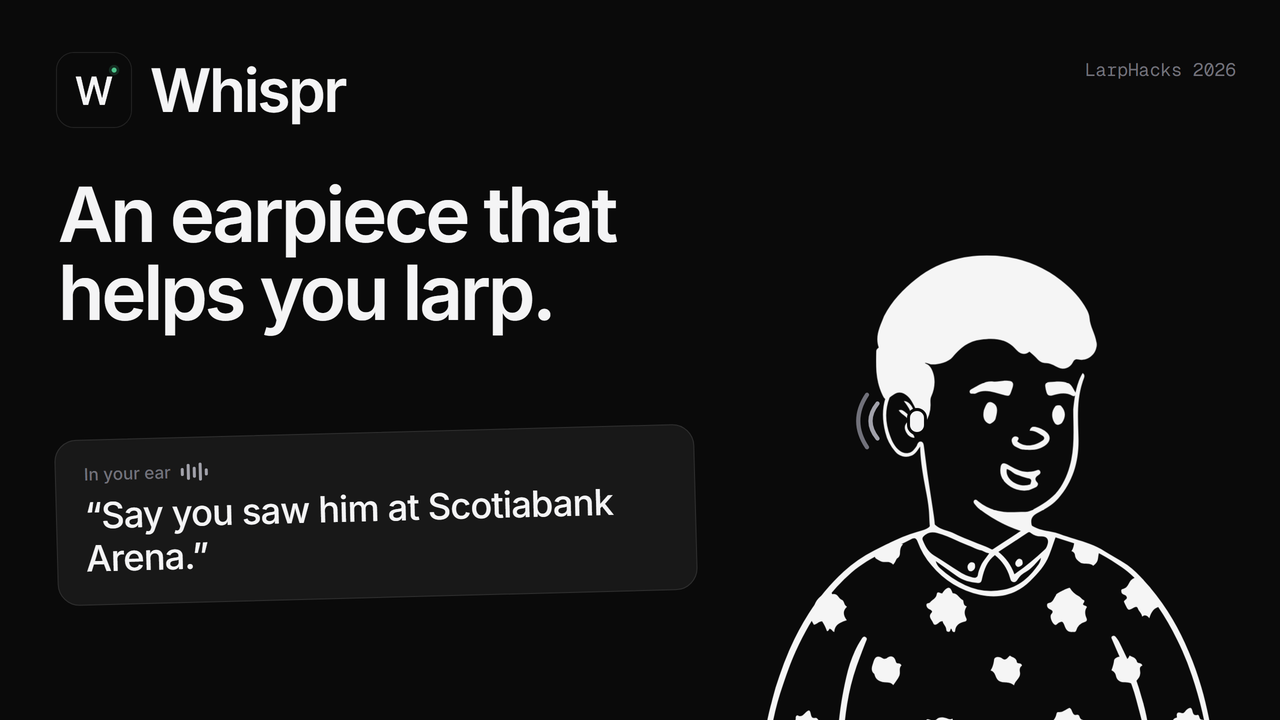
Whispr is an earpiece that helps you larp. It's a lighthearted improv game for iPhone and headphones.
- Whispers your next line: it listens to the conversation and gives you a short cue in your ear, with the full line on screen.
- Finds the proof: when someone asks for evidence, a background task looks for a believable photo and puts it on your phone while you keep talking.
- Gets you out: when the bluff falls apart, Panic rings your phone with a fake call so you can walk away.
- Plays different roles: superfan, job candidate, first date or over-the-top car salesman, and every persona follows whatever the conversation is really about.
- Shows how close you are to getting caught: a live reading updates as the other person talks.
How we built it
- iPhone app (SwiftUI): captures the mic, plays whispers through your headphones, shows the line and the photo, and runs the fake call. Sign-in uses Supabase and remembers you.
- Audio gateway (Node and TypeScript): streams speech to ElevenLabs Scribe for live transcription, works out who's talking, and speaks whispers with ElevenLabs Flash.
- Brain (Python and FastAPI): Jev by TypeSafe AI makes the fast decisions on each finished line: who spoke, whether you need help, whether to find a photo, and how much danger you're in. Claude Haiku 5.5 writes the words, and Brave Search finds the photos.
Challenges we ran into
- Telling two voices apart: Scribe's real-time mode doesn't label speakers, and Whispr must never coach you on your own words. We started with loudness, then moved to voiceprints so it works even when both people talk at the same volume.
- Getting lines that were actually useful: early whispers were vague or kept drifting back to one artist. Too few rules gave generic lines, and too many made the AI admit it didn't know or invent facts. We kept testing the prompts on real conversations to find the balance.
- Speed: a whisper that arrives late is useless, so we cut the spoken cue to a few words and made every failure fall back gracefully.
- Photos on a real phone: many image hosts refuse app requests, so the gateway downloads each photo and serves it itself.
- Building fast in parallel: we accidentally built two separate brains at the same time, one in Node and one in Python, then merged them into one system.
Accomplishments that we're proud of
- A full loop from live speech to a whisper in your ear, with proof on your phone
- A fake call that gives you a real way out of the conversation
- Four personas running on one shared brain
- Automated tests across the brain and the gateway
What we learned
- Prompt rules interact: fixing one problem often creates another, so measuring real output beats guessing.
- Keeping decisions and writing separate pays off: a fast model decides whether to speak, and another writes the words.
- In a live demo, fallbacks matter as much as features.
What's next for Whispr
- Handling group conversations, including knowing when a line is aimed at you
- Whispers that stay accurate on questions with one right answer
- More personas
Built With
- brave
- callkit
- claude
- elevenlabs
- fastapi
- jev-(typesafe-ai)
- node.js
- python
- render
- supabase
- swift
- swiftui
- typescript


