-
-
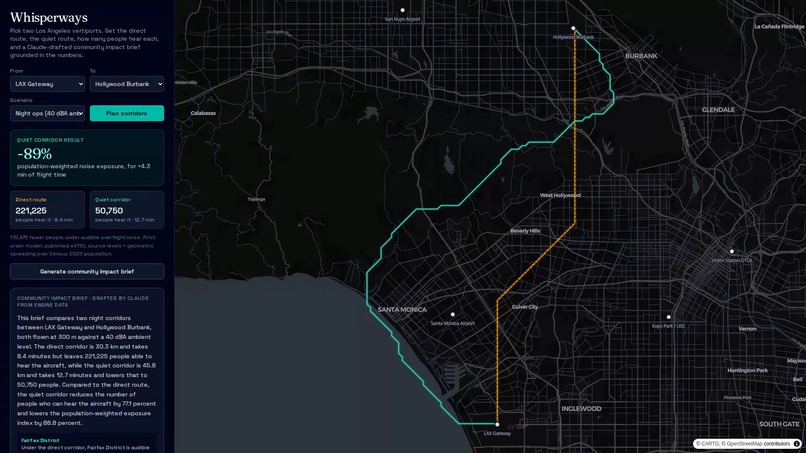
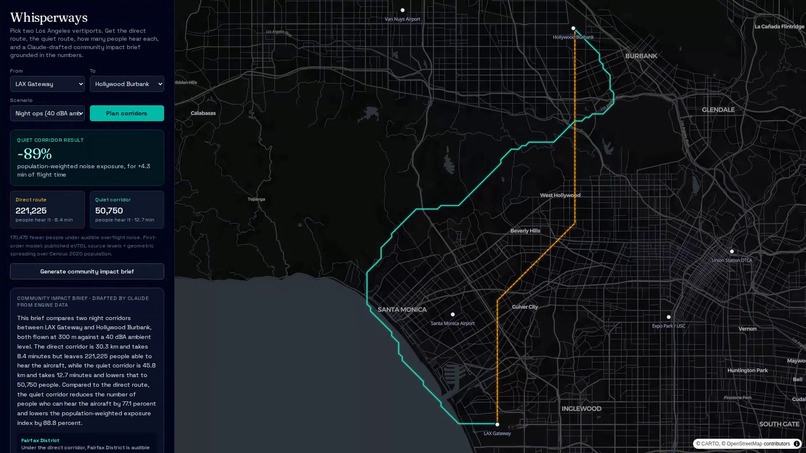
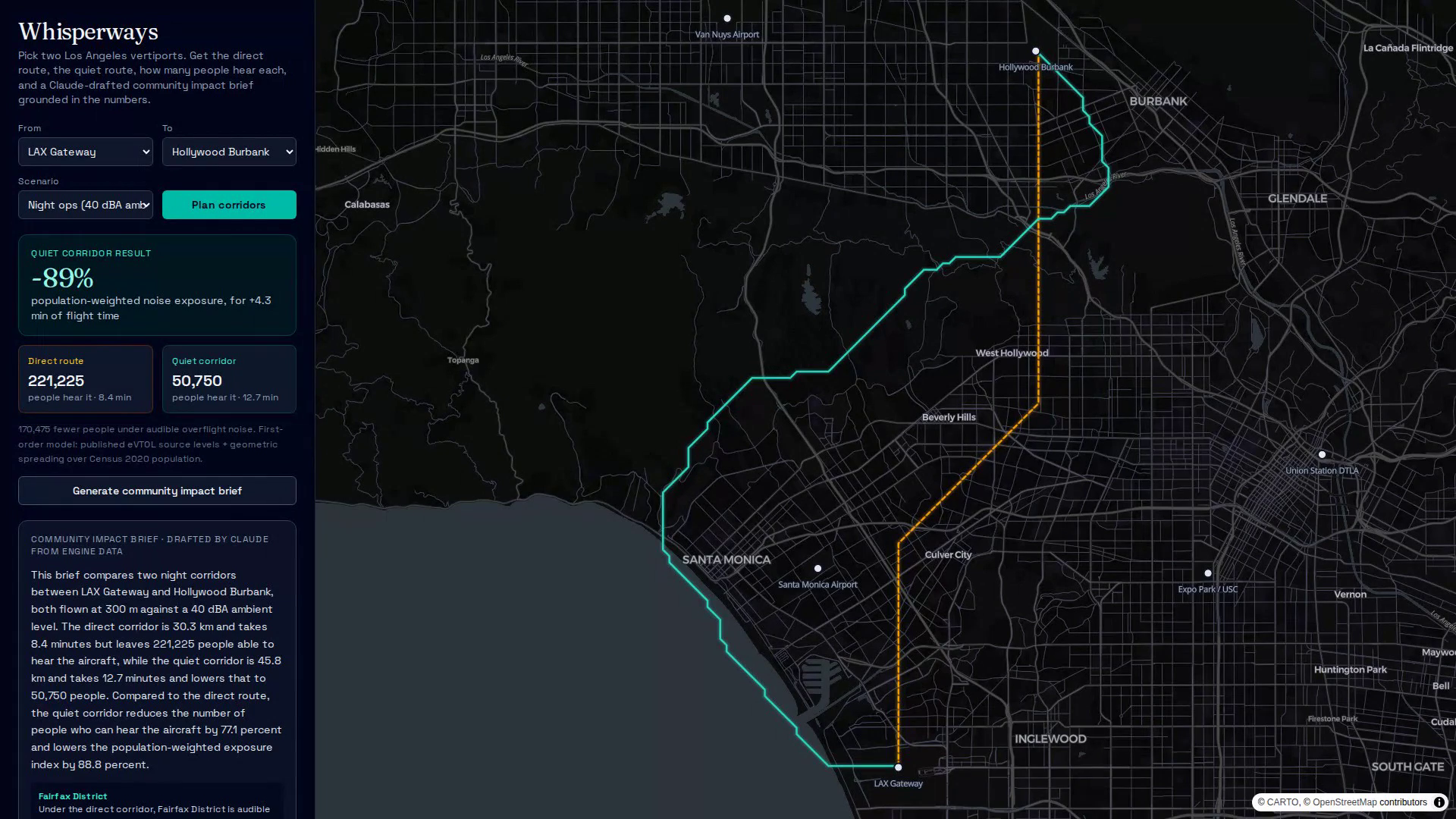
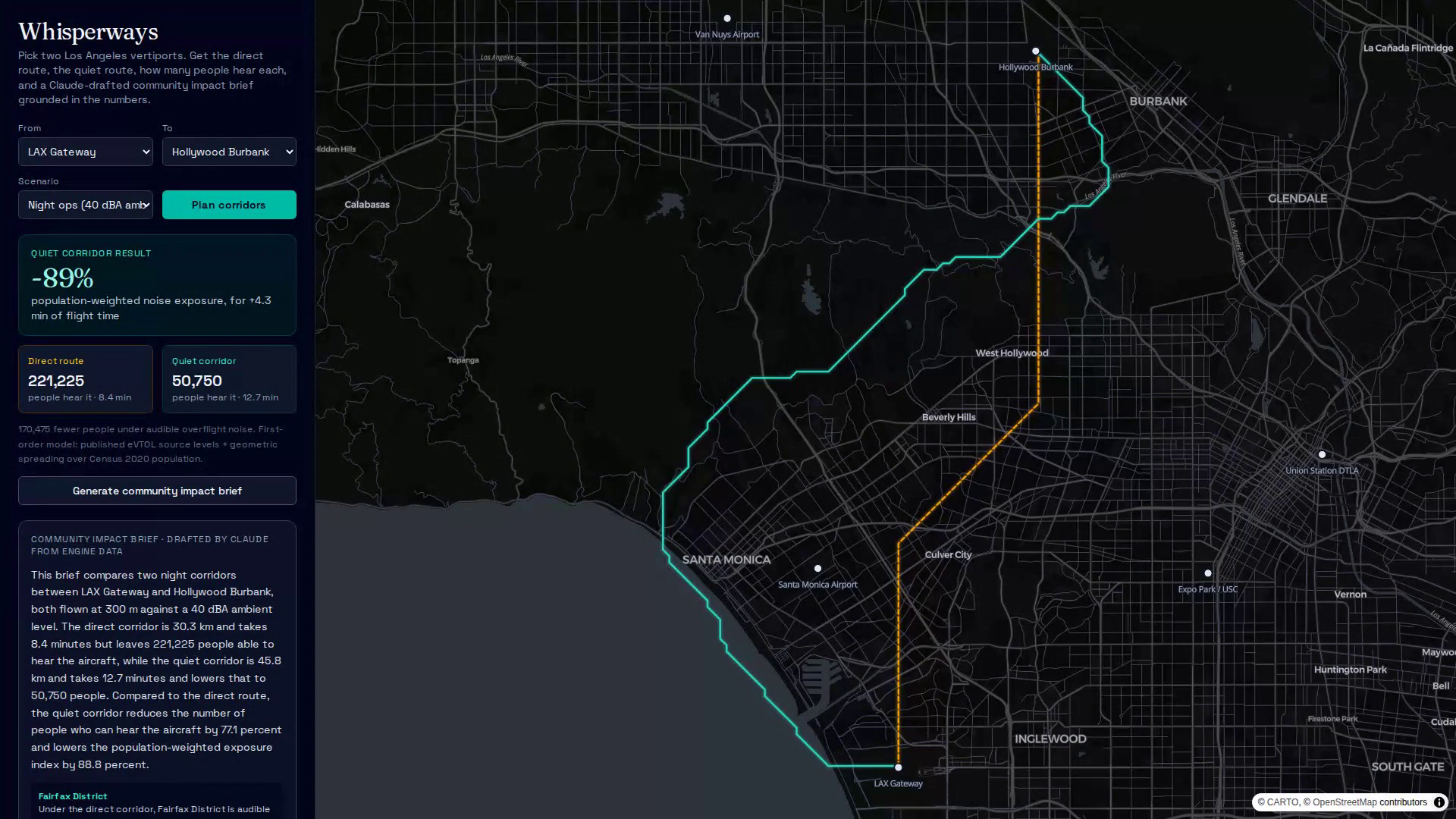
LAX to Burbank at night: the amber direct route and the teal quiet corridor the engine found over real census population.
-
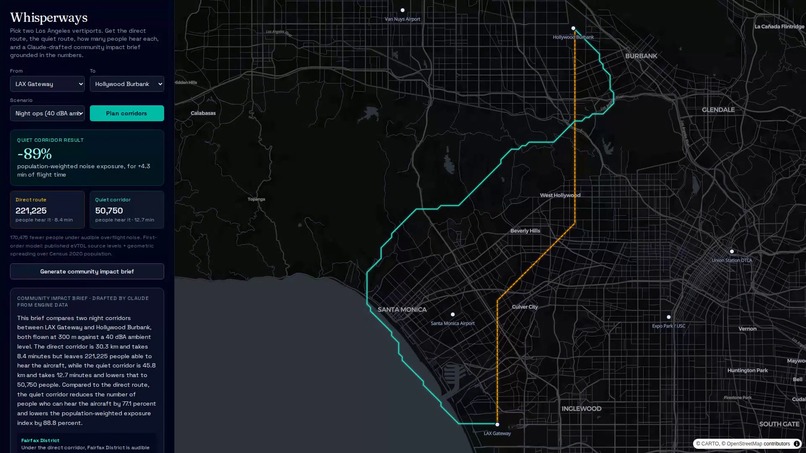
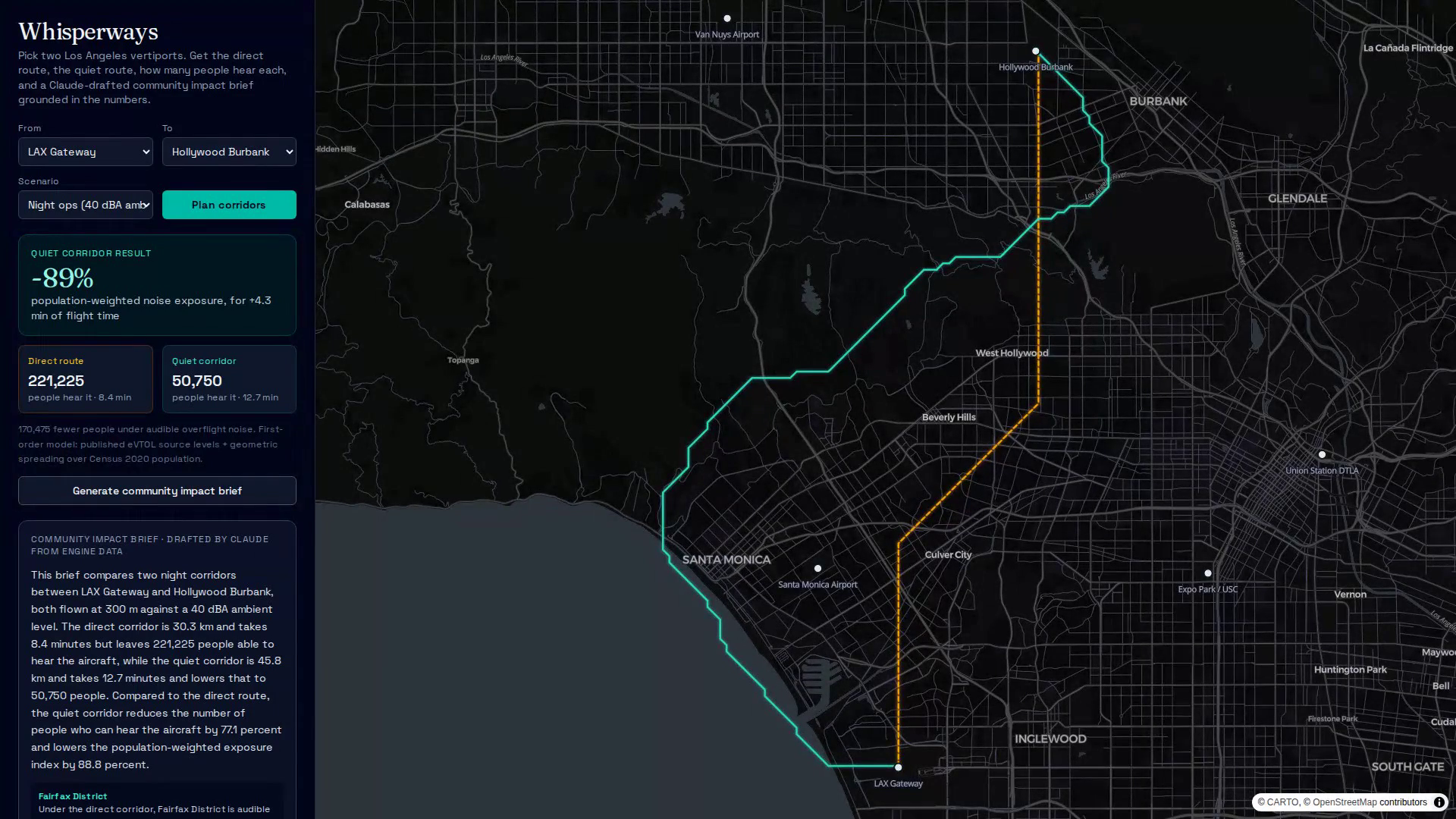
Claude's community impact brief, grounded only in engine output: what Fairfax District hears under each corridor.
-
The trade, computed: 77 percent fewer people audible, an 89 percent lower exposure index, for 4.3 extra minutes.
-
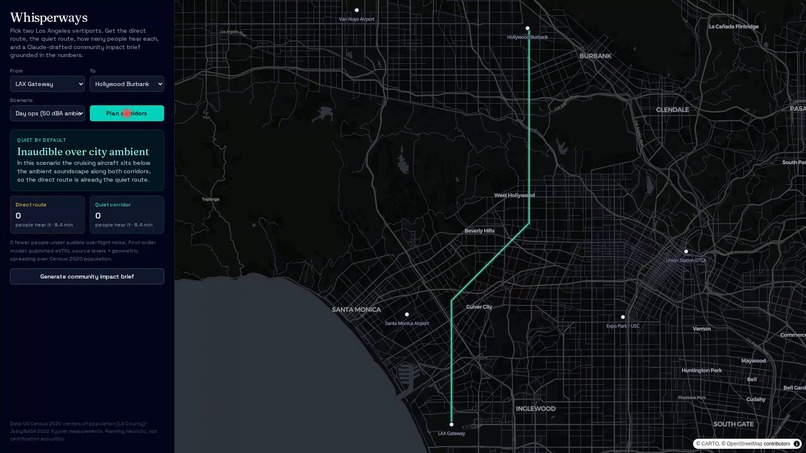
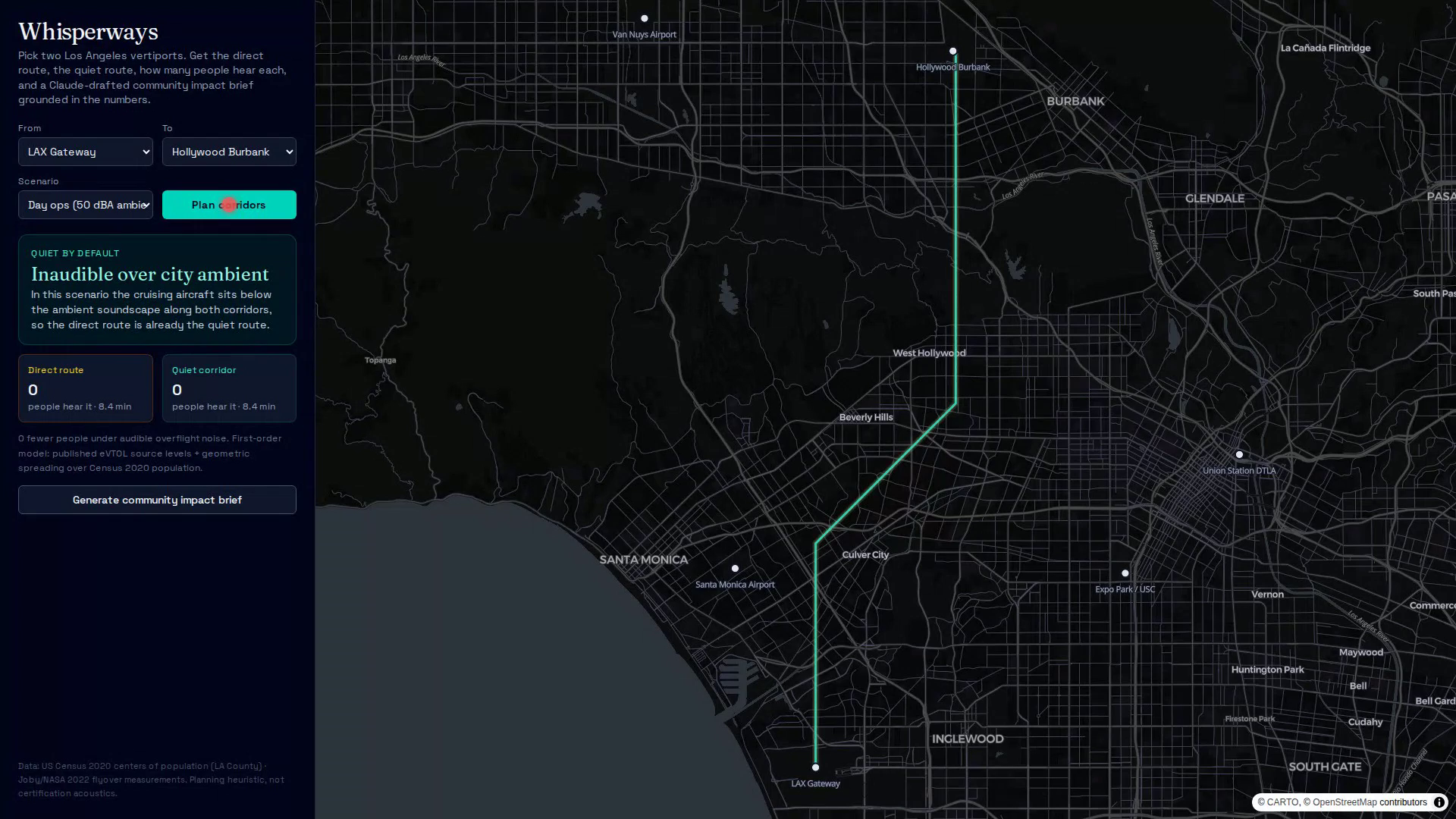
Honesty built in: by day a cruising eVTOL sits below city ambient, and Whisperways says so instead of inventing a benefit.
-
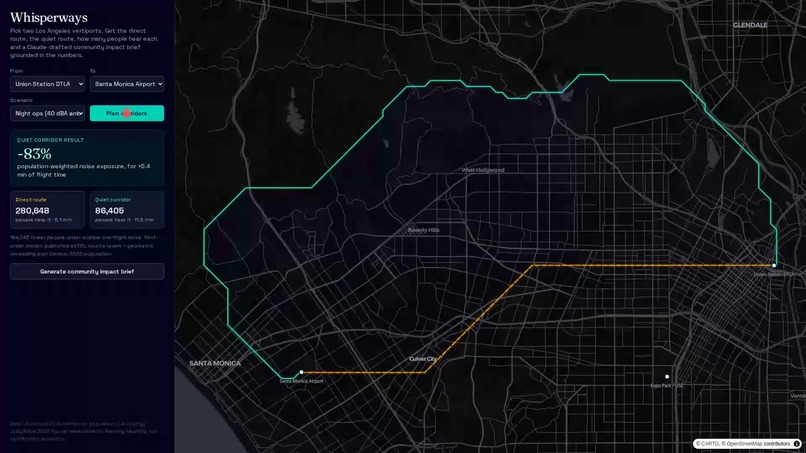
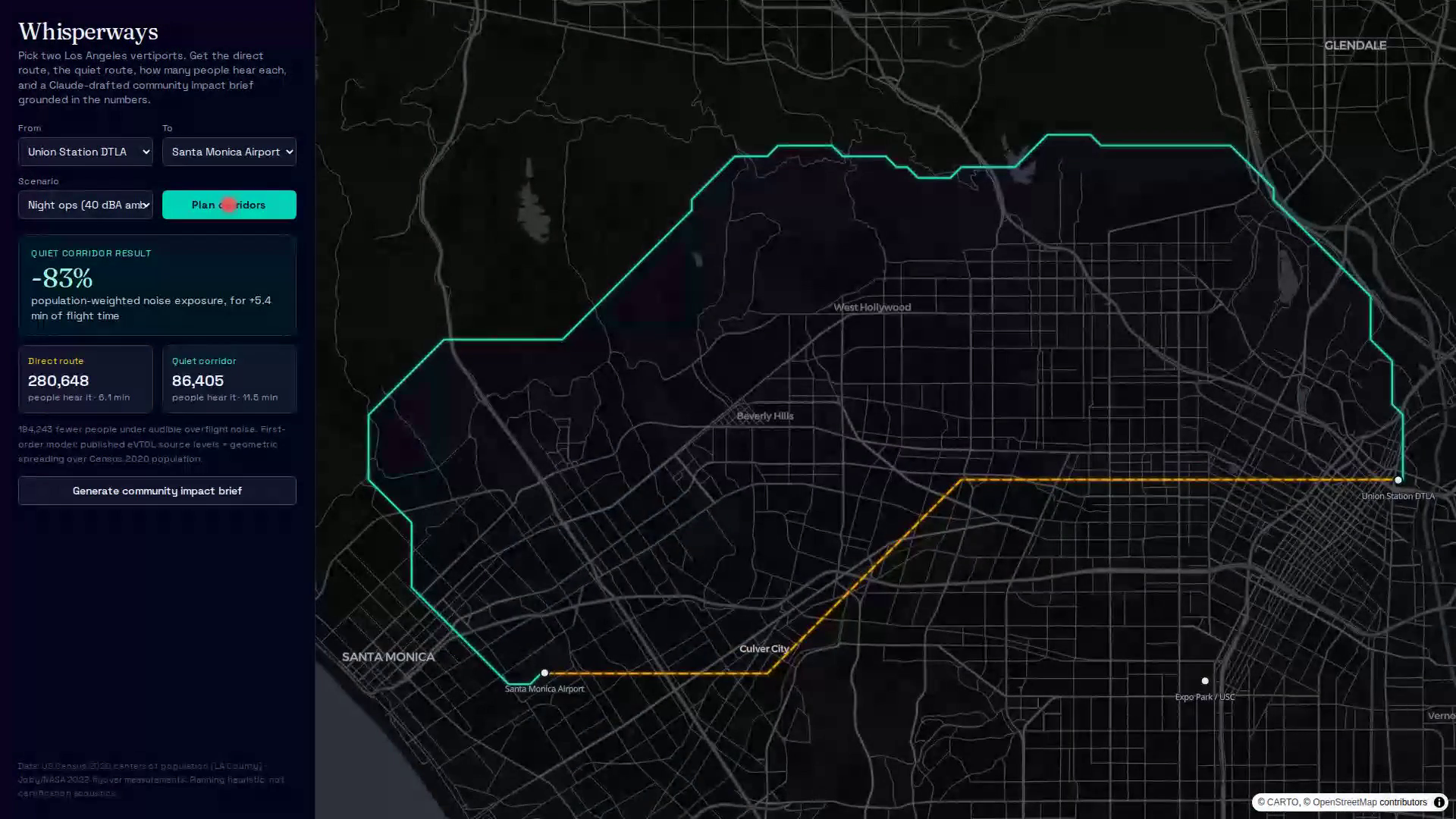
Live planning on any vertiport pair: Union Station to Santa Monica in about a second of compute.
The problem
Advanced air mobility will not be decided by range or battery chemistry. It will be decided by community acceptance, and the gating complaint is noise. Vertiport approvals, certification limits, and neighborhood opposition all hinge on one question: who hears these aircraft, and how loudly? Yet route planning today optimizes distance and airspace, not the people below.
What Whisperways does
Pick two vertiports in Los Angeles and Whisperways returns two corridors. The direct route is distance-optimal. The quiet route is optimized against population noise exposure. For each you see distance, flight time, how many people the model predicts can hear the aircraft above the ambient soundscape, and a population-weighted exposure index. The headline result: LAX to Hollywood Burbank at night, the direct route is audible to about 221,000 people; the quiet corridor cuts that to about 51,000 people (77 percent fewer), and cuts the population-weighted exposure index by 89 percent, for 4.3 extra minutes.
Then Claude drafts the Community Impact Brief: a neighborhood-by-neighborhood account (Fairfax District, West Hollywood, Toluca Lake on the demo route) of what each place hears under each corridor, the honest tradeoff, and mitigation topics for discussion. The model receives only engine-computed numbers and is forbidden from inventing anything beyond them.
How we built it
- US Census Bureau 2020 tract centers of population (LA County, public domain), rasterized to a 250 m grid covering 5.3 million people.
- A first-order acoustic model: published eVTOL overflight level (Joby S4, about 45.2 dBA at 500 m, NASA/Joby acoustic flight campaign, results published 2022) with geometric spreading against day/night ambient baselines.
- A routing engine that convolves population with the audible footprint kernel and runs Dijkstra, trading meters of detour against person-decibels.
- One server route calls claude-opus-4-8 with a schema-constrained output for the brief. Next.js App Router, MapLibre GL, Vercel; the API key stays server-side and the endpoint is rate-limited (burst-verified 429s).
- 28 unit and acceptance tests over the acoustics, routing, real-city results, and brief prompt/parsing. Built end-to-end with Claude (Claude Fable 5 in Claude Code); the Co-Authored-By trailers in the git history record it.
Honesty notes
The acoustic model is first-order (no atmospheric absorption, terrain, or directivity) and the UI labels it a planning heuristic, not certification acoustics. The vertiport set is curated and illustrative. The demo mode serves a frozen result for deterministic capture; it is a genuine captured output of the same engine and the same live Claude call path, disclosed in the README.
What's next
Noise budgets as infrastructure: multi-city grids, time-of-day corridor schedules, cumulative exposure accounting across a whole network, and briefs that cite the exact model assumptions per paragraph.
Built With
- anthropic-claude
- census-data
- maplibre-gl
- nextjs
- typescript
- upstash
- vercel

Log in or sign up for Devpost to join the conversation.