-
-
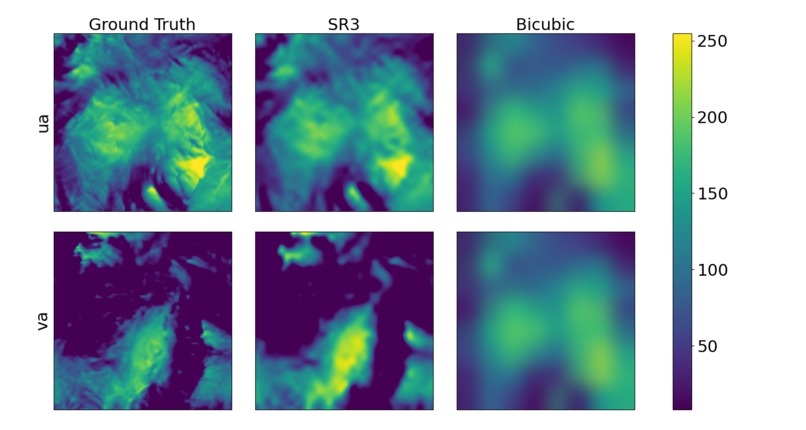
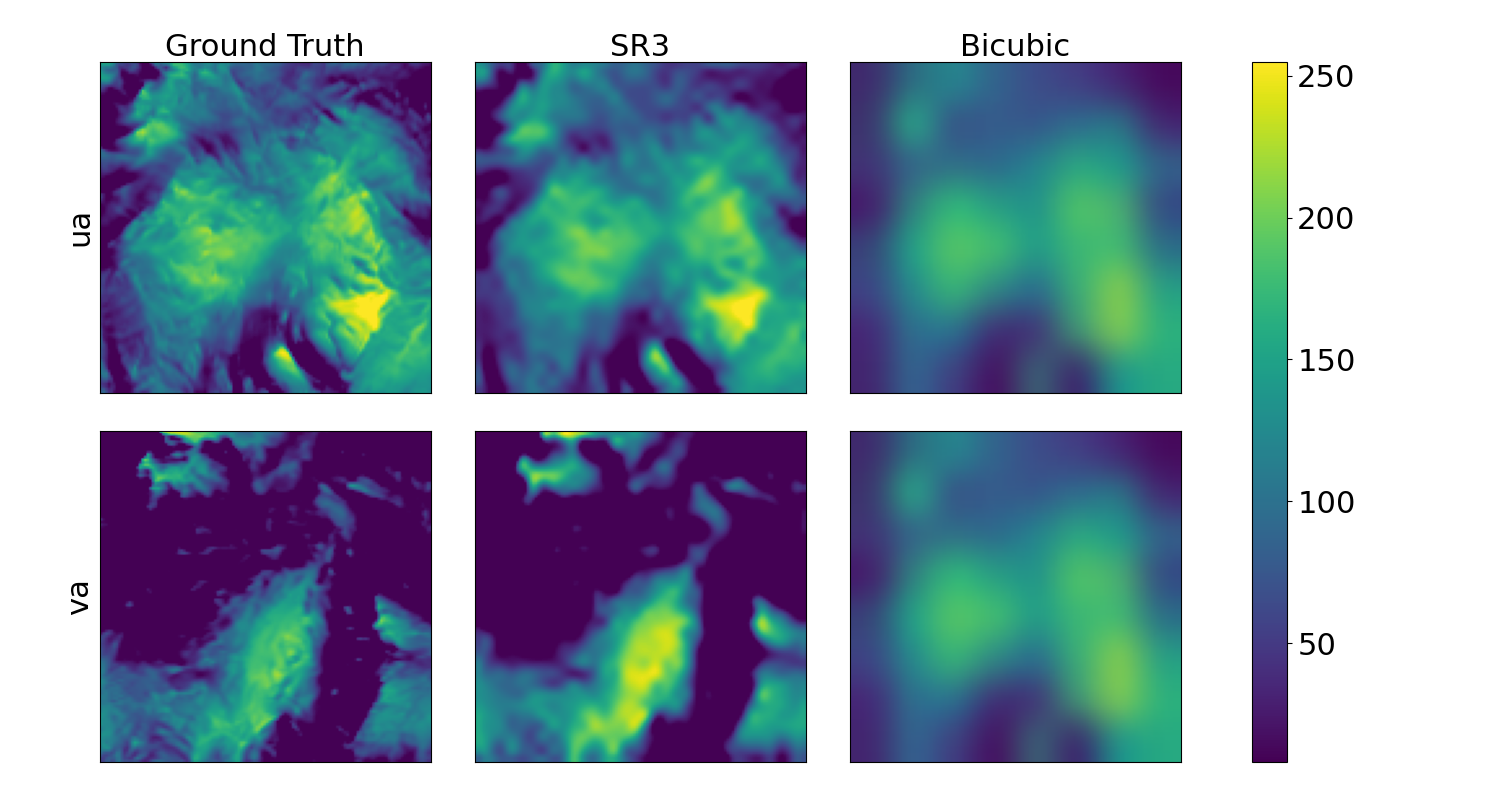
Sample Super-Resolution Model Outputs
-
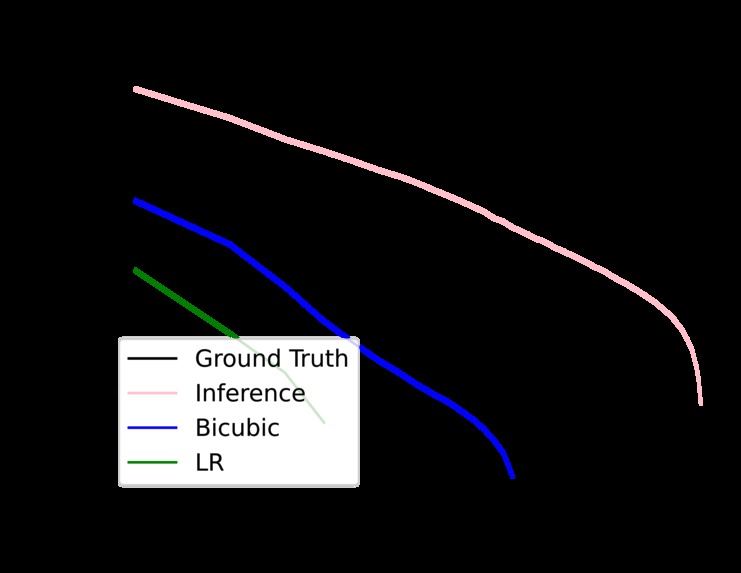
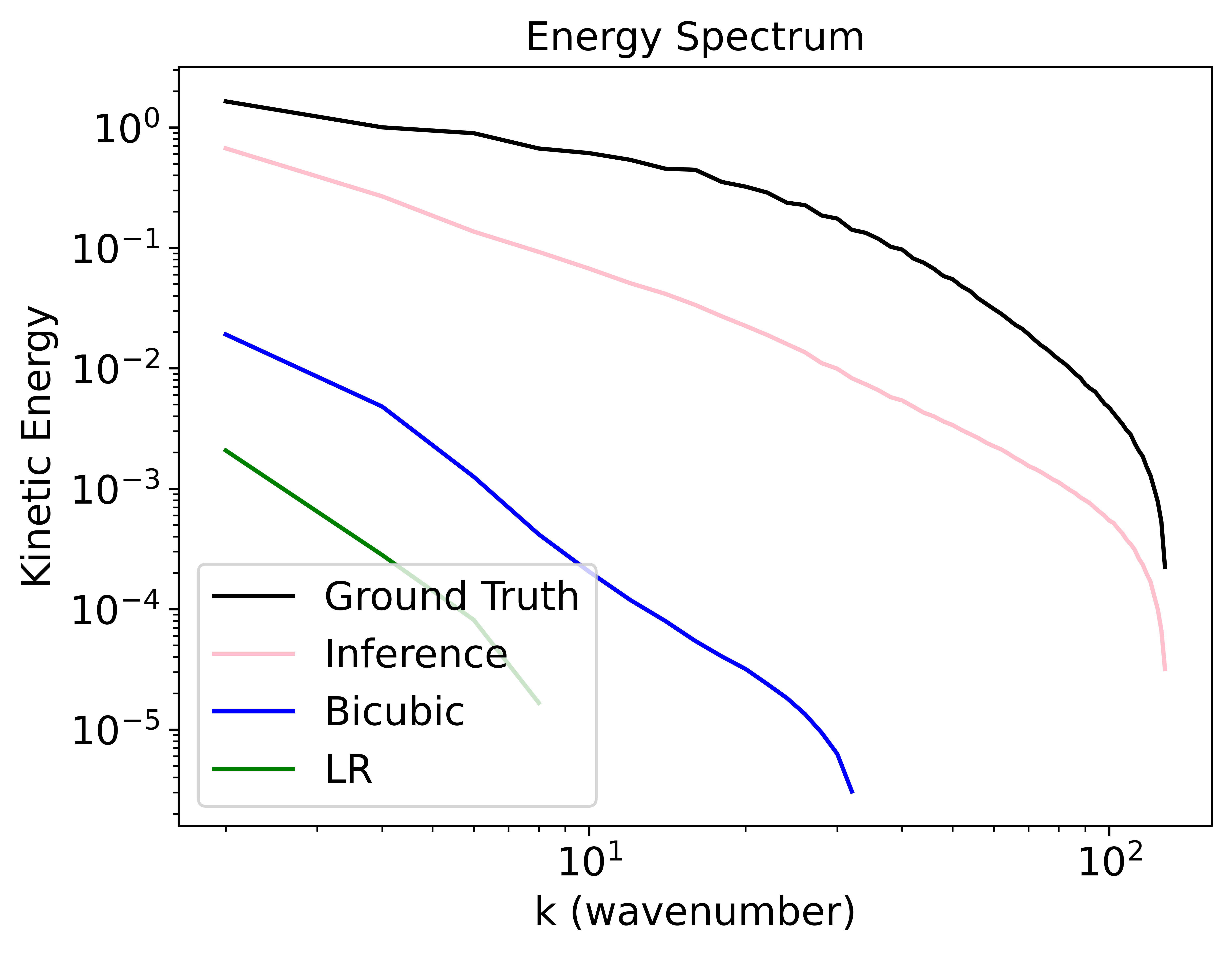
Kinetic Energy Spectra for Models Evaluated
Inspiration
The transition to green energy grids depends on detailed wind and solar forecasts to optimize the siting and scheduling of renewable energy generation. Operational forecasts from numerical weather prediction models, however, only have a spatial resolution of 10 to 20-km, which leads to sub-optimal usage and development of renewable energy farms. Weather scientists have been developing super-resolution methods to increase the resolution, but often rely on simple interpolation techniques or computationally expensive differential equation-based models. Recently, machine learning-based models, specifically diffusion models that perform image super-resolution via iterative refinement, have outperformed traditional downscaling methods.
What it does
“Whispers of the Wind” demonstrates the capacity of these diffusion-based techniques to generate physically-consistent wind field outputs at high resolutions. Specifically, it achieves 5x super-resolution, taking inputs at 10-km spatial resolution to output wind speeds at a 2-km spatial resolution.
How we built it
This model is based on the SR3 architecture, which uses the ResNet block, channel concatenation style, and attention mechanism in low-resolution features of DDPM. The dataset used to train and evaluate the model is obtained from the National Renewable Energy Laboratory’s (NREL’s) Wind Integration National Database (WIND) Toolkit, with a focus on the continental United States. Wind velocity data consists of westward (ua) and southward (va) wind components, calculated from wind speeds and directions 100-km from Earth’s surface. The WIND Toolkit has a spatial resolution of 2-km × 1-hr spatiotemporal resolution. The wind dataset contains data sampled at a 4-hr temporal resolution for the years 2007 to 2013. Wind test data are sampled at a 4-hourly temporal resolution for the year 2014.
Challenges we ran into
Due to limited computational resources, I wasn’t able to extensively benchmark and fine-tune the hyperparameters of the model. Additionally, the limited scope of the dataset makes the results less generalizable, and it is difficult to conclude the success of the model on areas outside of the United States or in current or future years.
Accomplishments that we're proud of
The model successfully achieves 5x super-resolution which outperforms basic downscaling methods! In terms of visual output, the wind field outputs from the model more closely resemble the ground truth data, which shows that it holds promise to be applied in the operational context, where power planners need to decide wind farm configurations to maximize energy outputs.
What we learned
Diffusion models are highly-capable, and further explorations should be made as to how they can be applied to natural datasets. The applications of machine learning to combating climate change are impressively vast, and it is important to take advantage of the wealth of satellite data that exists to empower change. It is also important to design models which are domain-specific: in this case, because this model was trained and evaluated on wind speed data, it was important to include physical consistency comparisons (such as the kinetic energy spectra) to validate the outputs.
What's next for “Whispers of the Wind”
Super-resolution is an ill-posed problem for which a single low-resolution climate scenario can correspond to multiple high-resolution scenarios. In future works, we will extend the benchmark to stochastic super-resolution techniques such as generative adversarial networks (GANs), variational auto-encoders (VAEs), and normalizing flows and metrics such as CRPS. Validating these models on data outside of NREL’s WIND Toolkit and NSRDB will also widen the scope of this study and enable in-depth model comparisons.


Log in or sign up for Devpost to join the conversation.