Inspiration
The original idea was simple:
I wanted to build an animal translator.
But the more I thought about it, the more I realized how misleading that could be. Animals communicate through posture, movement, vocalizations, facial expressions, and context — but we cannot honestly claim that an AI model can simply translate those signals into human language.
So I changed the question.
Instead of asking “What is this animal saying?”, I wanted WHISPER to ask:
“What might this observable behavior mean, and how confident can we be?”
That became the foundation of WHISPER.
The goal is not to give animals fictional voices. It is to help humans become better observers.
What it does
WHISPER is an AI-assisted animal behavior interpreter that analyzes observable signals and provides a cautious, evidence-linked interpretation.
Users can provide different types of input:
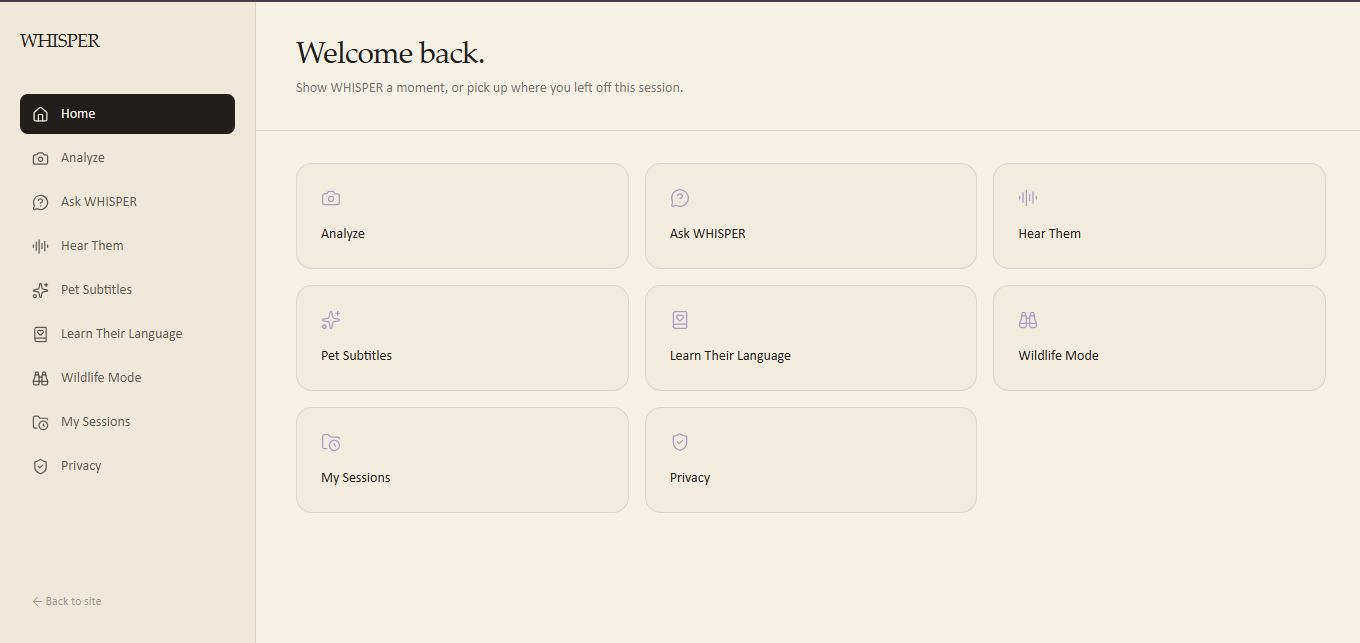
🐾 Photos — analyze posture, body position, facial cues, and visible context. 🎥 Video — examine extracted frames for observable behavioral signals. 🔊 Vocalizations — analyze animal sounds and provide a cautious interpretation. 💬 Ask WHISPER — ask follow-up questions about an observation. 🐶 Pet Subtitles — generate a playful but uncertainty-aware interpretation. 📚 Learn Their Language — learn about common behavioral signals. 🦉 Wildlife Mode — interpret wildlife behavior while emphasizing safe, non-invasive observation. 🗂️ My Sessions — keep observations available during the current session.
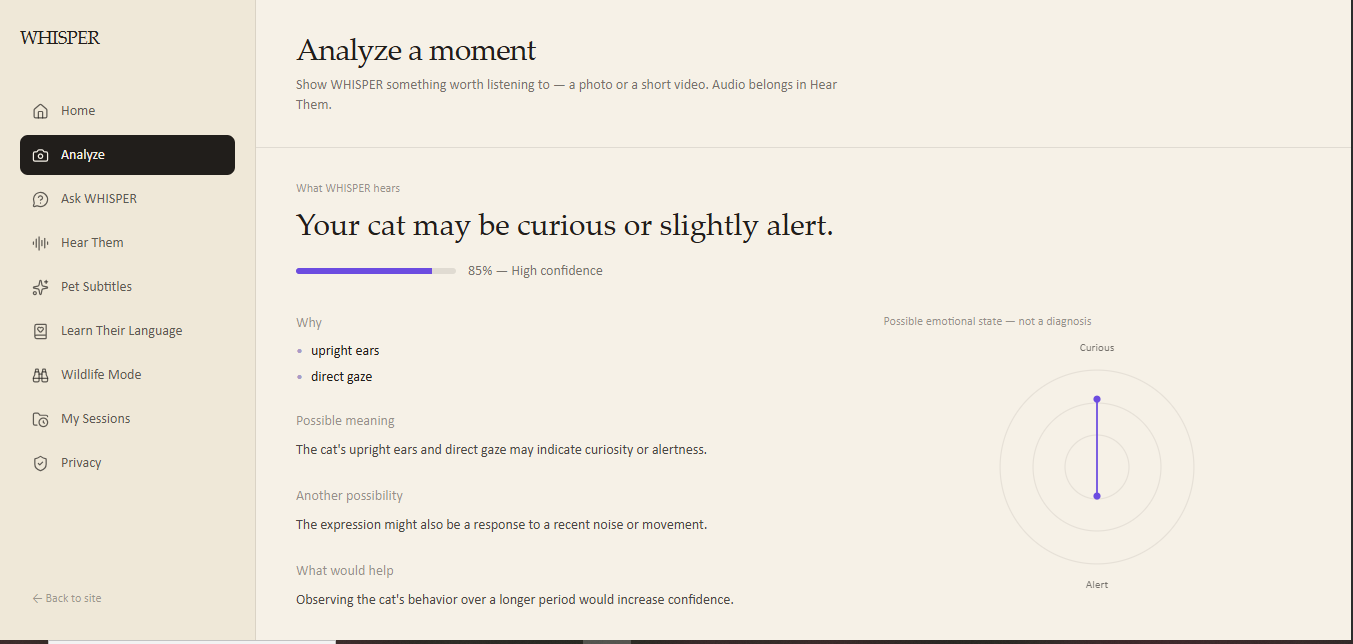
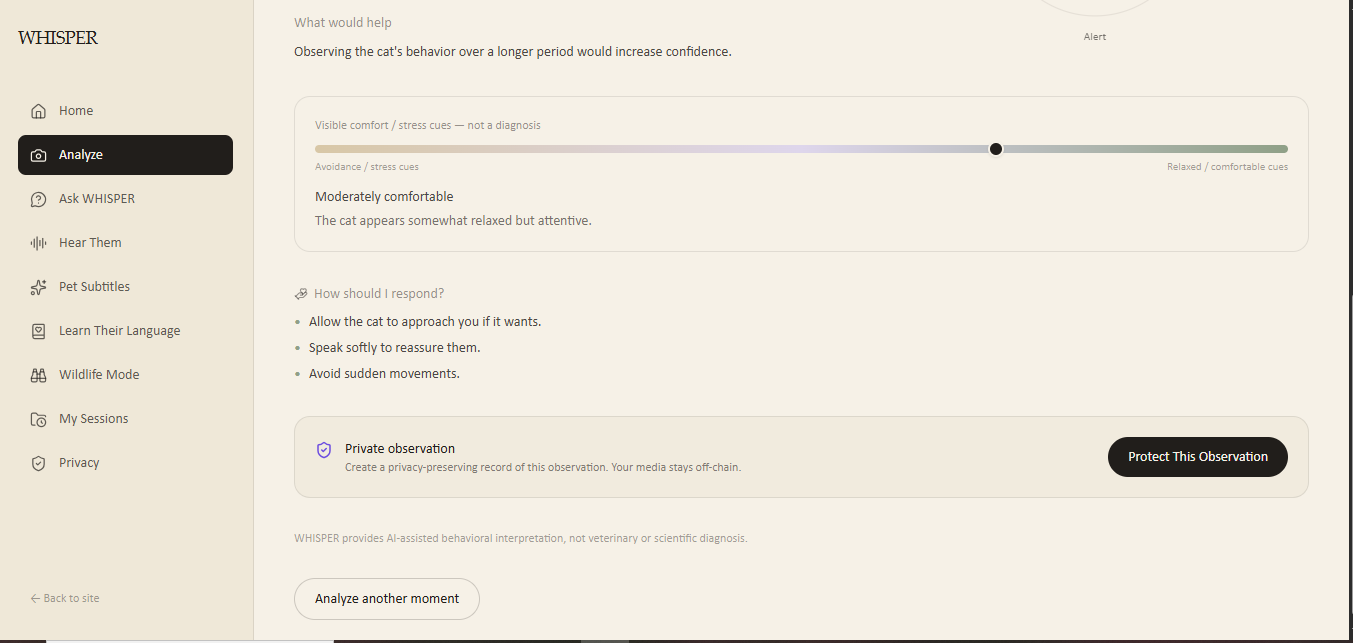
Rather than returning a single absolute answer, WHISPER identifies observable cues, explains what they may indicate, provides alternative possibilities, and assigns a confidence level.
For example, instead of saying:
“Your dog is angry.”
WHISPER aims for something closer to:
“The stiff posture and backward-oriented ears may indicate discomfort or heightened alertness. Other explanations are possible, especially without additional context.”
That distinction is the heart of the project.
How we built it
WHISPER was built as a modern web application using:
Next.js React TypeScript Tailwind CSS OpenAI models GPT-4o Node.js Midnight / Compact Lace wallet integration Vercel GitHub
The core AI pipeline uses multimodal models to process different types of observations.
Conceptually, WHISPER takes observable evidence $E$ and produces an interpretation $I$ with an associated confidence estimate $C$:
$$ WHISPER(E) \rightarrow (I, C) $$
The important part is that $C$ is not presented as scientific certainty. It represents the system's confidence in its interpretation based on the available observable information.
The application uses server-side API routes for analysis, follow-up questions, subtitles, and vocalization processing. Temporary session history is handled through sessionStorage.
We also designed a privacy-preserving architecture around Midnight. The idea is that an observation could eventually be committed to a verifiable state without exposing the underlying private media.
The current Midnight integration is a foundation rather than a completed end-to-end deployment. WHISPER intentionally does not fake blockchain transactions, zero-knowledge proofs, or transaction hashes.
Challenges we ran into
The biggest challenge was not getting an AI model to produce an answer.
It was deciding how much the AI should claim to know.
Animal behavior is highly contextual. The same posture or vocalization can have different meanings depending on species, environment, individual history, surrounding stimuli, and what happened immediately before the observation.
That meant designing WHISPER so that uncertainty is a feature rather than something hidden.
Another challenge was multimodal input. Video and audio require different processing approaches, and the current implementation uses extracted video frames rather than pretending to perform perfect continuous motion tracking.
We also had to think carefully about privacy. Animal observations can contain more information than expected — locations, homes, people, wildlife habitats, and other contextual details.
Accomplishments that we're proud of
We're proud that WHISPER doesn't pretend to solve a problem in a way that sounds impressive but isn't scientifically defensible.
The most important decision we made was to reject the idea of a magical “animal language translator” and build something more honest.
We're also proud of:
Building a working multimodal web experience rather than only a concept. Combining image, video, and audio-based interaction. Making uncertainty and alternative interpretations part of the user experience. Providing evidence-linked behavioral cues instead of unexplained conclusions. Creating a dedicated wildlife mode focused on responsible observation. Designing a privacy-preserving architecture for future verification. Being transparent about what is and isn't implemented.
What we learnedWe learned that building responsible AI is often less about making a model say more and more about making it know when to say less.
We also learned that a good AI interface should communicate uncertainty without becoming useless.
Simply saying “we don't know” isn't enough. The system should explain why it isn't certain and what additional context could change the interpretation.
Most importantly, WHISPER taught us that sometimes the best version of an idea is not the original idea.
We started with:
“Can AI translate animals?”
We ended up with:
“Can AI help humans listen more carefully?”
What's next for WHISPER
Future versions could include:
More sophisticated temporal analysis of complete videos. Species-specific behavioral models. Larger evidence libraries grounded in animal behavior research. Better audio classification and environmental context detection. Long-term observation patterns for individual animals. Human feedback loops to improve interpretations. A fully deployed Midnight privacy and verification flow. Stronger provenance and evidence tracking for individual observations. Collaboration with animal behavior researchers and welfare organizations.
Ultimately, WHISPER isn't trying to give animals a human voice.
It's trying to make humans better listeners.
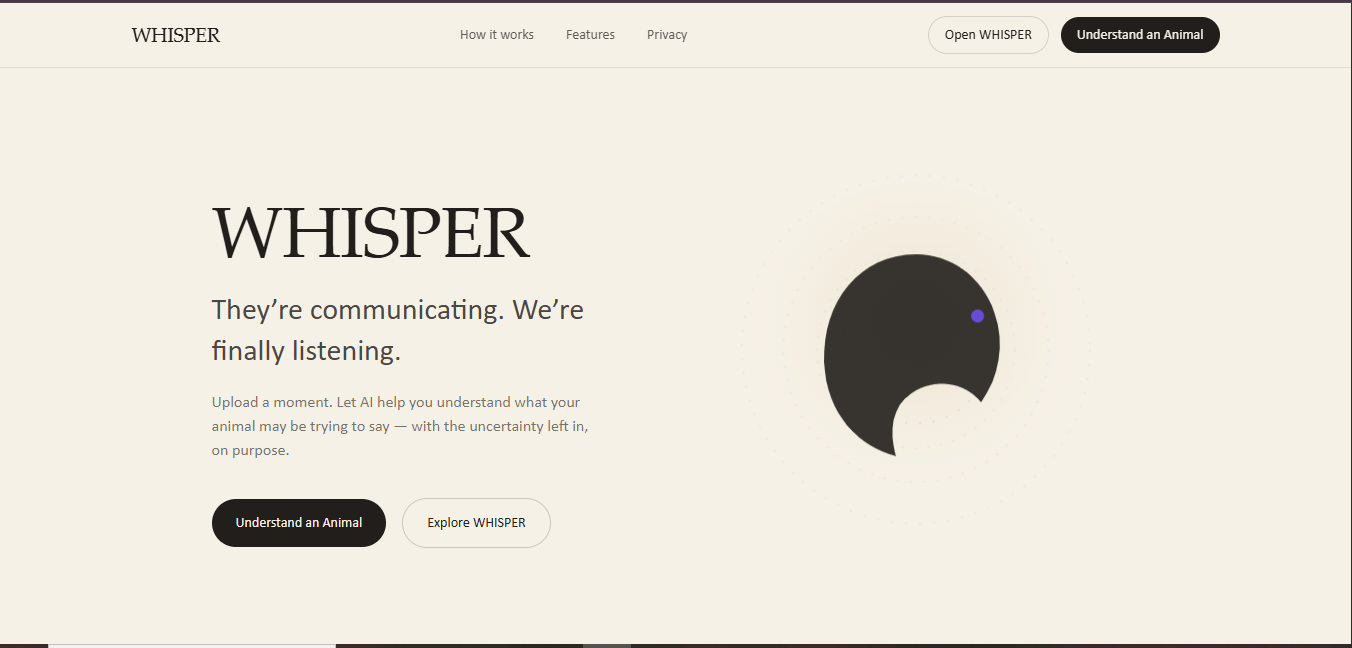
🐾 They're communicating. We're finally listening.
Built With
- ai
- audio-ai
- compact
- computer-vision
- github
- gpt-4o
- lace
- midnight
- multimodal-ai
- next.js
- node.js
- openai
- privacy-preserving
- react
- tailwind-css
- typescript
- vercel

Log in or sign up for Devpost to join the conversation.