-
Title slide
-
Setup
Inspiration
Modern defense operations demand autonomous recon in dangerous environments in GPS and wifi-denied, jammed, or structurally compromised environments. Current solutions either demand high-bandwidth links that fail instantly under jamming, or go blind the moment comms drop.
We wanted to build something that could operate where nothing else does: a recon system that whispers back just enough intelligence to matter using the most resilient, minimal link available.
Whisper:
- Operates completely offline — no GPS, no Wi-Fi, no cloud
- Detects objects using onboard edge vision
- Navigates autonomously to operator-specified objectives in simulation
What it does
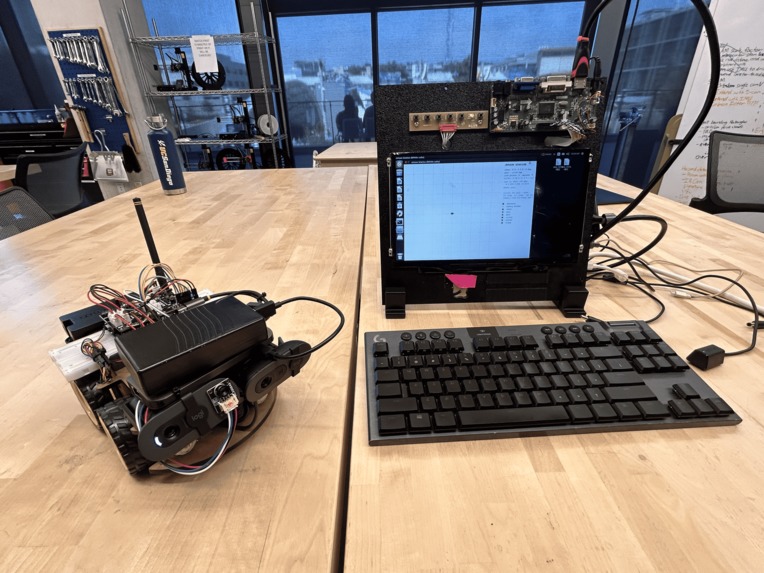
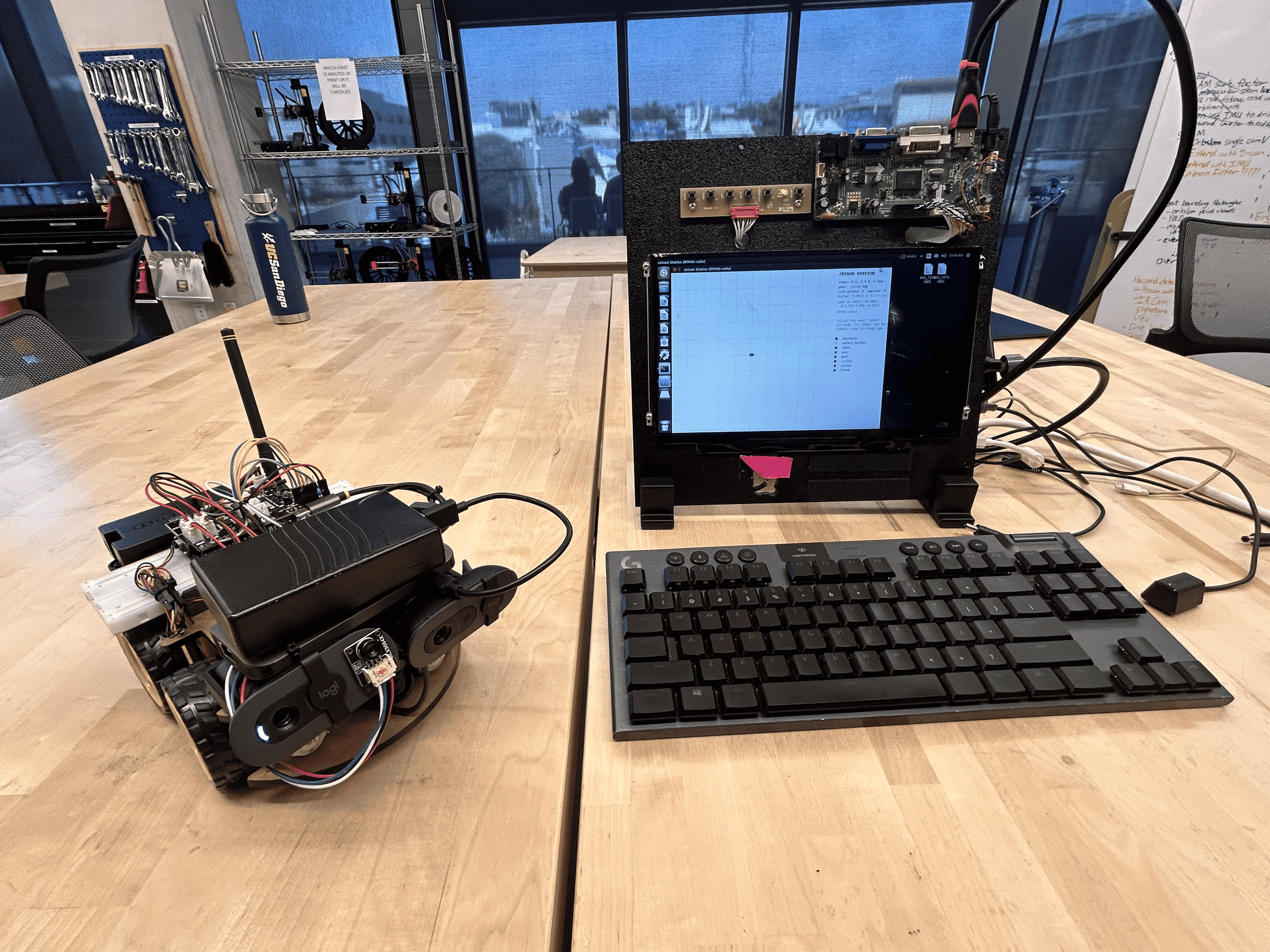
Whisper is a two-node autonomous recon system built for denied environments. An Arduino Uno Q (TX node) acts as the forward edge unit. It uses a camera to determine its own position and orientation, runs onboard image processing to classify objects, and transmits compressed intelligence packets over LoRa to an Jetson Orin Nano. Each packet contains information on size and position of each object.
A Jetson Nano (RX node) receives these packets, runs statistical models to correlate incoming data points, resolves them into a coherent spatial map, and orchestrates pathing commands back to the TX unit. A local Wi-Fi dashboard provides human operators a platform to pick a point to for the robot to go through in simulation.
How we built it
Arduino Uno Q (TX): Camera position estimation and orientation; onboard image processing pipeline for object detection; LoRa module for low-bandwidth outbound transmission Jetson Nano (RX): Receives and decodes LoRa packets; statistical model correlates points by confidence to resolve the environment; calculates pathing; transmits commands back over LoRa; hosts a local Wi-Fi dashboard for operator visibility LoRa link: Carries compressed structured data — type, location, confidence — keeping bandwidth requirements extremely low and the link resilient to interference 3D printed mounts: clean robotic attachments printed on the Bambu A1 Minis using Onshape and Autodesk Inventor
Challenges we ran into
We learned a lot on how to use Arduino Uno Q ecosystem in order to integrate from its App Lab environment to the Jetson through LoRA. One hardware challenge was that pairing the Uno Q with the Elegoo motor shield produced pin conflicts that forced us to solder directly on the shield and create wire extensions to attach the LoRA module and IMU. From there, we learned to work with the imu_monocular library to extract meaningful positional data from camera and IMU alone. Getting a CV pipeline running within the Uno Q's tight memory and compute budget required aggressive optimization. Designing a LoRa packet schema compact enough for narrow bandwidth while still carrying actionable threat intelligence took multiple iterations.
Accomplishments that we're proud of
We're proud that we were able to get a fully running computer vision pipeline to run natively on an Arduino Uno Q and transmitting only key information through LoRa to the Jetson Nano ground station.
What we learned
Building Whisper taught us that the hardest problems in defense tech aren't software — they're hardware integration. Soldering fixes on a motor shield, wrestling with pin conflicts, and squeezing a CV pipeline into a microcontroller's constrained memory are the kinds of problems that don't show up in documentation. We learned the Arduino Uno Q ecosystem from the ground up, figured out how to extract meaningful positional data from a camera alone, and designed a LoRa packet schema through iteration until it was both narrow enough to transmit and dense enough to be useful. Most importantly, we learned that the right constraint forces the right thinking — LoRa's bandwidth limitations pushed us to ask what information actually matters, and the answer made the whole system more robust, not less.
What's next for Whisper
One of our original goals was to enable drone swarming. Moving forward, communicating and scaling information over LoRA with multiple devices, utilizing an IMU, and a universal ground station would be the next goal.

Log in or sign up for Devpost to join the conversation.