🌸 Inspiration
Some of the most important health questions are the ones we feel least comfortable asking out loud.
A girl might wonder, "Is this normal?", "Am I supposed to feel this way?", or "Can I do sports while on my period?" — and still stay silent because she feels embarrassed, fears being judged, or simply doesn't know who to trust.
Asking someone close to us can mean receiving information shaped by family beliefs, stigma, or myths. Searching online can be overwhelming too, with conflicting information that can be difficult for a young person to evaluate on her own.
The problem isn't that information doesn't exist.
The problem is that asking for it can feel unsafe.
Whisper Circle was born from a simple belief:
No girl should have to stay confused because she was too embarrassed to ask.
For a hackathon centered around girls, technology, and real-world impact, we wanted to build something that uses AI for a deeply human purpose: making it easier to ask the questions that are hardest to say out loud.
🌍 SDG Impact & Relevance
Whisper Circle sits at the intersection of SDG 3: Good Health and Well-being and SDG 5: Gender Equality.
Access to understandable health information is an important part of helping people make informed decisions about their bodies and wellbeing. For girls and young women, sensitive topics such as menstruation, puberty, hygiene, and sexual wellbeing can be especially difficult to discuss openly.
Whisper Circle addresses that barrier by creating a private, approachable space where users can ask questions naturally and receive source-grounded information without the shame or intimidation that can make health education harder to access.
Our goal is not simply to provide more information.
It is to reduce the distance between having a question and feeling safe enough to ask it.
That is where we see Whisper Circle's impact: using technology to make health education more approachable, understandable, and empowering.
💡 A Fundamentally Different Approach
AI can already answer health questions.
So why build Whisper Circle?
Because a fluent answer is not automatically a trustworthy one — and a technically good answer is useless if someone is too uncomfortable to ask the question in the first place.
Whisper Circle was designed specifically around that gap.
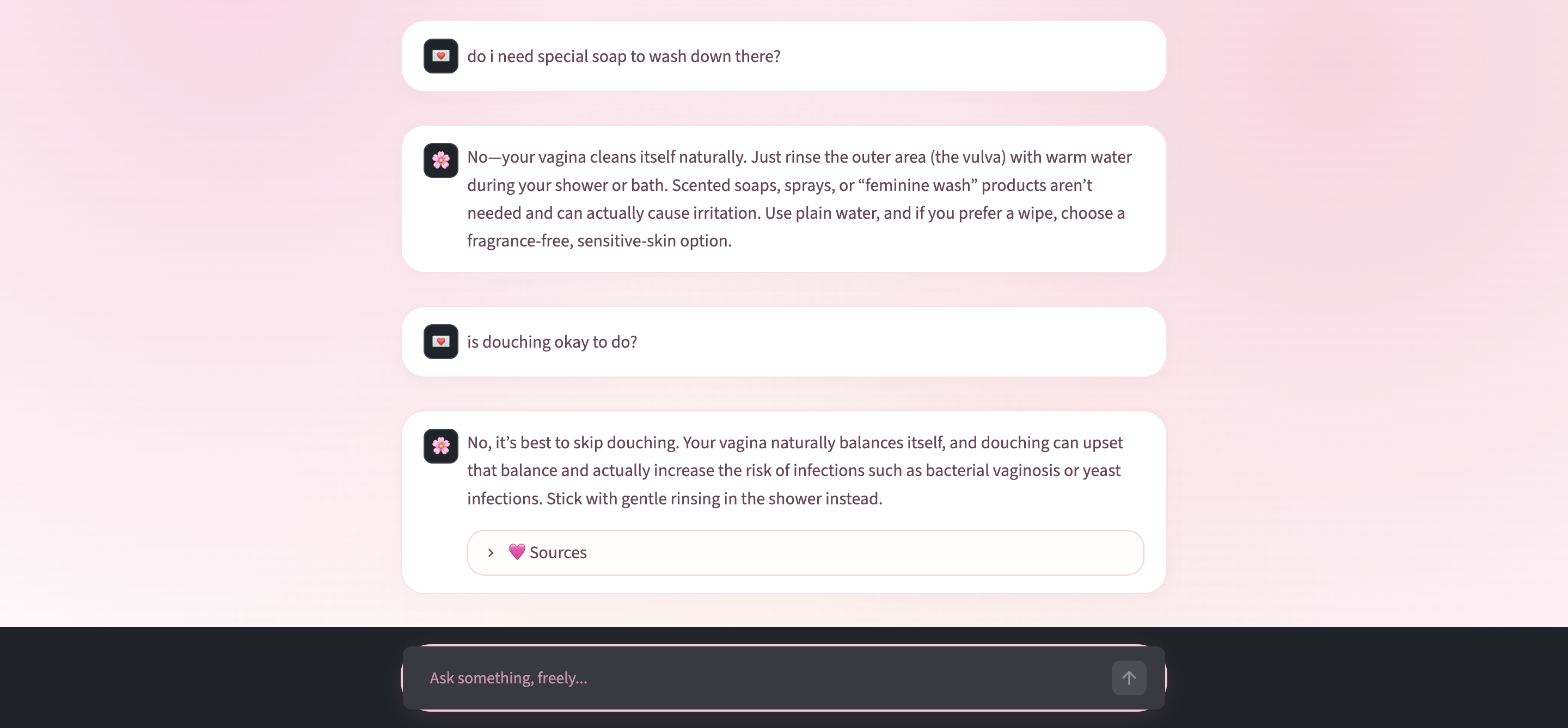
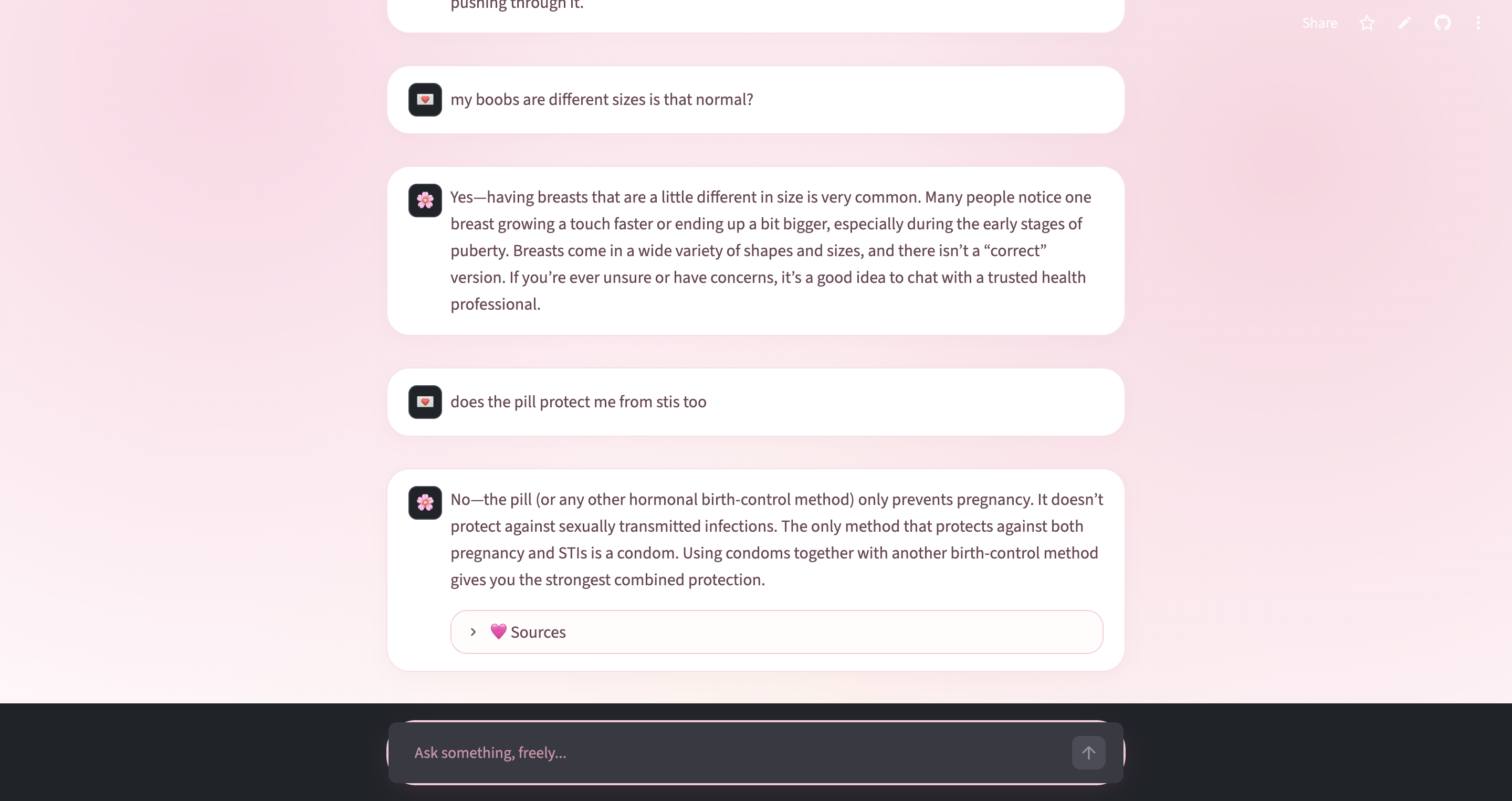
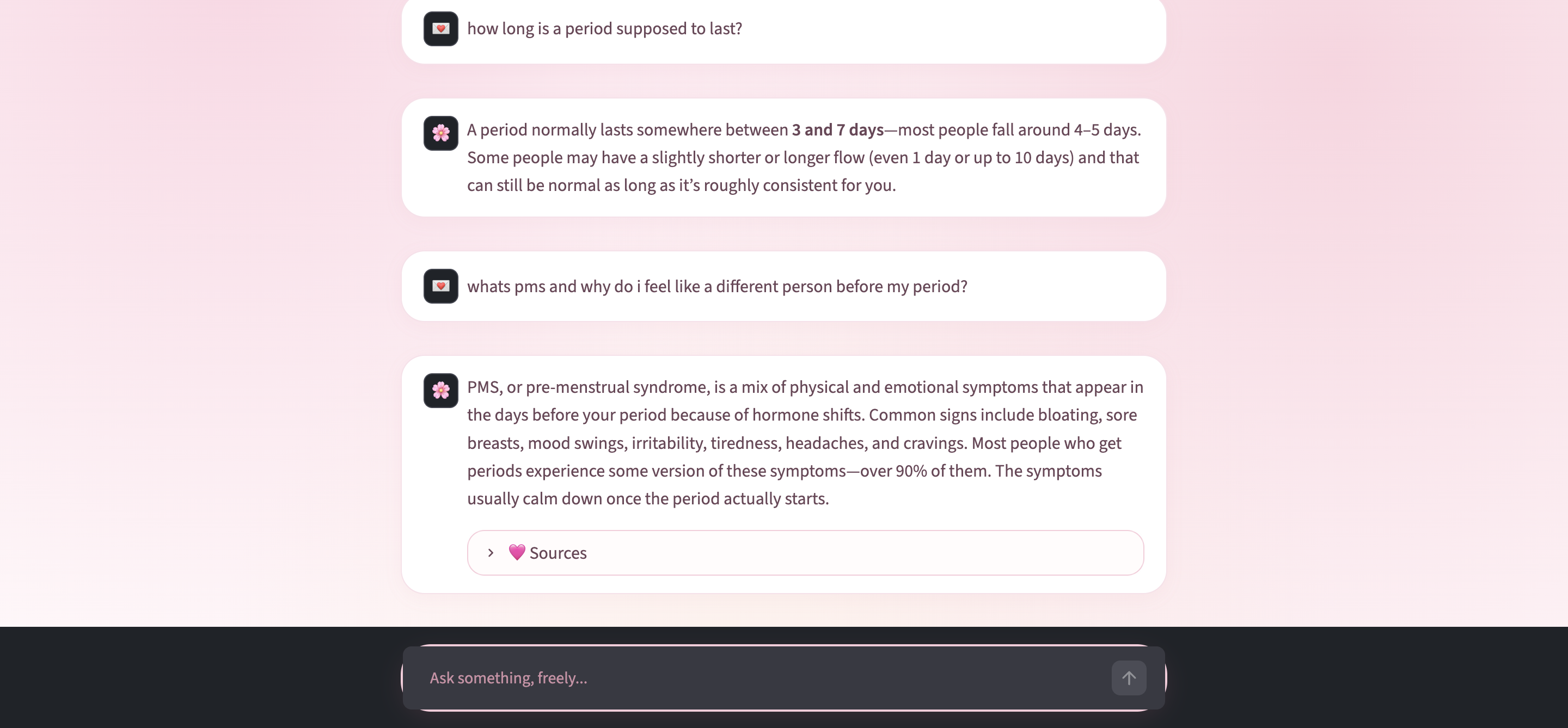
Instead of behaving like a general-purpose chatbot, it combines a gentle conversational experience with a retrieval-grounded knowledge system. Relevant information is retrieved from a curated health knowledge base before the AI generates a response, and the underlying source can be shown directly in the conversation.
We also deliberately constrain the AI to answer only from the information it has been given. When the available context does not cover a question, Whisper Circle is instructed not to guess and instead recommend speaking with a healthcare professional.
And then there is the human side.
The language, interface, and visual design were created to feel warm and approachable rather than clinical or intimidating.
We don't want Whisper Circle to feel like a textbook.
We want it to feel like a safe first step.
💬 What It Does
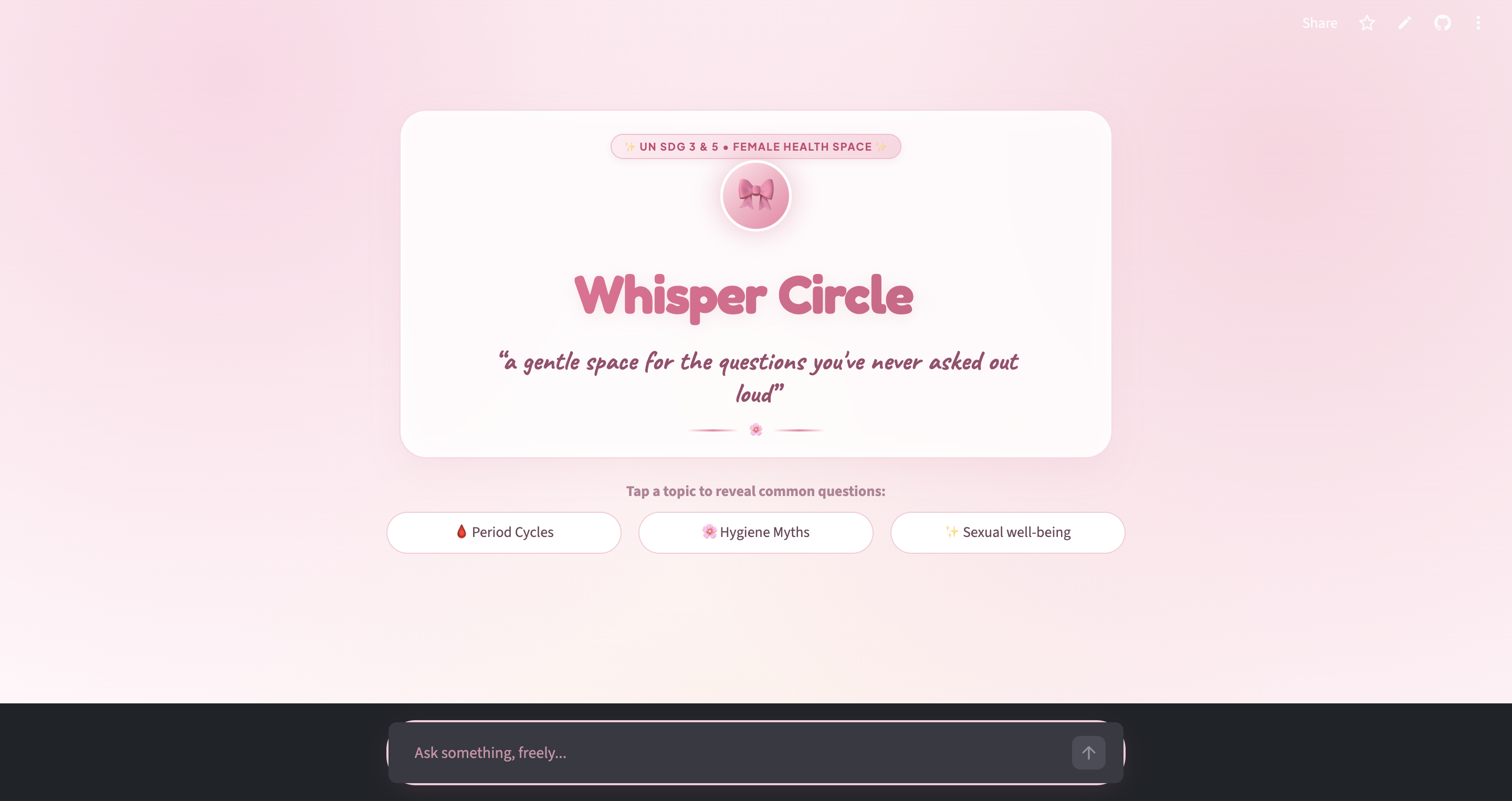
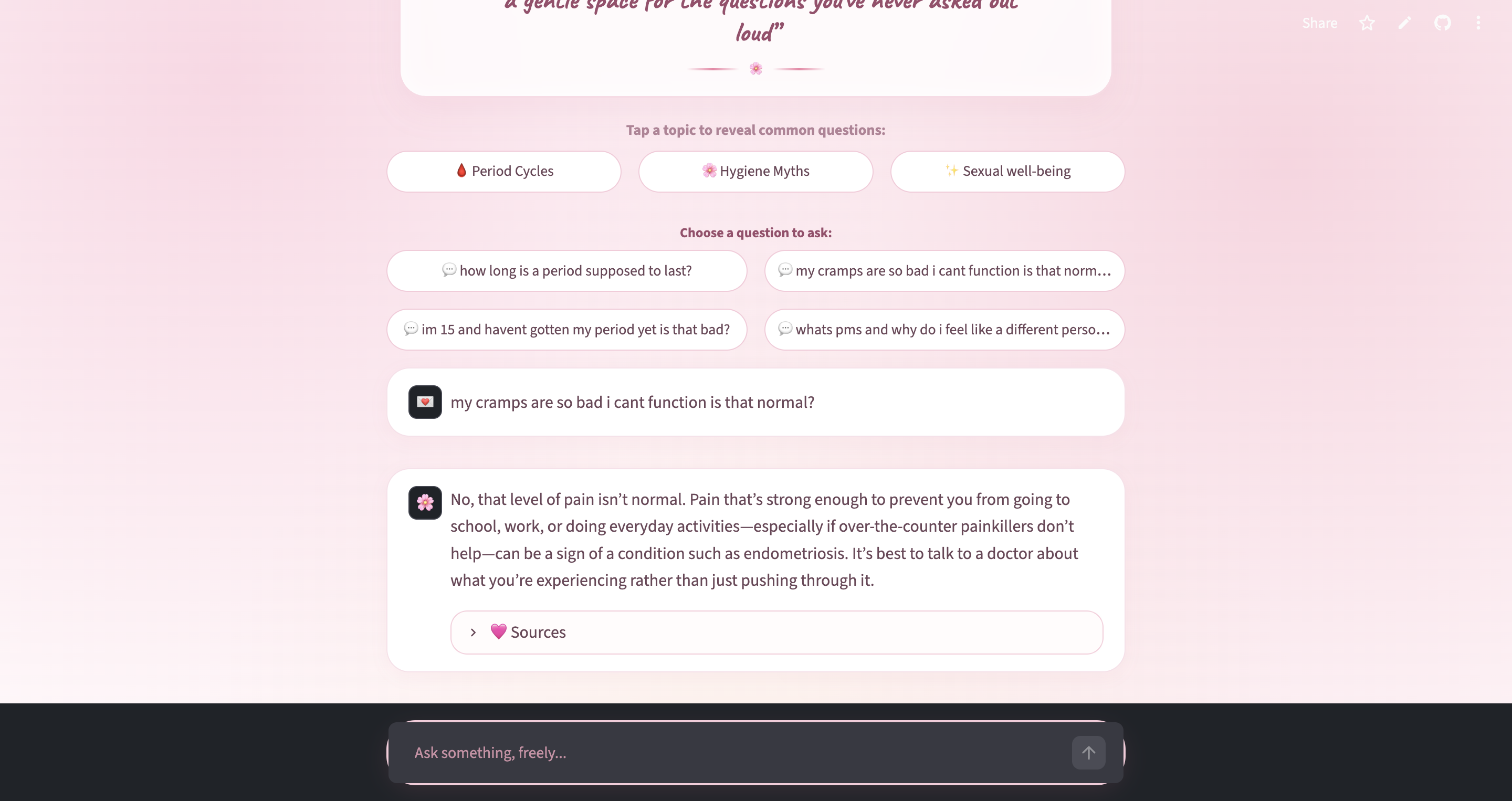
Whisper Circle is an AI-powered health companion where girls can ask real questions about their bodies — from periods, hygiene, and puberty to sexual wellbeing and relationships — using their own words.
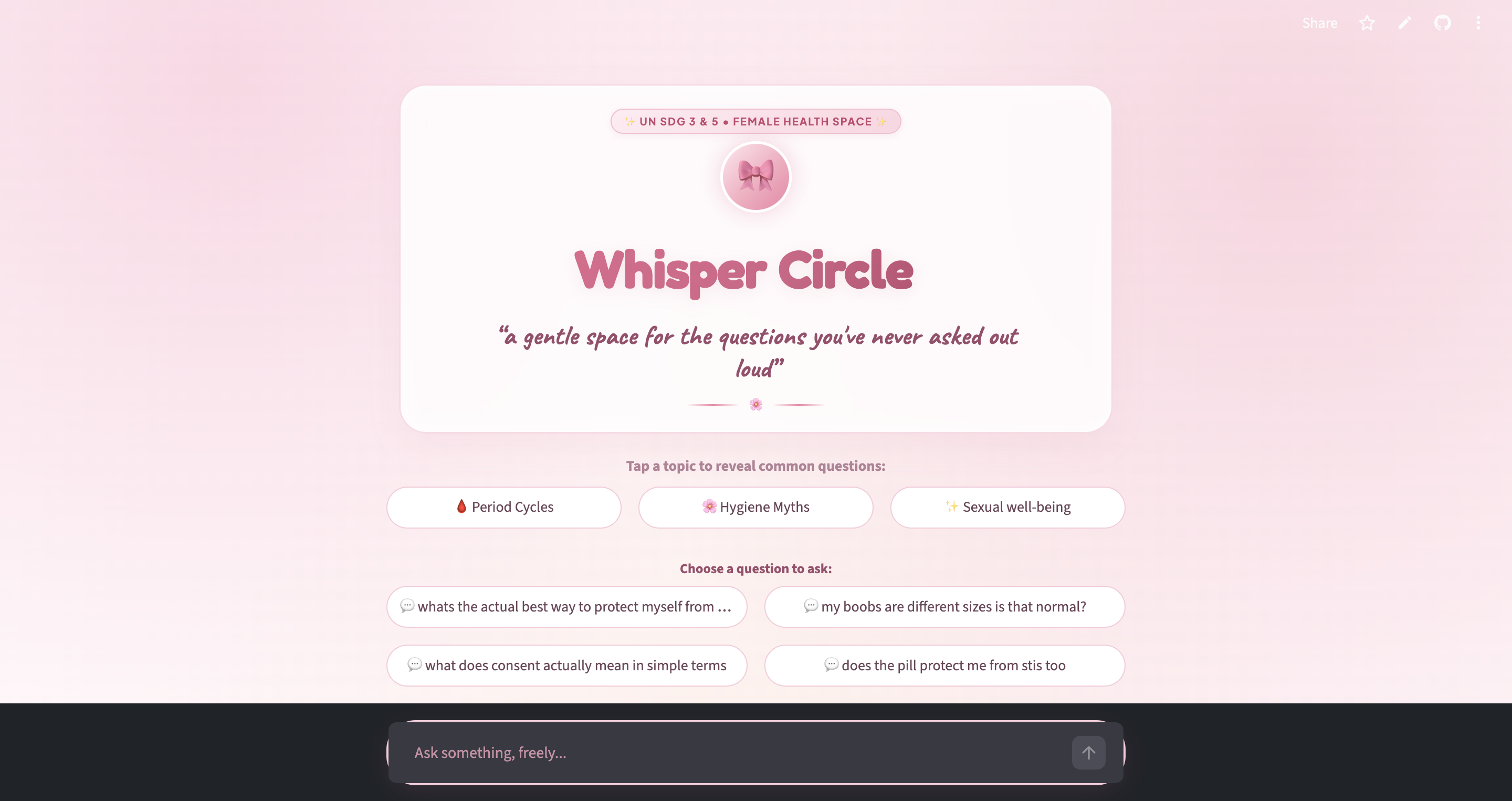
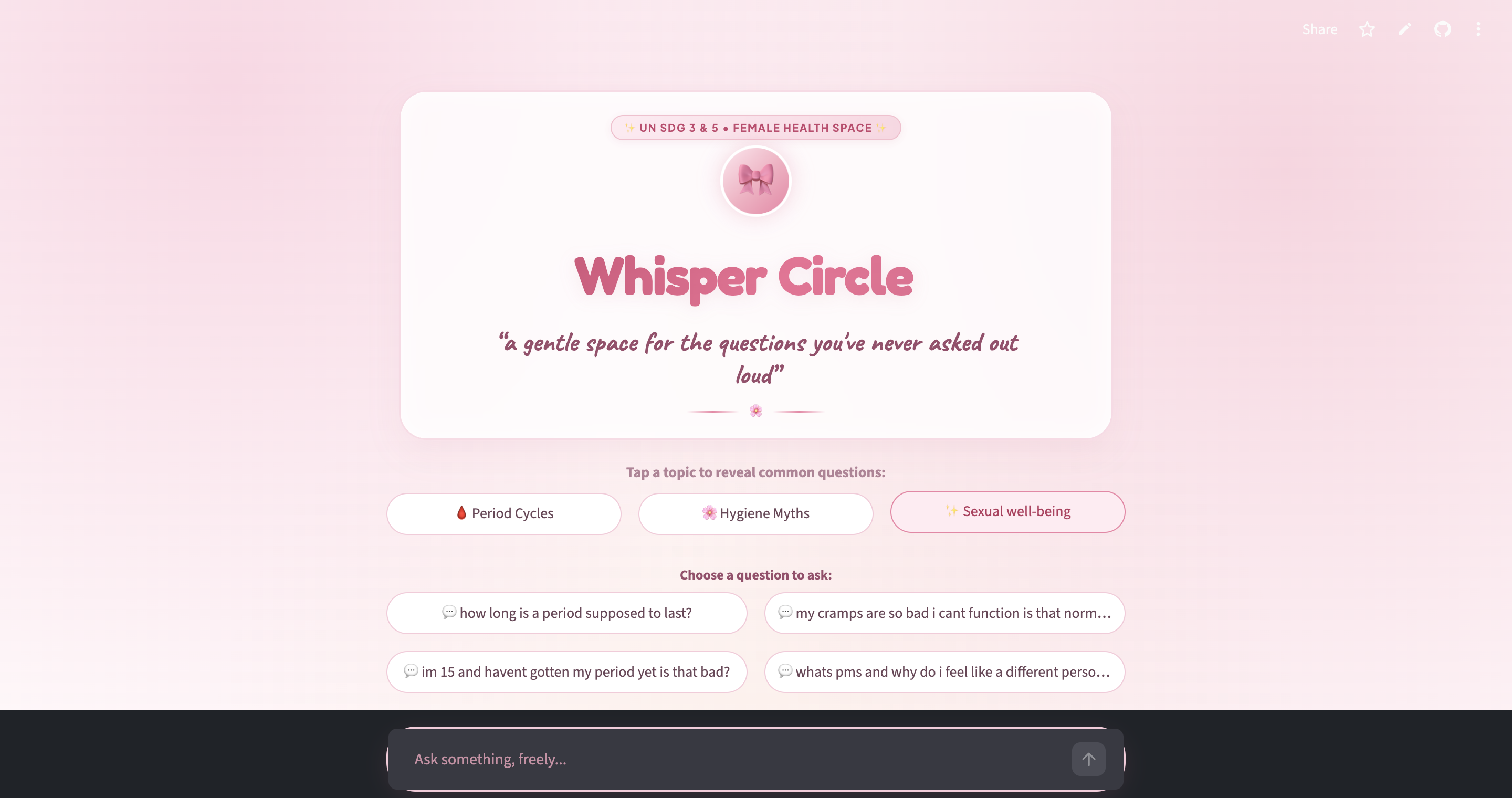
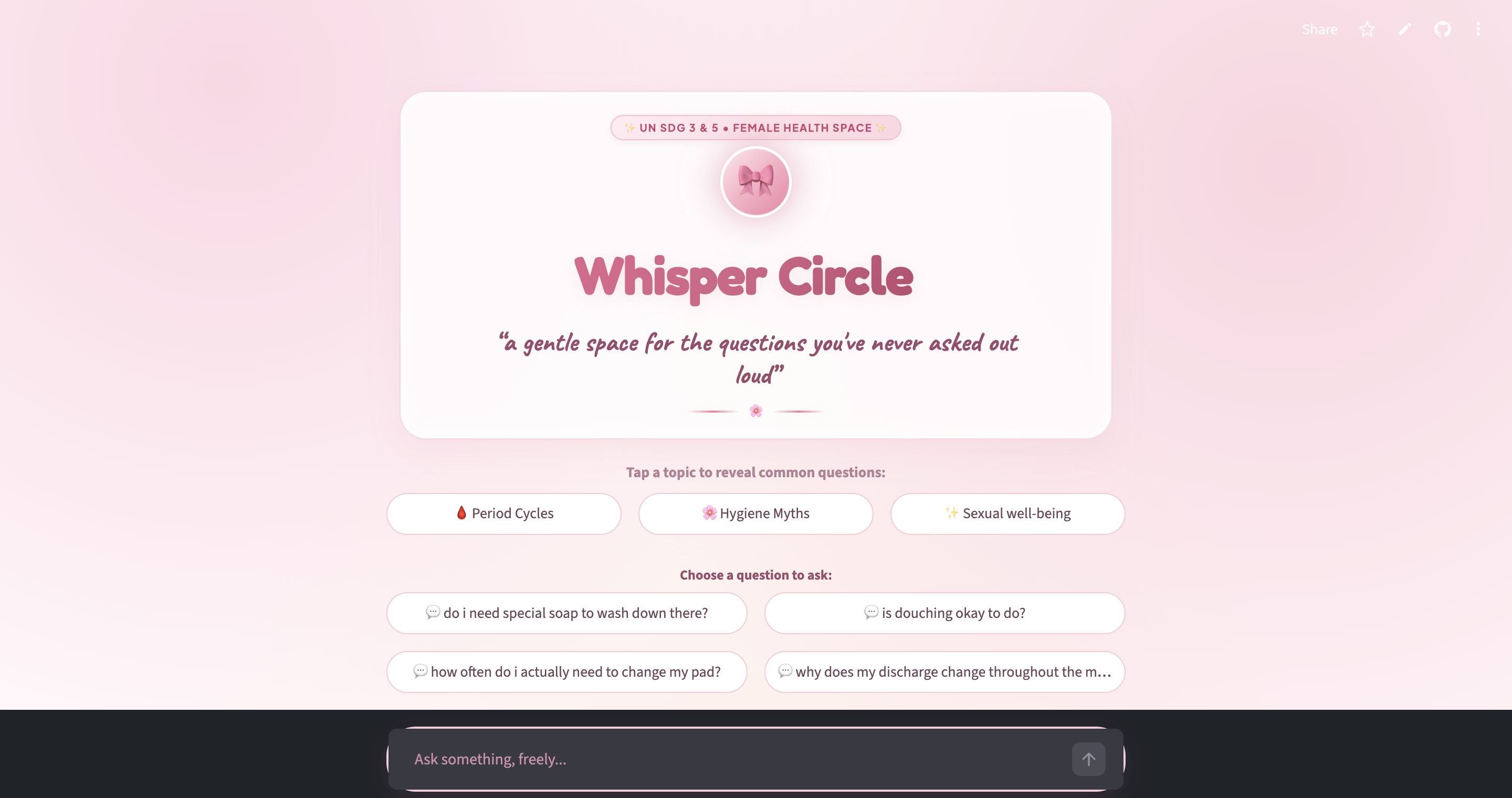
Users don't need to know medical terminology or figure out how to phrase a question "correctly." They can simply ask what is on their mind, or choose from common questions across different health topics.
Each response is grounded in relevant information retrieved from the knowledge base, with the underlying source displayed directly beneath the answer.
When a question falls outside the available context, Whisper Circle does not simply invent an answer. It is instructed to be transparent about the limitation and recommend seeking professional help when appropriate.
The experience is built around three simple principles:
Ask naturally. Get grounded answers. Never feel ashamed for asking.
🛠️ How We Built It
We wanted Whisper Circle to be more than an AI chatbot with a pretty interface.
We built it around one question:
How can we make sensitive health questions both easier to ask and safer to answer?
Whisper Circle is built with Python, Streamlit, Groq, and ChromaDB.
At the heart of the app is a retrieval-grounded workflow. When a user asks a question, ChromaDB retrieves the most relevant information from our curated health knowledge base before the AI generates a response. Each knowledge chunk keeps its source URL, allowing responses to point back to their underlying information.
We then pass that retrieved context to the AI with explicit instructions to answer only from the available information and never guess beyond it.
Streamlit powers the interactive experience, while Groq handles the conversational generation and streaming response.
We also invested in the experience itself: soft colors, rounded components, custom typography, subtle animation, and a calm visual language designed to feel welcoming rather than clinical.
Technically, we built a grounded AI system. Emotionally, we built a place that feels safe to ask.
🌧️ Challenges We Ran Into
The hardest part wasn't getting an AI to answer a question.
It was deciding how an AI should answer a vulnerable health question responsibly.
A model can produce a convincing response even when the underlying information is incomplete. In a health context, that creates a problem: confidence can easily be mistaken for correctness.
That led to one of our most important design decisions:
Whisper Circle should not improvise medical information.
We built the system so relevant source material is retrieved before generation, and the model is explicitly instructed to stay within that context. When the knowledge base does not cover a question, it should say so rather than guess.
But the technical challenge was only half the problem.
We also had to solve for tone.
Health information can become intimidating when it sounds like a medical textbook. We wanted Whisper Circle to be supportive without becoming childish, dismissive, or overly clinical.
That meant constantly balancing two goals:
- The information needed to feel trustworthy.
- The experience needed to feel safe.
Finding that balance became one of the most meaningful parts of building Whisper Circle.
🏆 Accomplishments We're Proud Of
We're proud that Whisper Circle became more than an AI demo.
We built an experience around a very specific human moment:
the moment someone has a question, but doesn't know where to turn.
🌸 We Made Sensitive Questions Easier to Approach
Sometimes the hardest part isn't finding an answer — it's finding the courage to type the question.
Whisper Circle includes a range of suggested questions covering topics that are often treated as taboo, awkward, or simply "too embarrassing" to bring up. Seeing questions like these already written on the screen quietly tells the user:
You are not the only one wondering this. And yes, this is a place where you can ask it.
These prompts lower the tension around sensitive topics, give users an easy starting point, and make it clear from the moment they open the app that no question is too awkward to belong here.
We wanted the platform itself to normalize curiosity — before the conversation even begins.
And that is what we're most proud of 🤍🤍
🧠 What We Learned
We started this project thinking the biggest challenge would be building the AI.
We ended up learning that the harder question was:
"How do you build something people can trust with the questions they're most afraid to ask?"
We learned that responsible AI is not simply about generating good-looking answers. It is about controlling what information the model can rely on, knowing when the system does not have enough context, making sources visible, and being honest about limitations.
Our implementation reflects that lesson:
Retrieve first. Generate second. Never pretend to know what isn't there.
We also learned that design can be part of the solution.
A technically accurate health tool can still fail if the experience makes someone feel uncomfortable, judged, or overwhelmed.
Whisper Circle taught us that innovation doesn't always require inventing an entirely new technology.
Sometimes, it means taking technology that already exists and applying it thoughtfully to a problem people have quietly been living with for years.
🌱 What's Next for Whisper Circle
Whisper Circle is a beginning, not an endpoint.
Our next step is to grow the prototype into a more comprehensive and responsible health education companion.
We want to expand the knowledge base with more medically reviewed resources, broaden coverage across puberty and reproductive health, strengthen source transparency, and continue improving safeguards around sensitive questions.
We also see a major opportunity to make Whisper Circle multilingual and culturally adaptable, so access to understandable health information isn't limited by language or by knowing how to ask a question in formal medical terminology.
Longer term, we want to explore collaboration with healthcare professionals, educators, and organizations working in girls' health — connecting digital education with trusted human support when a question needs to go beyond an AI conversation.
We imagine a world where a girl can have a question about her body without first having to wonder whether it's embarrassing, inappropriate, or "too awkward" to ask.
Whisper Circle is a small step toward that world.
🎀 Because no girl should have to choose between staying silent and figuring it out alone.


Log in or sign up for Devpost to join the conversation.