Inspiration
U.S. fire departments responded to an average of 37,365 home fires involving heating equipment each year from 2020 to 2024, with about 417 deaths a year. Space heaters and heating stoves were involved in 30% of those fires and 73% of the deaths. 46% of the fires happened between December and February. (NFPA findings, via ANSI)
Every safety page says "don't overload the circuit". If you rent, you usually don't know what the circuit is. Outlets in two different rooms can be on one breaker, and two outlets in the same bedroom can be on different ones. A watts-to-amps calculator tells you a 1500 W heater draws 12.5 A. It can't tell you that the hair dryer across the room is on the same breaker.
Who it's for
Renters, students in off-campus apartments, and anyone in an older building who is about to plug in a space heater this winter.
What it does
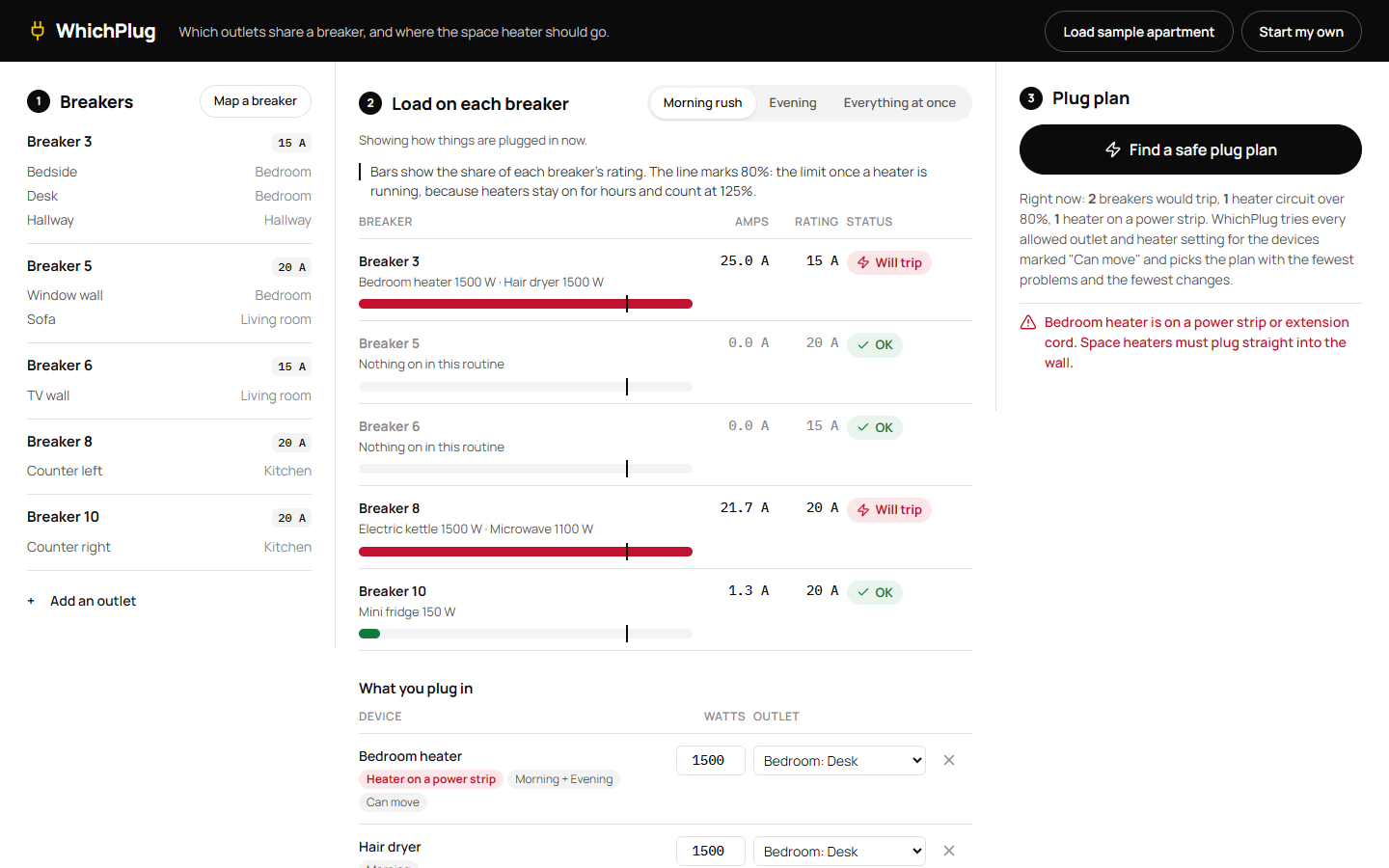
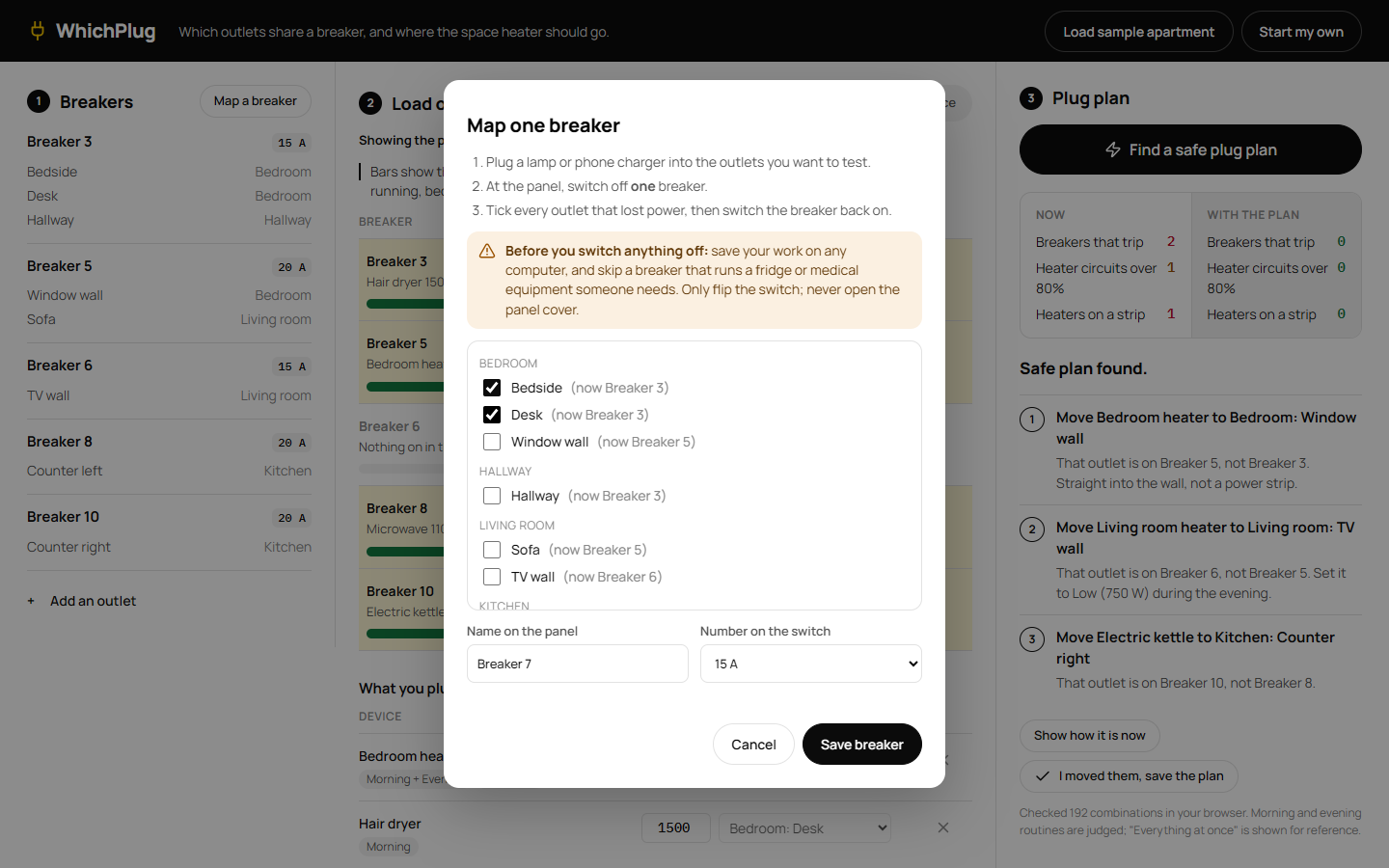
- Map your breakers. Switch off one breaker, tick the outlets that lost power, and enter the number printed on the switch (15 A or 20 A). Outlets you haven't mapped are treated as one shared 15 A breaker per room, the worst case. The mapping window reminds you to save your work first and to skip any breaker that runs a fridge or medical equipment.
- Add what you plug in and when you use it: the morning rush, the evening, or both.
- Find a safe plug plan. For the devices you marked "Can move", WhichPlug tries every allowed outlet in the same room and every Low setting for heaters. It picks the plan with no heater on a power strip, the fewest breakers over their rating, the fewest heater circuits over 80%, the fewest Low settings, and then the fewest moves.
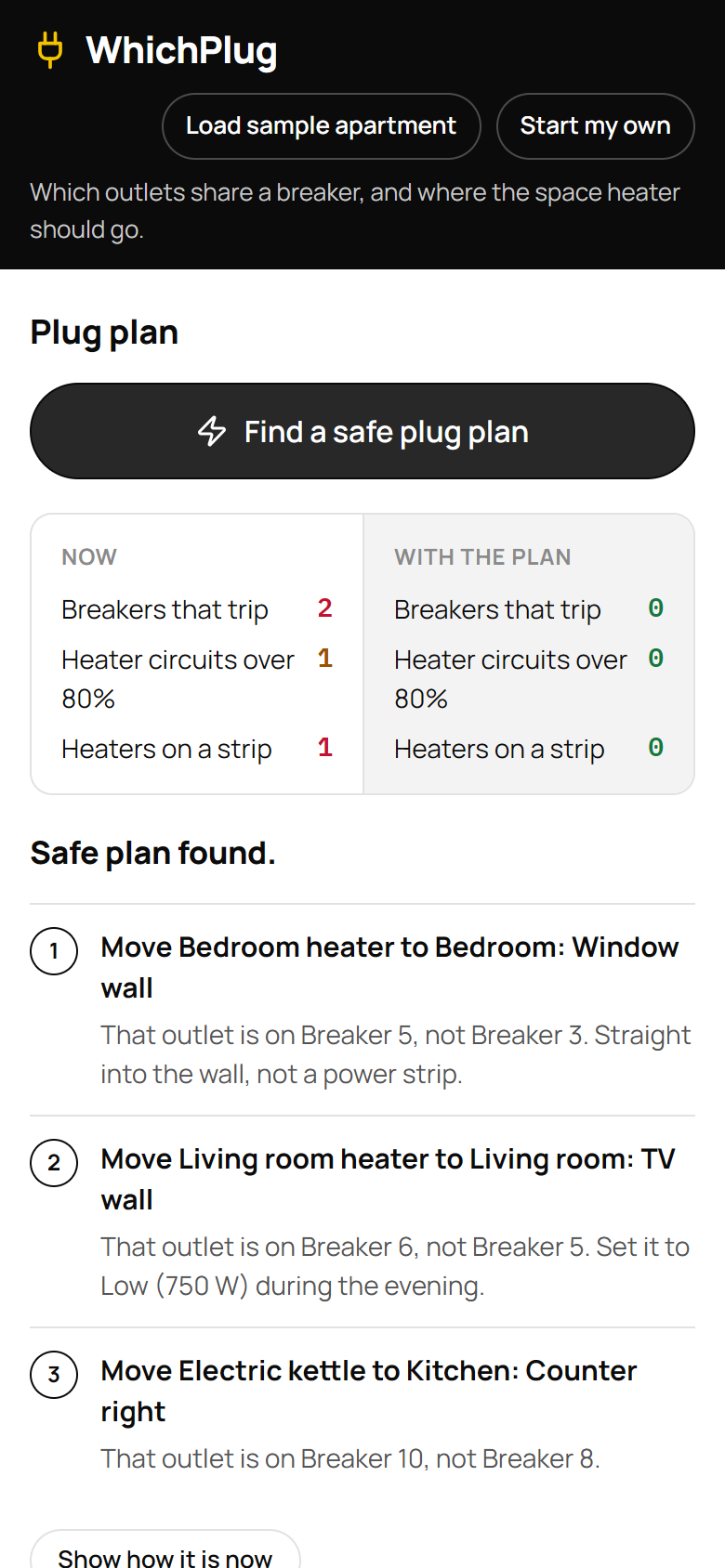
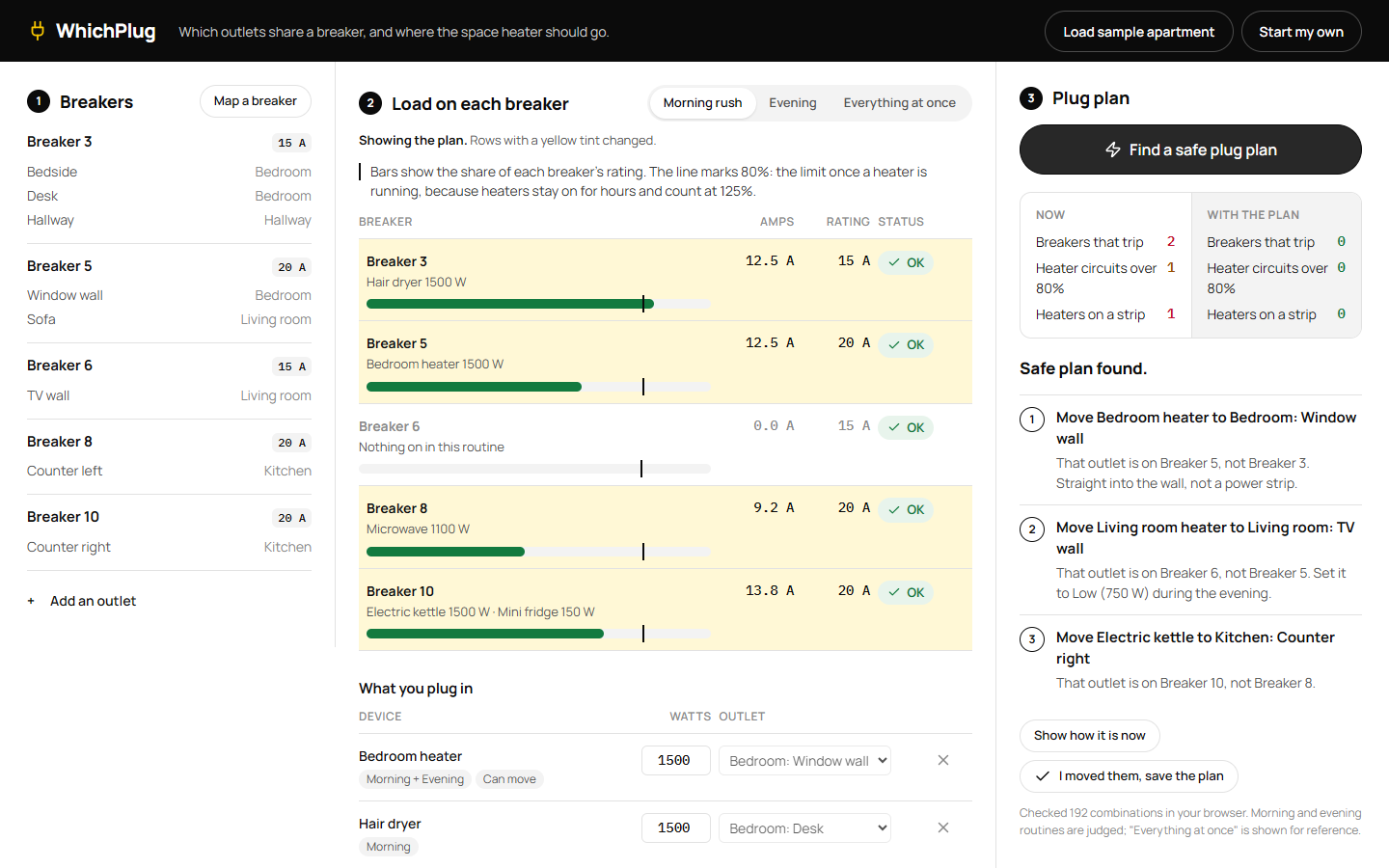
The result shows the counts before and after, the steps to take ("Move Bedroom heater to Bedroom: Window wall. That outlet is on Breaker 5, not Breaker 3."), and anything that moving plugs can't fix ("Don't run these at the same time").
The sample apartment loads by default, so you can try it without entering anything. In the sample, the bedroom heater sits on a power strip next to the hair dryer, and both are on a 15 A breaker. The plan moves the heater to the window outlet, which turns out to be on a different 20 A breaker, moves the kettle to the other counter, and moves the living room heater to the TV wall on Low in the evening.
How we built it
It's a static web app in plain JavaScript with no build step. Nothing leaves the browser; your home is saved in localStorage.
engine.jsholds the load math and the solver as pure functions, so the same code runs in the browser, the tests, and the evaluation script.- The load rule comes from NEC 210.19(A)/210.20(A): continuous load x 125% + other load must fit the breaker. Heaters count as continuous because they run for hours. That's where the "80% rule" comes from, and it's why a 1500 W heater on High is already too much for a 15 A circuit by itself (12.5 A x 1.25 = 15.6 A).
- "A heater never goes on a power strip" is enforced in code. The solver doesn't even generate that option.
- The solver is an exhaustive search over the allowed moves. It refuses to run above 400,000 combinations and asks you to mark fewer devices as movable. The sample apartment takes 192.
- The appliance list uses the top of the U.S. DOE typical-wattage ranges, and every value can be edited to match your label.
How well it works
I generated 40 apartments with known breaker maps: 20 for building and 20 held out and run once after the rules were frozen. Then I asked "will a breaker trip?" three ways. All numbers are in results.json in the repo.
| Check | Dev set (12 of 20 would trip) | Holdout set (11 of 20 would trip) |
|---|---|---|
| Each wall outlet on its own | missed 4 | missed 5 |
| Whole room as one 15 A breaker | missed 0, 0 false alarms | missed 2, 2 false alarms |
On the holdout set, 18 homes had a trip, a heater over 80%, or a heater on a strip. WhichPlug found a plan with no trips for 12 of them. Breaker trips went from 16 to 7 and heaters on power strips from 7 to 0, with 1.22 changes per home on average. In the other 6, no allowed move clears every trip, so the app lists which appliances not to run at the same time instead of claiming a fix.
Challenges we ran into
My first version flagged everything above 80%, which made a lone 1500 W hair dryer on a 15 A circuit look dangerous. That's wrong, because the 80% rule is about continuous loads. Switching to the actual NEC rule (continuous x 125% + the rest) fixed it. Under that rule a 1500 W heater won't trip a 15 A breaker on its own, but it does break the continuous-load limit.
The second problem was the evaluation. When I counted "over 80%" as unsafe, almost every home with a heater failed every check, so the comparison said nothing. Measuring "will the breaker trip" separated the methods: checking each outlet alone misses the cases where two rooms share a breaker.
What we learned
Most of the value is in the boring step: knowing which outlets share a breaker. Once that map exists, the math is simple, and a small search finds plans people wouldn't guess, like using the window outlet that happens to be on a bigger breaker.
Limitations
- U.S. 120 V homes only. No 240 V appliances, and no GFCI or AFCI nuisance trips.
- It trusts the watts you enter. Many hair dryers are 1875 W, so check the label.
- By default a device can only move within its own room.
- It can't see wiring faults. If an outlet is warm or smells burnt, stop and tell your landlord, whatever the numbers say.
- The evaluation homes are generated. I haven't tested it with real renters yet.
What's next
A printable breaker map to tape inside the panel door, and a "landlord report" that lists outlets that share a breaker across rooms.
Built during the hackathon
All code was written from 2026-11-22 until the deadline. There is no pre-existing code.
Credits
- NFPA heating fire statistics (2020-2024 averages), reported by ANSI.
- U.S. DOE typical appliance wattages, as reproduced in Penn State EGEE 102.
- NEC 210.19(A) and 210.20(A) for the continuous-load rule.
- Lucide icons (ISC), Manrope and IBM Plex Mono fonts (SIL OFL).
- AI assistance: Claude (Anthropic) helped write code and first drafts of this text. I chose the problem, the rules and the test cases, and reviewed everything.
Setup steps (for judges)
Open https://whichplug.vercel.app and press "Find a safe plug plan". To run locally: clone the repo, run any static server in the folder (for example npx serve .), and open it. npm test runs the engine tests and npm run eval regenerates results.json.
