-
-
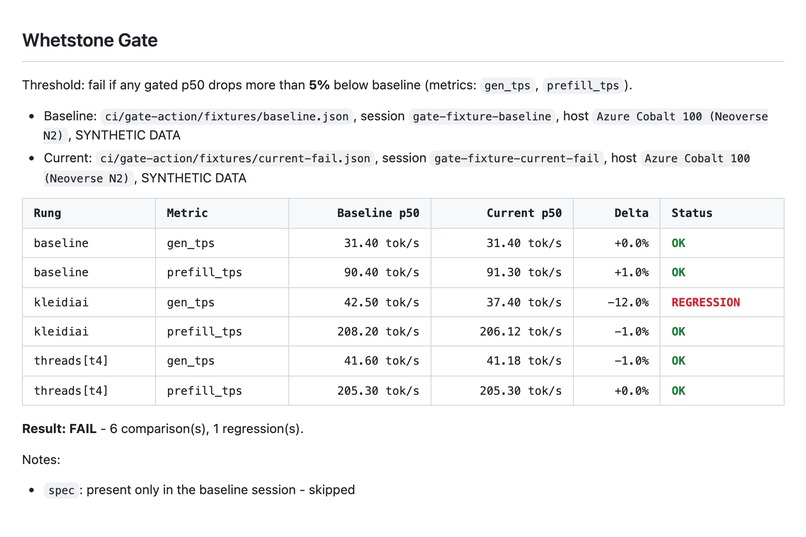
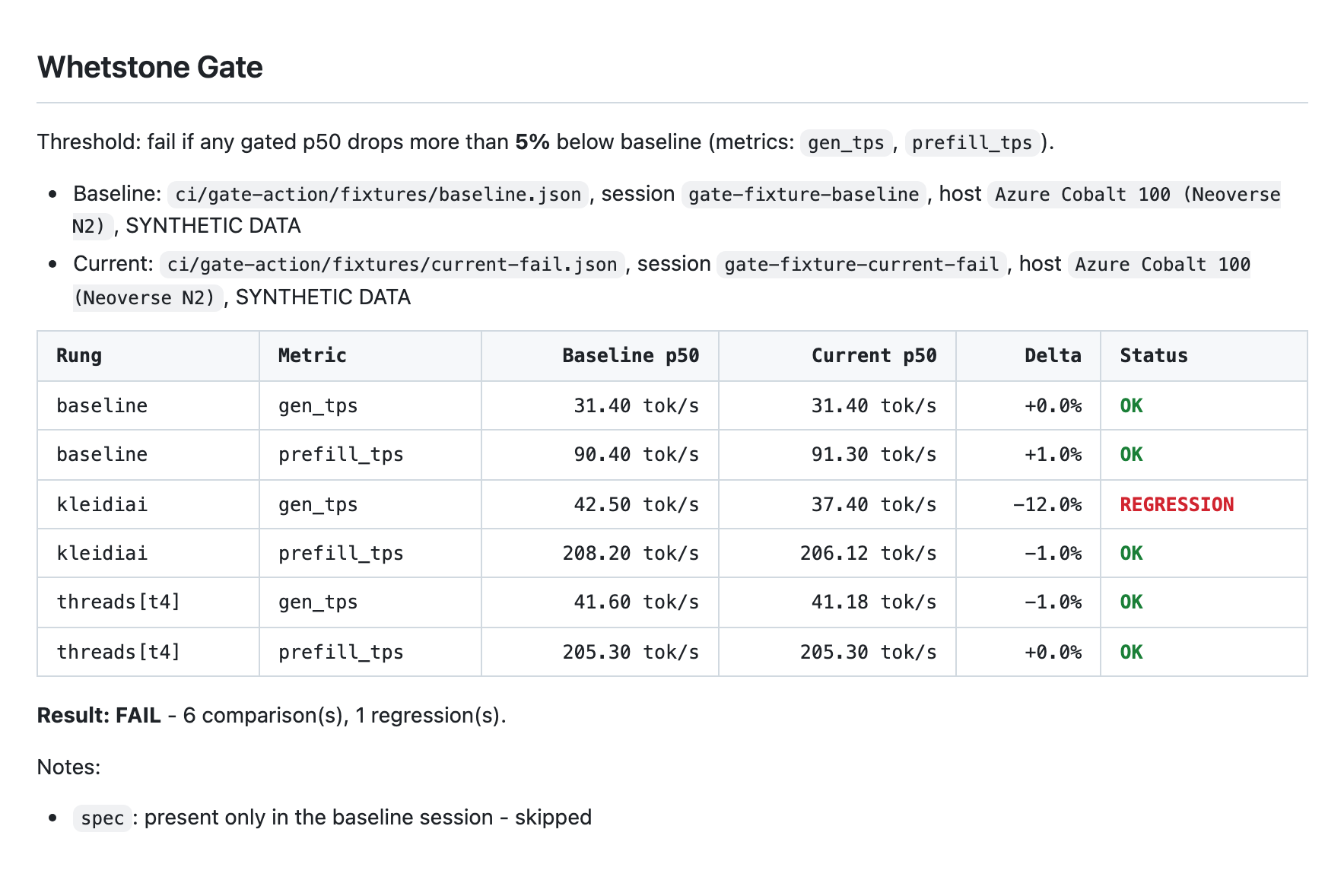
Gate Failing
-
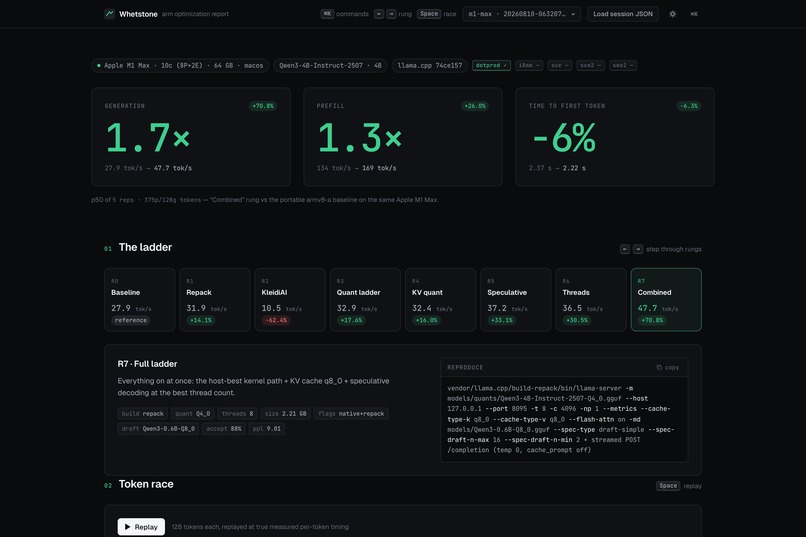
Tool
-
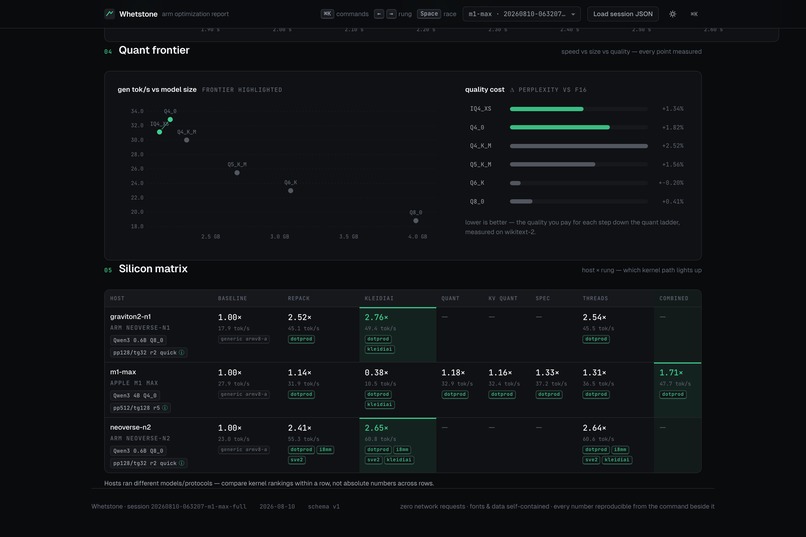
Silicon Matrix
-
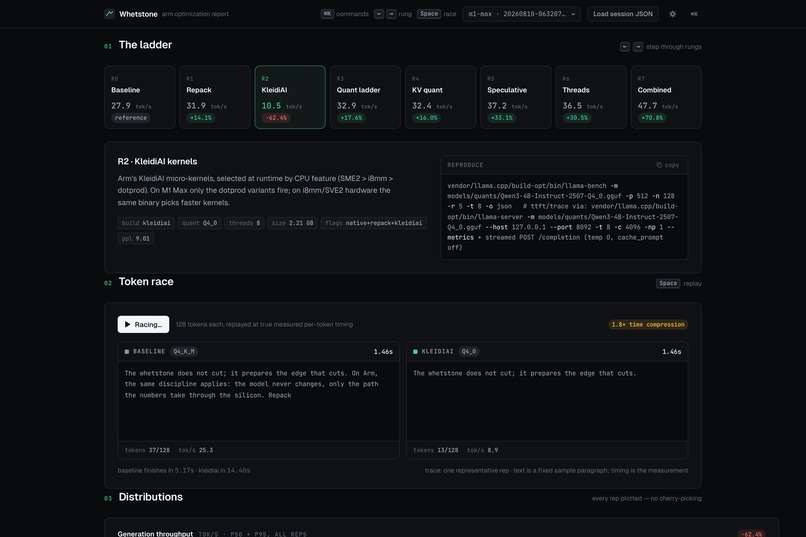
Kleidiai
-
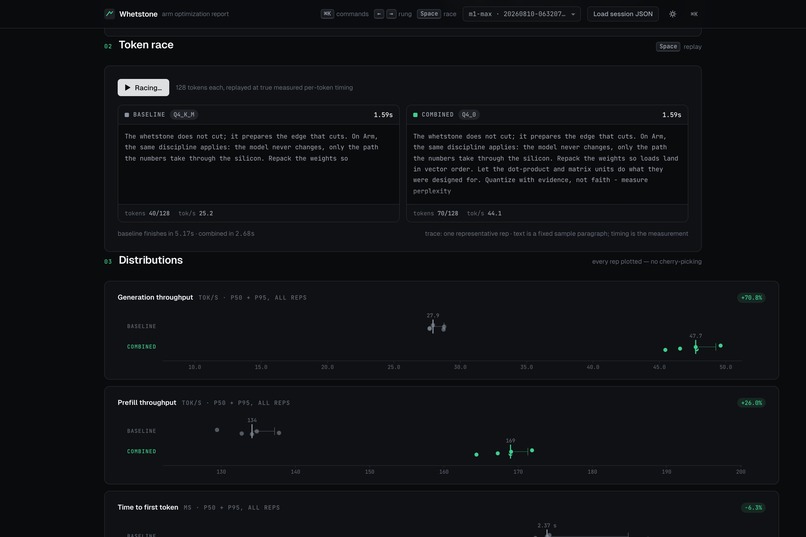
Token
-
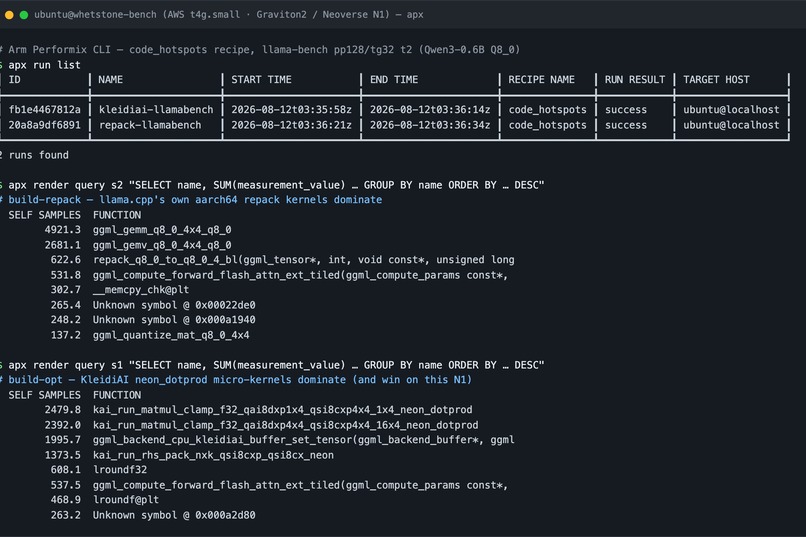
Performix Kernel
-
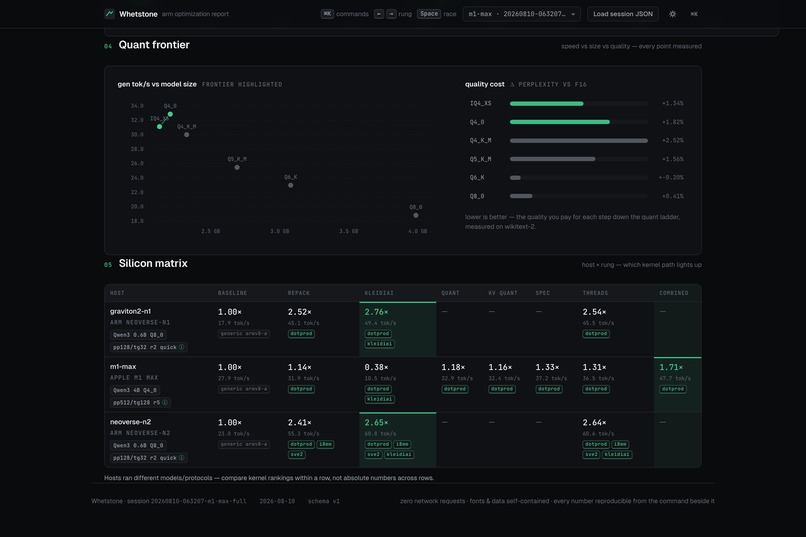
Quant Frontier
Try it before you read it
- 30 seconds: the live interactive report — https://tjohnson012.github.io/whetstone/ — scrub the ladder, replay the token race, open the three-silicon matrix.
- 2 minutes: watch the reusable CI gate hold a planted regression permanently red: https://github.com/tjohnson012/whetstone/pull/1
- 5 minutes, no Arm hardware needed: dispatch the
benchworkflow in the repo — GitHub's own arm64 runners rebuild everything and regenerate our numbers on machines we do not control. - 15 minutes on any Apple Silicon Mac: docs/SETUP-ARM64.md from
git
clone
to reproducing the headline finding live (cold-start verified: every command, first try). - docs/JUDGES.md is this menu, in-repo.
What it is
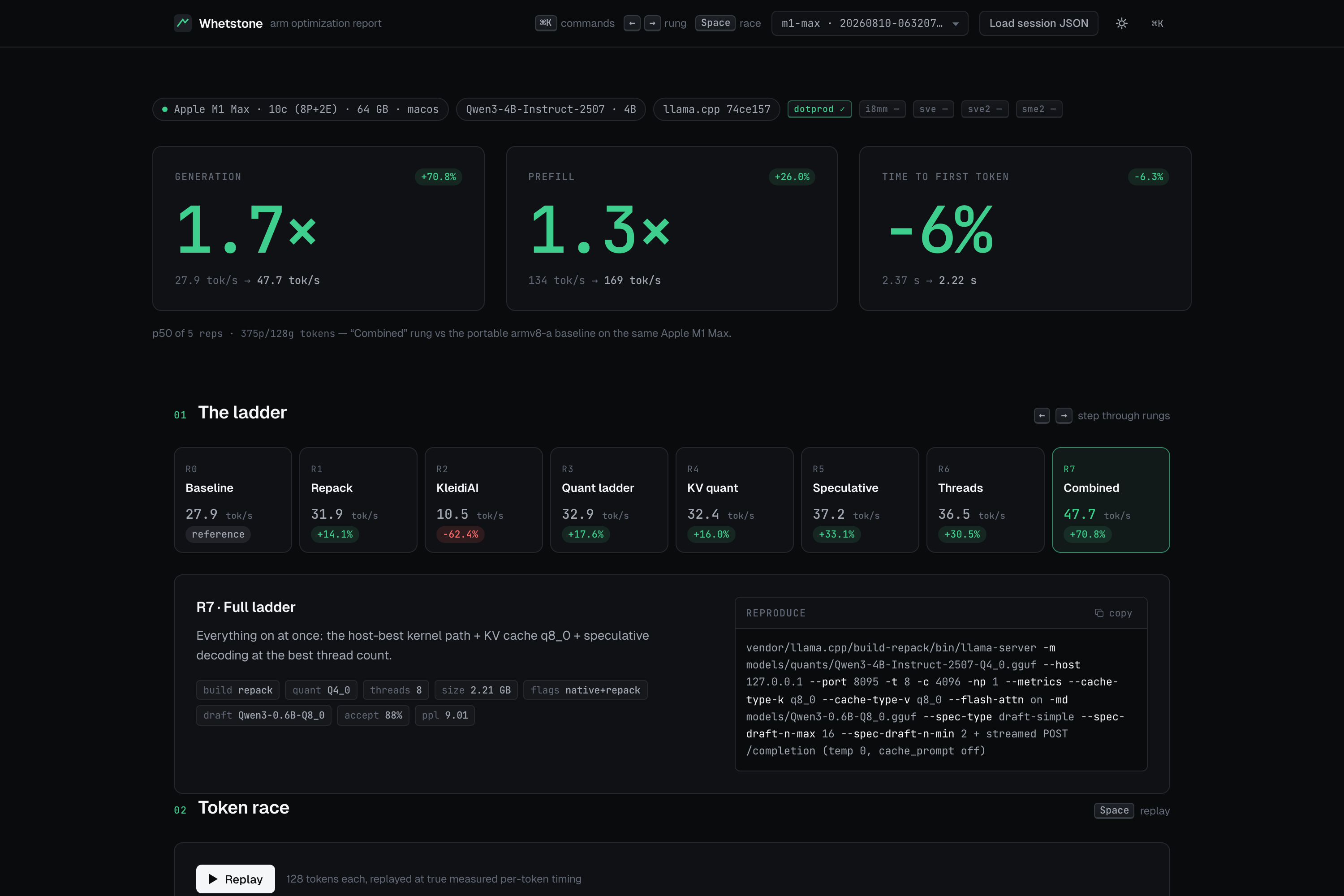
Whetstone is an optimization instrument for LLM inference on Arm CPUs. One model (Qwen3-4B-Instruct-2507), one pinned llama.cpp commit, a seven-rung ladder of Arm-specific optimizations — generic build → aarch64 runtime repacking → KleidiAI kernels → quantization sweep → quantized KV cache → speculative decoding → thread tuning — each rung measured the same way: raw samples, P50/P95, TTFT, per-token traces, peak RSS, and perplexity, with the verbatim reproduction command stored next to every number.
Mobile AI, on the mobile device developers actually carry: an Arm-powered laptop, fully on-device, offline, nothing leaves the machine. Track fit is confirmed in writing — the track targets "Arm-powered client devices such as smartphones, tablets, and laptops," and the organizer answered the exact Apple Silicon question in the challenge forum: "Yes, optimizations for Apple Silicon does count!" (https://arm-ai-optimization-challenge.devpost.com/forum_topics/44631-does-an-apple-silicon-mac-qualify-for-the-mobile-ai-track)
The results (Apple M1 Max, p50 of 5 reps, full protocol)
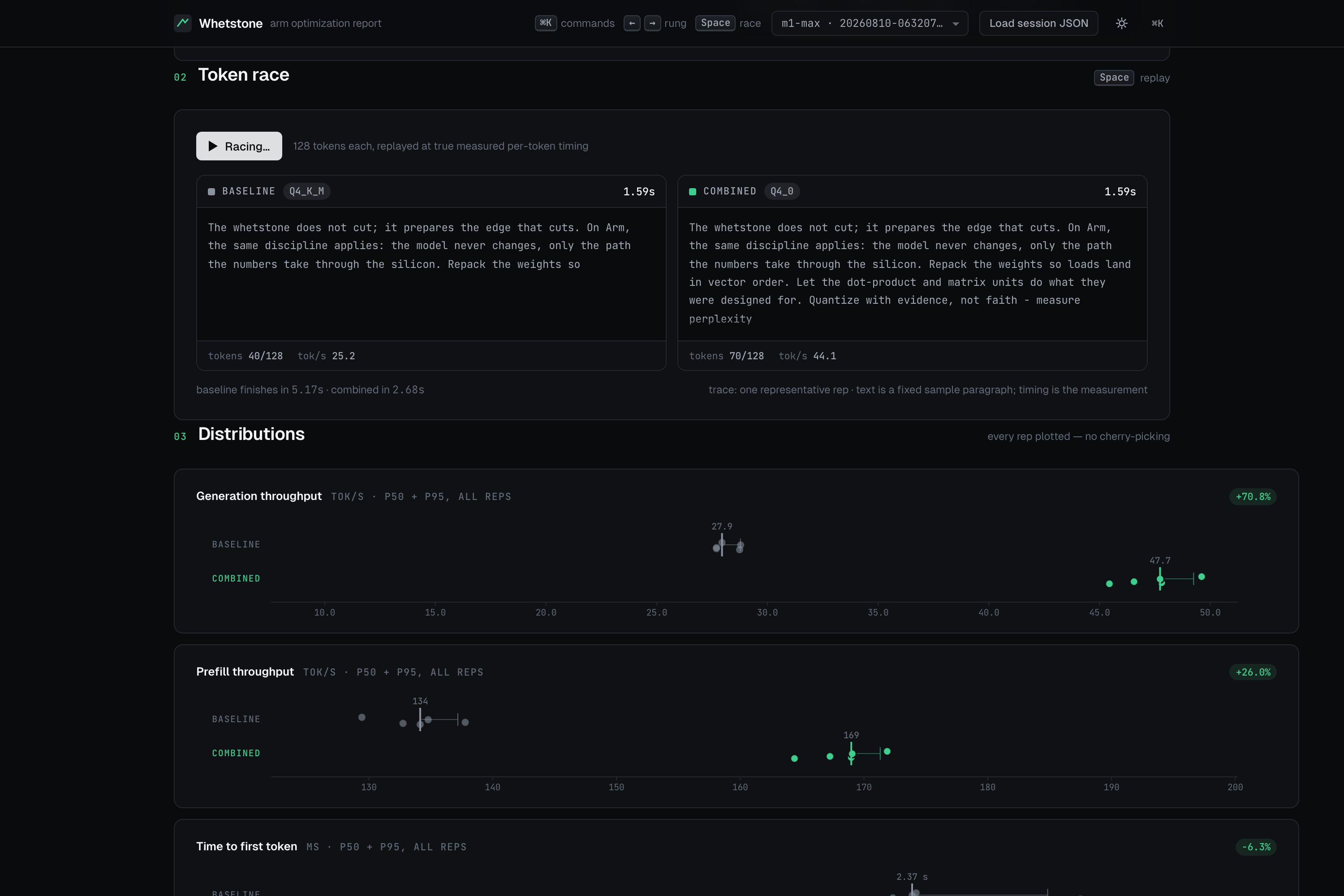
- Generation 27.9 → 47.7 tok/s (1.71x) at identical output quality (greedy speculative verification is exact; 88% draft acceptance measured).
- Prefill 134 → 196 tok/s at the best thread configuration; TTFT 2.37 s → 1.89 s from the first rung alone.
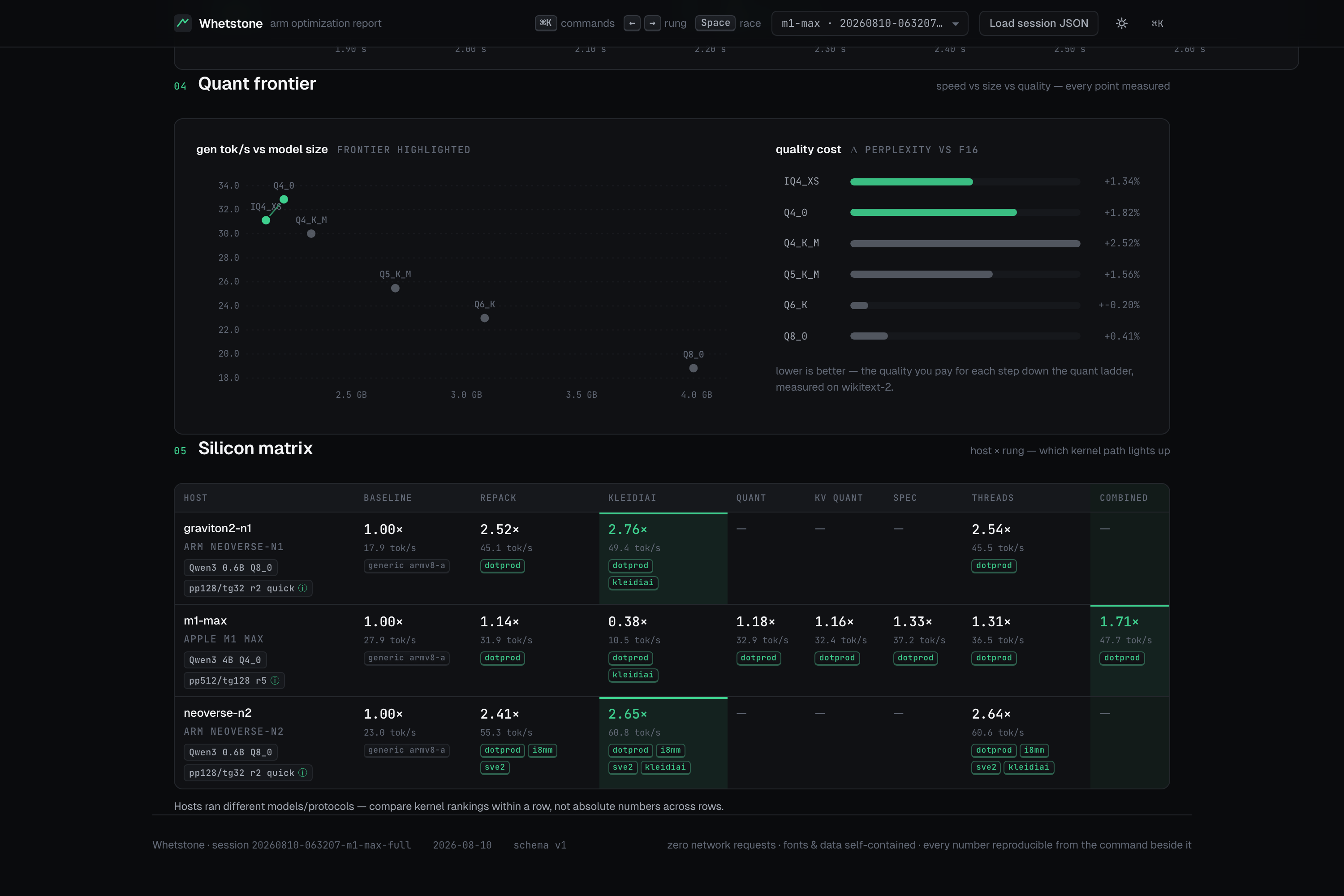
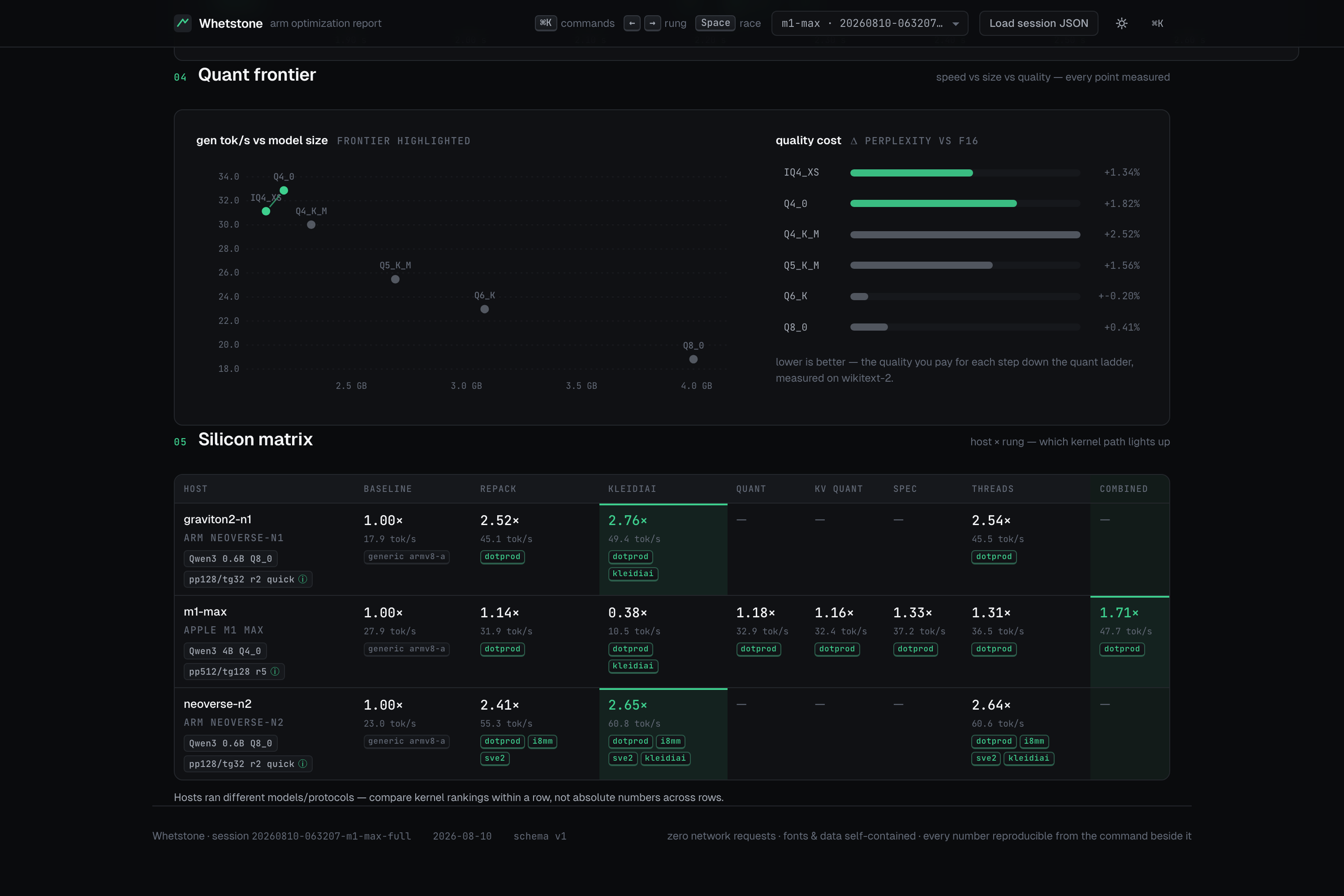
- Every quant carries its quality bill: Q4_0 is +1.82% perplexity vs an F16 reference measured on identical wikitext-2 chunks. Speed claims without quality evidence are how benchmarks lie; ours can't.
The finding (this is the part worth your three minutes)
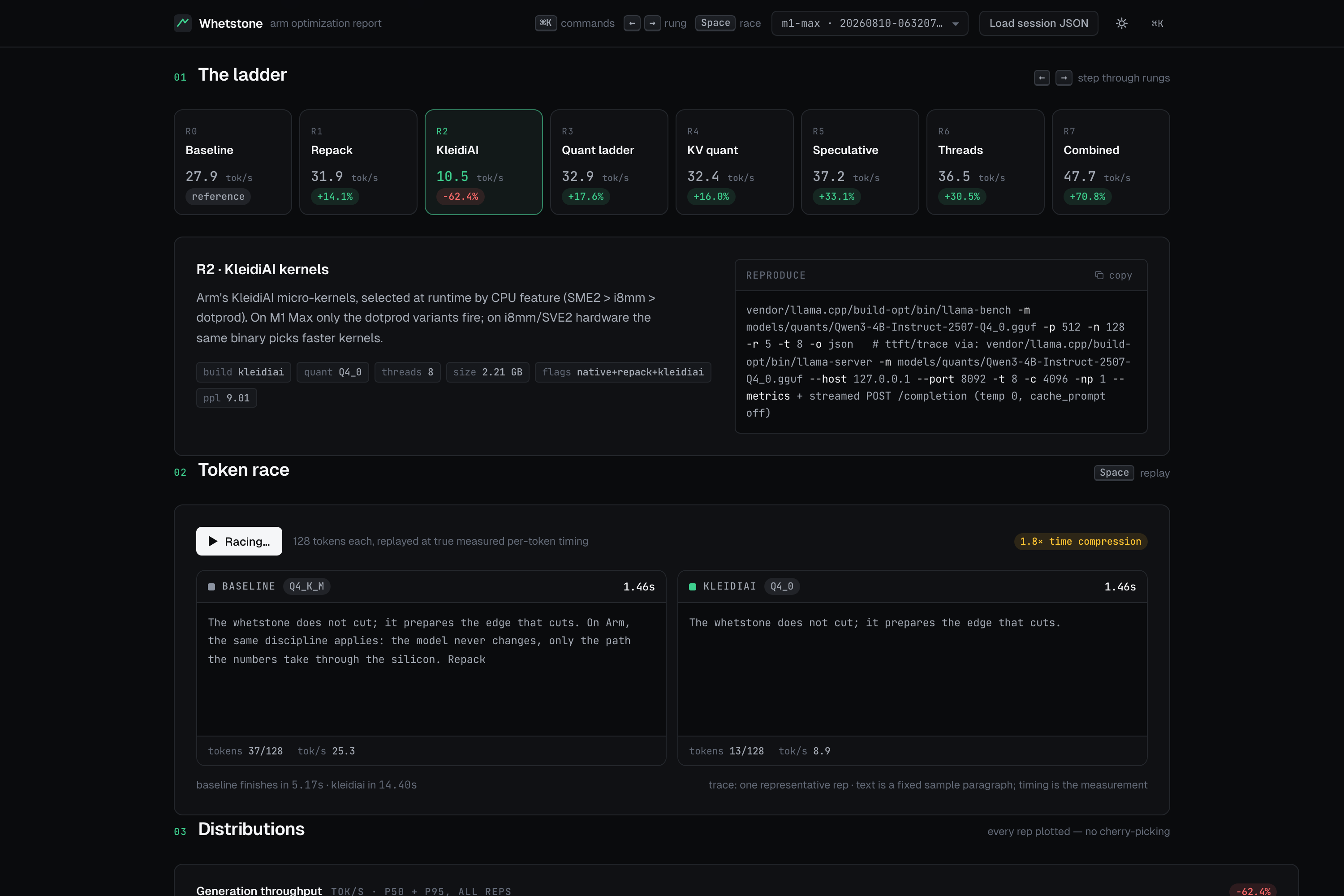
Enabling KleidiAI — Arm's recommended acceleration library — triples token-generation latency on the M1 Max (10.5 vs 31.9 tok/s against llama.cpp's own repack kernels; same commit, same model, same flags), while the same binary wins on Neoverse N2 (60.8 vs 55.3 gen, 232.5 vs 153.0 prefill).
So we formed the obvious rule — dotprod-only silicon prefers repack, i8mm
silicon prefers KleidiAI — and then tested it on a third chip. It
falsified our rule. AWS Graviton2 (Neoverse N1) is dotprod-only exactly
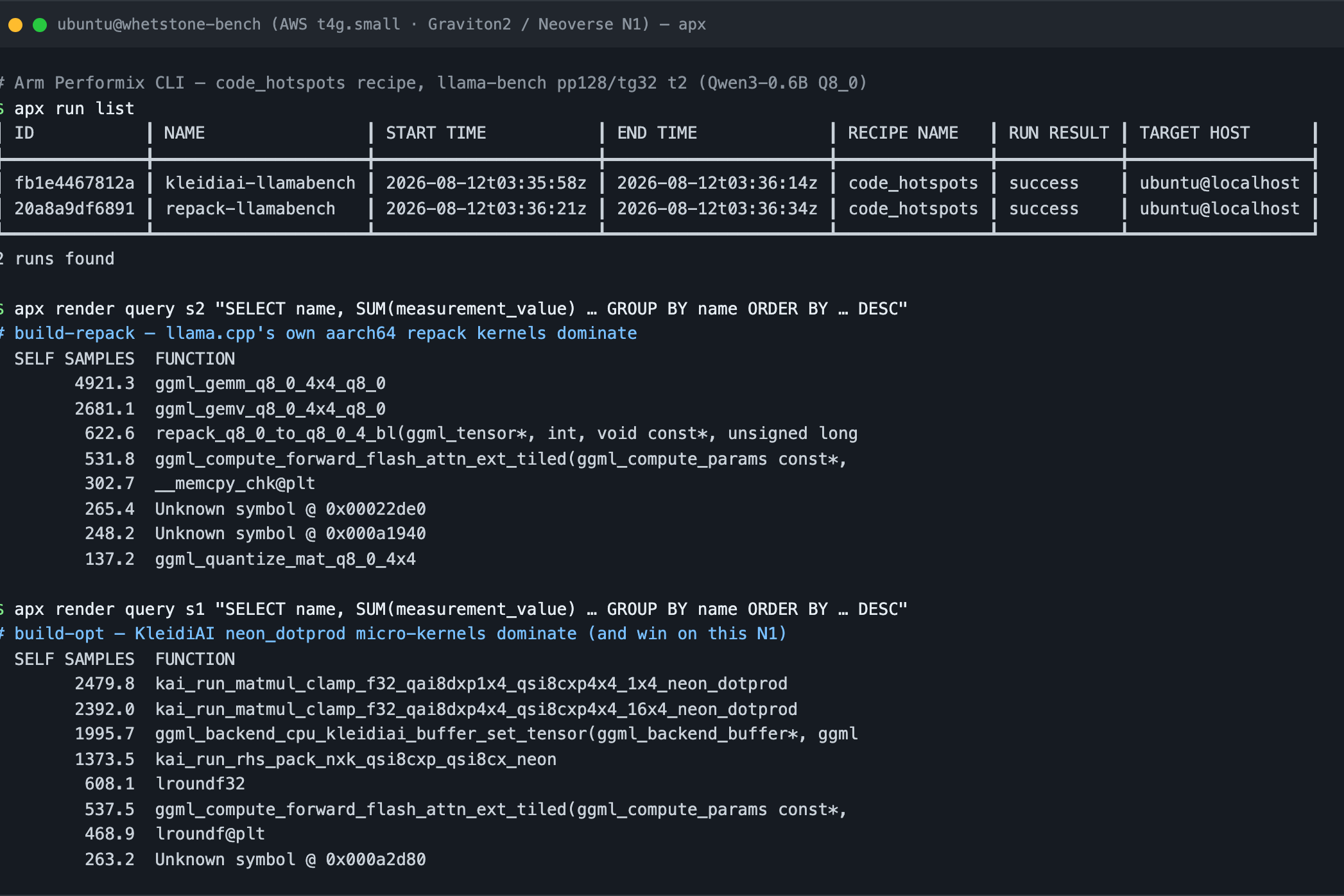
like the M1, and KleidiAI wins both axes there (228.6 vs 135.9 prefill, 49.4
vs 45.1 gen; TTFT 3,733 → 451 ms vs the generic build). The collapse is a
property of M1-class cores, not of CPU feature flags. Arm Performix
code_hotspots profiles on the Graviton instance provide kernel-level
receipts: each build's self-time sits in exactly the kernels it claims
(kai_run_matmul_*_neon_dotprod vs ggml_gemm/gemv_q8_0_4x4_q8_0).
The fast path is a property of the silicon — not the library, not its feature flags — and nothing warns you. That is why the deliverable is an instrument, not a number: Whetstone measures the ladder on your machine, auto-selects the host-best kernel path, keeps both isolation rungs visible as ground truth, and documents its own heuristic's failure honestly. The regression is reported upstream: https://github.com/ggml-org/llama.cpp/issues/27078.
The N2 ranking was re-validated on 4-vCPU public runners on submission day — same result, wider margin (461.9/101.8 vs 304.5/89.7). Cloud-host numbers are 0.6B quick-protocol runs — the kernel ranking is the claim there, never absolute cross-host numbers; the UI badges every row with its model and protocol.
What ships (all MIT, all reusable)
- The Instrument — hand-built web app, no chart libraries, no network calls: ladder scrubber that morphs every number, token race replaying real per-token timestamps, sample-level distributions, quant frontier, three-silicon kernel matrix. Exports to a single self-contained report.html.
- whetstone CLI — stdlib-only Python benchmark harness, macOS/Linux arm64, schema-validated session JSON.
- whetstone-gate — composite GitHub Action failing PRs on p50
regressions (
uses: tjohnson012/whetstone/ci/gate-action@v1); PR #1 is its permanent live demonstration. - Session schema + report exporter + table renderer — the README's own result tables are generated from the measured JSON by script; prose cannot drift from data.
How we measured
Three pinned builds of llama.cpp 74ce157 (generic / repack-only / KleidiAI —
the third exists because KleidiAI has no runtime off-switch at this commit,
which we document, along with two more pitfalls: quantized V-cache requires
flash-attn on CPU, and -md without --spec-type silently never drafts).
pp512/tg128, 5 reps after warmup; TTFT and traces from llama-server's SSE
stream; peak RSS from /usr/bin/time; perplexity with matched-chunk F16
reference. Full protocol, threats to validity, and explicit non-claims:
docs/METHODOLOGY.md.
Built With
- apple-silicon
- arm-performix
- arm64
- aws-graviton
- github-actions
- kleidiai
- llama.cpp
- python
- qwen
- react
- typescript
- vite

Log in or sign up for Devpost to join the conversation.