Inspiration
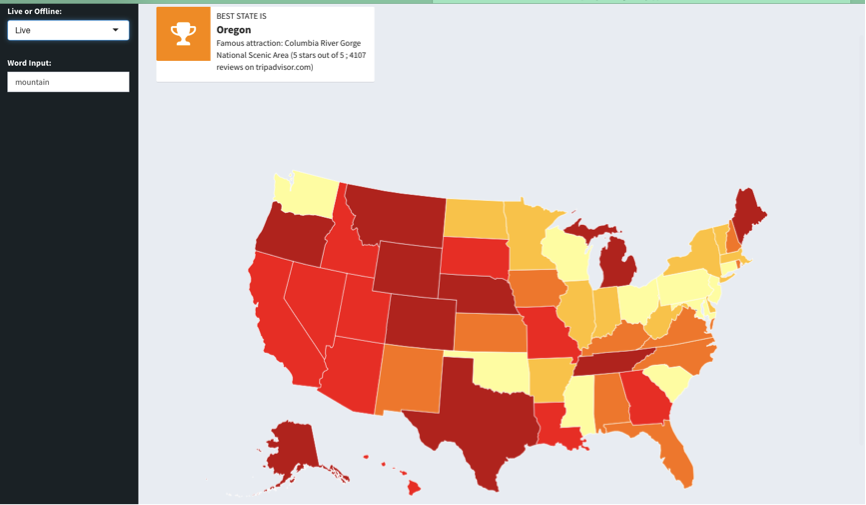
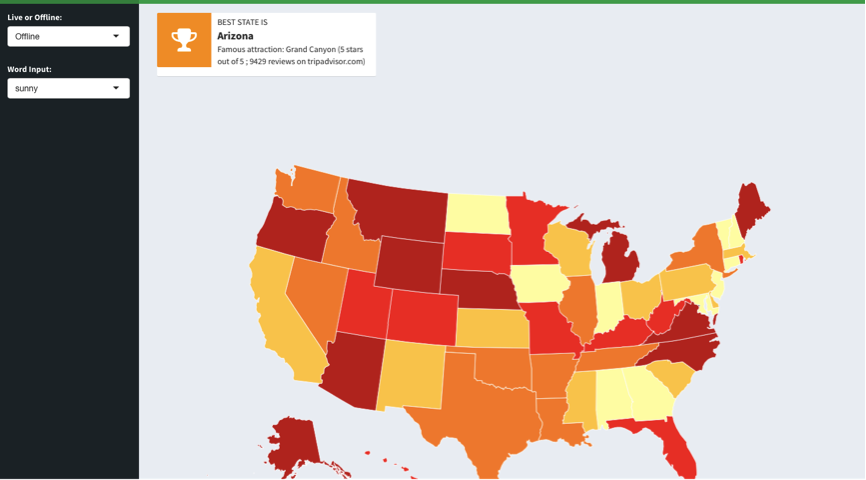
This app aims at helping users to select a best travel destination. This app works as an experienced traveler who has been to almost everywhere around the nation. It takes as input a user’s description of his/her ideal place to go and returns a colored map of the United States. The darker the color of a state is, the more it deserves a visit. Just as if an expert has sorted out the attractiveness of every state for the user.
What it does
The basic idea works as this:
- Take in data from user’s description.
- Use text mining technique to process the paragraph to a list of words that only contains stemmed words and leave out stop words.
- Use random forest (Gini decrease or entropy reduction) to rate the informativeness of each word. For example, the word “beautiful” is meaningless in state selection since every state must have some beautiful places. In contrast, “mountain” is an informative word since some states have mountains but some do not.
- Use the most informative words to search for reviews online (at tripadvisor.com) and calculate the weighted average rating of each state (weighted by number of reviews).
- Demonstrate the overall rating of every state in the map.
However, it will be too slow to run random forest every time it gets input. Instead we randomly scraped some sample reviews and ran random forest based on the high frequency words of those reviews. Then we picked up the most meaningful words into a dictionary and record their meaningfulness, which is implied by Gini decrease. When user types in a paragraph of description, we find the most meaningful words in his or her paragraph and then use these words to carry out further search.
How I built it
Major techniques used in this project include web scraping, text mining, random forest and website developing.
What's next for Where To Go
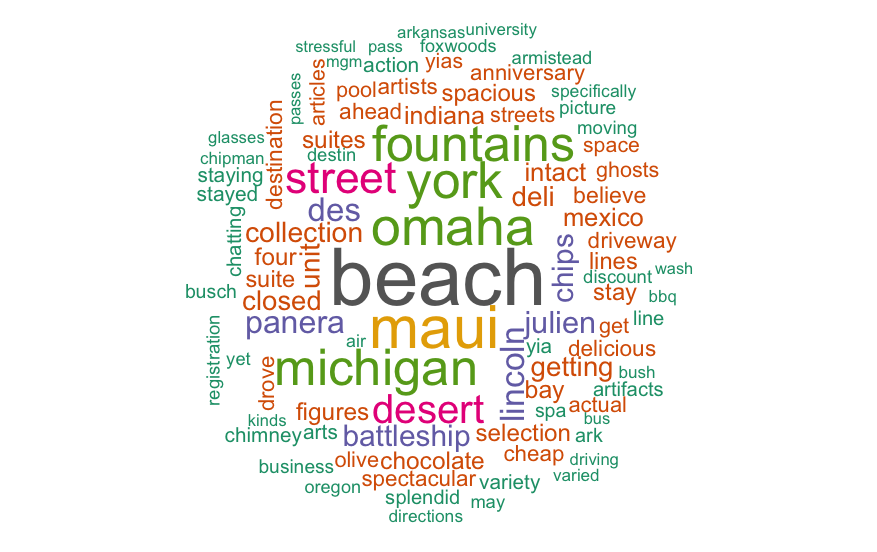
There is a whole university we can go from this point. First, we can improve the result by comparing user’s descriptions with major attractions’ review and see which state contains the largest number of suitable attractions. Second, we can easily include other considerations like travel budget (which has already been showed in the website) into the recommendation. Third, we can use more website than tripadvisor.com (which has a robot proof verification). Forth, we can draw word cloud of reviews on those related attractions for user to enhance their inspiration.
Further, this idea can be easily transferred to any item’s selection as long as scraping reviews is plausible. For example, we can do restaurant recommendation, hotel recommendation, and even online shopping searching. Making our website more appealing is also something we should work on in future.


Log in or sign up for Devpost to join the conversation.