Inspiration
As an immensely curious person, I have noticed that among the many, often unrelated topics I'm interested in, there's a major disconnect in overlapping discourse that could lead to productive solutions.
Along the same strain, I have observed and experienced the tugs and pushes of a disconnect, an invisible hand that steers, and determines who has access to the appropriate resources for an elite academic admissions race. Distances that become much harder to close when it's no longer simply a conversational barrier but large distances to be covered. As a Neuroscience major myself with a hobbyist interest in sociology I teamed up with my friends in Data Science.
What it does
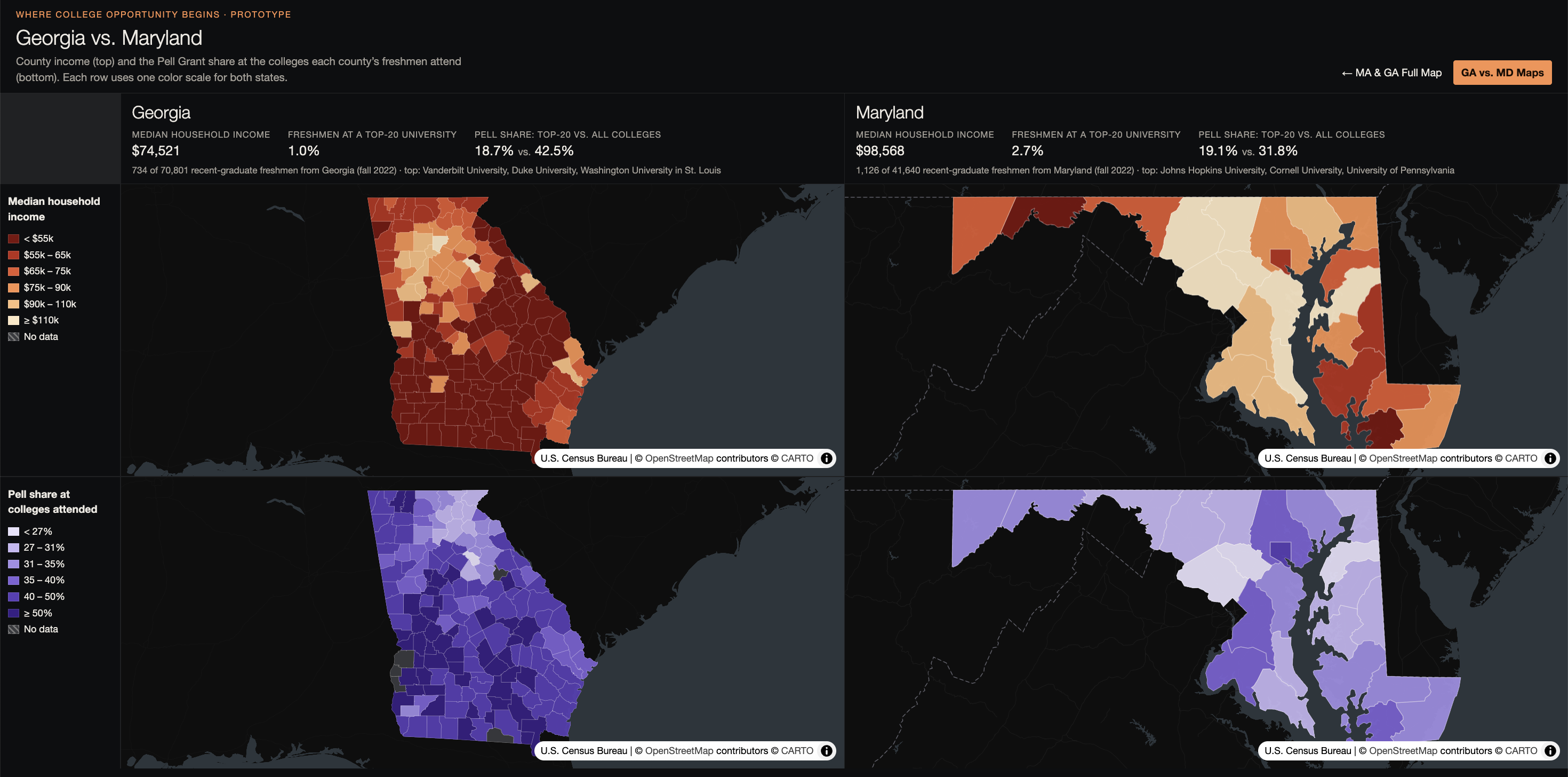
Our project allows users to see how geography and characteristics of being an underserved community can play into going to college. Where students enroll and their access to elite colleges. We observed this to control for socioeconomic factors by seeing how Pell Grant recipients fit into this picture.
How we built it
Starting off with workshopping a high-level design to be the architecture for our project, we used AI to create a prompt that we fed into Kiro. After extensive consultation with the resources at our disposal, we made use of Mapbox and Open Street View to create real county boundaries from the Census Bureau. Working with Kiro, and running into issues with it multiple times before overcoming them. We incorporated data sets which contained 2020 County Census data of Massachusetts and Georgia Populations, several datasets from NCES, Federal Student Aid’s Pell Grant data, and institutional characteristics from IPEDS data.
Challenges we ran into
As a first-timer at a hackathon and never having created a project of this size before. My teammates and I gained massive trust in ourselves through the advice given to the mentors around us. After the twelve, and growing, hours I’ve spent here, I’ve gained an incredible amount more comfort with working with generative AI for fully working project creation --compared to where I was at the start. I’ve learned how to put the “human” into AI.
Accomplishments that we're proud of
How we find the necessary data to be used for this project was the biggest struggle we encountered and had to work through, albeit with annoyed frustration. We used Kiro and learned how AI can be used to develop projects and expand upon ideas we might have. Having learned that AI is nowhere near perfect, we need to do the post-AI version of debugging in order to get our projects where we wanted.
What we learned
Three out of the four of us have never used AI to produce a project start to finish, back-end and UI all included.
What's next for Where Opportunity Begins
Our project has the opportunity to expand greatly in numerous different directions. This project has taken inspiration from the many papers I’ve read out of sheer curiosity, and I hope this project can inspire others in my previous position to tinker with science and delve their hands into the world around them by encouraging curiosity. Inspired by research scientists who end their projects with a call to action by encouraging further steps, this project would be expanded to include even more data from other sources to further back up this idea, and our prototype would be expanded to be nation-wide, rather than only two states.
This interaction and visually engaging figure would be used by nonprofit organizations working for underserved communities for social impact. For political activism and to increase awareness. I believe people have a natural tendency and inherent drive to improve their condition and create the infrastructure that holds the power for incredible good.
Built With
- kiro
- mapbox
- maplibre
- node.js
- python
- typescript
- vite

Log in or sign up for Devpost to join the conversation.