Inspiration
Managing time becomes difficult when work, personal activities, family commitments, studies, and events all compete for the same limited time. Traditional calendar applications are good at recording events, but they do not actively reason about how different commitments interact.
We created Whenever AI Personal Scheduling Application to make scheduling more intelligent. Our goal is to give users an AI assistant that understands their commitments, preferences, and priorities and helps them organize their time without requiring them to manually coordinate everything.
What it does
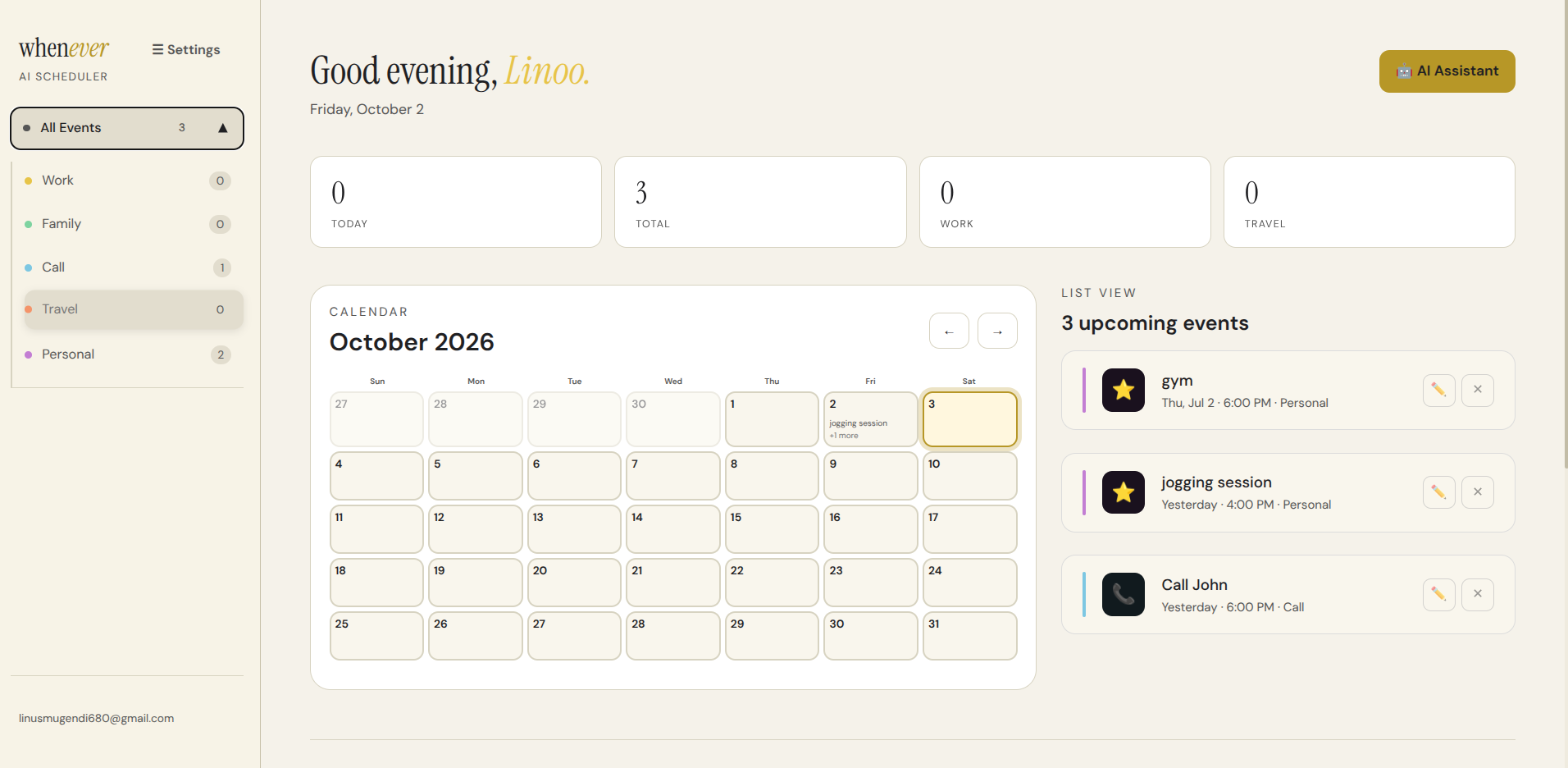
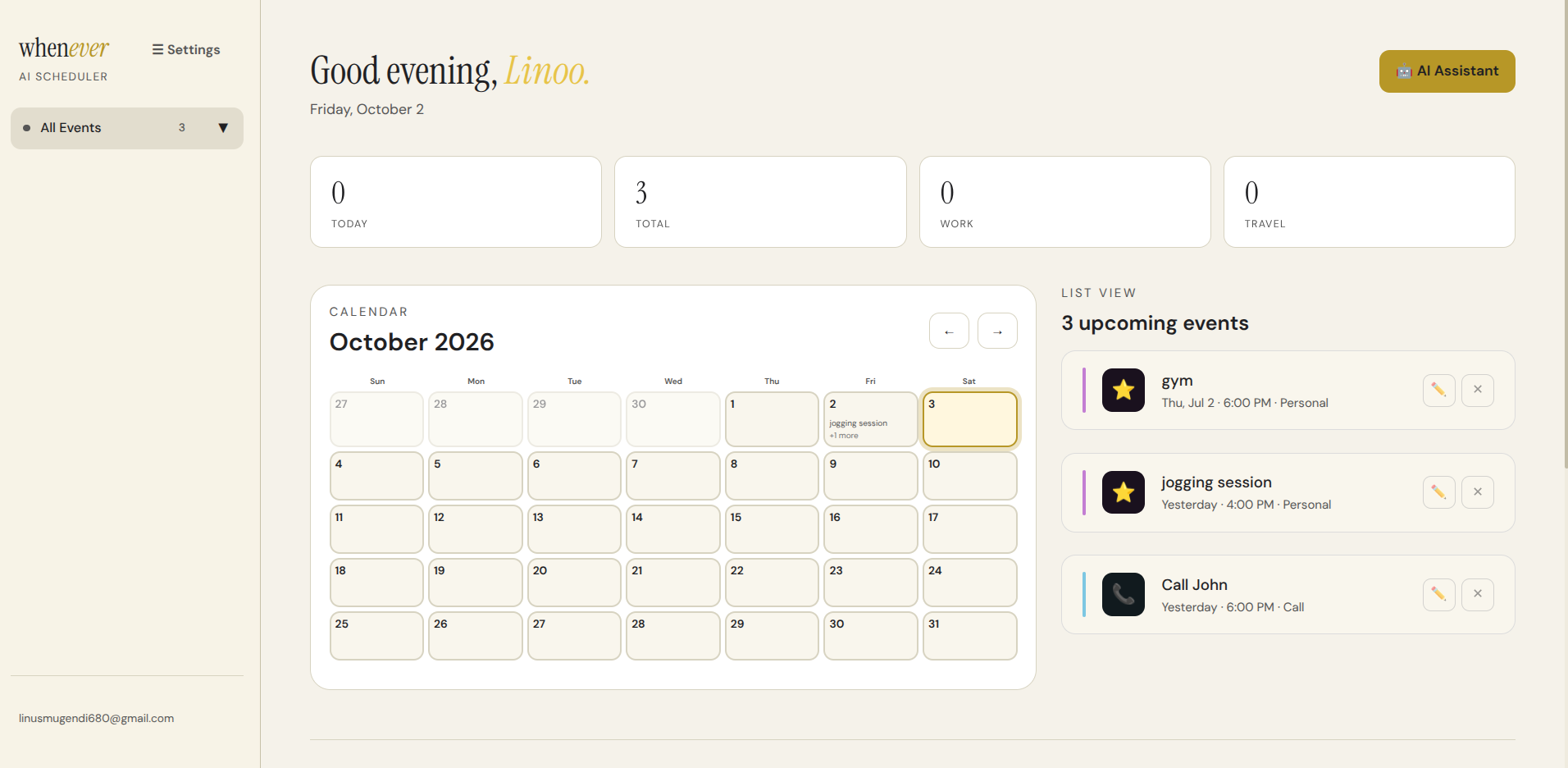
Whenever is an AI-powered personal scheduling application that helps users plan and manage events across different areas of their lives, including work, personal activities, family commitments, and other events.
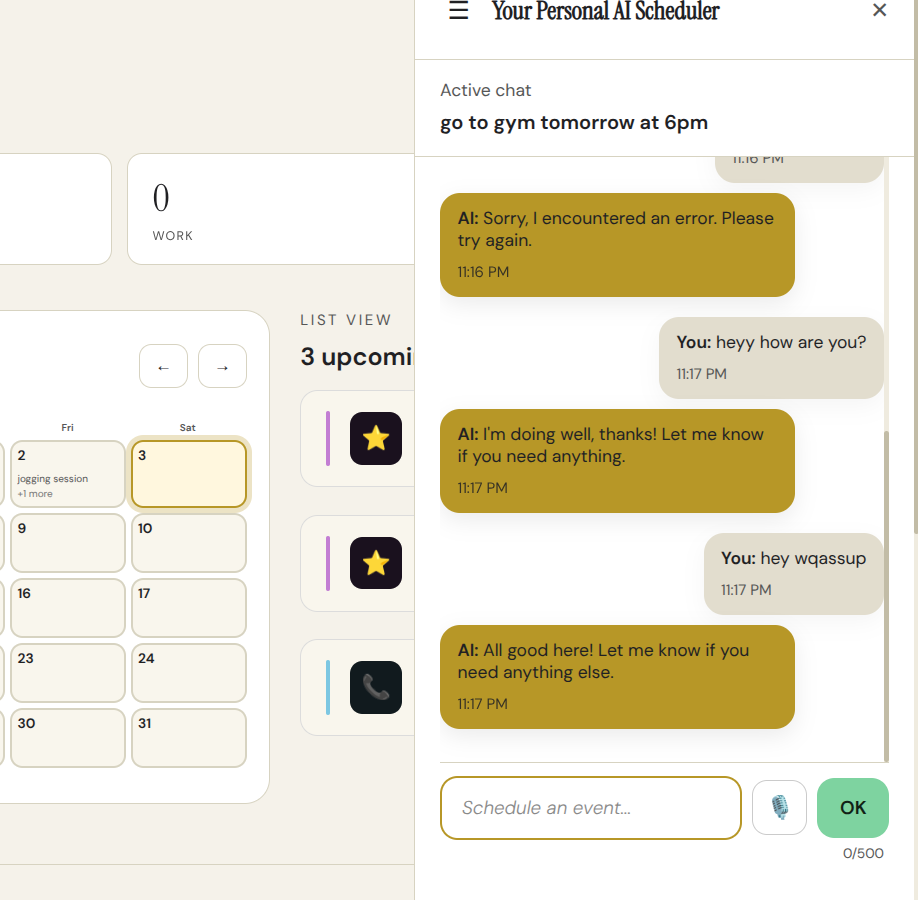
Users can interact with the application using natural language to describe what they need to accomplish or schedule. The AI helps organize these requirements into a practical schedule while considering existing events and available time.
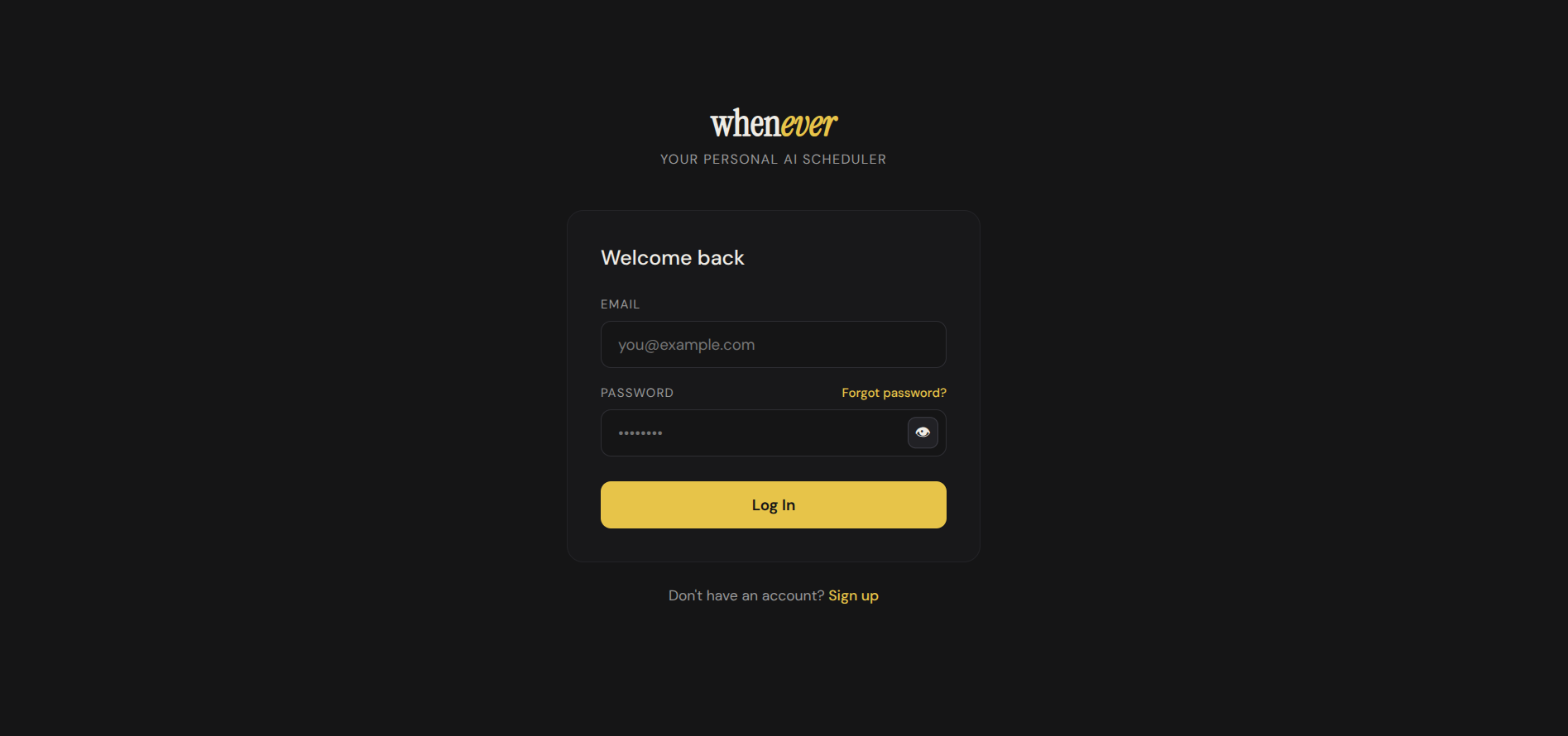
The application also provides user authentication, persistent event data, scheduling workflows, and reminders. For this hackathon, the AI reasoning layer has been integrated with NVIDIA Nemotron through Nebius Token Factory.
How we built it
Whenever was built as a full-stack web application with an AI scheduling layer, persistent data, and event-management functionality.
We use Supabase for authentication, database storage, and Row Level Security. The application frontend provides the scheduling interface, while the backend handles AI requests and application operations.
For the hackathon, we integrated NVIDIA Nemotron through Nebius Token Factory as the AI reasoning layer. The model works with the application's scheduling context to help interpret user requests, reason about commitments, and generate scheduling decisions.
The application also uses background workflows for reminders and scheduled actions, allowing users to continue receiving relevant notifications without keeping the application open.
Challenges we ran into
One of our main challenges was making AI-generated schedules practical rather than simply producing natural-language responses. A useful scheduling system needs to consider existing events, priorities, available time, and potential conflicts.
Another challenge was connecting AI reasoning with structured application data. The AI needs to understand scheduling context while the application must reliably validate and execute the resulting operations.
We also had to migrate the existing AI layer to NVIDIA Nemotron through Nebius Token Factory while preserving the scheduling functionality and user experience already implemented in Whenever.
Accomplishments that we're proud of
We are proud of building Whenever as a complete scheduling application rather than just an AI chatbot or proof of concept.
The application combines AI-assisted scheduling, user authentication, persistent event management, reminders, and background workflows into a single system.
We are particularly proud that we were able to take an existing working application and integrate NVIDIA Nemotron through Nebius Token Factory into its core AI workflow. This allowed us to extend an existing product with new AI infrastructure while preserving its underlying scheduling capabilities.
What we learned
We learned that building a useful AI application requires more than integrating a language model. The AI must work together with structured data, application logic, tools, and user workflows.
We also learned the importance of separating AI reasoning from deterministic application operations. The AI can interpret requests and help determine what should happen, while the application is responsible for validating and executing those operations reliably.
Working with Nebius Token Factory and NVIDIA Nemotron also gave us practical experience integrating open AI models into a real application rather than using them only for standalone experimentation.
What's next for Whenever AI Personal Scheduling Application
Our next goal is to make Whenever more adaptive and autonomous while keeping the user in control.
We plan to improve constraint-aware scheduling, adaptive rescheduling, personal preferences and memory, calendar integrations, and additional scheduling tools.
We also want Whenever to respond intelligently when a user's plans change. If an event is cancelled, delayed, moved, or added, the application should be able to identify the affected commitments and generate an updated schedule.
Our long-term vision is for Whenever to become a personal AI time-management agent that continuously helps users coordinate work, personal activities, family commitments, and events while making better use of their available time.
Built With
- agents
- application
- automation
- factory
- generative
- javascript
- language
- large
- models
- natural
- nebius
- nemotron
- nvidia
- personal
- processing
- react
- scheduling
- supabase
- token
- vite
- web

Log in or sign up for Devpost to join the conversation.