
Inspiration
In the heart of evolving smart cities, with digital technologies to reimagine and redefine urban living, we noticed a very important lacuna: collaboration tools. WHEN?? draws its inspiration from our vision to contribute toward a smart city by finding one of the most vital solutions for urban challenges: making it easier for busy people to find the time to connect.
This chance to make a huge difference in time management and collaboration came at such a time when cities were looking at how technology could increase efficiency, sustainability, quality of life, and services. Whereas existing tools such as When2meet can work to some degree, they aren't utilizing digital capabilities for the dynamic needs that modern city life throws at them. We set out to develop not just a solution which would simplify the way of scheduling but do so in a way that stays true to the core principles of smart cities:
- Improving Efficiency: Automating and optimizing the meeting scheduling process with WHEN?? will reduce the time and effort needed to do the coordination, freeing urban professionals and students to be more productive elsewhere.
- Sustainability Enhancement: Indirectly, through smart digital solutions, WHEN?? helps in giving its contribution towards sustainability through contributing to a reduction of unnecessary travel and efficient resource use while scheduling shared spaces.
- Improving Quality of Life: By streamlining collaboration and minimizing scheduling stress, WHEN?? aims to increase work-life balance and overall well-being of city residents.
- Improving City Services: While not traditionally defined as a city service, WHEN?? is representative of how digital innovation can make new creations that improve lifestyles and work in cities.
Our inspiration was informed by the belief that, in a smart city, even the most mundane yet fundamental tasks of city living-such as meeting and event coordination-can be improved through appropriate deployments of technology.
What it does
WHEN?? introduces the concept of team scheduling with a set of features that are intelligently designed for today's urban dweller. It includes:
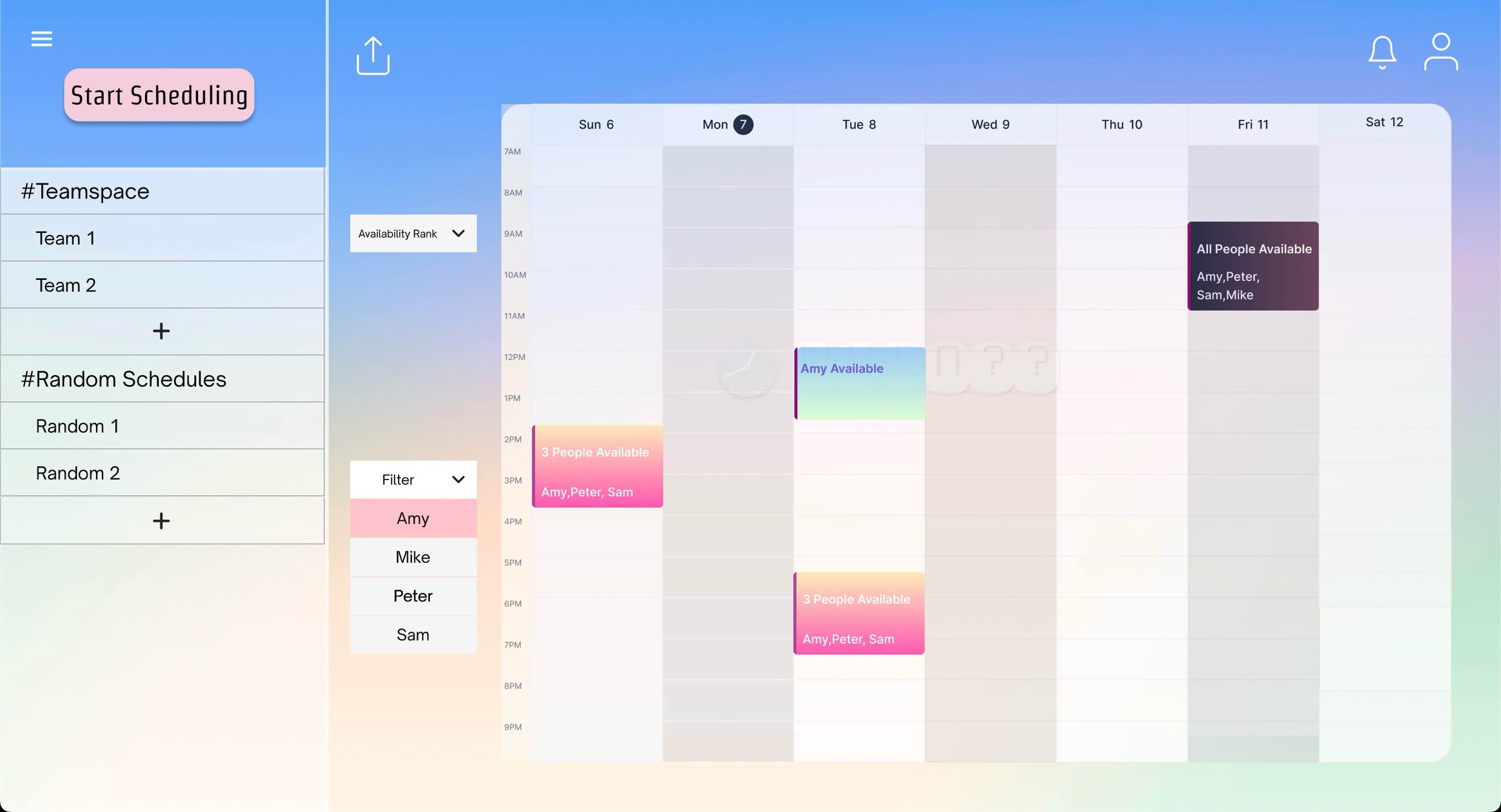
- Intelligent Ranking: Time slots will automatically be sorted from most to least available, saving time in decision making;
- Advanced Filtering: Keep track instantly of who's available at precisely what time, accelerating the choice of a time slot;
- Excel Export: Convenient sharing and integration with other planning tools-ideal for the busy professional.
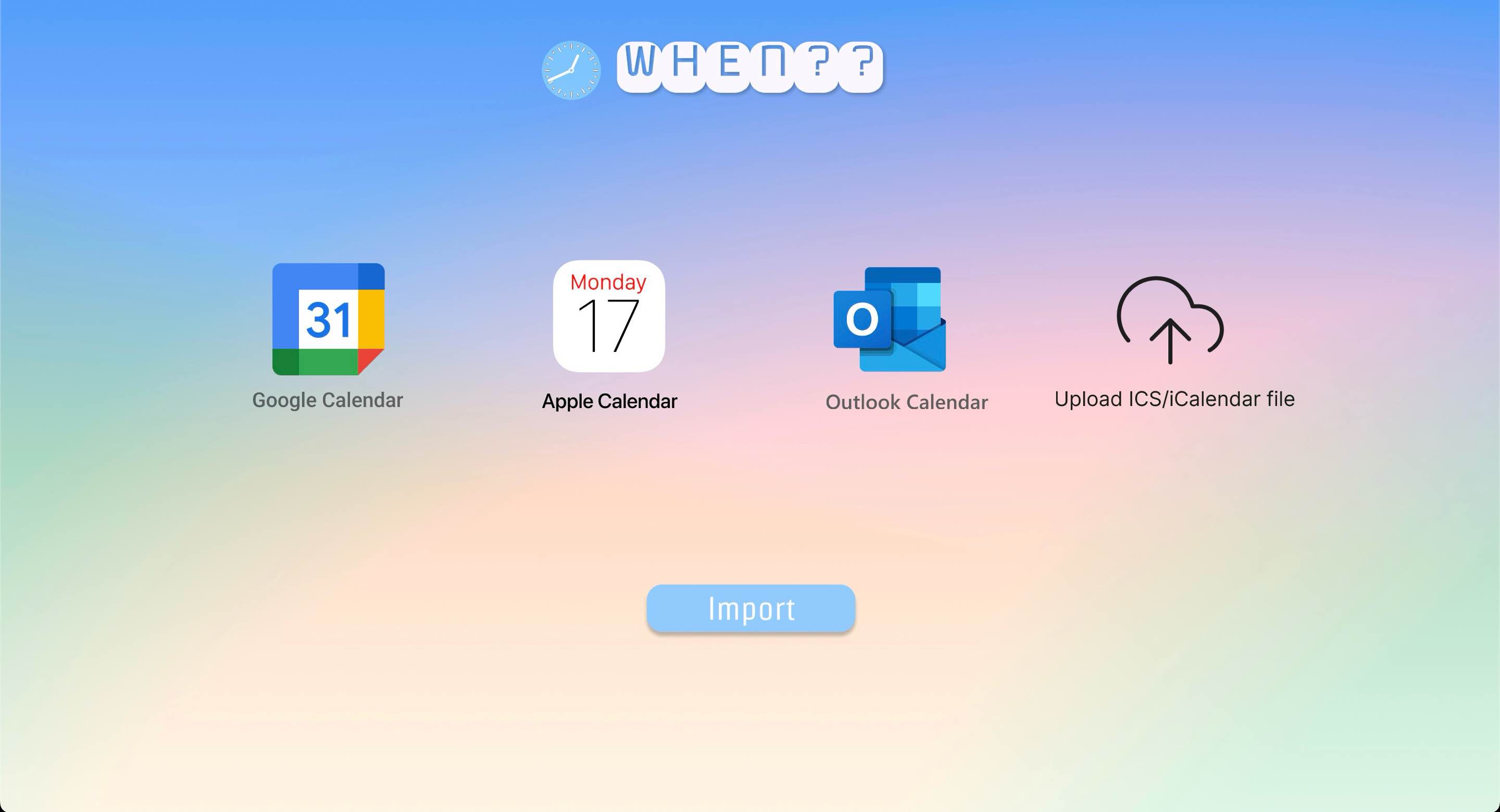
- Integration of Calendars: It will import, with zero input required, schedules from Google Calendar, Apple Calendar, Outlook, and ICS files to keep the availability updated.
- Fixed Teams: Persistent scheduling environments avoid creating new links for each and every meeting.
- Enhanced Interface: Glancing and making out the availability data in one go is easier. ## How we built it To attain these milestones, we adopted the following strategic approach:
- We started with our process through extensive UI/UX design in Figma, creating a comprehensive blueprint for our platform's visual and interactive elements.
- On the backend side, we have implemented Google API authorization with Python; thus, the base for features related to calendar integration has been laid.
- Our frontend was implemented using a combination of JavaScript, HTML, and CSS for key pages like login and signup.
- Throughout the entire development, we tried to keep the design and functionality in focus for the user, managing to stay within the scope of busy urban professionals and students alike, while continueing to think about how more accessible it can be. ## Challenges we ran into
- Authorization with Google APIs became a little more painful than expected and forced us to deep-dive into different authentication protocols and security features.
- One of the major challenges was to design a UI which would be intuitive, user-friendly, and host our ambitions.
- Integration with various calendar APIs proved to be a bit more complex than planned because we had to understand many different authentication mechanisms and data formats.
- One of the big challenges was to devise an algorithm that had the role of ranking and filtering data by availability efficiently without compromising performance.
- Also, data privacy and security had to be ensured with the utmost care, especially while handling the calendar information imported.
- Balancing the grand vision of WHEN?? with the time constraints for the hackathon.
Accomplishments that we're proud of
As we reflect upon our progress, which began at HackHarvard 2024, we are proud of how far this has taken us in bringing WHEN?? into reality:
- Comprehensive UI/UX Design: We successfully designed and integrated a cohesive user interface for the following modules:
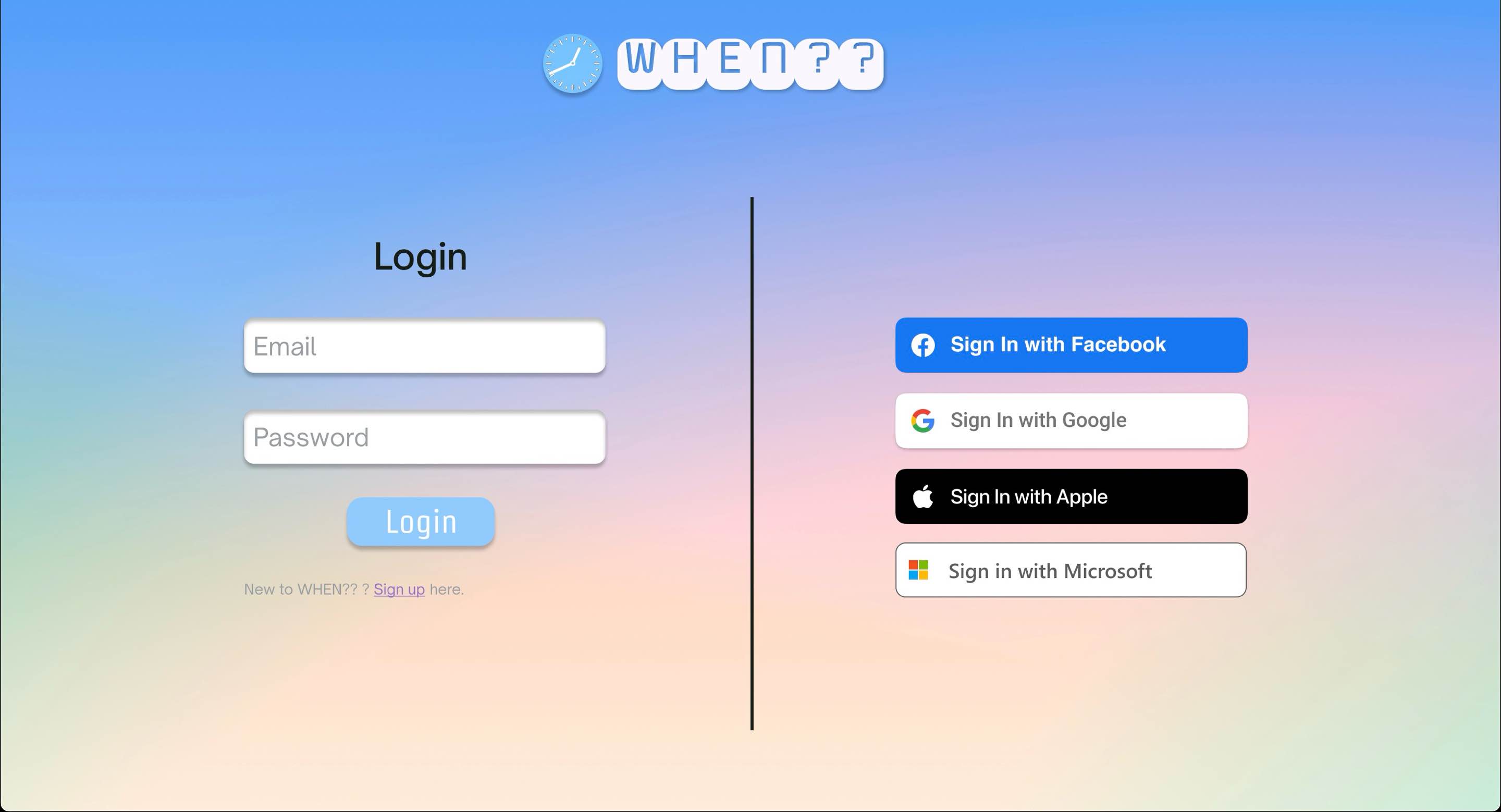
- Intuitive sign-up and login page to make sure users come in through a secure gateway.
- Team formation page to help create teams without much hassle.
- Calendar import page to lay the foundation for our revolutionary schedule integration feature.
- A home page listing the names of team and one-time schedules clearly for the user to glance at and get a feel for.
- A detailed page for the schedule of a team, containing a calendar view with core functional features: filtering, ranking, and exporting.
- Intuitive sign-up and login page to make sure users come in through a secure gateway.
- Google API Authorization: The most challenging parts of our project were to complete the authorization of Google API. This will be a key for us on the backend side so that we may open the door for easy integrations of calendars, one of the distinctive features of WHEN??.
- Frontend Development: For us, the design was converted into an working capability through developing certain key frontend components that included:
- A fully functional login page wherein users would input their credentials to log in successfully.
- A signup page for onboarding new users to the WHEN?? platform.
- Smart City-Oriented Design throughout our development process: We have kept our attention on how to create a tool which tackles real challenges within an urban context and contributes to efficiency and life quality in smart cities.
- Advanced Features Groundwork: Our unique filtering, ranking, and exporting features are not yet complete, but the groundwork is laid to set up WHEN?? as a powerhouse in schedule management.
These are huge milestones toward changing the way city people will schedule. Each piece that we finish gets us closer to a complete-and-easy-to-use environment that will ultimately enhance collaboration and time management for residents in smart cities.
What we learned
Our journey in developing WHEN?? at HackHarvard 2024 has really been an innovation crucible that pushed us to forge our ideas into reality under that time pressure. Really, this has been a class in tech and teamwork, tucking insights that are sure to shape our future efforts for life. Herein lies the art of digital urban design: In designing the WHEN?? interface, we also came to understand the balance required between functionality and simplicity. From login to team scheduling, every page designed was another lesson in digital space creation-feeling intuitive to navigate, just as well-planned city streets should be.
- API Landscape: Integrating the API provided by Google was like building a bridge from one digital world to another. It opened our eyes to the complex ecosystems driving this connected world and to the importance of secure, efficient data highways in modern applications.
- Frontend: Where Vision Meets Reality: Translation of our Figma designs into functional web pages has been a journey from abstract to concrete. The skills honed in the realm of HTML, CSS, and JavaScript taught us that often, true creativity lies in overcoming the technical constraints.
- The Rhythm of Development at the Hackathon: We learned to dance to the fast-moving rhythm of hackathon development by making fast decisions and pivots. This taught us a lot about agile thinking but also about the art of distinguishing what is essential from what will be great to have one day.
- User-Centric Problem Solving: Focusing on the needs of busy urban dwellers really hit home about user-centered design. That real people with real-world challenges are at the core of every feature and function is what brought the feeling full circle.
- The Power of Synergy in Collaboration: The different skills of UI/UX, back-end, and front-end development combined into something more than the sum of its parts. We learned that effective division of labor is actually about one vision and one language. -Impact-Driven Innovation: Aligning our project to the Smart Cities track expanded our view to include how technology could play its role in urban development. It made us feel responsible to create solutions that would work not only functionally but also contribute meaningfully to urban life.
This was more than a competition; it was a miniature of the very urban environment we were trying to improve with its rapid pace, its challenges, and its opportunities for innovation around every corner. As we go forward in continuing to develop WHEN??, we bring with us not only new skills but a renewed passion towards creating technology that pulses with the lifeblood of our cities.
What's next for WHEN???
Next steps that extend our achievements at this time include the following:
- Full implementation of filtering, ranking, and export functionalities in core features
- Extension of calendar integrations to include Apple Calendar, Outlook, and imports via ICS files.
- Development of the team spaces feature for persistent scheduling environments
- Improvement of the back-end side to fit the advanced data processing for the unique features
- Usability testing to iterate on UI/UX with feedback from the real world. (This would further include exploring partnerships with city planning departments of local cities for integration into bigger smart city initiatives.)
Some further ideas to enhance the impact of our tool on urban life and beyond include:
- AI-Powered Smart Scheduling: Schedule meetings at times when participants are most likely to be free, using machine learning algorithms based on historical behavior, personal preferences, and even ongoing events or real-time traffic flow in a city. This agrees with the improvement of efficiency within smart cities by making traditional services more intelligent and data-driven.
- Intelligent Workplace Solutions: Focus on the development of enterprise-level features for large organizations, including: department-wide scheduling, managing resources, and analytics for space utilization. This development contributes to efficiency objectives of a smart city by making resource utilization more efficient in corporate environments.
- Accessibility Features: Features must be provided to accommodate people with disabilities, hence assuring equal access by all city residents to scheduling technology. This is also in line with improving the quality of life and civic amenities by being sensitive to the needs of different urban populations.
- Cross-platform ecosystem: Developing native mobile applications and integrations with smart home devices to provide a seamlessly integrated scheduling experience for every part of urban living. Conventional scheduling tools are then made ubiquitously accessible, hence improving efficiency and the quality of life.
As we build out WHEN??, our vision will not change-developing a scheduling solution that is able to answer not only the call of living smart city-style but, importantly, also contributes positively toward upgrading both the quality of life and work effectiveness of citizens in urban centers around the world.


Log in or sign up for Devpost to join the conversation.