-
-
Vocalime presents Wheely: car repair assistance, when you need it the most
-
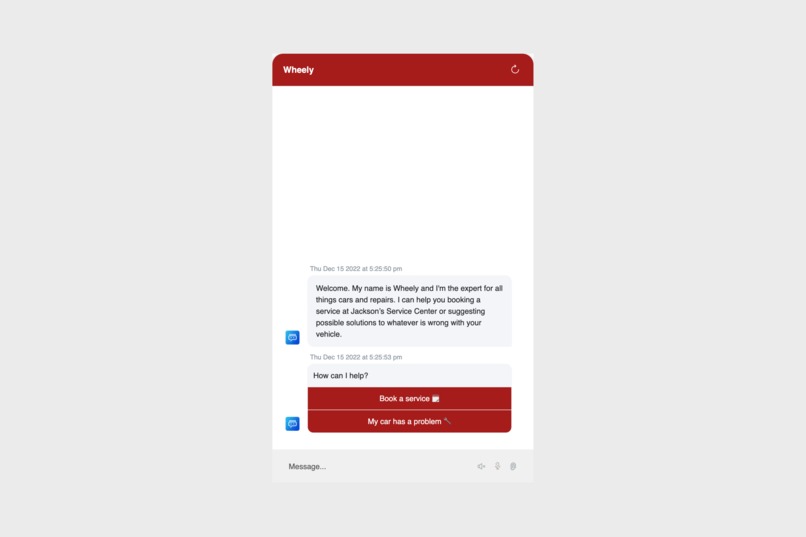
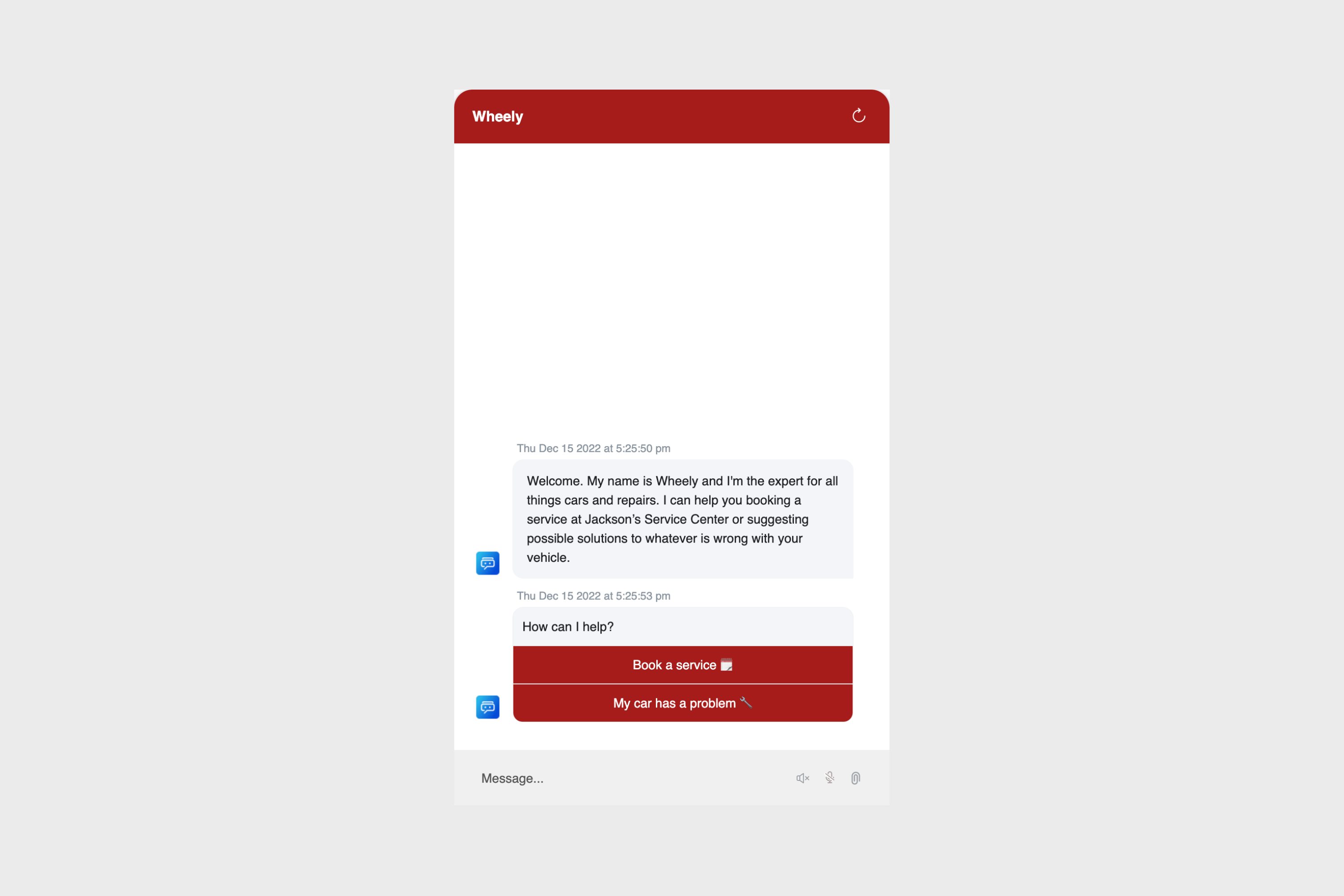
Wheely allows you to book a car service and get to know more about the issues of your car
Inspiration
The inspiration for Wheely comes from the direct experience of the father of one of our team members. As a car mechanic and repair shop business owner, he reported his frustrations with the amount of calls his shop gets everyday.
Although there is someone at the shop helping him deal with calls and booking appointments, they found that a high percentage of the call traffic referred to customers who are experiencing usual, traditional problems, which may or may not require any mechanic intervention. People call to start getting information about their problem and not necessarily because they want to immediately book an appointment. These problems can sometimes be solved directly speaking through the phone and, even when the customer is invited to bring their vehicle in for a check, a few times the mechanics don't really end up getting their hands dirty. In both these hypotheses, the time put in for solving the issue would not result in any (at least immediate) economic return.
Another popular reason for calling in is booking a car service. These are often longer calls, they require customers to be aware of different information about their vehicle that they don't always have at the ready, and expect the repair shop representative at the phone to ask always the same questions.
As we familiarized ourselves with the father of our colleague's story, we realized these cases would benefit greatly from being automated . This seemed to benefit the repair shop, as the phone lines would be left open for more urgent and unique situations. Equally, customers would be left satisfied by the 24/7 availability and the opportunity of taking their time to get their info for a car maintenance check-up, without jumping off a call and having to pick up the conversation at a later date.
At this point, we started to wonder whether this was the common experience amongst mechanics and car repair shops. This took us to our research phase, where we relied on several sources. We went from examining market researches, industry-specific blog posts and YouTube channels of mechanics, to reading through Reddit threads of people who work in the field and finally interviewing some car repair shop owners. Looking through the qualitative as well as quantitative data we gathered, some interesting insights emerged.
From our conversations with car repair shop owners and scouring their online communities, it became clear that the experience we described above was widely shared amongst mechanics. Smaller shops that don't have an assistant to answer the phone during working hours reported higher levels of frustration, as incoming calls also prevent them to focus entirely on the part of their job they like the most, i.e. working on the vehicle itself. On the other hand, even large car repair shops that have an assistant devoted to answering phone calls, seem to struggle to keep up with the incoming traffic.
Some of them also reported receiving complaints from their customers, who struggled to get in touch with them via phone, as the line was always busy and/or personnel wouldn't be able to pick up even during working hours when focused on other activities.
From the interviews, we also got some more specific information on the customer support queries that were most common and the reasons for which customers, in general, tend to contact mechanics for. Generally, two use cases seemed to emerge as the most common ones: requests for car servicing and requests for initial information about the possible causes of a problem their car is experiencing.
Finally, our market research opened our eyes to the incredible potential in terms of scalability of the solution. According to Statista, there are over 230k car repair shops today in the U.S. alone, and the number is expected to grow in the coming years. The size of the market proved that there would be a huge potential for the automated solution we were thinking of building.
What it does
Our solution is Wheely, a bot built for a specific, fictional, car repair shop (Jackson's Service Center), that can easily be adapted to fit the needs of any other of the over 230k car repair shops in the U.S.
Its 2 main features reflect the main reasons for contact that the shop owners were reporting to us:
Booking a car service, asking for the smallest possible amount of info from the user. Whereas the calls for this type of activity can get pretty lengthy, Wheely allows users to book a service by simply providing their license plate and state of registration, as it automatically fetches all the info on the car via API. While new users are guided through the process of customizing their servicing, returning users can also ask to replicate their previous servicing's preferences for the one they are presently booking, further reducing the time of the booking experience. Still, users who aren't as familiar with the offering of a car repair shop are guided by Wheely, who can answer questions about things like the difference between genuine OEM replacement parts and generic ones.
Asking for information about a specific car problem, which allows users with an issue to get to know more about its possible causes through the answers provided by Wheely. This feature can function as support in moments when the mechanic is unavailable, or outside of working hours, as it collects contact info from the user so that they can be contacted about their more complex problem by a human mechanic expert. Currently, Wheely is knowledgeable about over 65 frequent car issues (covering over 90% of typical car problems), ranging from a stuck gas pedal to a shaking steering wheel.
How we built it
For building Wheely, we referred to our tried and tested process, involving the following phases.
1. Idea generation The first step was to think about industries that are rather under-automated and identify possible opportunity areas and use cases. The car maintenance and car repair industry is definitely one of them. The direct experience of the father of one of our team members made us realize the amount of customer communication involved in running a car repair shop.
2. User research As anticipated in the first section, we conducted qualitative as well as quantitative research. We organized interviews with mechanics and car repair shop owners, studied their online communities on YouTube, blogs, and Reddit, and analyzed market research available on the web.
3. Scope definition Referring to the insights we got to through our research (see Inspiration section), we were able to settle on two use cases and selecting the most high-impact features to include. The guiding criteria were: improvement on the present user experience, frequency of use case, possibility to automate the task, cost/labor savings and potential for additional revenue offered to shop owners.
4. Conversation Design Based on the two basic use cases (book car servicing / ask for help with car problem) and the different types of users (new / recurring) that Wheely might be welcoming, we designed the flows and sub-flows of the bot. The design was adapted to suit the different informational needs and emotional states that the user might find themselves in, based on the use case and their status (new vs. recurring).
5. Implementation on the Kore.ai platform Between this and the previous phase, we studied the Kore.ai resources to familiarize with a platform we were completely new to. After following the introduction courses based on each of our roles in the team, we started implementing the designs into the Kore.ai platform. We created the main Dialog Tasks, established the connection to the external API we had sourced to get vehicle data from user's license plates, and set up the Knowledge Graph for the FAQs.
6. Testing and Optimization Finally, we tested all the user flows, fixed the issues and optimized them according to the outcomes.
Challenges we ran into
As with all projects, we encountered some challenges on our way.
The first and, perhaps, most consistent challenge was with learning to work on the Kore.ai platform itself. As mentioned before, this was our first time utilizing it. As we started to learn about it through the documentation and the courses provided, we understood that there would be a natural learning curve to familiarize ourselves with the capabilities of the platform. The technicalities and some of the logics for the different components of the platform were different from what we had become accustomed to through other tools and understanding them took some time and effort from the whole team.
In terms of the conversation design, the main challenge was in balancing two equally crucial goals we had set for the experience: keeping the number of turns and information requests to a minimum, while being helpful and welcoming of car savvy users and non-experts, alike.
Accomplishments that we're proud of
Overall, Wheely has been a great project to work on that has given us many reasons to be proud of.
One of the ones that stands out to us is the fact that we have been able to make it easy for car savvy and novices alike to find a response to a car problem, at a time when they might really be panicking and looking for help, but the mechanic isn't available to talk. After all, cars don't only break down during working hours and being in that situation can be particularly stressful for someone, especially if there is no one to support them through that.
Equally, we are very proud to have developed a solution that would truly make a difference in the daily operations of a car repair shop. Wheely is able to support mechanics in their job, allowing them to focus on their hands-on work on the vehicles, while not missing out on any opportunity of serving their recurring customers and welcoming new ones.
Another reason to be proud is the adaptable levels of guidance that Wheely offers to its users. Booking a car service can be very easy for someone and Wheely will allow these car savvy users to go through the process as quickly as possible, while still customizing their service as much as they want. On the other hand, other users might need some guidance about the different choices they are asked to make about the service and Wheely truly supports these users in making informed decisions.
What we learned
The journey of building Wheely on the Kore.ai XO platform and participating in this Botathon was definitely a learning experience.
First of all, it made us realize the untapped potential for automation of customer interactions in the car maintenance industry, and its scalability. It was very inspiring to hear from first-hand experience how automating responses to just a few concrete and repetitive use cases would make a huge difference to the operations of these businesses.
Secondly, we learned a lot about the platform itself and how Kore.ai can be leveraged to build an assistant. We deepened our knowledge about many interesting capabilities of this tool and got a better grip on what are its opportunities.
What's next for Wheely
Starting from this first MVP of Wheely, there is a bright future lying ahead for this bot. Some steps to work on to further enhance its utility would be:
- Implementation of adjacent use cases to the ones already in place (e.g. booking of a vehicle inspection)
- Optimization and fine-tuning for other suitable channels (e.g. IVR and Whatsapp)
- Connection to CRM systems of real car repair shops to get real-time info about recurring customer's information and appointment availability.
- Iterating after user testing and adding more FAQs to Knowledge Graph, based on reports of real user utterances.
Built With
- api
- javascript
- kore.ai
- zylalabs


Log in or sign up for Devpost to join the conversation.