-
-
logo
-
Time Machine Background Design
-
Ask What If Question...
-
Analysis Summary
🧪 WhatIf_
Inspiration
Every major shift in history started as a question someone was afraid to ask out loud:
- What if the internet became mainstream?
- What if a pandemic shut down the world?
- What if clean energy became cheaper than coal?
We wanted to build a tool that lets anyone ask those questions seriously — not just as thought experiments, but as structured simulations backed by AI reasoning.
The name came first: WhatIf_ — the underscore intentionally left open, waiting for the user to define the future.
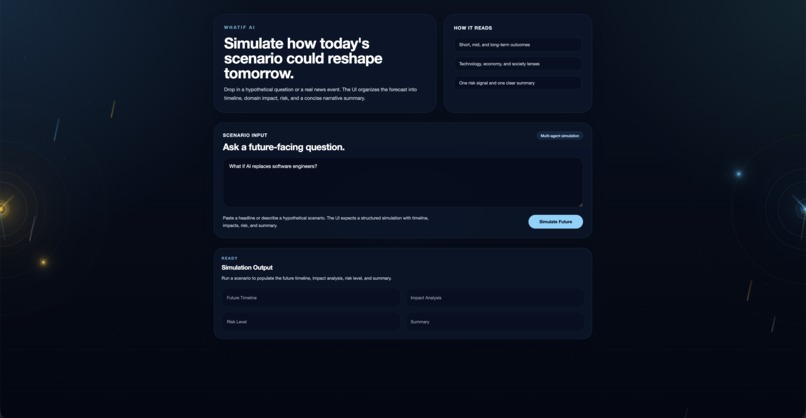
Visually, we were inspired by the feeling of standing inside a time machine — not a clean sci-fi UI, but something dynamic, alive, and actively reshaping timelines.
What it does
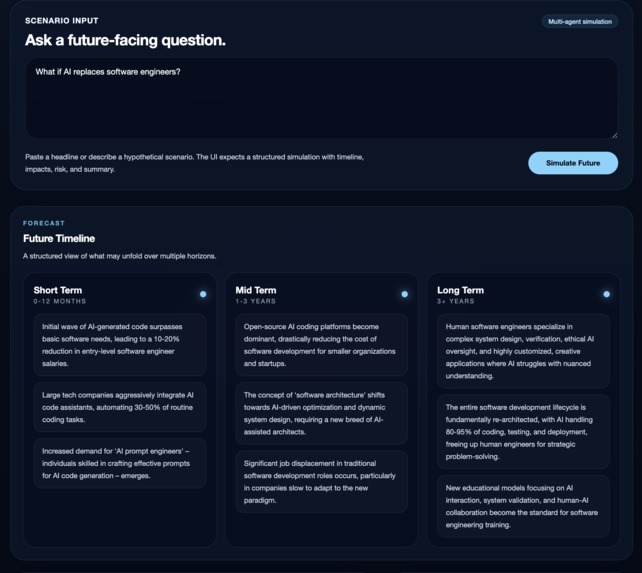
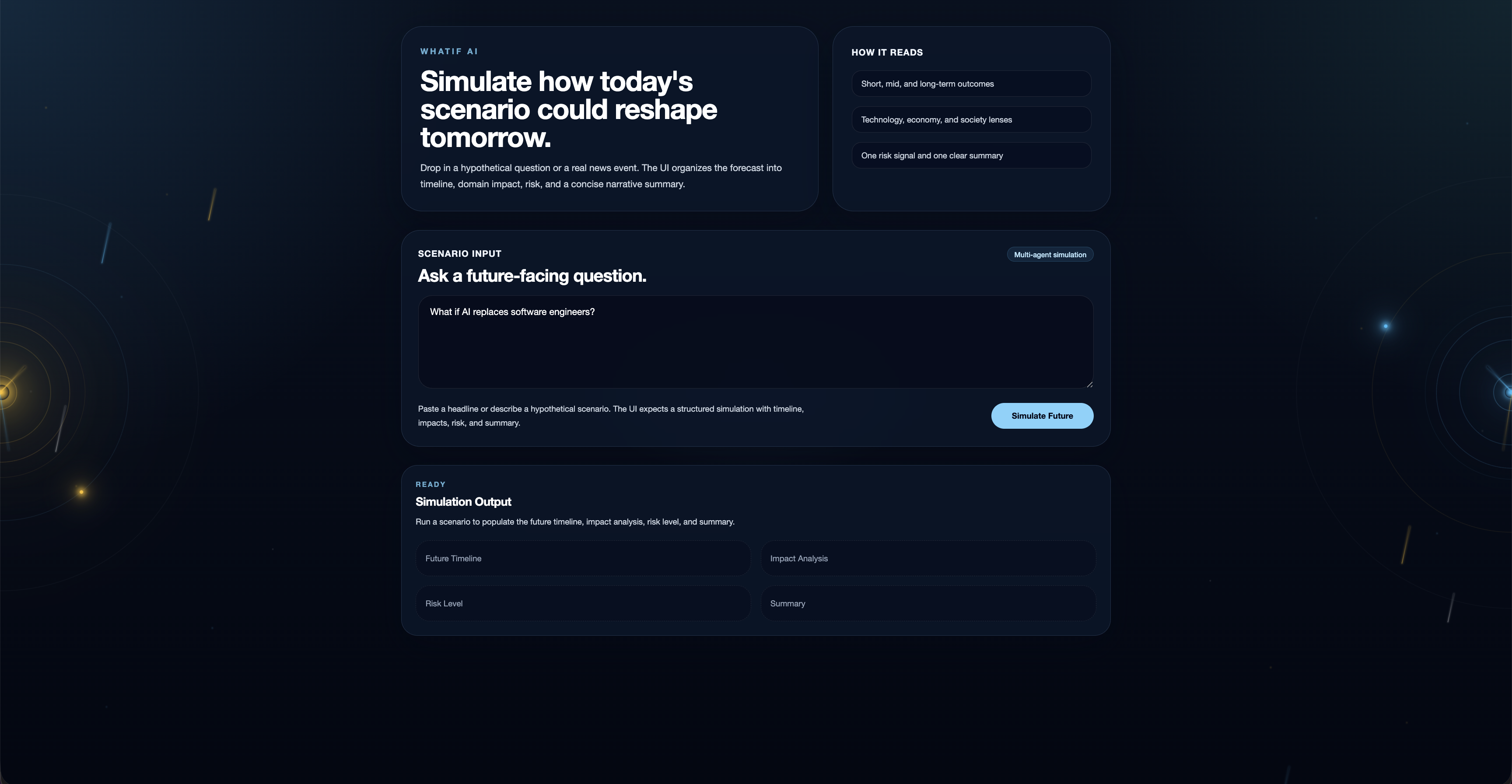
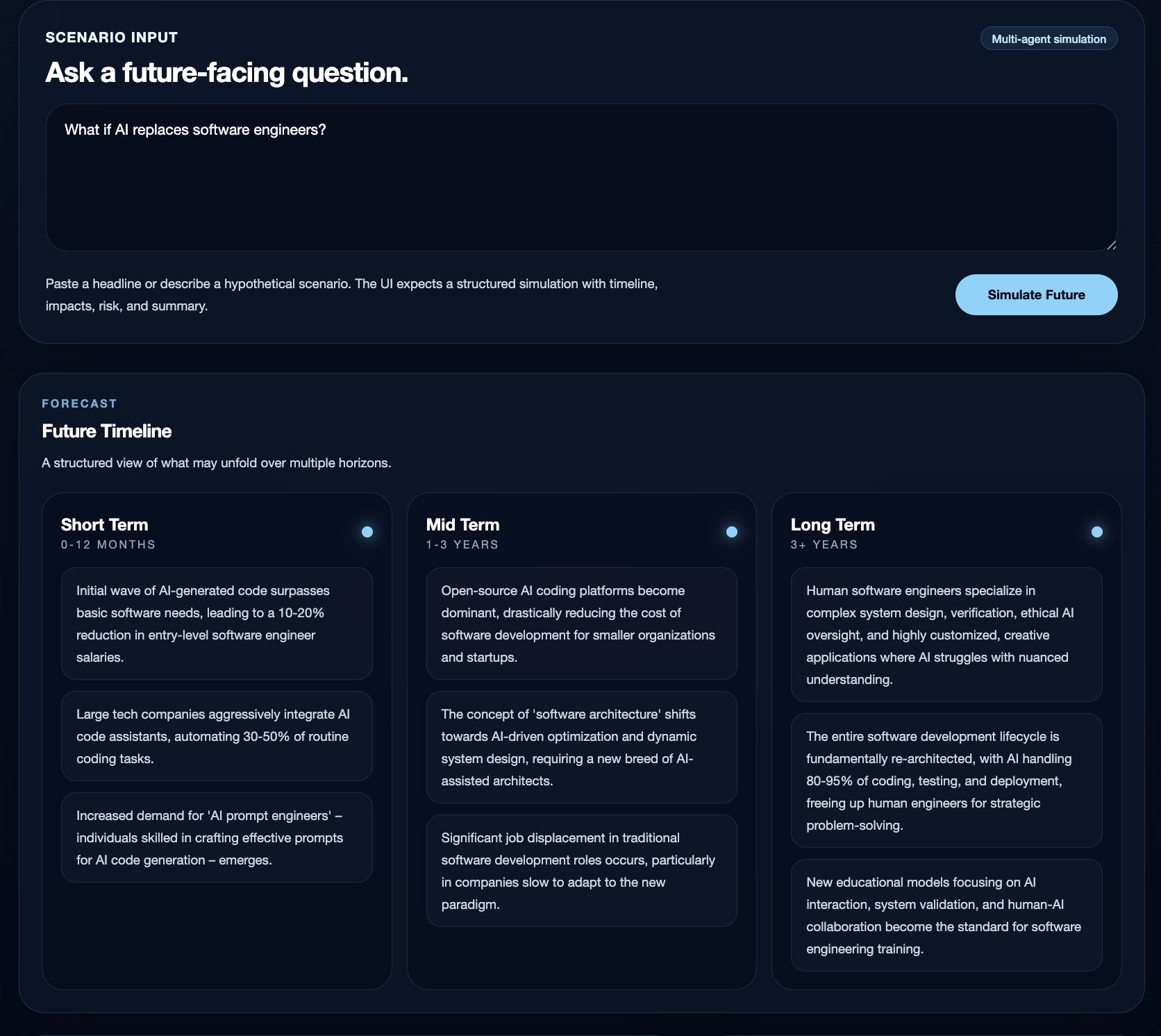
WhatIf_ takes any hypothetical scenario or real-world news and simulates its future consequences across multiple dimensions:
⏱ Timeline
Short-term: 0 to 12 months
Mid-term: 1 to 3 years
Long-term: more than 3 years
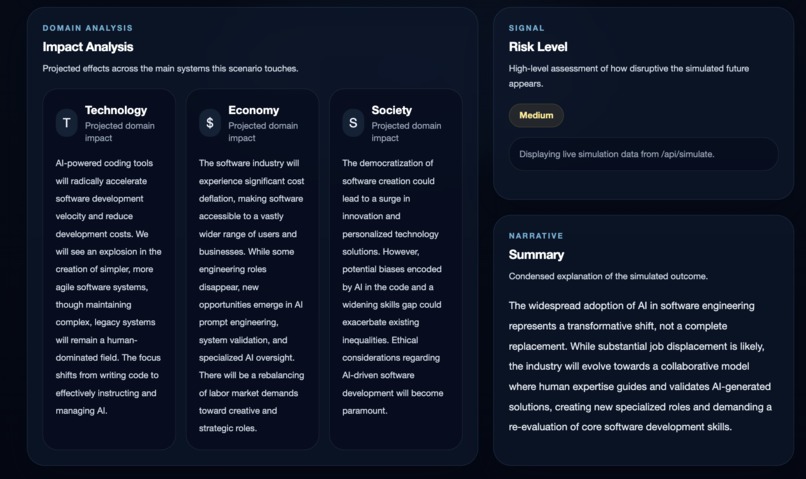
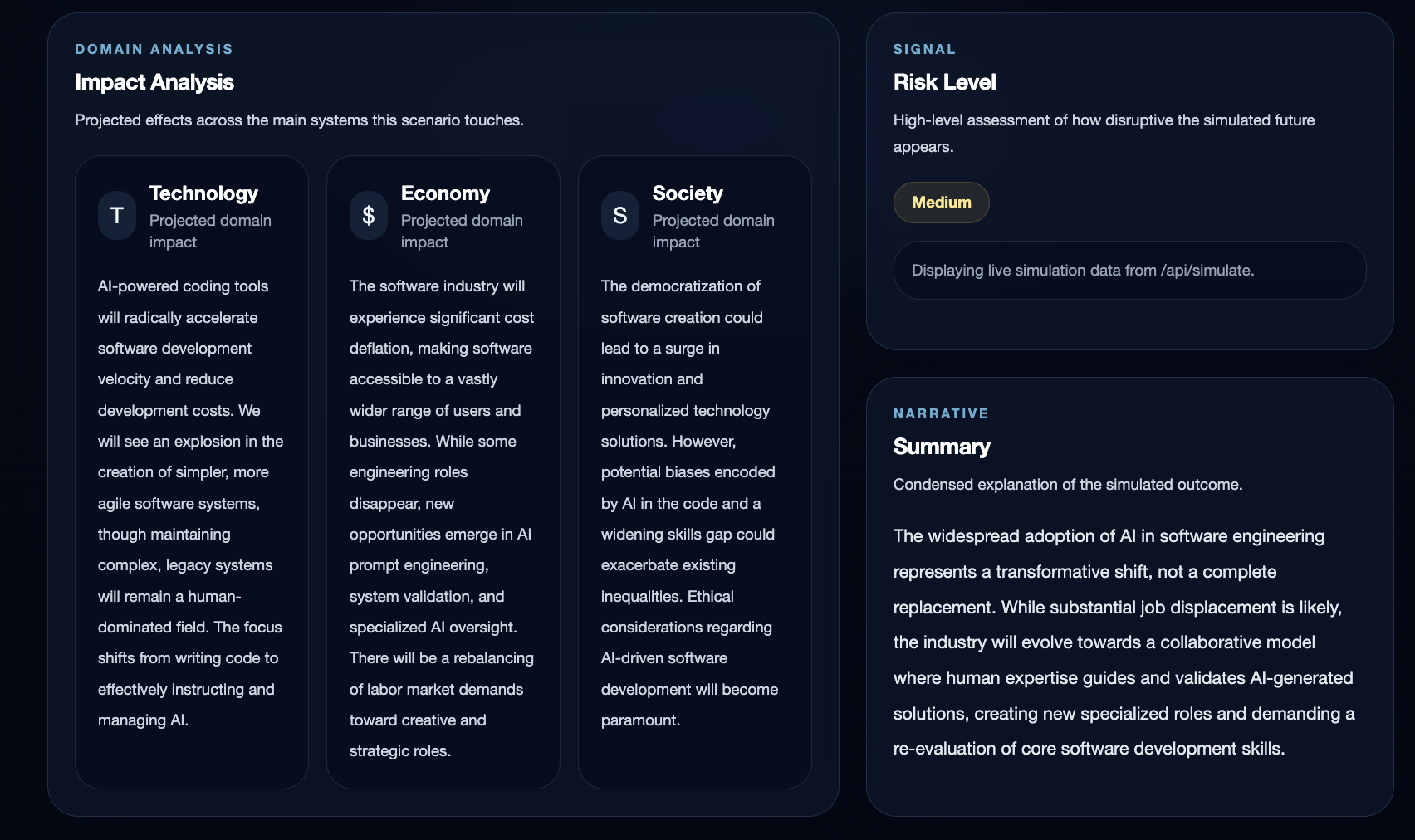
🌍 Domain Impact
- Technology
- Economy
- Society
⚠️ Risk Level
$$ r \in {\text{Low},\ \text{Medium},\ \text{High}} $$
🧠 Executive Summary
A concise 2–3 sentence synthesis designed for decision-making.
The system always returns a result. Even if the AI fails, a contextual fallback ensures the simulation never breaks — making it reliable for real-world use and demos.
How we built it
We kept the stack lean and fast for hackathon execution:
| Layer | Technology |
|---|---|
| Frontend | Next.js (App Router), React |
| Styling | Tailwind CSS + custom dark theme |
| Backend | Next.js API Routes |
| AI (Cloud) | Gemini API |
| AI (Local) | Ollama (Gemma models) |
| Language | TypeScript (strict) |
🧠 Architecture
The system follows a structured pipeline:
User Input
↓
Orchestrator (lib/agents.ts)
↓
LLM Provider (Gemini → Ollama<Gemma4>)
↓
Response Parser (JSON validation + coercion)
↓
Simulation Result → API → UI
We originally designed a multi-agent system, but optimized it into a single structured prompt for speed and reliability.
🔄 Fallback System
We built a multi-layer fallback pipeline:
$$ \text{result} = \begin{cases} \text{Gemini}(m_i) & \text{if any cloud model succeeds} \ \text{Ollama (local)} & \text{if cloud fails} \ \text{Contextual fallback} & \text{if all fail} \end{cases} $$
This ensures:
- Works online or offline
- Works with or without API key
- Demo never breaks
Challenges we ran into
🔀 Merge conflicts from parallel agents
We built frontend, backend, and AI pipeline in parallel branches. When merged, conflicts weren’t just syntax — they were logic-level mismatches. We had to reconstruct intent instead of line-by-line fixes.
⚡ API rate limits
Gemini free-tier limits caused inconsistent failures. We solved this by:
- cascading across multiple models
- adding Ollama local fallback
🧠 Multi-agent overhead
Originally, we made 7 LLM calls per simulation, which caused rate limits and latency.
We optimized to 1 structured prompt, achieving:
$$
\frac{1}{7} \text{ cost, faster response, higher reliability}
$$
🎨 UI geometry (unexpectedly hard)
Even visuals required math:
$$ \text{left} = -\frac{w}{2}, \quad \text{top} = 50\% $$
And for orbit animations:
$$ \text{transform-origin}_x = -r \quad \text{or} \quad 100\% + r $$
Accomplishments that we're proud of
- 💪 The app never breaks thanks to a three-layer fallback system
- 🎨 A fully animated UI built entirely with CSS (no canvas, no WebGL)
- 🧠 A clean, type-safe architecture despite heavy merge conflicts
- 🌐 A local-first AI system that works even without internet
What we learned
- 🧠 One strong prompt beats many weak agents
- 🔄 Fallback design is product design — reliability matters more than perfection
- 🎨 UI and animations require real math, not just aesthetics
- 🧩 Strong typing (TypeScript) saves time under pressure
What's next for WhatIf_?
- 🔀 Scenario comparison (“What if we act vs don’t act?”)
- 📚 RAG-based grounding with real historical data
- 📊 Confidence intervals from multiple simulations:
$$ \hat{r} = \text{mode}(r_1, r_2, \ldots, r_n), \quad \sigma_r = \text{entropy}(P(r)) $$
- 📤 Export/share simulations (PDF or link)
- 🎤 Voice input for faster ideation
🚀 WhatIf_ turns curiosity into simulation — and simulation into insight.
Built With
- claude
- geminiapi
- gemma4
- google-gemini-api
- next.js
- next.js-(app-router)
- next.js-api-routes
- ollama
- ollama-(gemma-models)
- react
- tailwind
- tailwind-css
- typescript

Log in or sign up for Devpost to join the conversation.