
Inspiration
What Would You Do was inspired by a simple idea: sometimes the best conversations start with the right question.
We wanted to create an experience that helps people capture spontaneous, funny, honest, or thoughtful answers without the pressure of posting them publicly.
Instead of creating another social media platform, we focused on something more personal: giving users interesting prompts, letting them record their answers as videos, and allowing them to decide what happens to those videos afterward.
The result is a simple question-based video experience built around self-expression, memories, and optional sharing.
What it does
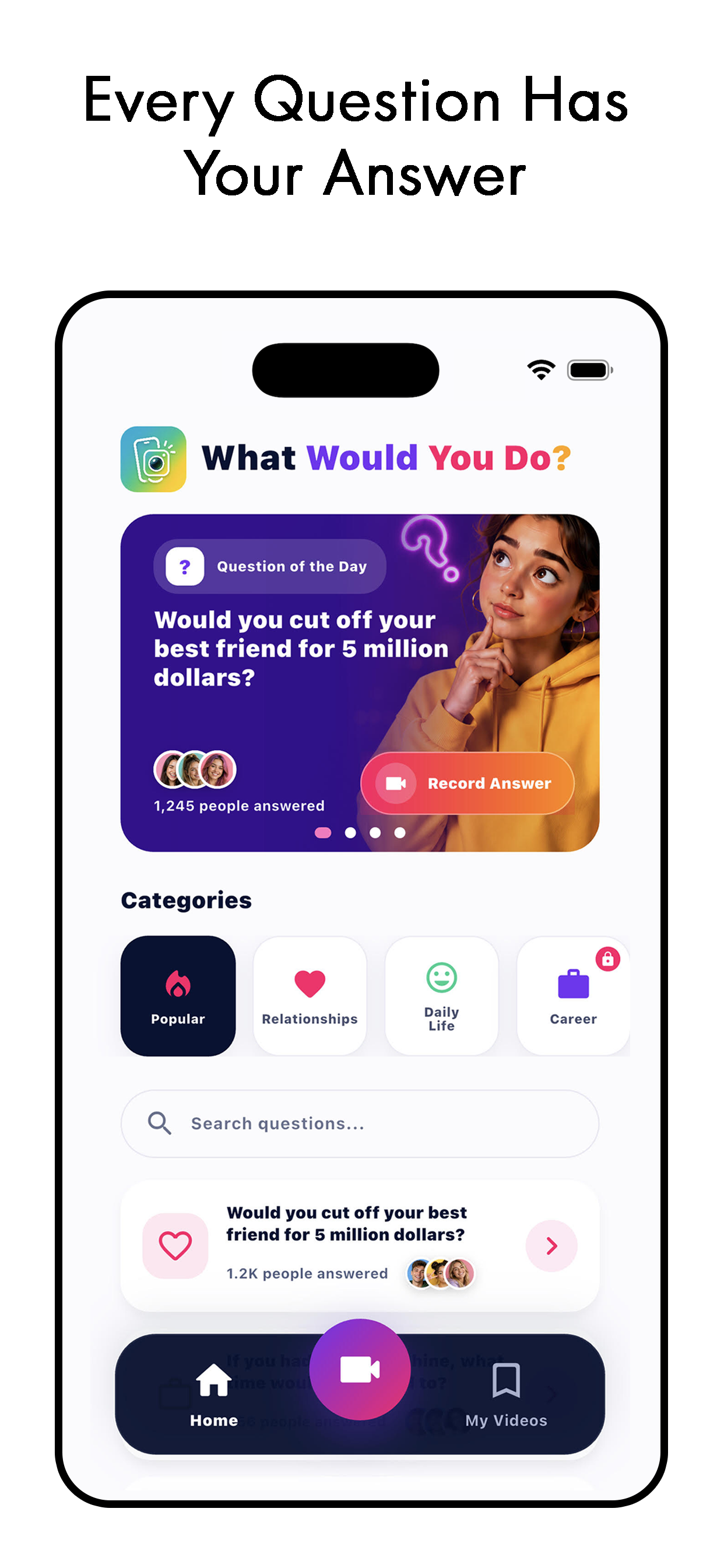
What Would You Do is a mobile application that presents users with interesting, funny, personal, and thought-provoking questions.
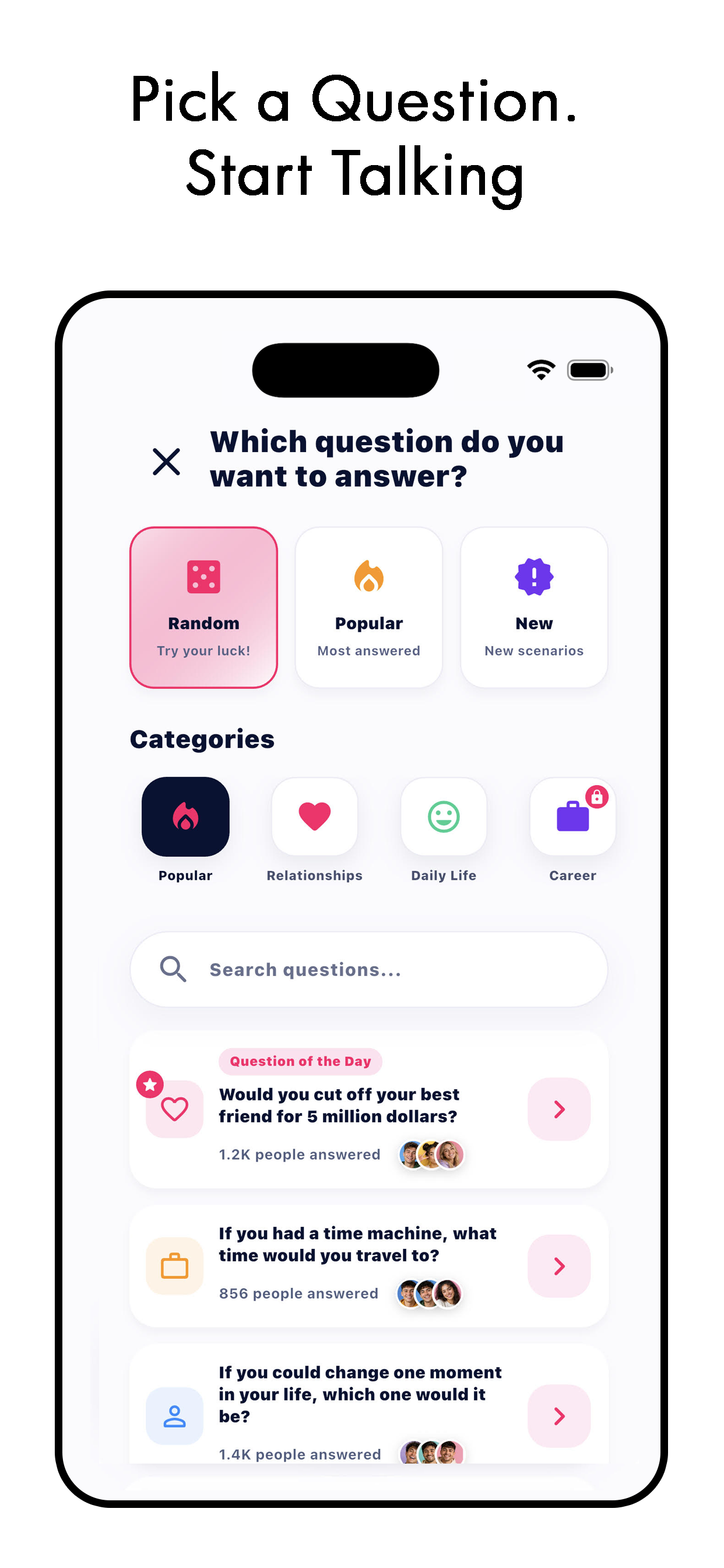
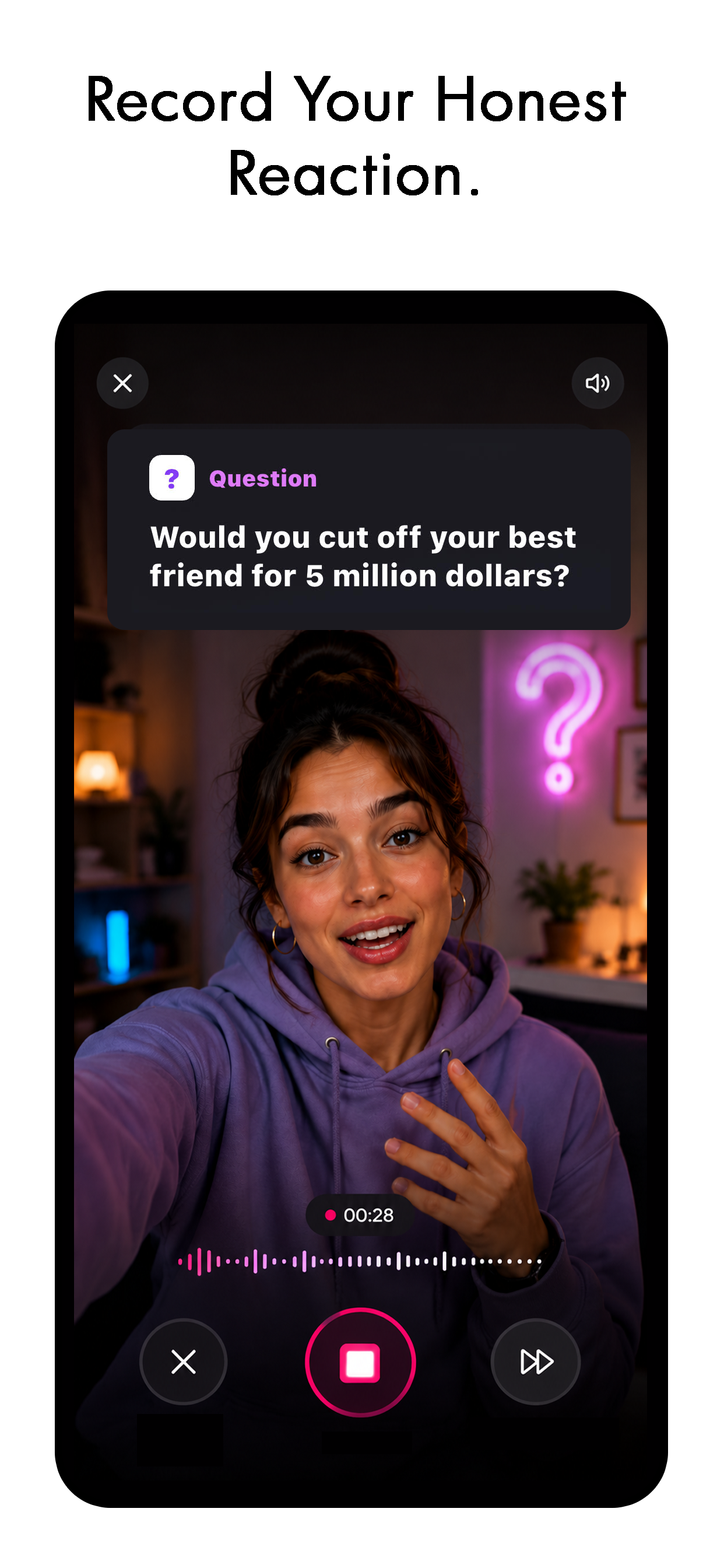
Users choose a question, record their answer as a video, and save that video to their personal collection.
The videos are not automatically published or shared with a public audience. They remain private unless the user chooses to share them with friends, family, or others through external sharing options.
Questions cover categories such as relationships, friendship, work life, ethical dilemmas, difficult decisions, funny situations, secrets, red flags, and hypothetical scenarios.
The core experience is simple:
Choose a question → Record your answer → Save the memory → Share it only if you want to.
How we built it
We designed What Would You Do as a mobile-first application focused on making video recording as simple and frictionless as possible.
The application is built around a structured question library. Users can browse different categories, select prompts they find interesting, record video responses, and save their favorite questions or recordings.
We also used AI-assisted workflows to help generate, organize, and improve the question library. This allows us to create a wide range of prompts across different moods and topics while keeping the actual answers completely personal and human.
Privacy was an important part of the product design. Rather than publishing recordings by default, the user stays in control of each video and decides whether it should remain private or be shared.
Challenges we ran into
One of our biggest challenges was creating questions that immediately make people want to answer.
A good question has to be short, easy to understand, and still interesting enough to trigger a story, opinion, memory, or emotional reaction.
Another challenge was keeping the application simple. Since the product is not a traditional social network, we wanted to avoid unnecessary feeds, follower systems, likes, and other features that could distract from the main experience.
Video recording and storage also introduced technical challenges, including camera handling, media processing, performance, file management, and creating a smooth experience across different devices.
We also had to think carefully about privacy and sharing so that users always understand when a video is simply saved and when they actively choose to share it.
Accomplishments that we're proud of
We are proud that we created a product with a very clear and focused interaction model.
Users do not need to create a profile for an audience or worry about performing for a public feed. They simply choose a question, record what they really think, and keep the result.
We are also proud of building a flexible question system that supports many different experiences, from funny conversations with friends to personal reflections and memorable family moments.
Most importantly, we kept the user in control. Recording a video does not mean publishing it. Sharing is always a separate and intentional decision.
What we learned
One of the biggest things we learned is that a good prompt can make video creation much easier.
Many people may want to record something but do not know what to say. A carefully designed question removes that hesitation and gives them an immediate starting point.
We also learned that privacy can fundamentally change how people interact with a video application. When users know that their answer is not automatically being posted publicly, they can feel more comfortable giving spontaneous and authentic responses.
The project also showed us that AI can be valuable behind the scenes for generating and organizing prompts while keeping the core experience centered on real human answers.
What's next for What Would You Do
Our next goal is to make What Would You Do more personalized and useful for different situations.
We want to introduce smarter question recommendations, themed question packs, couple and friendship challenges, family question sets, party modes, and special collections for different occasions.
We also plan to expand AI-assisted question generation so users can receive prompts based on a topic, mood, relationship, or situation.
In the future, What Would You Do could become more than a question app. It could become a personal library of video memories — capturing people's opinions, stories, reactions, and personalities at different moments in their lives.
Answer the question. Save the moment. Share it if you want to.
Built With
- ai
- ios
- social
- video


Log in or sign up for Devpost to join the conversation.