-
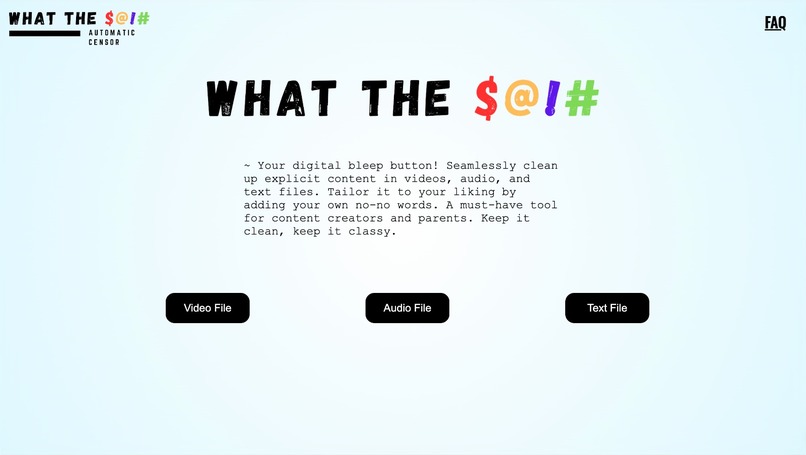
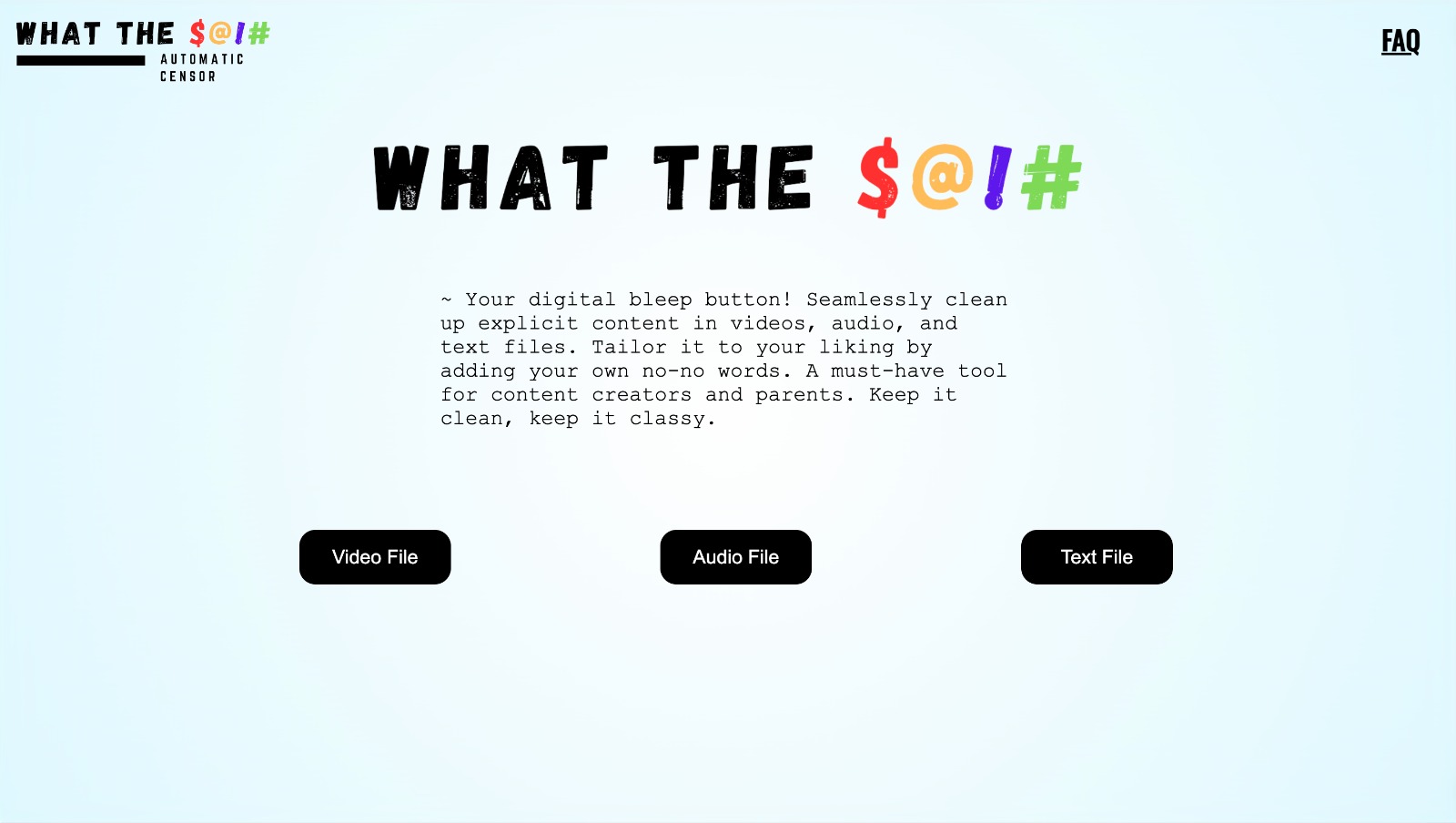
Main home page
-
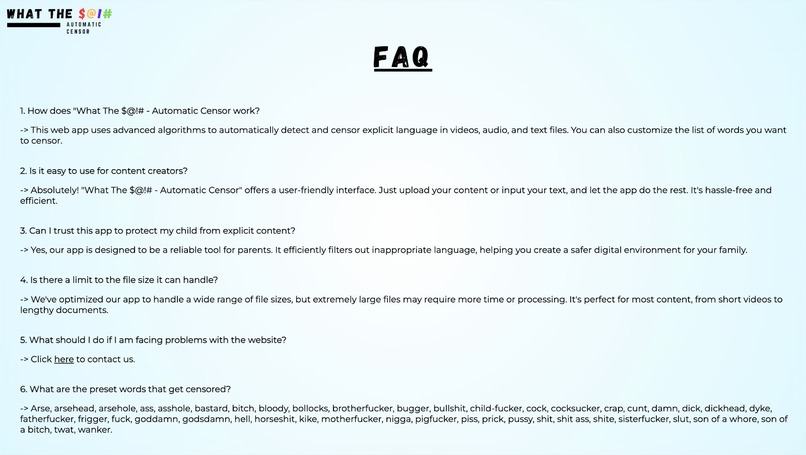
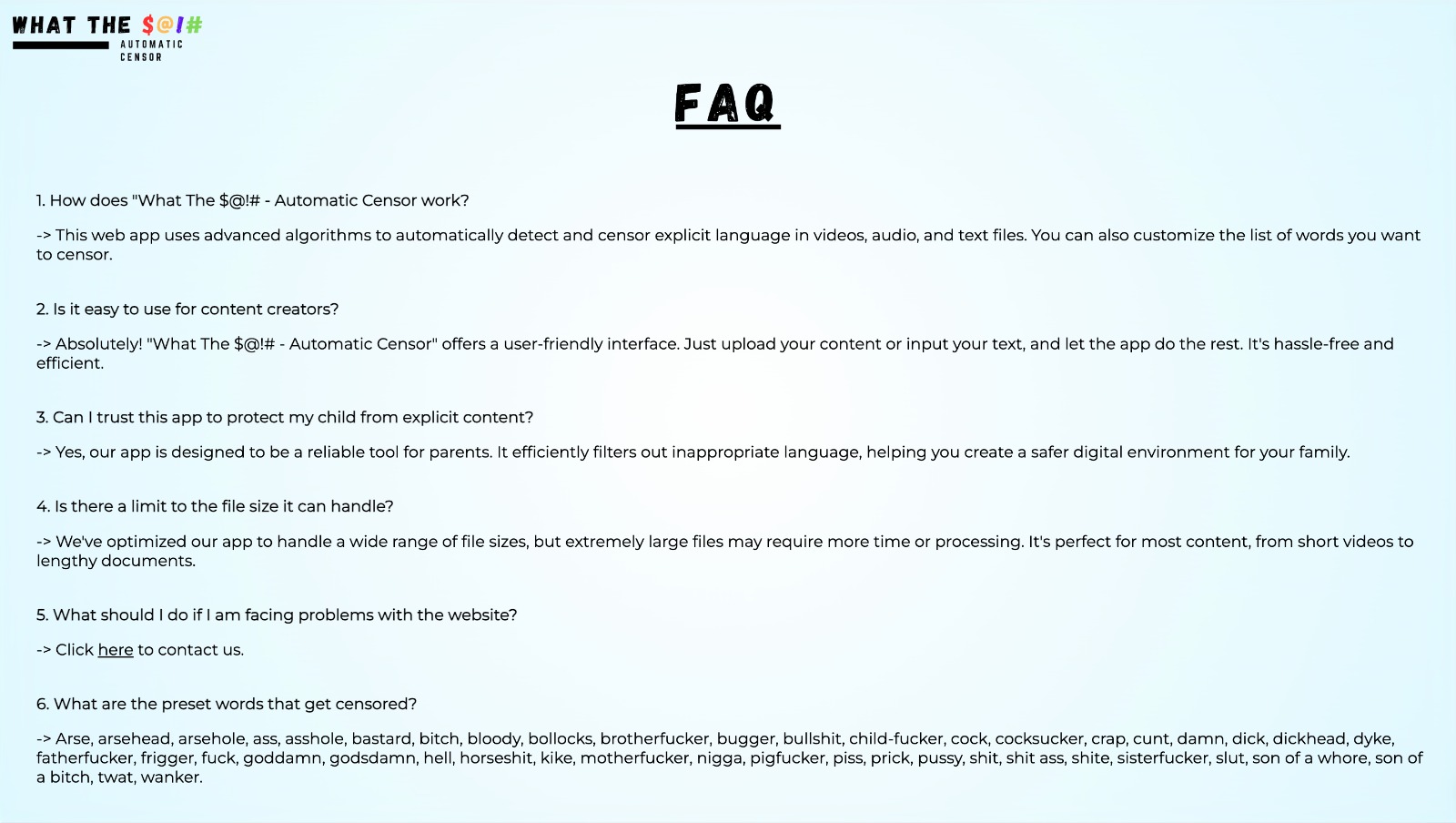
FAQs page
-
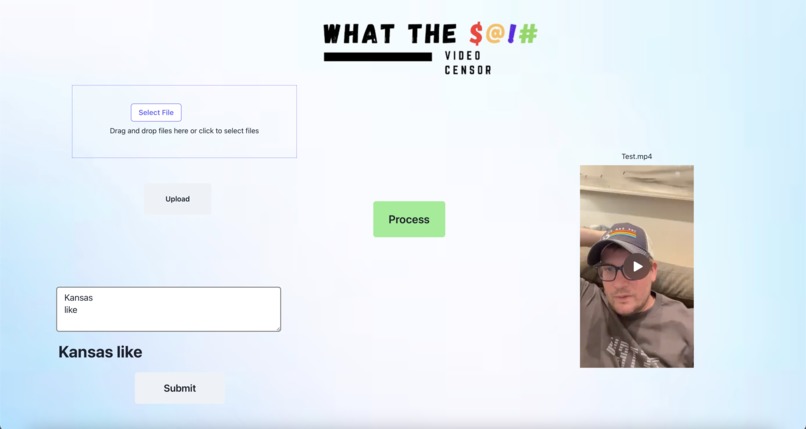
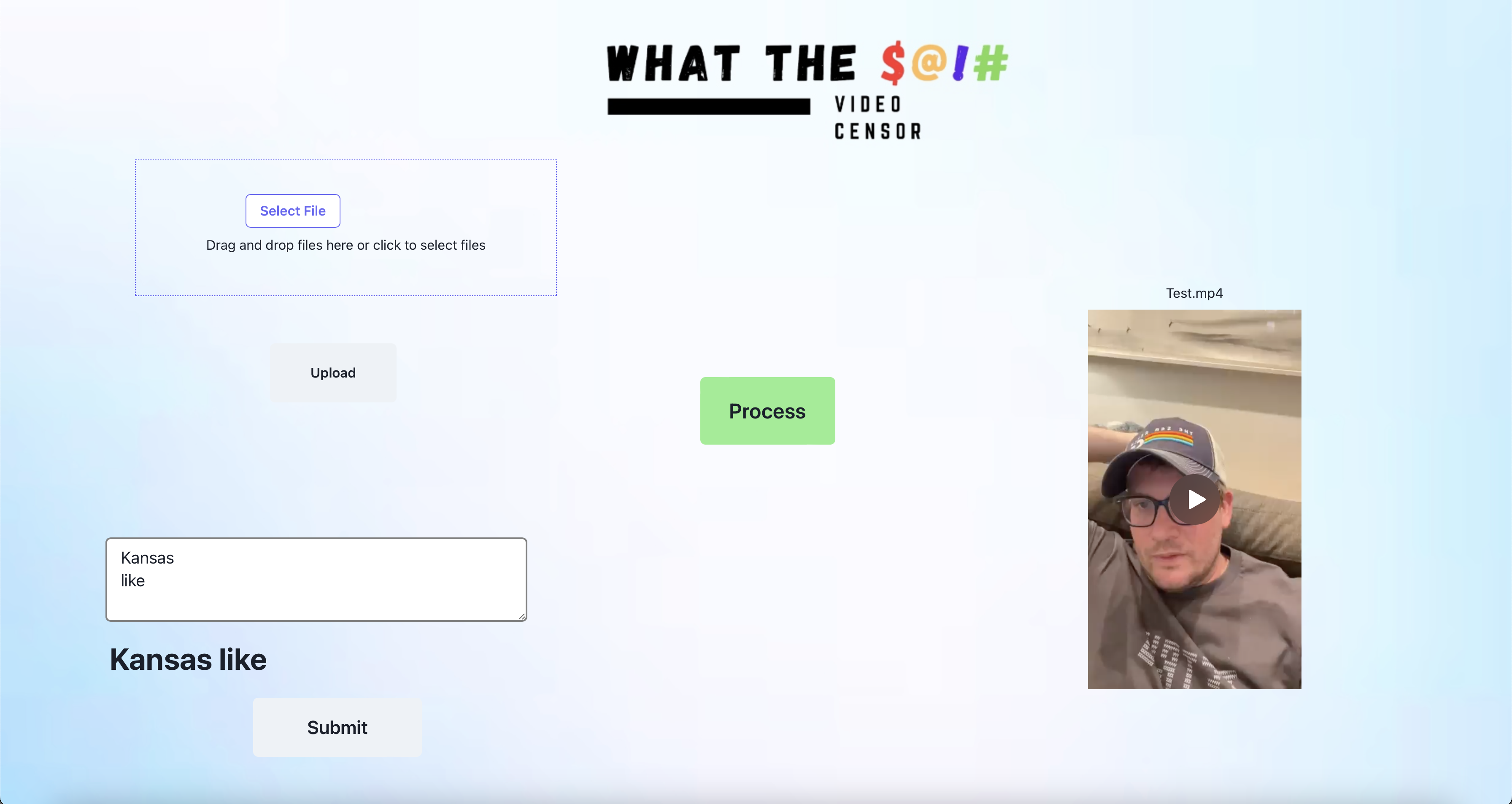
Custom VideoCensor Page
Inspiration
Our inspiration for this project was born out of a need for a more accessible and responsible way to engage with digital content in a world where inappropriate language and content can be pervasive. In today's age, a significant portion of online content contains explicit or offensive material that may not be suitable for various settings, such as educational environments or professional presentations. We believe that access to information and media should be more inclusive and adaptable, which led us to create an automatic censor that can transcribe and filter out profanity in videos, audio, and text files. Furthermore, we recognize the importance of child safety and the need for parents to monitor the content their children consume. Our tool not only promotes a cleaner and more respectful online environment but also empowers parents to ensure that their children are exposed to age-appropriate content.
What it does
Our program is a cutting-edge solution that caters to the diverse needs of our users. It functions as an automatic content censor, offering the capability to process and filter out inappropriate language and content from a wide range of media, including videos, audio files, and text documents. We understand that there are countless scenarios where one might need to use online content, be it for educational, professional, or family purposes, but the presence of offensive material can be a hindrance. Our program simplifies this by allowing users to upload their files, which are then transcribed and meticulously scanned for any objectionable words or phrases. The program also provides users with the flexibility to define their own custom censorship rules, giving them greater control over the content they consume or share. In a world where the internet is flooded with explicit content, our program aims to empower users to curate and create a more respectful and safe digital environment tailored to their unique requirements.
How we built it
We developed our program using a combination of HTML, Reflex (a Python library), and Python, creating a robust and user-friendly application. The front end, built with HTML, provides a user-friendly interface for interacting with the system. Reflex, on the other hand, played a pivotal role in constructing webpages that seamlessly connect with Python, facilitating the necessary backend operations. Reflex was an invaluable asset in our project, bridging the gap between our user-friendly front end and the robust backend. It not only facilitated a smooth transition but also empowered us to incorporate essential features like video playback into our web application. Thanks to Reflex, our project achieved a polished and complete look, enhancing the overall user experience. This dynamic library played a key role in ensuring that our application seamlessly integrated user interactions with the powerful Python backend, resulting in a more engaging and refined final product. Python served as the core of our backend, and we harnessed the power of libraries like MoviePy and AssemblyAI to enhance our program's capabilities. With MoviePy, we adeptly handled video and audio files, enabling dynamic editing based on the transcribed content. AssemblyAI was instrumental in real-time caption generation, complete with timestamps. To ensure content appropriateness, we leveraged Python to cross-reference the transcript against a database of profanity, stored in a text file, as well as any custom words provided by the user. This process allowed us to pinpoint and redact specific timestamps associated with objectionable content, ultimately producing a censored, refined version of the media. The result is a versatile and effective solution for filtering and enhancing digital content.
Challenges we ran into
As a team of three first-semester freshmen in computer science at Arizona State University, our first hackathon experience brought about a series of challenges and valuable lessons. We entered the competition somewhat uncertain about what to expect, and finding the right balance between being adequately prepared and over-prepared proved to be a concern. Traveling to the event introduced an additional layer of complexity, given the stakes and the desire for a fruitful outcome. The need to quickly grasp Reflex, a new sub-language, added another dimension of learning while staying on track with our pre-established plan. The often slow and unreliable Wi-Fi presented a major hurdle, particularly since our primary backend code required a swift internet connection for efficient processing.
Accomplishments that we're proud of
During the two-day hackathon, we achieved remarkable progress and successfully built a working prototype well within the given time frame. Each member of our team contributed their expertise to different aspects of the project. Pratham, despite starting from scratch, quickly learned Reflex and skillfully developed the interface connecting the backend to the frontend, which included the video playback feature. Harshit took on the challenge of learning HTML and CSS during the hackathon and skillfully crafted the main front pages. Syna worked diligently on the backend, creating an efficient Python program. While our responsibilities were well-defined, we also supported each other when facing difficulties. Overcoming several obstacles along the way, we persevered and, upon testing our code with a more reliable network, were delighted to find that our model was impressively fast and potentially more efficient than many existing programs in the market. These challenges not only proved to be valuable learning experiences but also demonstrated our adaptability and success in a competitive environment. We take great pride in what we accomplished during this hackathon.
What we learned
Through this enriching experience, we, as a team of first-semester computer science freshmen, gained invaluable insights and lessons. Our first hackathon was an eye-opener, teaching us to find the right balance between preparation and readiness, and how to persevere in the face of challenges. We discovered that with dedication and teamwork, we could not only build a functional prototype but also do it within the tight time constraints of the hackathon. Our individual journeys were equally enlightening. Pratham, with determination, learned Reflex from scratch and managed to create a seamless interface between the backend and front end, even incorporating video playback. Harshit, in a commendable feat, picked up HTML and CSS during the competition, enabling us to design polished front pages. Syna, as the backend wizard, worked out the entire logic behind our model and by utilizing the available open-source libraries and functions, crafted an efficient Python program. Perhaps the most significant lesson was our ability to support each other. Despite our defined roles, we helped out whenever challenges arose. Slow and unreliable Wi-Fi posed a significant obstacle, particularly since our primary backend required a fast internet connection. However, we persevered, and this challenge led us to the discovery that our model was impressively fast and potentially more efficient than many existing programs on the market. In the end, these challenges shaped us, highlighting our adaptability and ability to thrive in a competitive environment. We take immense pride in our accomplishments during this hackathon and look forward to applying these lessons to future endeavors.
What's next for "What The $@!#"
The future of "What the $@!#" holds exciting possibilities as we explore avenues for expansion and enhancement. First and foremost, we are keen on developing a web extension that employs the same logic as our current model. This extension would serve as a versatile tool for testing online content for profanity, effectively creating a parental control system that not only identifies inappropriate material but also censors it, granting parents peace of mind as their children navigate the internet. In addition to this, we envision the inclusion of a feature allowing users to apply custom censor sounds to video and audio files, adding a personal touch to the censorship experience. Furthermore, we aspire to broaden our program's capabilities by not only redacting audio but also censoring the visual content during objectionable timestamps in videos. This expansion will make our product even more versatile and valuable in content filtering and enhancement. As a team, we eagerly anticipate further development and collaboration in future hackathons. We are also planning to present our idea to "Venture Devils," Arizona State University's entrepreneurial club, which provides funding for projects like ours. This step will help us transform our prototype into a fully realized implementation, ensuring that "What the $@!#" can make a substantial impact in the realm of online content filtering and enhancement.


Log in or sign up for Devpost to join the conversation.