-
-
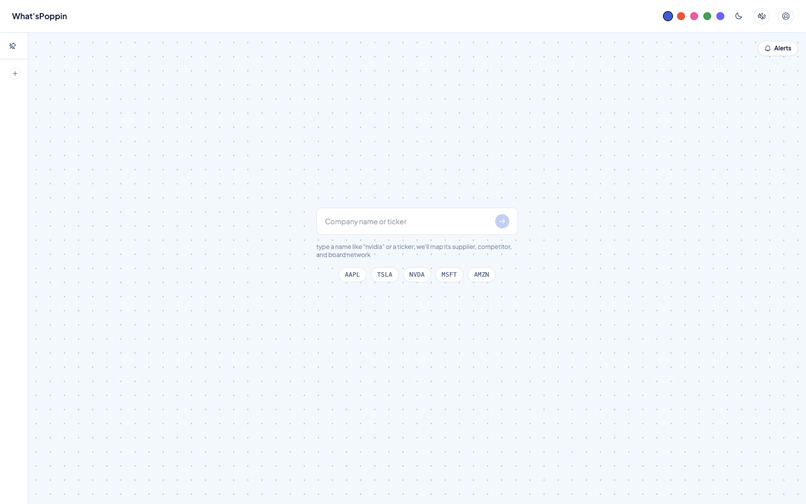
Search for the Company
-
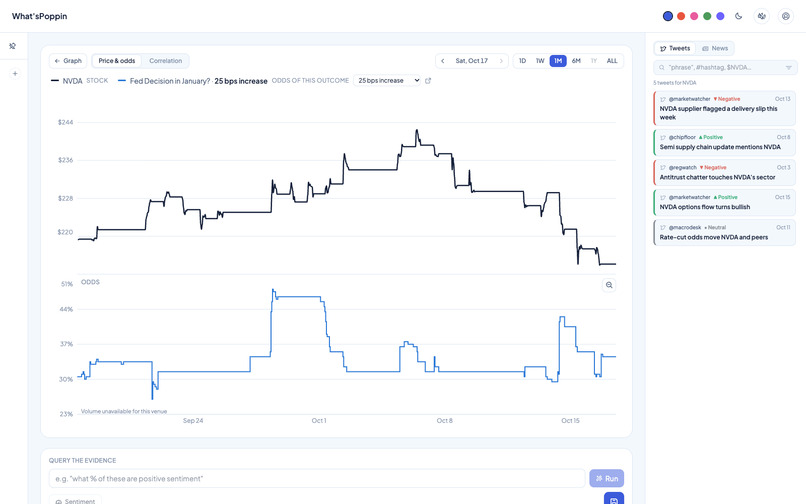
Price vs Odds
-
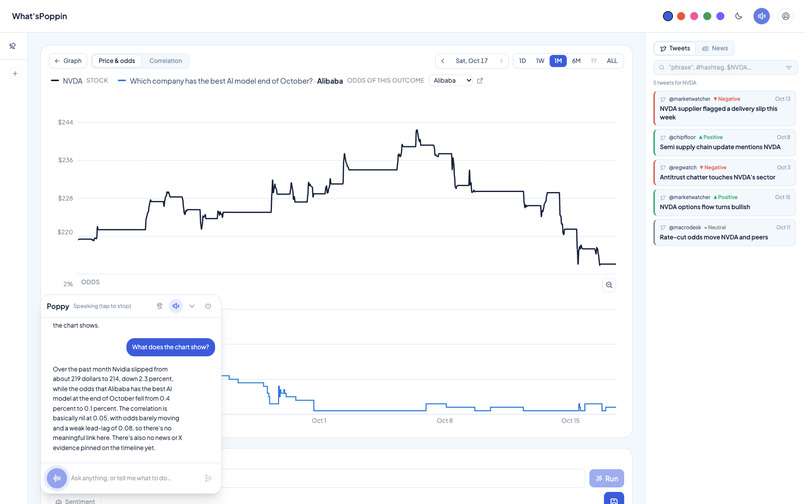
Voice Chart
-
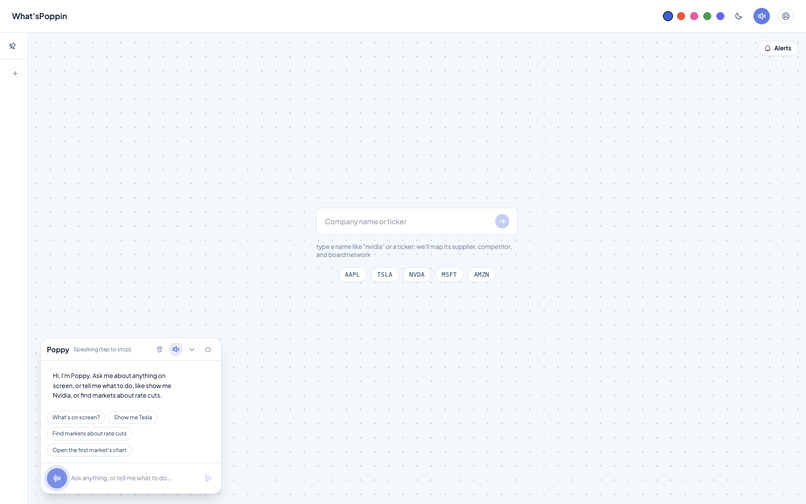
Voice Assistant
-
Company Graph
-
Market Search
-
Voice Graph
Inspiration
Prediction markets (Kalshi, Polymarket) now price real-world events minute by minute: Fed decisions, tariffs, export controls, elections, earnings. That is an early, real-money read on exactly the risks that move stocks. But there are tens of thousands of markets and nothing links them to companies. An investor holding NVIDIA has no way to know which markets matter to NVIDIA, its suppliers or its competitors, and usually finds out about a move on social media after it is already priced in.
What it does
What'sPoppin is a portfolio intelligence agent for event risk: it watches the markets around your companies and explains what changed and why, with every claim traced to a source.
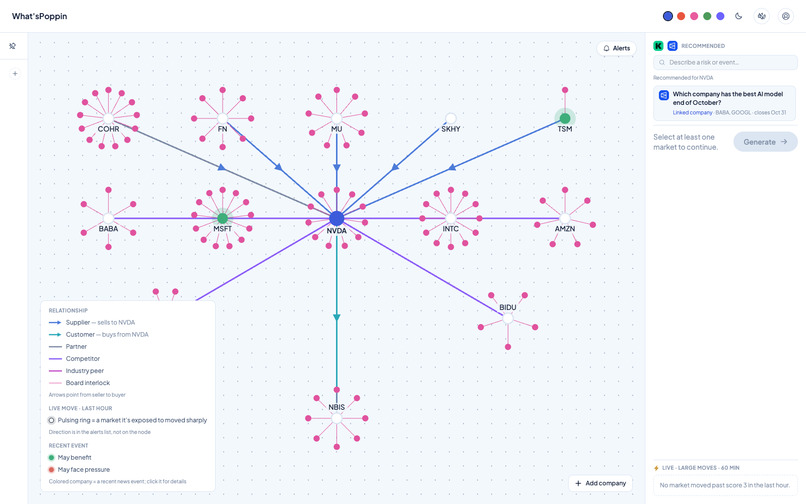
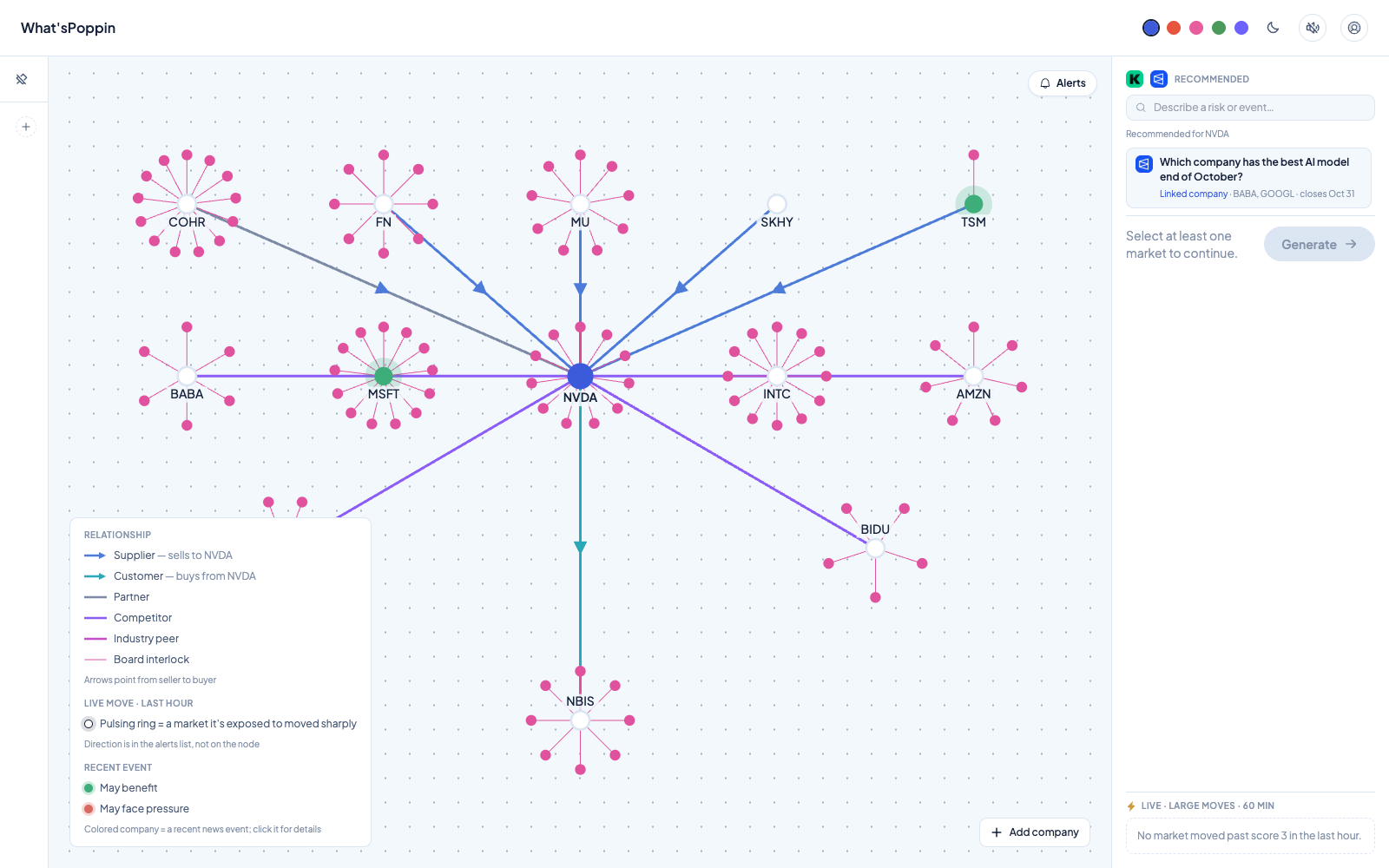
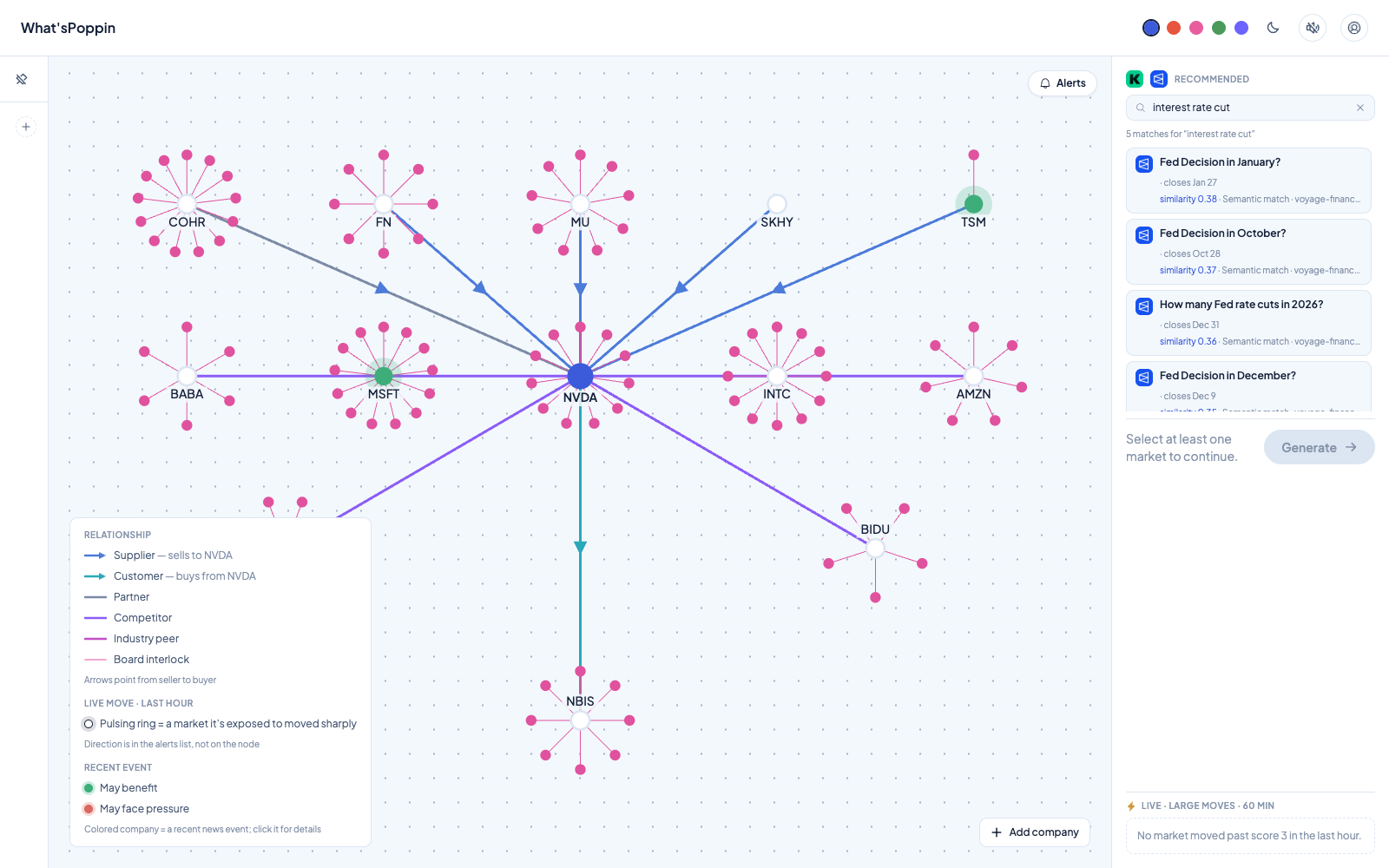
- Company graph from SEC filings. Search any listed company. Its suppliers, customers, partners, competitors and board interlocks are extracted from 10-K/10-Q and insider filings. Every link stores the URL of the filing it was read from; nothing is saved from model memory.
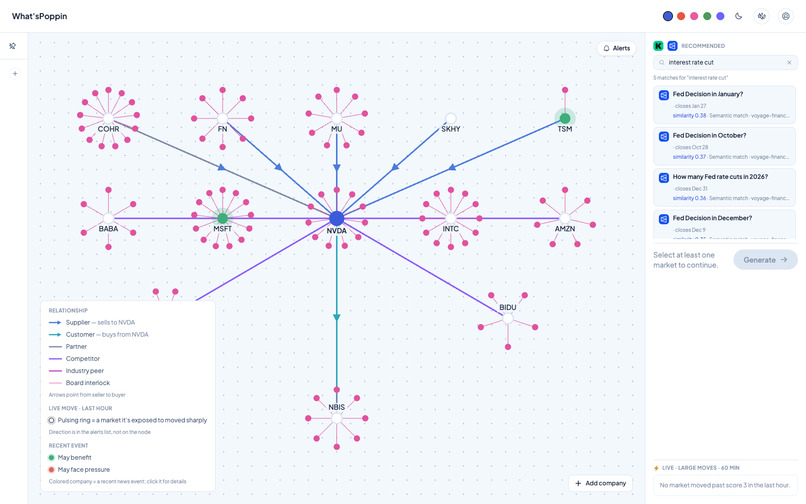
- Markets that matter. Every open Kalshi and Polymarket market is tagged with the companies, sectors and themes it affects. Or describe a risk in plain English ("war in the middle east oil supply") and semantic search finds it.
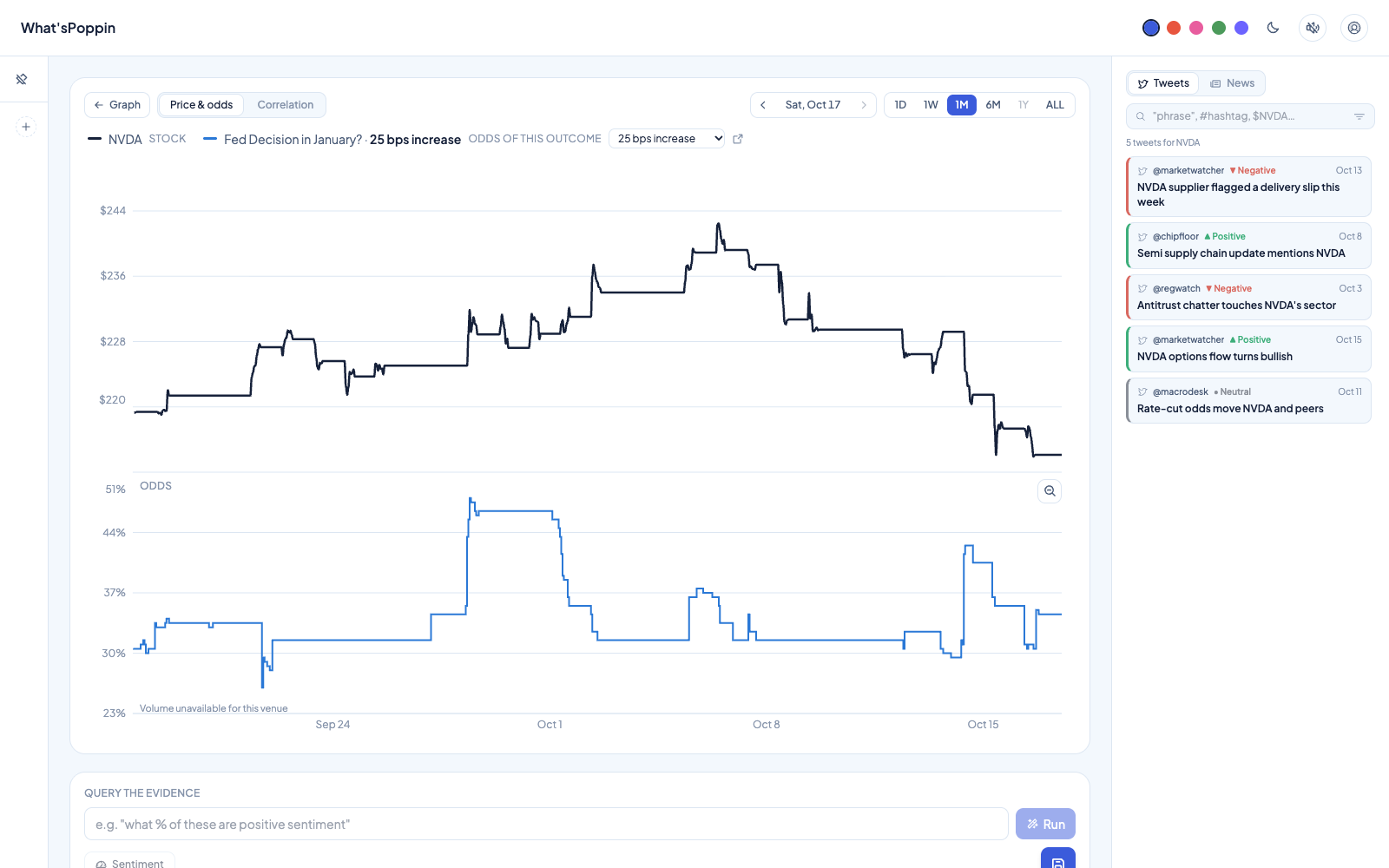
- Stock vs. odds. The stock and the market's odds on one timeline, market-adjusted against SPY, with rolling correlation, confidence bands and lead/lag, and an explicit "correlation, not causation" framing. It refuses to show a number with fewer than 25 data pairs.
- Evidence on the chart. News articles (and X posts) are classified for sentiment and pinned to the moment they were published. Ask questions over them: "what % of these are positive?"
- Live alerts. A detector scores every market every second against its own history (price z-score, volume bursts, whale orders, order-flow imbalance) and raises an alert only on real moves. Each alert is traced through the graph to the companies that may feel it. Example from a live run: a Kalshi market on California gas prices moved, and What'sPoppin mapped it to Chevron, Exxon and Shell.
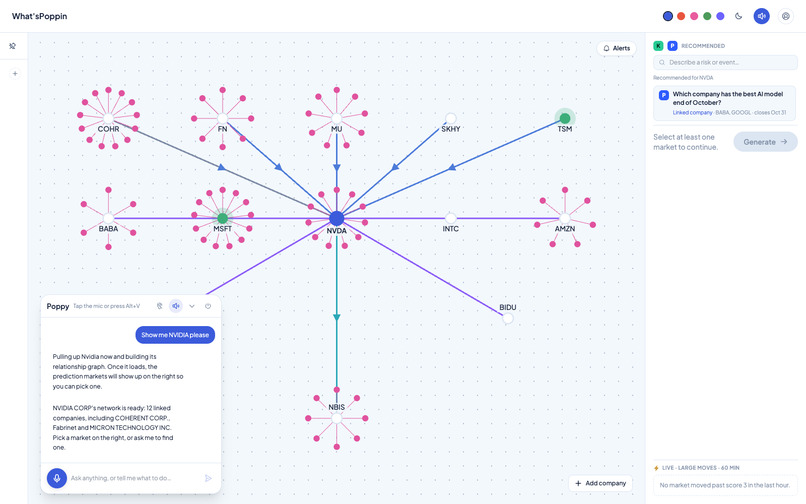
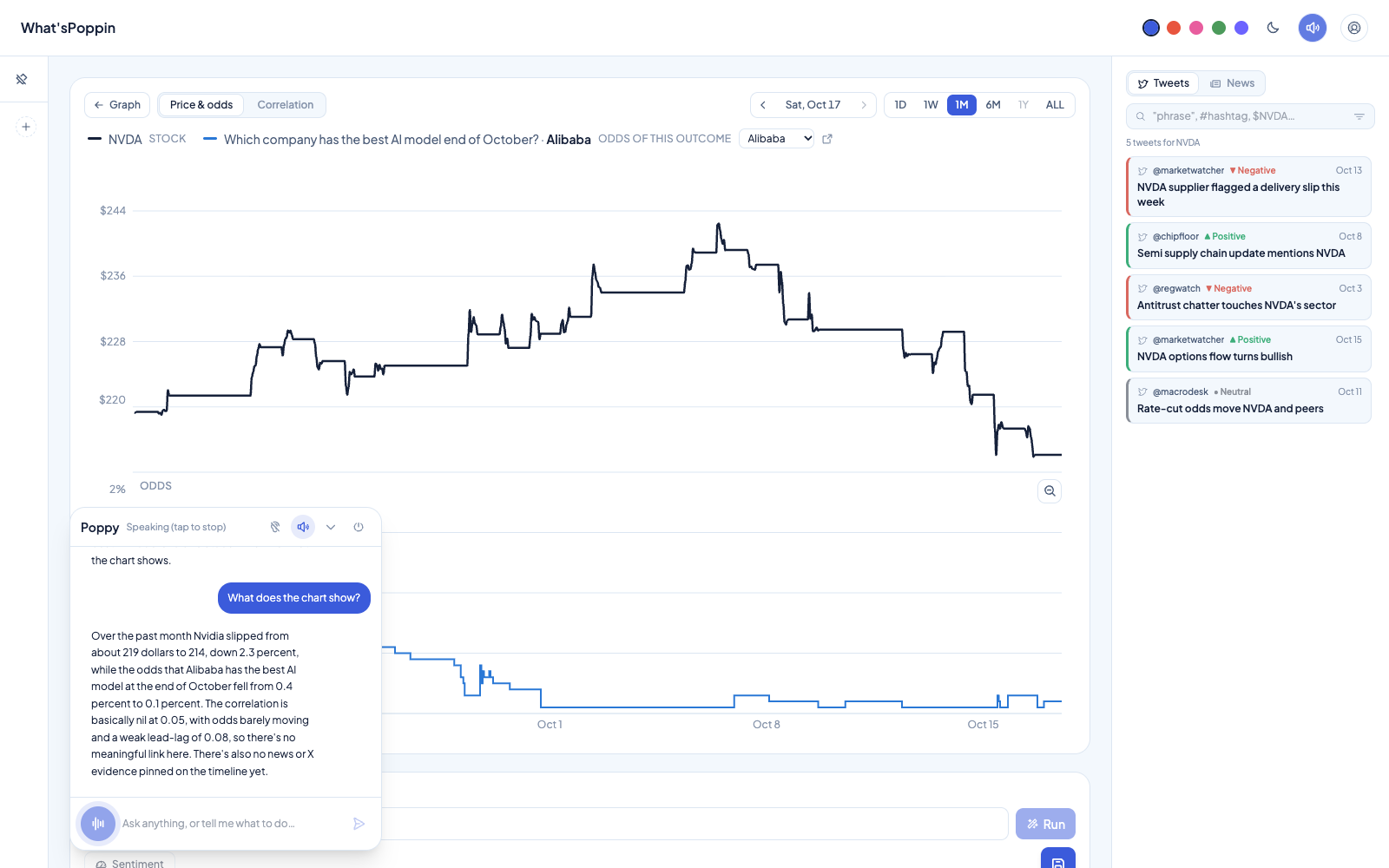
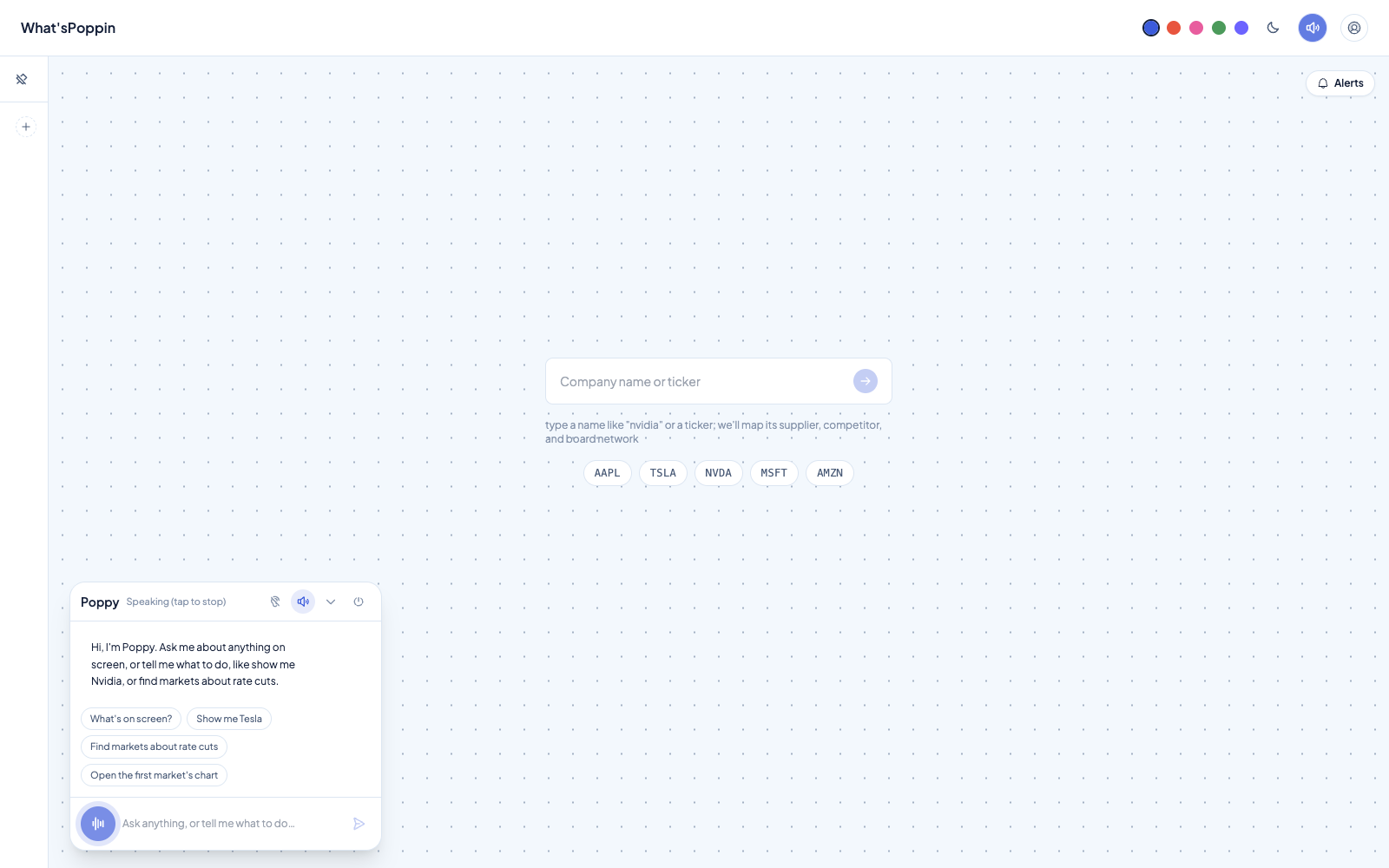
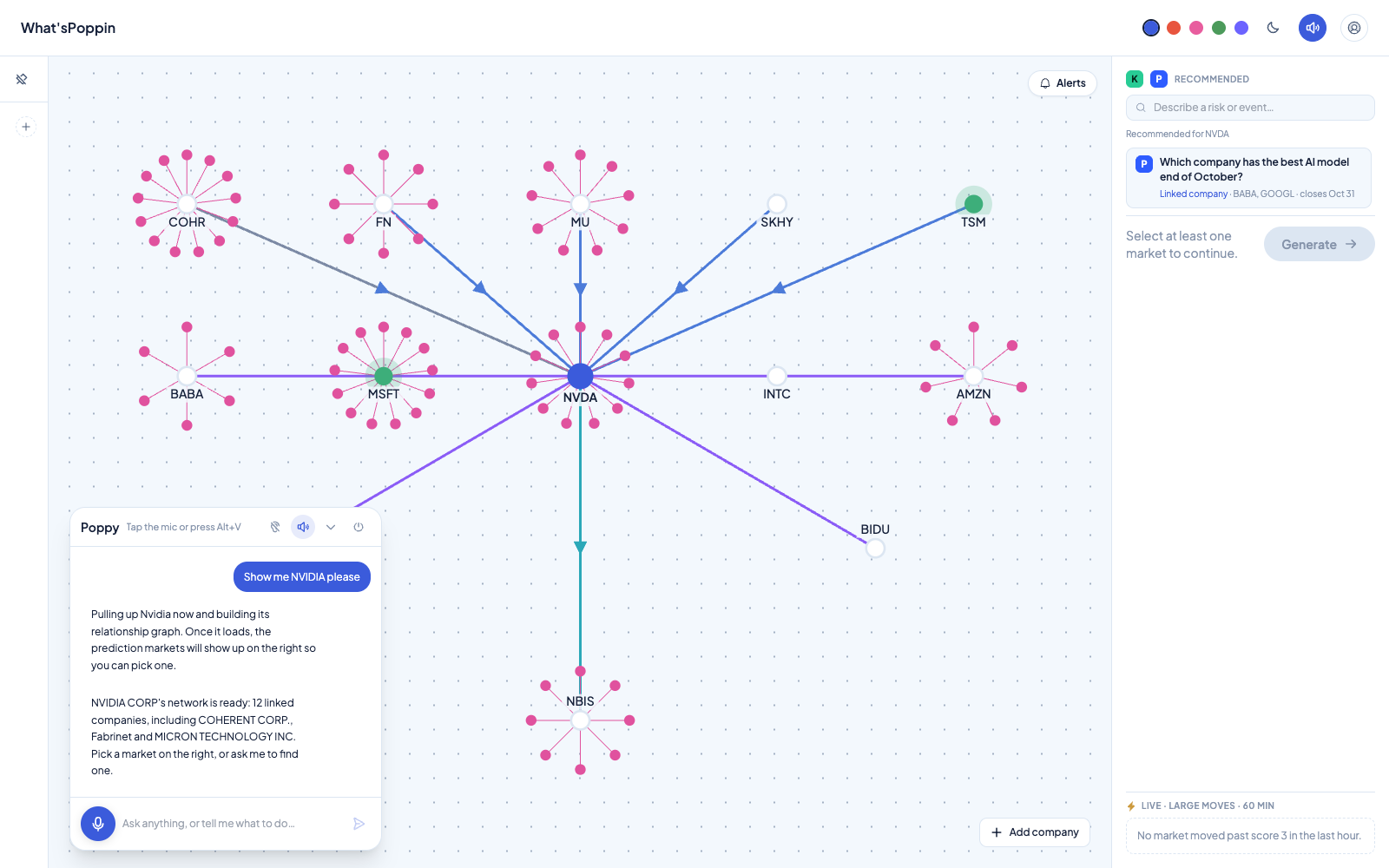
- Poppy, the voice analyst. Talk to the app: "Show me Nvidia", "find markets about rate cuts", "select the first market and open the chart", "what does the chart show?". Poppy sees what's on screen, drives the UI, and answers only with companies, markets and numbers that are actually displayed. It gives information, not trading advice.
How it fits Money Intelligence
The track asks for agents that do investing research and portfolio intelligence where every number traces back to a source. What'sPoppin is that for event risk:
- Research analyst: it reads SEC filings and produces a sourced relationship graph; each edge cites its filing.
- Portfolio intelligence: it watches markets around your companies and their supply chain, and explains what changed (the alert), why (the evidence), and who is exposed (the graph).
- Grounded numbers: stock bars come from Alpaca, odds from the venues, news from real articles, relationships from SEC filings. Poppy is constrained to the numbers on screen.
How we built it
- Backend: Python, FastAPI, Postgres. Workers stream Polymarket over WebSocket and poll Kalshi's public REST API (the Kalshi key is optional; with one it streams), compute per-market baselines, run the 1-second alert detector, and map alerts to companies.
- Frontend: React + TypeScript, with a force-directed company graph, overlay charts and the Poppy dock.
- Data: SEC EDGAR, Kalshi, Polymarket, Alpaca (stocks), NewsAPI.
Nicrron: all the AI, through one gateway
Every model call goes through the Nicrron API (api.nicrron.ai):
nicrron/autoextracts structured relationships from SEC filings, classifies news sentiment, answers yes/no questions over evidence, and is Poppy's reasoning model. Every answer is validated against a schema; bad output is rejected, never guessed.voyage/voyage-finance-2(through Nicrron) embeds every market event for semantic search, and shortlists candidate companies for each market before the model confirms them. On 20 live markets this cut model calls from 77 to 40 and made tagging about 3× faster (8.7 s to 2.8 s per event) while keeping 88% of the original tags.
ElevenLabs: Poppy's ears and voice
- Scribe (speech-to-text) transcribes what the user says; the browser detects the end of speech after about 1.3 s of silence.
- Flash (text-to-speech) speaks Poppy's reply and narrates what just loaded ("Nvidia's network is ready: 12 linked companies…").
- The ElevenLabs key stays on the server; the browser only talks to our API.
PRISM: observability for the agent
- Every Poppy turn and every market search is traced as a run with timed steps:
assistant.turn=context.snapshot(retrieval) →llm.complete_structured(model) → oneaction.*step per UI action;markets.search=embeddings.search(retrieval) →venue.activity_filter(tool). - Each run is sent to PRISM as a trace (
/api/traces) with its steps as spans (/api/spans/ingest), on a background thread so tracing never slows a request. A failed step marks the run failed with its error type, which is what PRISM's Root Cause clusters group on. PRISM's connection health shows every stage green: traces received, trajectories assembled, analysis ready. - Knowledge Base: "Tesla Research Corpus" (Tesla's FY2020, FY2023 and FY2024 10-K figures with source IDs) assigned to a Tesla Filing Analyst agent. Every run starts with a
knowledge_base.searchretrieval step against PRISM's Knowledge Base, then the model call, thencheck.numbers_supported, which verifies each financial number appears in a retrieved source and is cited. - Root Cause: the v1 prompt's failures form one cluster of unsupported or period-mismatched financial claims (8 traces; detectors
failed_tool_call8/8 andunsupported_answer7/8; PRISM's judge, 5 of 5 votes, traces it to the failing number-check step; we verified the class as Prompt, because that check fails only when the prompt lets the model write unsupported numbers). Why it happens: the v1 prompt allowed the model to write a polished answer without requiring each financial number to map to retrieved evidence, so it could omit citations or mix relevant facts from the wrong fiscal period. - Evaluator: a custom PRISM AI evaluator, "Every financial number is supported by retrieved evidence" (100 / 70 / 40 / 0 rubric: citation present, cited source retrieved, same metric, same value and unit, same fiscal period), run on the same three prompts with v1 and v2. v1 scored 40, 40, 40 (it computed differences and percentages that no source contains); v2, which requires every number to come verbatim from a cited source, scored 100, 100, 40. The average went from 40 to 80, and the one remaining v2 failure is a real one: an uncited restatement of a correct figure.
Challenges we ran into
- Kalshi without a key. The live WebSocket needs an API key, so we added a keyless mode that polls Kalshi's public REST API and writes the same rows, only when a quote changes.
- PRISM integration. Our first exporter used a Bearer token and a raw payload and was rejected; PRISM expects the
X-PRISMtrace-Keyheader and its trace/span schema. - Chat models vs. strict schemas. Models routed through a gateway don't always answer in the requested shape; we normalize the common shapes instead of rejecting correct answers.
- Models invent "helpful" numbers. Even with citations required, the model computed differences and margins that no source contains. The fix was an explicit rule: report only values that appear verbatim in retrieved content and describe changes in words (the Root Cause and Evaluator story above).
- Honest statistics. Raw price correlation is misleading, so we use SPY-adjusted returns and logit odds changes, show confidence bands, and refuse to compute on thin data.
Accomplishments that we're proud of
- A company graph where every edge cites a real SEC filing.
- An alert pipeline that runs end to end on live data: move detected, mapped to companies, shown on the graph.
- A voice analyst that can drive the whole app and refuses to invent numbers.
- 673 backend tests and 123 frontend tests.
What we learned
- Prediction markets are a genuinely early signal, but only useful once they are mapped to companies.
- Grounding beats prompting: constraining the model to sources and validating every answer did more for reliability than prompt tweaks.
- Observability changes how you debug agents: seeing every step of a run makes failures obvious.
What's next
- Backtest the detector on historical Kalshi and Polymarket data (false-positive rate, and whether moves lead the stock).
- Watchlists and push alerts for your own portfolio.
- Kalshi streaming with an API key, and more venues.
Built With
- alpaca
- elevenlabs
- fastapi
- kalshi
- newsapi
- nicrron
- polymarket
- postgresql
- prism
- python
- react
- sec-edgar
- sqlalchemy
- typescript
- vite
- voyage-ai
- websockets

Log in or sign up for Devpost to join the conversation.