-
-
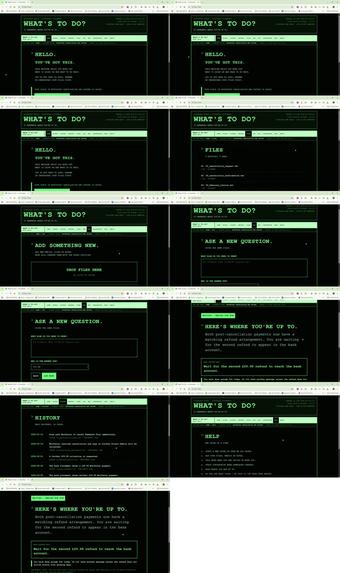
storyboard
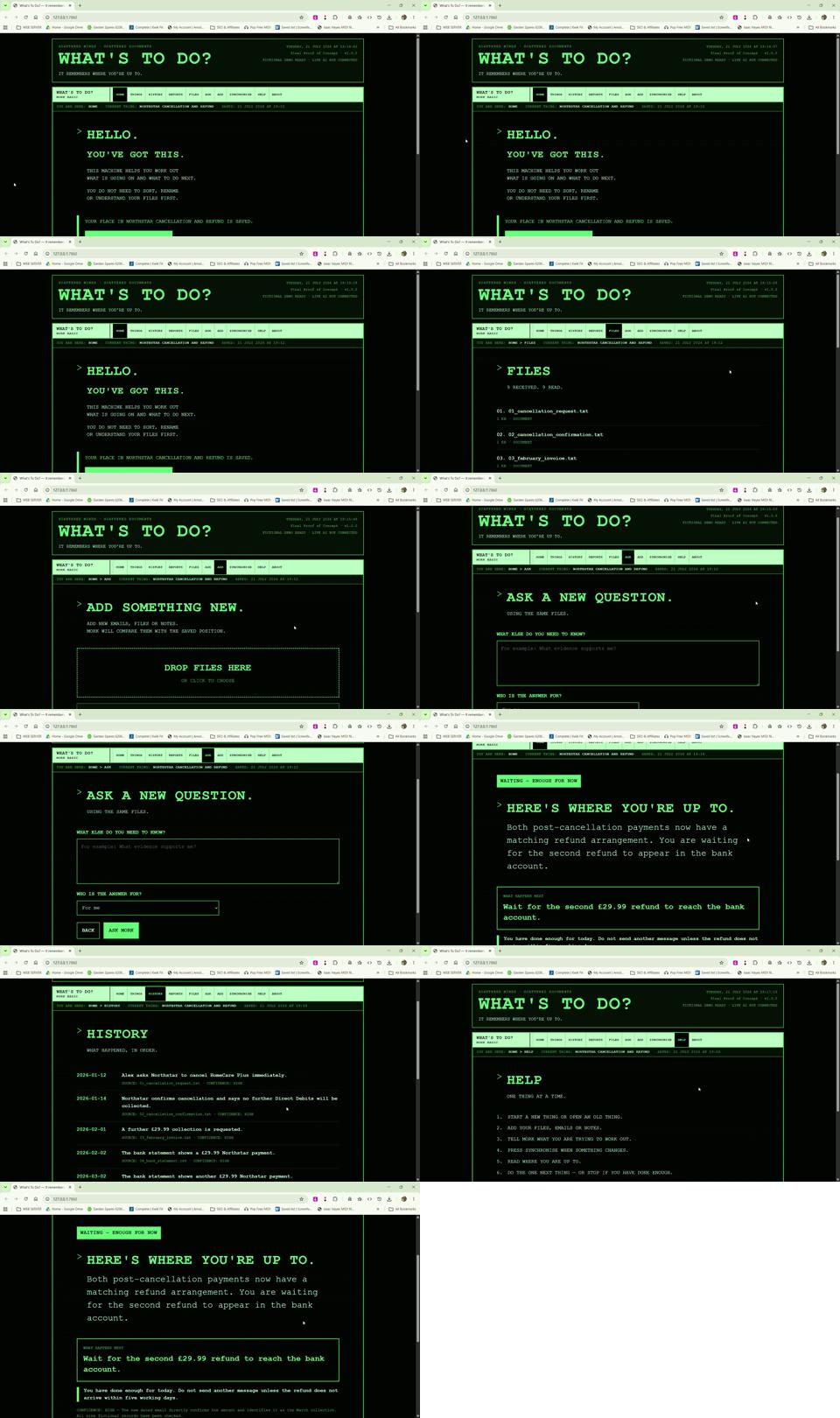
What's Occurring? Inspiration
The idea came from a simple question:
"What's occurring?"
People are surrounded by information but often struggle to understand it. Emails, PDFs, letters, receipts, notes, screenshots and messages become scattered across different places, making it difficult to see the bigger picture.
The project was inspired by the need to reduce that mental burden. Rather than creating more information, I wanted to build something that helps people understand the information they already have.
The prototype was originally inspired by organising complex real-world documentation, but the concept applies equally to healthcare, education, legal cases, insurance, project management and everyday life.
What it does
What's Occurring? ingests documents and turns them into something understandable.
Instead of asking users to read hundreds of pages repeatedly, it helps answer questions such as:
What has happened? What has changed? What am I waiting for? What should I do next? What information is missing?
The aim is to support executive function by helping people organise information into knowledge rather than simply generating more text.
How I built it
The application was built using Python together with HTML, CSS and JavaScript.
OpenAI models provide the reasoning and language understanding needed to analyse documents, identify important events, explain information in plain English and answer questions about the collected material.
The application provides separate areas for:
Managing things to do Importing files Asking questions Synchronising information Tracking history Producing reports
The goal throughout was to keep the interface simple enough that users can understand where they are and what has happened.
Challenges
The biggest challenge was not the AI—it was deciding how information should flow.
Many AI applications produce impressive answers but give users very little understanding of how those answers were reached.
I wanted to build something that makes the process transparent by keeping information connected, showing progress, tracking changes and helping users understand the journey from raw documents to meaningful conclusions.
Creating a simple interface for a complicated problem proved to be far more difficult than building individual AI features.
What I learned
I learned that AI is most valuable when it reduces confusion rather than simply producing more content.
Helping people understand complex situations may be more valuable than generating another paragraph of text.
I also learned how quickly a proof of concept can evolve when combining OpenAI models with a focused user experience and iterative prototyping.
What's next
This prototype demonstrates the core concept.
Future work includes:
Support for many more document types. Better timelines and relationship mapping. Collaborative workspaces. Improved search and reasoning across large collections of documents. Integrations with cloud storage and productivity tools.
Ultimately, the vision is to build an AI-powered sense-making platform that helps anyone answer one simple question:
"What's occurring?"
Built With
- accessibility
- analysis
- artificial
- automation
- css
- document
- executive
- flask
- function
- gpt-5
- html
- information
- intelligence
- javascript
- knowledge
- language
- management
- natural
- openai
- processing
- productivity
- python
- retrieval
- sqlite
- summarization

Log in or sign up for Devpost to join the conversation.