-
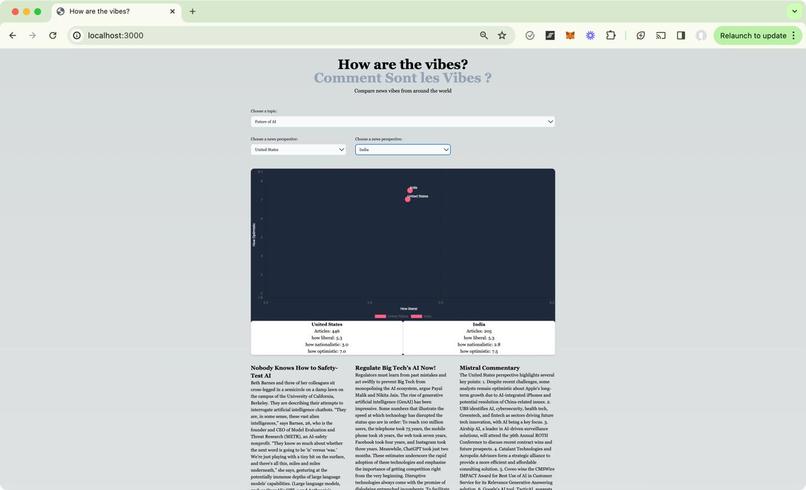
Main screen
-
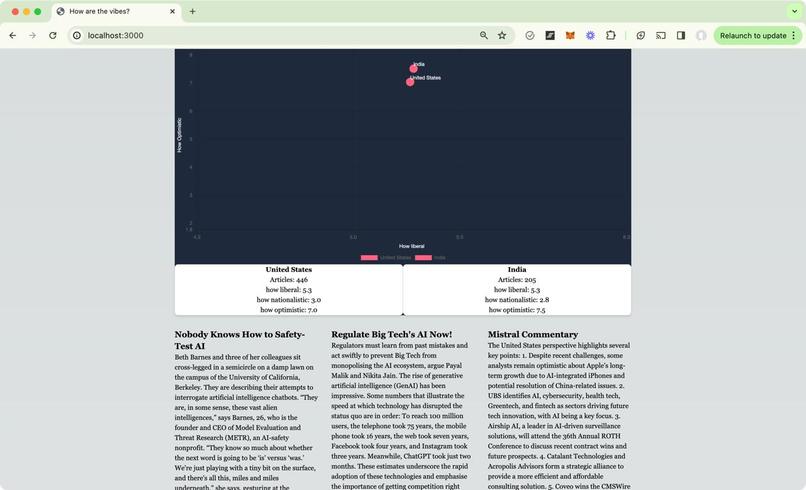
Zoomed into the graph and text
-
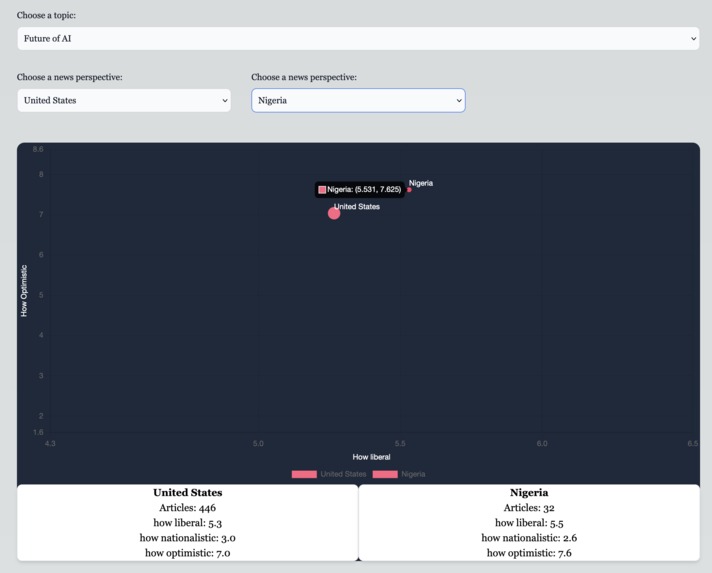
Zoomed into graph only
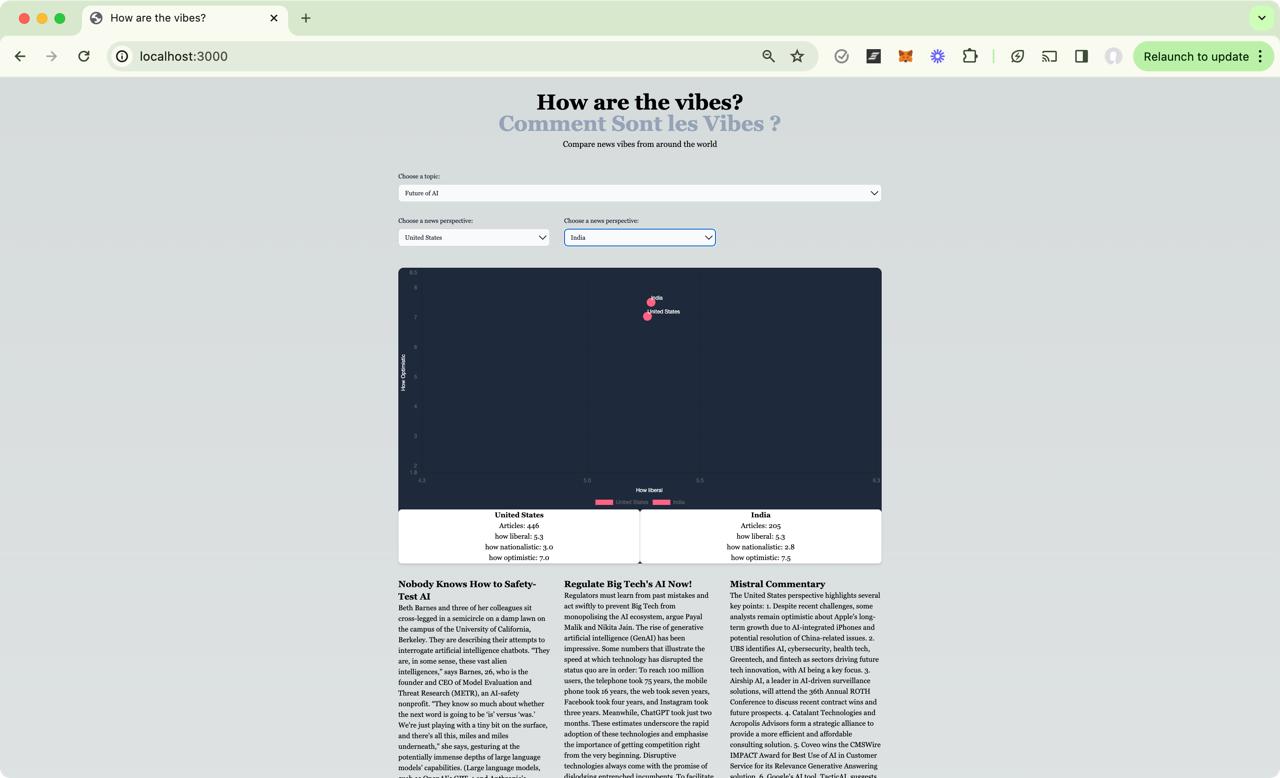
Inspiration
We all live in our own information bubbles. While this has been true since the hunter-gatherer days, during this era of instant access to global digital information, we feel that we can do better. Currently, even if we make a concerted effort to understand current events from multiple perspectives (using tools such as ground.news to see "both sides"), usually our horizon ends at the borders of our own country.
Our team imagines a different world, one where as global citizens we learn to see the events of our time through other nations' eyes.
That's why we built How are the vibes?, a platform to discover and visualize how other countries are thinking about the same news stories that we are.
What it does
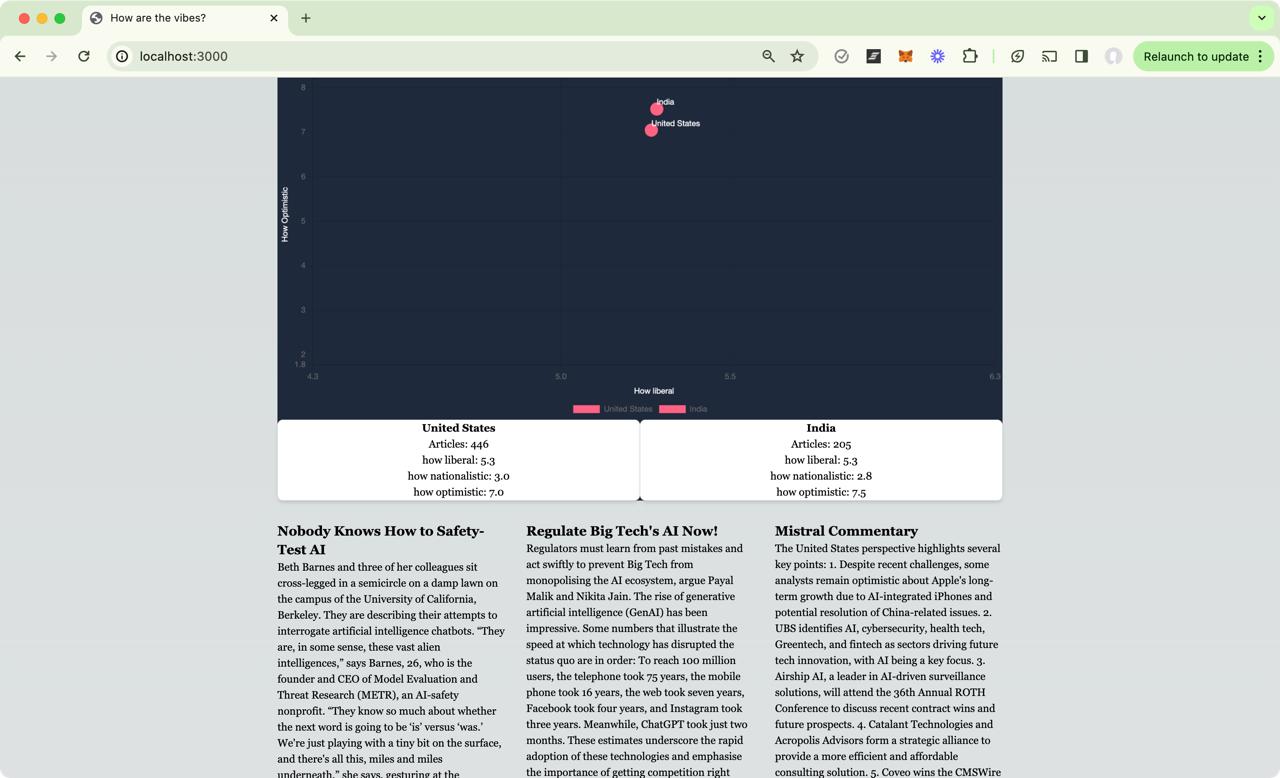
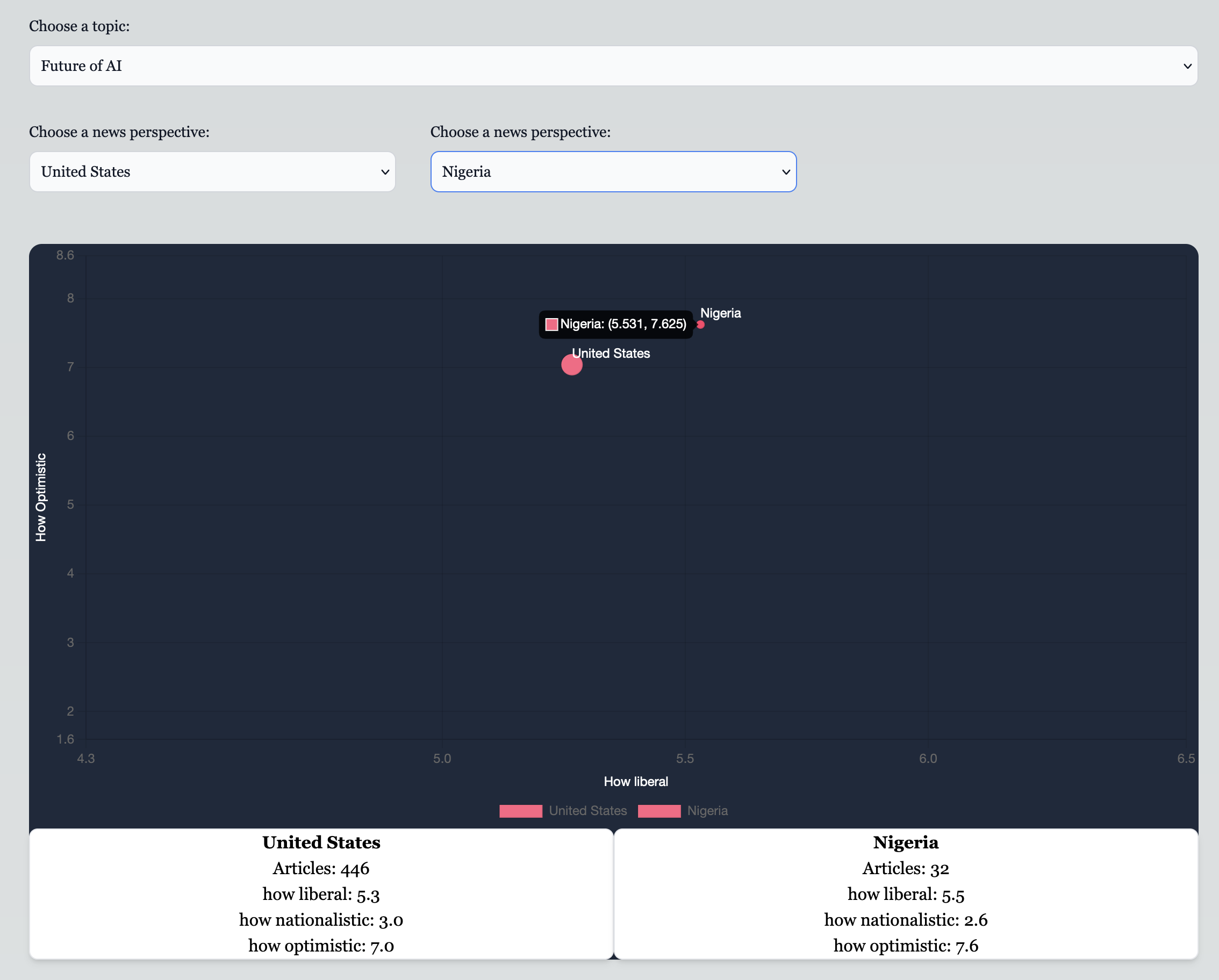
How are the vibes? allows you to choose a trending news topic and see statistics about the coverage of that topic across different regions. We include visualizations of some key factors like how each country's media leans in aggregate along the political spectrum, how optimistic the reporting is for that topic, and how strong of a sense of nationalism is present in the reporting for that topic. Additionally, we show a textual summary and comparison between the two perspectives, generated by Mistral-large.
How we built it
We built a data processing pipeline using a dump of news articles from the free MediaCloud API, first using Mistral-small to summarize over 6000 news articles across twelve topics and ten regions. These summaries were then piped into Mistral-7b for sentiment analysis along some relevant dimensions. All of this data was preprocessed and stored in a small SQLite database. Finally, we built a web app using Next.js for querying and display. Our Next.js backend additionally makes some calls to Mistral Large to display textual comparisons and summaries of the selected topic.
Challenges we ran into
Our main challenge was handing a large amount of data through APIs with relatively narrow rate limits (for a 24-hour hackathon, at least). We needed to download several thousand news articles to get a representative sample across geographies. Between downloading this data (which required multiple API calls per item), LLM summarization, and sentiment analysis, we started hitting rate limits pretty fast. A lot of our engineering went to making sure that we were able to process this data in time for the deadline. This even involved running off of two Mistral API keys (the hackathon-provided key and a team member's personal key), as well as running Mistral-7B locally on a team member's laptop.
We also had to tweak our prompts to ensure that they were effective at extracting signal from the data. Our initial prompts biased almost completely neutral, indicating that 99-99.5% of articles were completely neutral along the relevant axes. Empirically, this wasn't true, so we had to do some prompt engineering to extract some more signal. For instance, we switched from a qualitative scale to a quantitative one with more granularity and found that the model extracted much more signal. Similarly, we also cleaned the prompts and input to remove trailing spaces and other junk tokens and found an improvement in signal quality (down to ~87% neutrality, which aligns with our estimations for the specific data we were looking at).
Accomplishments that we're proud of
Our team name, En Attente, means pending in French (according to Mistral Large and our French friend). We all met in the lobby of SHACK15 yesterday, our Partiful applications still marked as pending while we waited for the event staff to start letting people in off the waiting list. Going from that initial chance meeting to building How are the vibes? together in 24 hours has truly been a "Zero to One" experience for us as a team. We're proud of our versatile uses for the Mistral API, our ability to grok unfamiliar APIs quickly, and our execution in putting together a data pipeline, backend, and frontend all within a day.
What we learned
We learned a few interesting details from simply using our project as we built it — for instance, India and Nigeria are somewhat more optimistic about the future of AI than the United States and Australia. Perhaps AI is seen as a great equalizer for developing and developed nations.
On the more technical side, we learned about optimizing prompts — removing extra tokens and trailing spaces made a qualitative difference in our results. Similarly, switching from a qualitative scale with 3 granularities to a quantitative one with 10 helped us get more signal from the data we had. Finally, we were also impressed by the quality of Mistral's multilingual support for Latin and Arabic scripts, especially for the small models. We did not expect to be able to use them without any further tweaking, but they seemed to work well with the few Latin/Arabic articles we had.
What's next for How are the vibes?
There's so many things we want to keep building — automatic retrieval of new stories as they become live, automatic detection of trending news topics, automatic detection of interesting axes to compare regions on (there's a theme here). We have aspirations for better visualizations, broader data inclusion, and automatic surfacing of news stories to reduce your own bias and puncture your news bubble.
On a more technical level, there's still so much potential for increasing the effectiveness of the models via fine-tuning. Specifically, we would like to fine-tune our Mistral-7B used for feature calibration to more consistently rate news stories along the axes we find relevant.
We currently have an implicit agentic framework in our data processing pipeline, since one model summarizes, another performs feature calibration, and yet another performs synthesis and analysis for the end user. We want to experiment with a more general framework for the models to find relevant features, such as by adding in another layer that decides which features to pass to the calibration layer.
On a broader scale, though, we built How are the vibes? to make us more integrated global citizens. We want to make ourselves more empathetic with others around the world, and in order to do that, we must be able to put ourselves at least a little bit into their shoes. With How are the vibes?, we feel like we've already planted a pretty good seed. If this is what we can do in a day, imagine what we can do in a lifetime.

Log in or sign up for Devpost to join the conversation.