
Inspiration
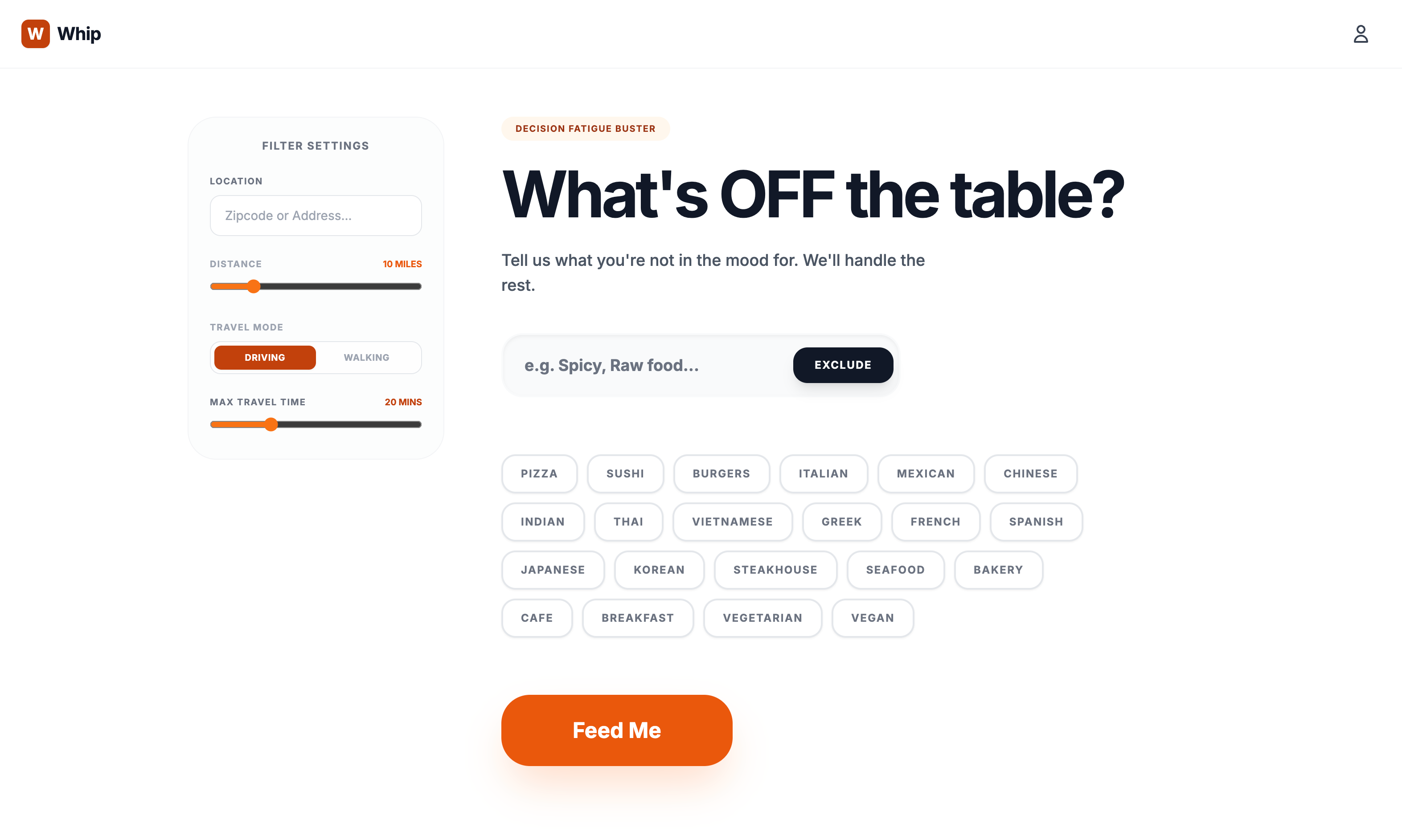
As women in tech, we often encounter differences in thoughts and processes in how products are brought to fruition. Throughout the last so many decades, men have predominantly been the thought leaders in the field of development. It has led to a line of thinking that is widely accepted but led me to wonder is there a different way of thinking about applications possibly? In no time at all I realized, this is most easily identifiable when it comes to the one thing everyone needs to do; eat. Conversations that happen all over the world daily that start with "What do you want to eat?". This is also as I've been often told a source of frustration for many people and their significant others. The inherent problem with this question is that many women don't know what they want to eat. We can tell you what we don't want to eat, but to go through everything and think about if we really want it? That is a tall order when you're hangry. This is a problem and WHIP (Where Hungry Ideas Pop) is the solution
What it does
Whips is a food discovery app built for indecision. Instead of asking users what they want, it starts with what they don’t—then uses Google Maps and Gemini to surface nearby, available options that actually work. By flipping the decision model, Whips reduces search time, decision fatigue, and food frustration.
How we built it
Whip was engineered to solve "decision fatigue" using an exclusion-first search model and the latest Google AI stack.
Smart Filtering (Places API New): Instead of traditional keyword search, we built a TypeScript engine that processes local restaurant data via the Google Places API and strictly filters out user "exclusions" (e.g., "No Spicy," "No Fast Food") to deliver pure matches.
Logistics (Routes API Matrix): We leverage the Google Routes API Matrix to calculate real-time travel times for every result simultaneously, ensuring recommendations strictly respect user transit constraints (Driving vs. Walking).
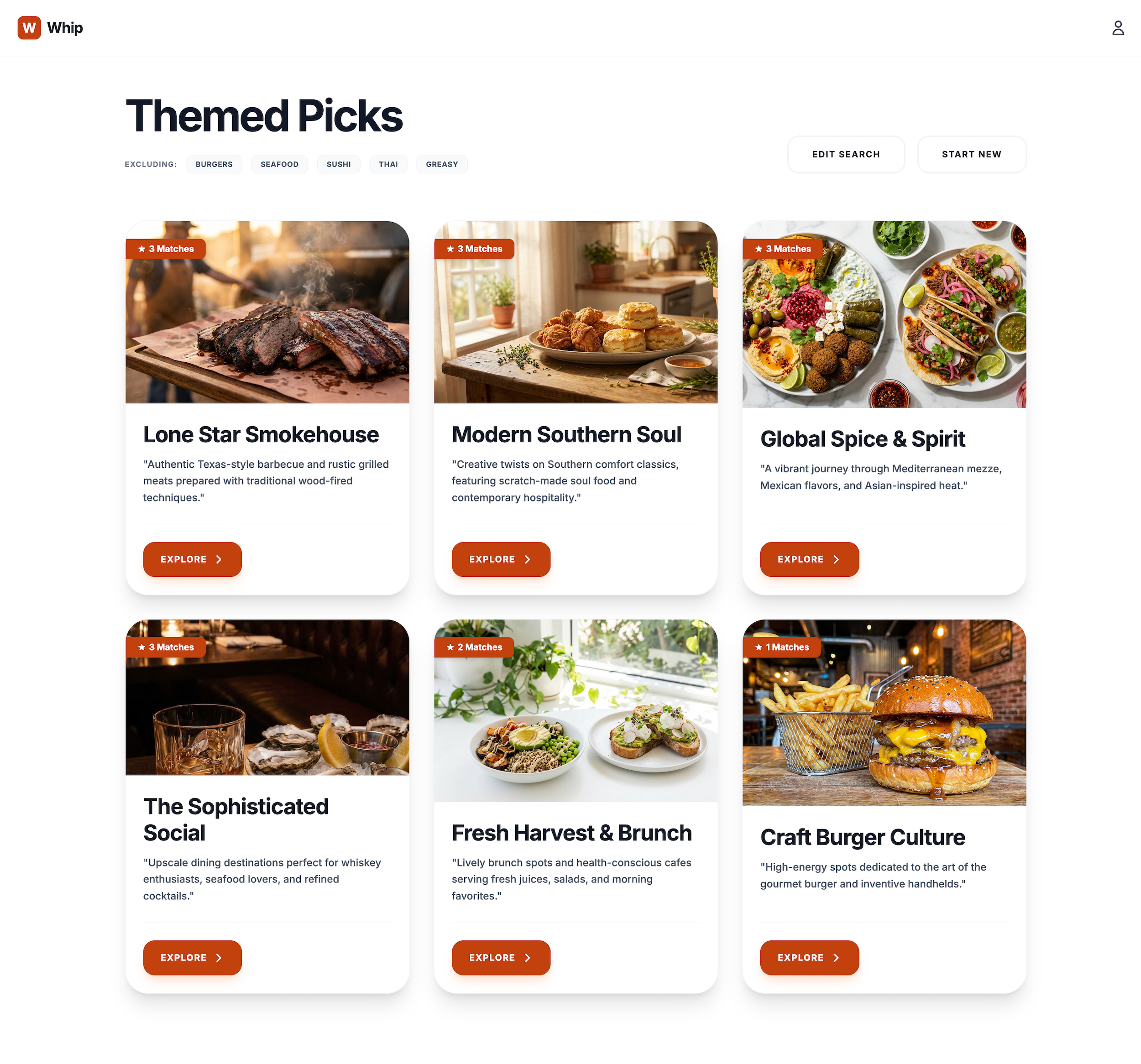
AI Curation (Gemini 3 Flash): Rather than showing a flat list, we use Gemini 3 Flash to semantically group matches into creative, themed categories (e.g., "Cozy Date Spots") in real-time.
Visual Discovery (Gemini 3 Pro): To create a premium feel, we used Gemini 3 Pro (Image) to generate "Instagram-style" cover art for every AI-generated category, tailored to the specific vibe of the suggested restaurants.
Cloud Stack: The app is built with React 19, Vite, and TypeScript for performance, then containerized with Docker and deployed on Google Cloud Run for scalable, serverless execution.
Quality Development
Tech Stack: Built with React 19, TypeScript, and Vite for a fast, type-safe, and modern SPA. UX/UI: Features a premium design system with glassmorphism, fluid animations, and a responsive mobile-first layout. Localization: Native support for English and Chinese.
Gemini 3 Integration
Semantic Grouping: Uses gemini-3-flash to dynamically categorize results into creative, context-aware themes rather than simple lists. AI Visuals: Leverages gemini-3-pro-image to generate photorealistic, "Instagram-styled" category headers in real-time.
Quality & Functionality
API Orchestration: Seamlessly combines Google Places, Routes, and Geocoding APIs for precise location and travel data. Clean Architecture: Modular service layers and strict type definitions ensure maintainable, high-quality code. Robust Features: Includes custom exclusion filters, real-time distance matrix calculations, and graceful AI fallbacks.
Challenges we ran into
Instability of AI studio were frustrating - Utilizing AI studio to Vibe code allowed us to quickly reach a level of development that I'll admit was unparalleled to what could be done before. The problem though is that changes made after the initial generation were not completely made to the existing code and/or subsequent unasked for changes would also occur altering existing specific code changes made previously regardless if they were related or not.
Processing time for image generation - In a world where people receive information constantly the speed of the generation of the Thematic images were something left to be desired. Trying to find ways to enhance that led to many different trials and errors
Exclusion Algorithm - How to do exactly what the app set out to do with the limited resources we have. Finding the answer to this was crucial and to do it in a way that was performant was a feat
Accomplishments that we're proud of
Putting this whole thing together is something we are extremely proud of. This has been an idea floating around in my mind for a decade. It was after talking to Chloe about it that pushed me to want to put it into action. Our first foray into vibe coding together was a dream and so much easier than the typical corporate work that we do on the day to day. The feedback loop, getting results all were simplified. We were so excited and driven by the speed of what we're able to accomplish between the 2 of us in such a short time. Finding the differences and executing on a dream has been an honor and a privilege that I never thought would arrive.
What we learned
Through this hackathon, we learned that the way ideas are delivered has fundamentally changed. By leveraging AI tools, we were able to significantly reduce development time and focus more on refining our ideas. Google AI Studio played a key role in rapid prototyping, allowing us to quickly test concepts and iterate through discussion. We also learned the importance of close collaboration. With a team composed of one product manager and one developer, we experienced a new, efficient way of working together to turn ideas into reality. This reflects a broader shift in how products are built today, faster, more collaborative, and increasingly powered by AI.
What's next for WHIP
I would love this to become a fully fledged app or part of a platform that allows users to engage with their favorite apps or a whole suite of apps in the way that best suits them. The exclusionary thought process is something that could help many industries and or types of apps. From air travel (what airlines do I not want to fly without having to click every single one in a checkbox), Medical (As a surgeon, I don't like using these instruments, what instruments do I need for this procedure that will accomplish the task for the right price without using those tools?), etc. If they knew, they wouldn't be looking). There are many other ways to utilize this mentality and I would love for WHIP to be the catalyst to start it.
Built With
- gemini3
- node.js
- react
- tailwindcss
- typescript
- vite


Log in or sign up for Devpost to join the conversation.