-
-
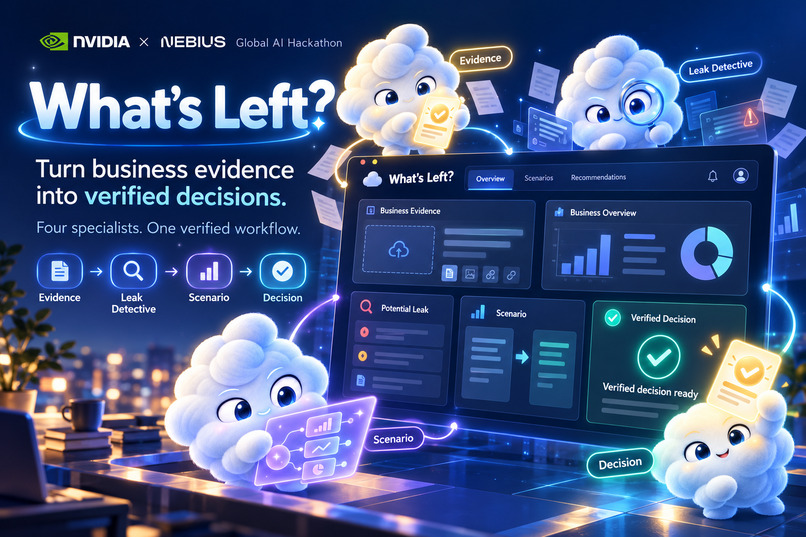
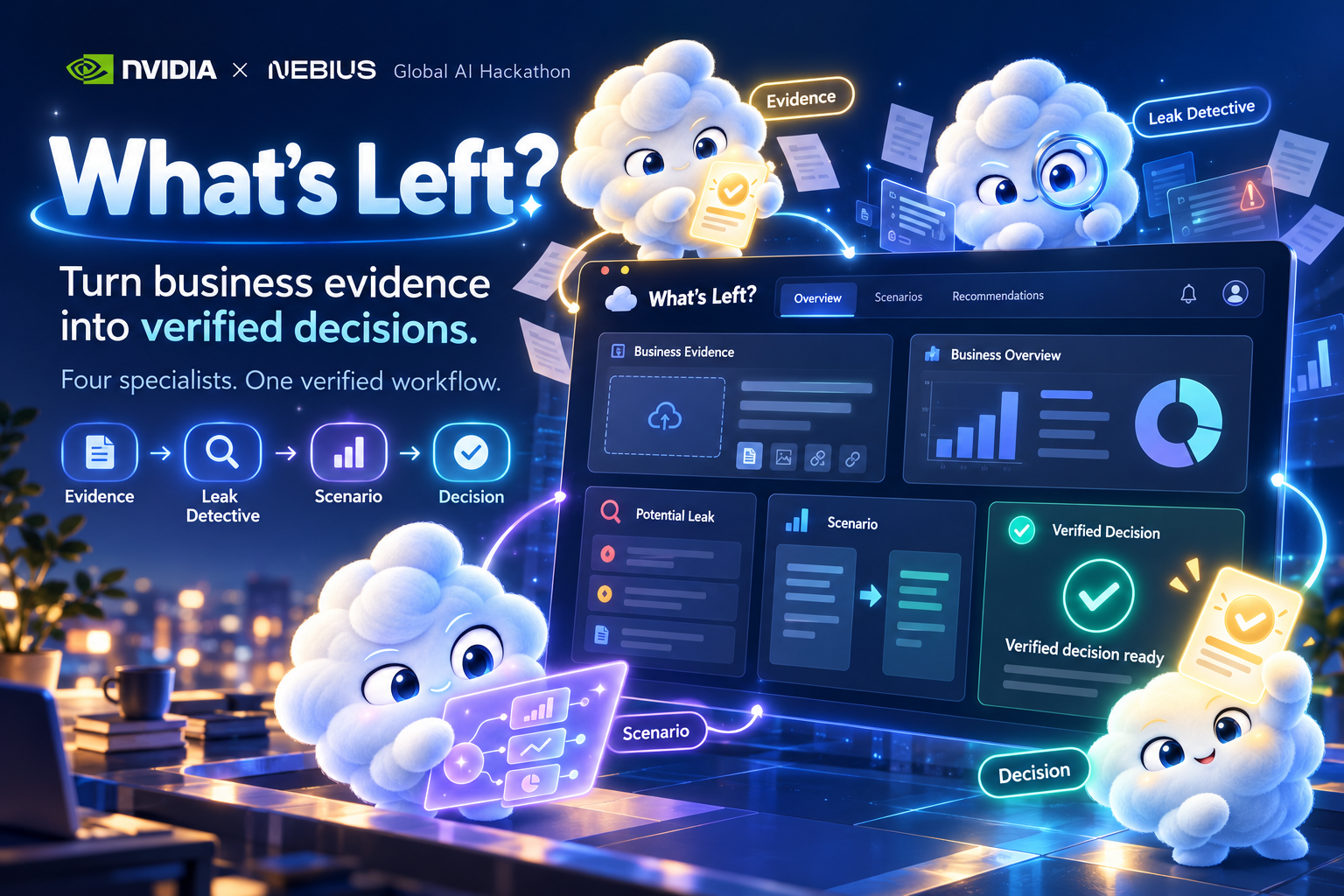
A reusable AI workflow that turns messy business evidence into verified decisions.
-
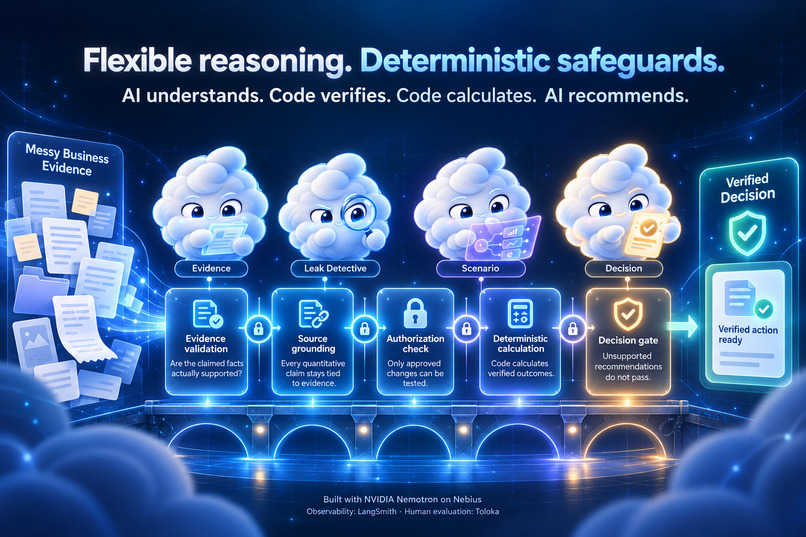
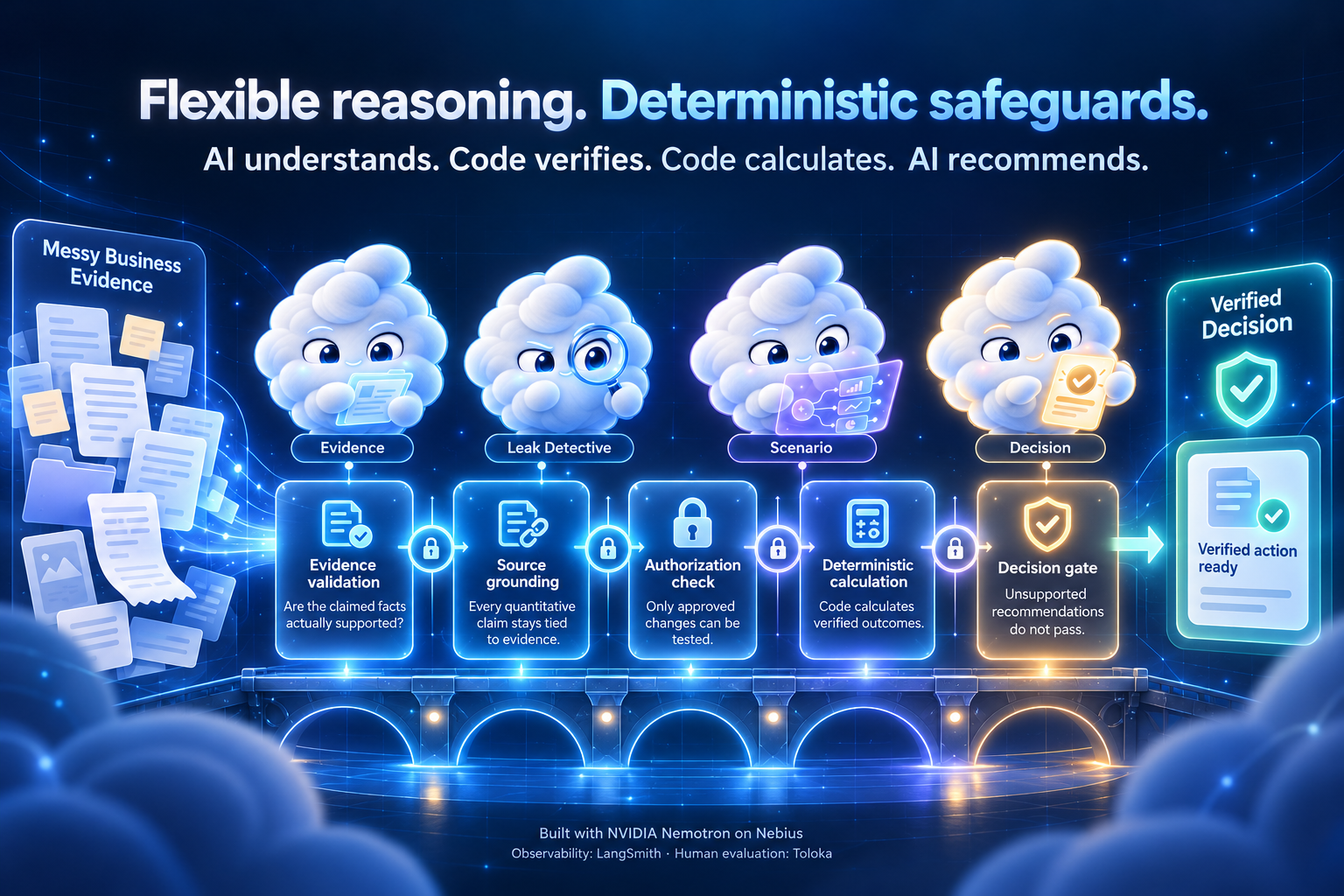
1. AI reasons flexibly while deterministic checks validate evidence, authorization, calculations, and decisions.
-

Four specialist agents analyze the same small business from evidence to a verified next step.

Inspiration
Small businesses often have plenty of operational data, but not enough time to turn that data into trustworthy decisions.
A shop owner may know revenue, staffing costs, delivery fees, waste, or operating expenses, yet still struggle to answer a simple question: What is actually reducing my margin, and what can I safely change?
I built What’s Left? to turn messy business evidence into verified, actionable decisions — without allowing the AI to invent numbers, permissions, or unsupported recommendations.
What it does
What’s Left? is a multi-agent business analysis system built around four specialist AI agents:
- Evidence Agent — extracts and structures business facts from the user's input.
- Leak Detective — identifies potential sources of margin leakage.
- Scenario Agent — proposes only scenarios that are supported by verified evidence and authorized changes.
- Decision Agent — turns verified scenarios into bounded, actionable recommendations.
The core design principle is:
AI understands → Code verifies → Code binds identity → Code calculates → AI recommends within verified boundaries.
Instead of trusting an LLM to perform the entire reasoning process, deterministic validation and calculation layers sit between the agents.
For example, in my demonstrated labor case, the system verifies that Tuesday evening labor represents 31.25% of sales against a management target of 25%. Management has explicitly approved testing one fewer staff member, so the system can safely simulate:
- Headcount: 4 → 3
- Labor cost: USD 2,500/month → USD 1,875/month
- Verified reduction: USD 625/month
The recommendation is produced only after the evidence, authorization, calculations, and decision gate have passed.
How I built it
The application is built with Next.js, TypeScript, React, and Tailwind CSS, with the production application deployed on Vercel.
The AI workflow uses NVIDIA Nemotron models on Nebius:
- Evidence / Leak analysis: Nemotron-3-Ultra
- Scenario reasoning: Nemotron-3.5-Lightning
- Decision support: Nemotron-3-Super
I designed deterministic validation around the model outputs so quantitative claims must remain tied to verified source evidence.
The system also separates:
- evidence extraction
- leak identification
- authorization
- scenario construction
- deterministic calculation
- decision gating
- recommendation generation
For observability and evaluation, I integrated LangSmith and conducted human-evaluation work using Toloka.
Challenges I ran into
The hardest part was not getting an AI model to produce an answer — it was preventing it from producing an answer that sounded reasonable but was not fully supported.
During testing I encountered issues such as:
- unsupported quantitative comparisons
- missing period anchors
- ambiguous per-worker units
- mismatched authorization
- derived numbers that were not explicitly grounded
- scenarios proposed without an eligible approved change
I therefore tightened the pipeline so that invalid or incomplete evidence stops the workflow instead of being silently converted into a recommendation.
When required information is missing, the system explains why the analysis stopped and what additional business input is needed.
Accomplishments that I am proud of
I am especially proud that the final production pipeline can complete the full flow:
Evidence → Leak → Scenario → Calculator → Gate → Decision
while preserving the boundary between probabilistic AI reasoning and deterministic business calculations.
The production demo completes the validated labor case without unsupported quantitative claims and produces a verified USD 625/month reduction scenario.
I am also proud of making the underlying architecture understandable through the interface. Each specialist agent has a distinct role, while the verified core shows users that the final decision is not simply an unchecked LLM response.
What I learned
I learned that trustworthy AI systems are often strongest when the model is not responsible for everything.
LLMs are excellent at interpreting messy context and identifying possibilities. Deterministic code is better at enforcing contracts, validating identities, checking authorization, and calculating numerical outcomes.
Combining the two allowed me to build a workflow where AI contributes flexibility without becoming the final authority over business facts.
What's next for What’s Left?
The next step is to expand What’s Left? beyond the current validated business cases into a broader small-business decision platform.
Future directions include additional operational categories, richer historical comparisons, more scenario types, persistent business profiles, and clearer explanations when evidence is insufficient.
My goal remains the same:
Turn business evidence into verified decisions.
Built With
- agents
- ai
- css
- generative
- langsmith
- llm
- nebius
- nemotron
- next.js
- nvidia
- react
- tailwind
- toloka
- typescript
- vercel

Log in or sign up for Devpost to join the conversation.