-
-
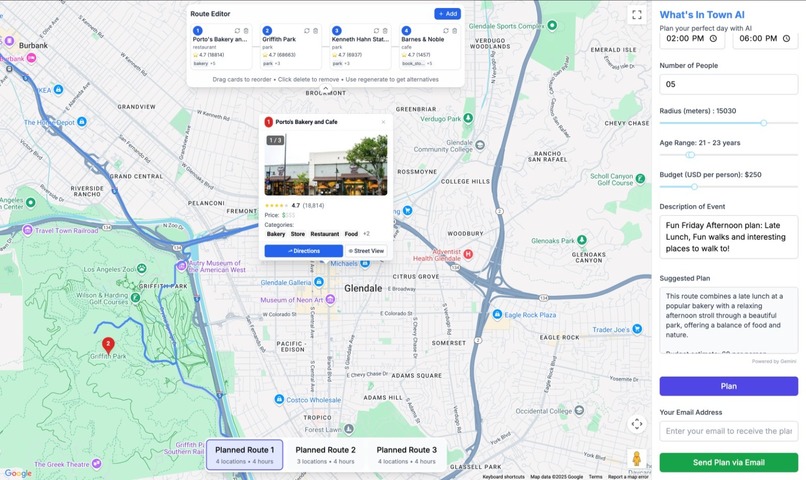
What's In Town AI Demo

Inspiration
Inspired by our undergraduate experience at Grinnell College, our platform transforms event planning from hours of research into seconds of AI-powered personalization. When pursuing an undergraduate degree in Grinnell, Iowa, one realizes that some of the most fun you can have is by visiting the nearby towns and cities - and there are so many of them. We often spent a great amount of time scouring the internet for “hidden gems” and ensuring we can give ourselves the best planned route. By leveraging AI-powered analysis and Google Maps integration, we turn exploration into an immersive journey where users can discover hidden gems, plan custom night-outs, and optimize their weekend adventures. This project redefines how individuals approach city exploration, blending artificial intelligence, location technology, and intuitive design to make event planning both accessible and exciting.
What it does
What's In Town AI uses Google Maps and Places API to intelligently discover venues within a user-specified radius and create 3 optimized routes for the users to choose from. The platform analyzes event descriptions with Gemini AI to automatically select the most relevant venue categories from 100+ place types, then generates multiple personalized itineraries for exploring small towns, local attractions, city highlights, and regional destinations. Users can compare different planned routes, edit individual points on their route, and visualize their entire plan on an interactive map with advanced markers.
Testing Instructions
Our product requires a special access code when first opening the app. This can be found in the ReadMe file on our project's GitHub (Linked Below).
How we built it
We built What's In Town AI using Next.js 15 with TypeScript, integrating Google Maps Advanced Markers, and Google Places API. The core intelligence comes from Google Gemini AI, which analyzes event descriptions to select appropriate venue types and generate detailed itineraries for small-town exploration. We implemented Firebase authentication for secure access, created dynamic route editing capabilities, and designed a responsive interface with TailwindCSS. The system processes user inputs through multiple API endpoints that coordinate place discovery, AI analysis, and route optimization for any location. Finally, we hosted it on vercel and used a S3 bucket to store our JSON data.
Challenges we ran into
A significant challenge was creating intelligent venue selection that works effectively in rural and small-town environments where traditional urban categories might not apply. We had to carefully engineer Gemini AI prompts to understand the unique character of small towns and map event descriptions to appropriate rural venue types while ensuring meaningful results. Storing our Maps API data after we had queried all the locations we needed for our route generation process was a great challenge. We chose to use an S3 bucket for this. Moreover, the Google Maps API sometimes gave us duplicate locations that had different place ID’s but the same name which was a pretty difficult bug to catch since we had to sift through large amounts of JSON data to find out where the issue was.
Accomplishments that we're proud of
Integrating multiple different Google Maps Platform services to create an interactive UI/UX for the user and consolidating this into a unified product. Finding an effective prompt for Gemini to work with the API data we gave it and curate a tailored experience. This allows us to intelligently select from 100+ venue categories based on event descriptions, creates multiple route strategies for comparison, and allows seamless editing of individual points
What we learned
Web Development, API Usage, LLM Usage, Google Maps API, and Prompt Engineering.
What's next for What's In Town AI
Building on What's In Town AI, we aim to expand into collaborative planning features specifically designed for groups of users, allowing individuals to vote on destinations and contribute preferences for their day out. We envision integrating social features like shared itineraries, destinations, user reviews, and community-driven recommendations from fellow students. Additionally, we plan to have weather-aware planning that is location dependent, and - as a long shot - partnerships with local businesses for discounts.


Log in or sign up for Devpost to join the conversation.