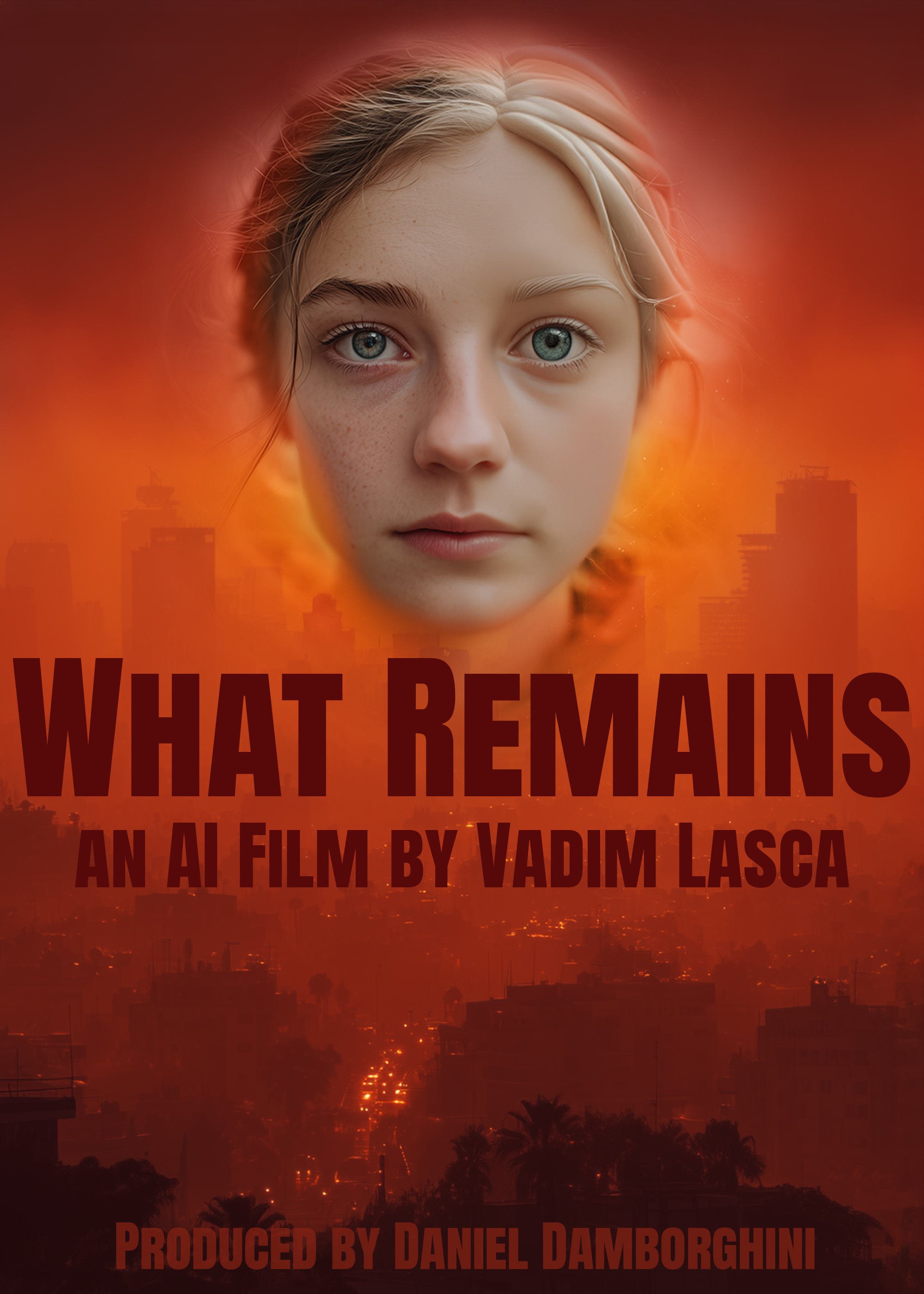
A few months ago, my friend and musician Daniel Damborghini, with whom I had collaborated before, asked me to create visuals for several beats he composed with my brother, Chapis Lasca. Some of the tracks felt so cinematic that I proposed making a mockumentary: a modern, dystopian, apocalyptic version of Powaqqatsi, Koyaanisqatsi or Baraka, but built entirely with AI-generated imagery and video.
I developed the idea from scratch, imagining impossible shots reflecting today’s global issues: environment, technological failures, digital dependence, wars, migrations, health, social control, and AI. The goal was to craft a narrative as coherent as possible.
The images were mainly generated in Midjourney and Flux models via ComfyUI, and at times with Gemini through Whisk. Midjourney gave me artistic, dramatic images; Gemini more realistic but less expressive; Flux more limited but very prompt-responsive. I chose an image-to-video workflow because I had clear ideas about framing, color, and composition, giving me greater creative control and reducing costs versus full text-to-video. For upscaling I used Magnific as my main tool, and once credits ran out, Topaz Gigapixel AI and Topaz Photo AI.
For animation I first tried Moonvalley Marey, but quality and prompt adherence were inconsistent, even with Motion Transfer (I filmed references on my phone) or animate camera. I shifted mainly to Seedance Pro on Krea, which delivered the best results, plus Seedance in Higgsfield and OpenArt. I also tested Veo3 via Flow, Midjourney, Runway, Luma Labs Dream Machine, and Wan 2.2 —effective in action scenes despite low resolution and 16 fps, fixed with Topaz.
After compiling the first videos, I did an offline edit to identify missing shots or artifacts. Corrections and new takes were done in Kling 2.1, Luma Labs Dream Machine, and again Moonvalley (with limited success). By then Nano Banana had launched, letting me reframe images closer to my vision. Low-quality clips went through Topaz Video AI, and the most problematic through Topaz Starlight.
Editing and grading were done in DaVinci Resolve. For the voiceover, I designed a voice without specific gender or age, a subtle hint of an AI narrator, created entirely with ElevenLabs.
This two-month process let me experiment with nearly every tool for image, video, and voice generation available today. As a filmmaker, I’ve always sought new ways to tell stories, and AI gave me the chance to build one I could not have made otherwise.
I hope you enjoy it.
Built With
- english


Log in or sign up for Devpost to join the conversation.