-
-
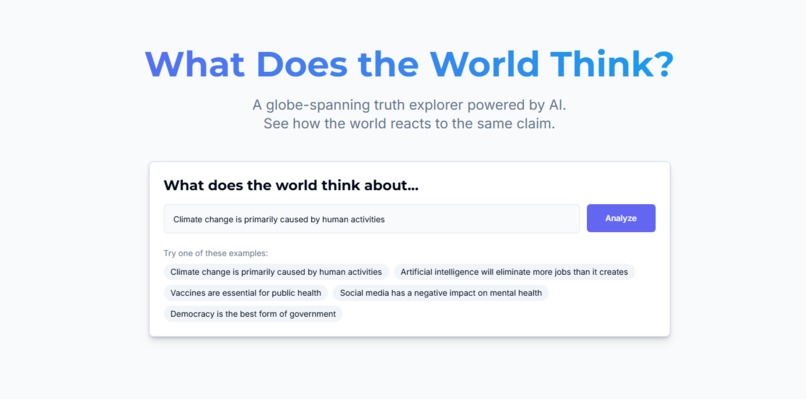
ask question
-
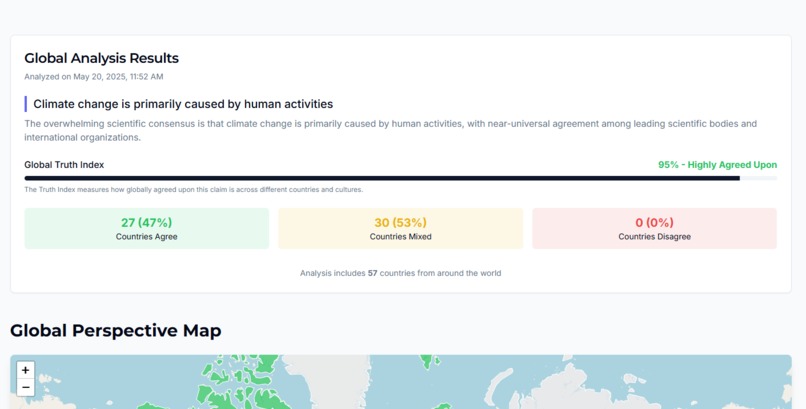
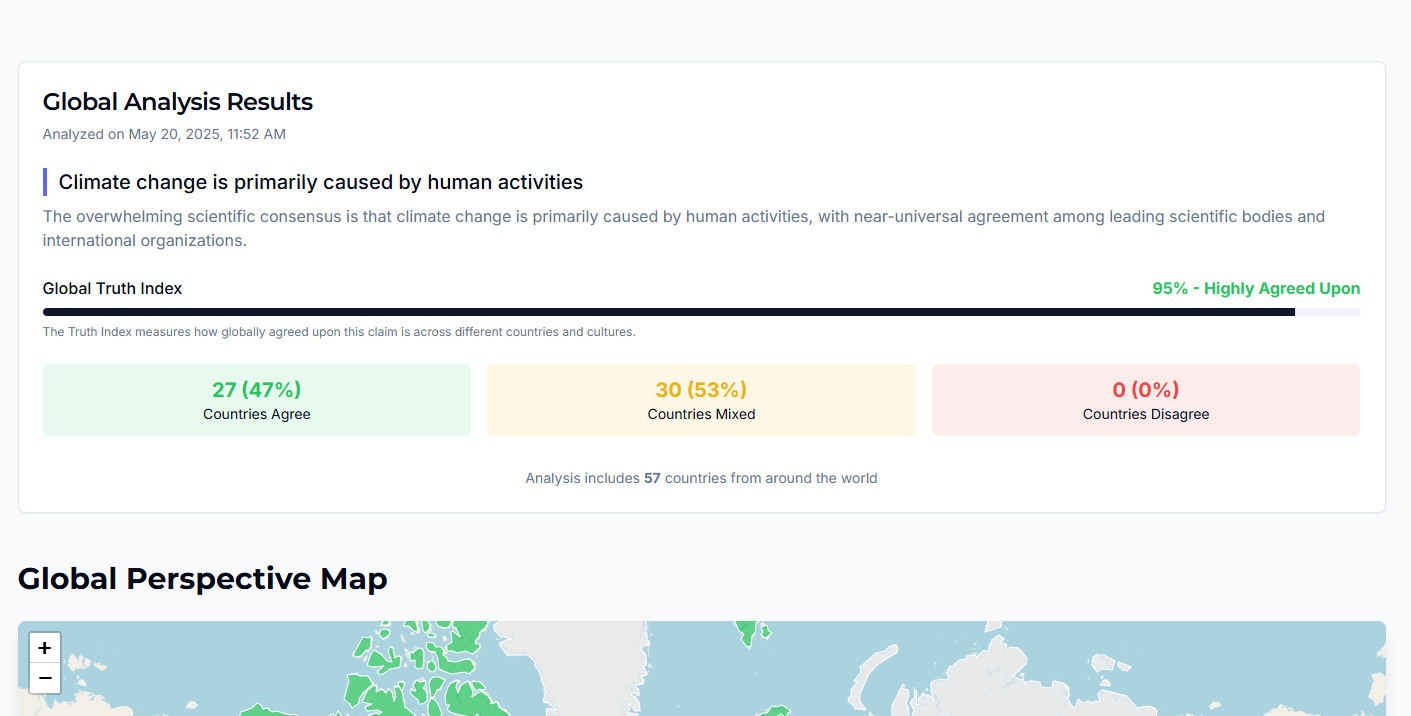
scores
-
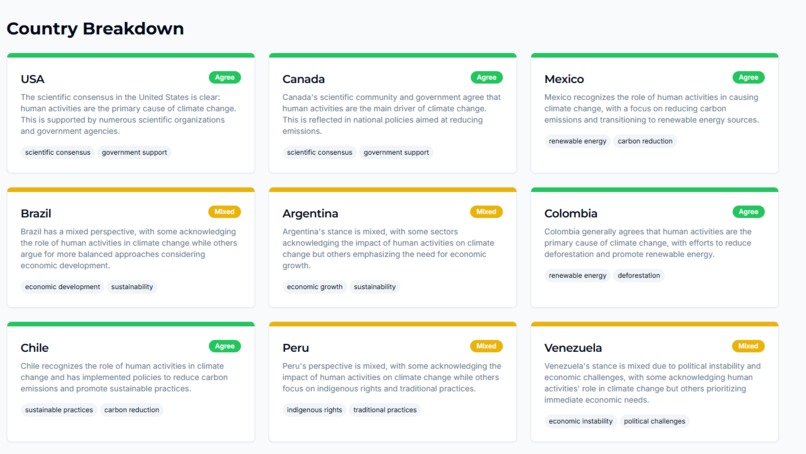
countries
-
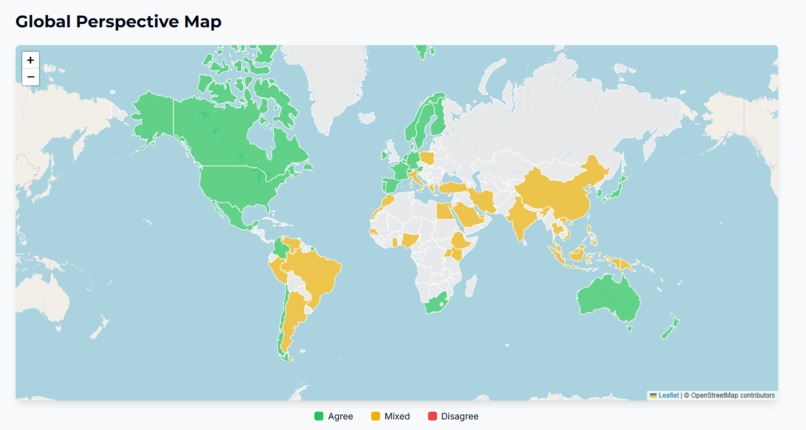
map

What Does The World Think?
Inspiration
The inspiration for "What Does The World Think?" came from the realization that in our increasingly connected yet polarized world, the same claim can be interpreted vastly differently across countries and cultures. We wanted to create a tool that could visualize these global differences in perspective, highlighting how cultural context shapes truth and consensus.
What it does
"What Does The World Think?" is an AI-powered global opinion analyzer that takes any claim or statement and provides a detailed breakdown of how it would likely be received across 192 countries worldwide. The application:
- Analyzes claims against cultural, political, and social contexts of different nations
- Calculates a "Global Truth Index" indicating how universally agreed-upon a claim is
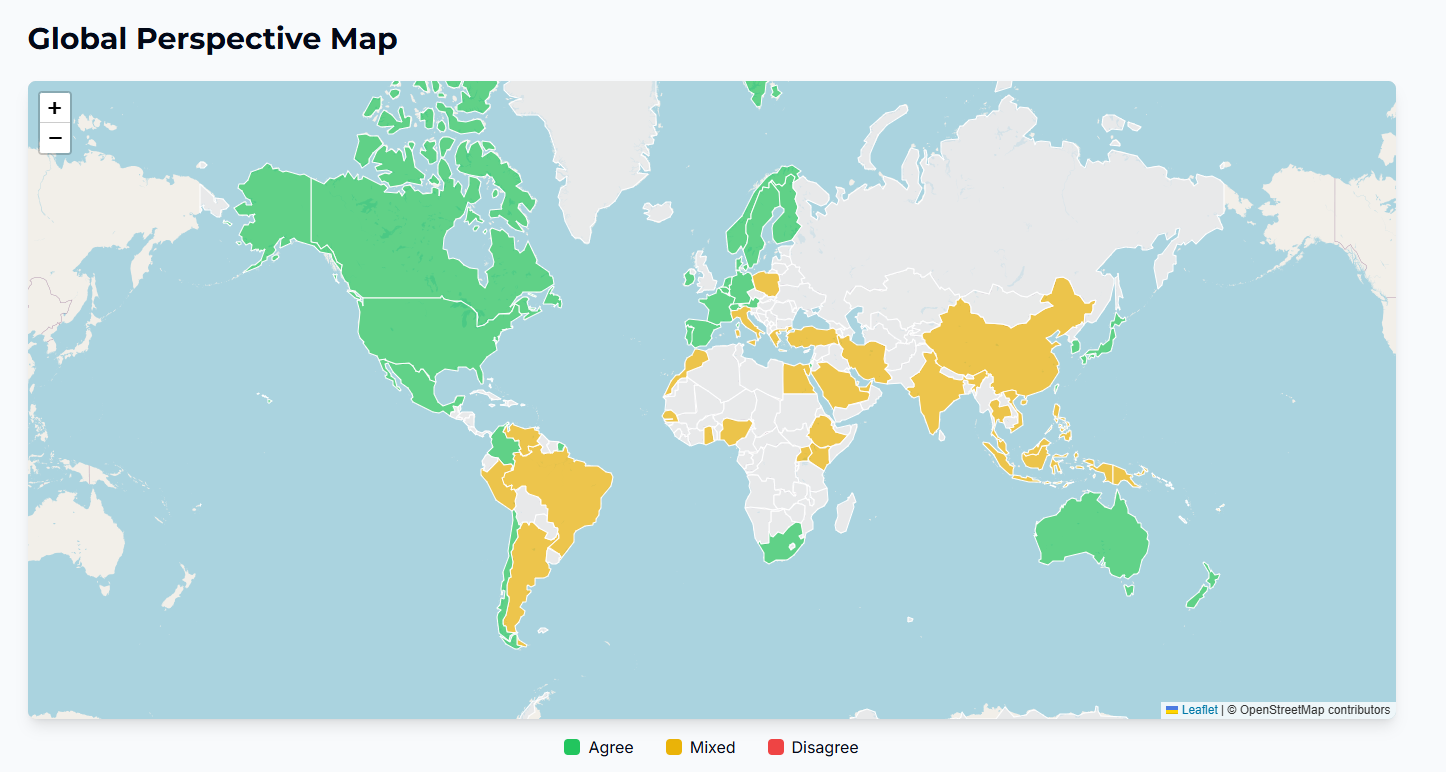
- Visualizes agreement levels on an interactive world map
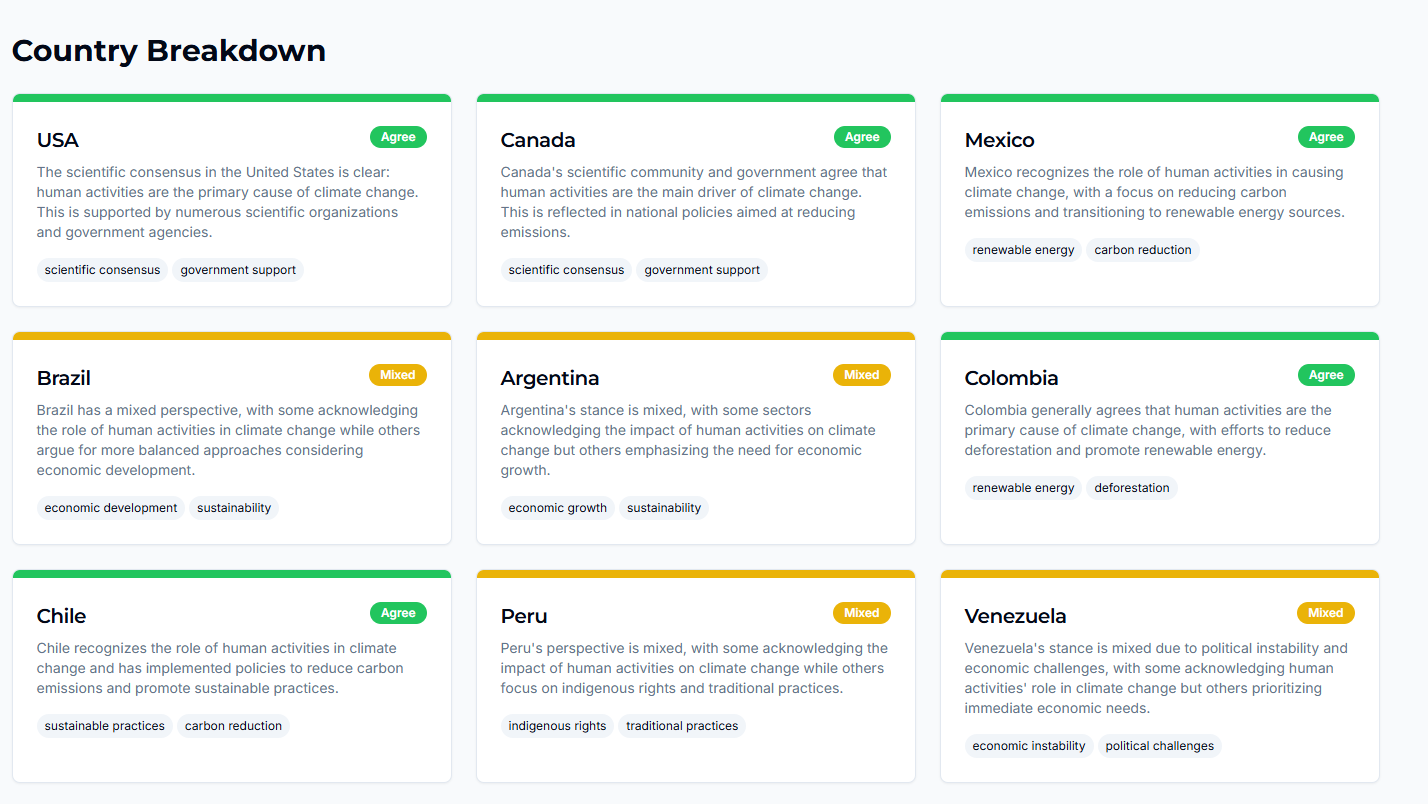
- Provides country-by-country breakdowns with cultural context
- Offers insights into why different regions might agree or disagree with the claim
How we built it
The application was built using a modern tech stack:
- React with TypeScript for the frontend framework
- Tailwind CSS and shadcn-ui for responsive, elegant UI components
- Perplexity AI API for sophisticated global perspective analysis
- Leaflet for interactive map visualization
- Custom data processing workflows to transform AI-generated responses into meaningful visualizations
Challenges we ran into
- Ensuring balanced representation of all global perspectives
- Accurately mapping country names to geographical data on the map
- Optimizing the prompts to Perplexity AI to produce consistent, well-structured responses
- Designing an intuitive UI that could convey complex geopolitical nuance
- Handling the significant computational demands of analyzing 192 countries simultaneously
Accomplishments that we're proud of
- Creating an accessible tool that helps people understand the subjectivity of "truth"
- Developing a responsive map visualization that works across devices
- Building a robust data processing pipeline that handles AI-generated responses reliably
- Designing an elegant user experience that makes complex global data approachable
- Achieving an intuitive way to represent agreement levels visually and statistically
What we learned
- The intricacies of working with large language models for structured data generation
- Techniques for visualizing geographical data effectively
- The complexity of representing global perspectives fairly and accurately
- How to optimize prompts to guide AI toward consistent output formats
- The importance of data validation when working with AI-generated content
What's next for What Does The World Think?
- Implementing historical tracking to show how global opinions evolve over time
- Adding detailed sources and citations for country-specific perspectives
- Introducing comparison features to analyze multiple claims side-by-side
- Creating shareable reports for education and research purposes
- Expanding analysis to include regional variations within countries
- Developing a mobile application for on-the-go global perspective checks
Built With
- leaflet.js
- react
- tailwind
- typescript


Log in or sign up for Devpost to join the conversation.