-
-
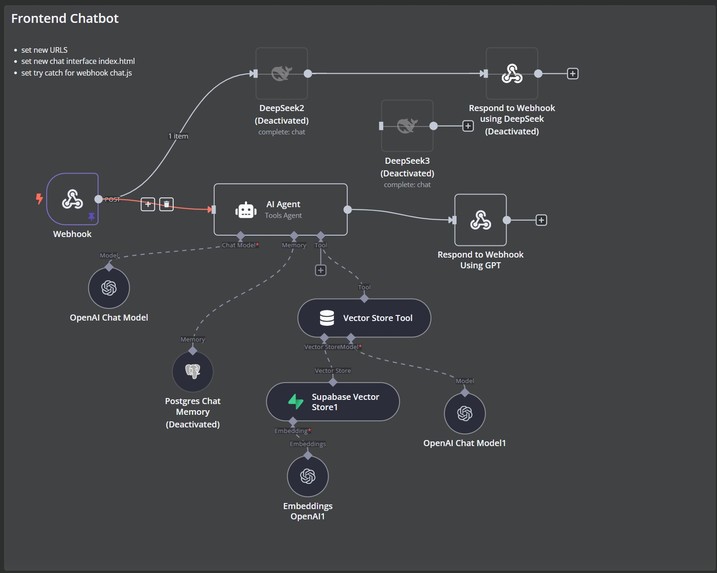
MediMind chatbot workflow: AI Agent with vector DB and multi-model integration
-
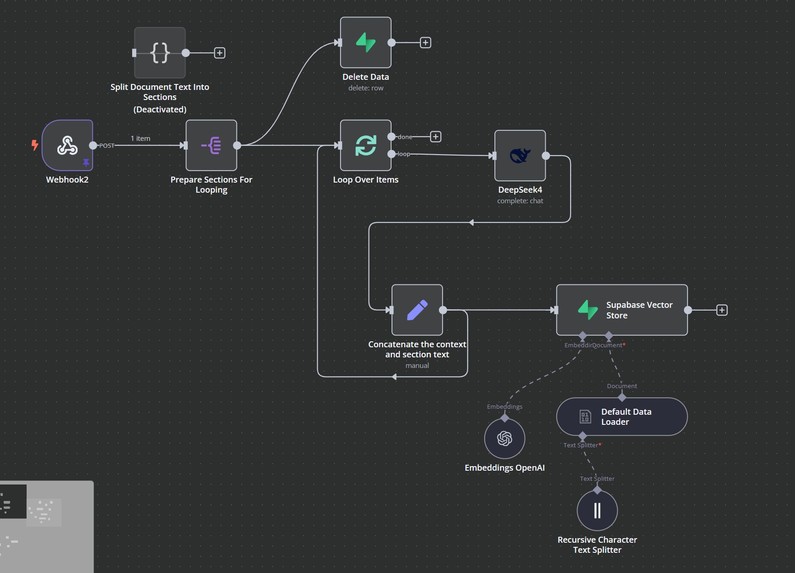
Contextual Based Embedding System


MediMind
Inspiration
The healthcare industry is drowning in data while thirsting for insights. As a healthcare software developer, I witnessed firsthand how clinicians struggle to extract meaningful information from fragmented patient records scattered across different systems. This disconnect often leads to rushed decisions, missed opportunities for preventive care, and suboptimal patient outcomes.
The inspiration for MediMind came from a simple observation: clinicians spend more time searching for information than actually interpreting it. What if we could harness the power of AI and contextual-based retrieval augmentation to provide large contextually relevant patient information precisely when and where healthcare providers need it?
What it does
MediMind is a SMART on FHIR compatible application that transforms healthcare decision-making through contextual retrieval augmentation. The system:
- Securely accesses authorized patient data through standard FHIR interfaces
- Processes (n8n) and chunks (DeepSeekv3) this information into context-rich fragments
- Stores these fragments temporarily in a vector database (Supabase Vector Store) for efficient retrieval
- Uses a sophisticated retrieval augmentation system to pull relevant information based on clinical queries
- Presents insights directly within the clinical workflow through CDS Hooks
- Enables natural language interaction with patient data via an intuitive user friendly chat interface
This creates a seamless experience where clinicians can access precisely the information they need at the point of care without having to navigate multiple systems or pages of records. For example: Clinicians can hold 4-7 items in working memory, while AI can process 100,000+ tokens across millions of records without fatigue, serving as an extended memory that surfaces critical patterns humans might miss.
How I built it
MediMind leverages several cutting-edge technologies:
- SMART on FHIR: For seamless integration with existing EHR systems and secure patient data access
- CDS Hooks: To provide contextual decision support directly in clinical workflows
- n8n Workflow Automation: For orchestrating data flows and integrating with AI services
- Vector Database: For efficient storage and retrieval of context-rich patient data fragments using PostgreSQL with vector embeddings and document matching cosine similarity function.
- Multiple AI Models: Combining DeepSeek v3, OpenAI's o4-mini, and ADA embeddings for optimal performance
- Express.js: For building the CDS service backend
- Vite + JavaScript: For creating a responsive and modern frontend
- Tailwind CSS: For crafting an intuitive and accessible user interface
The system maintains strict privacy standards by deleting all vector database entries when a session ends, ensuring no patient data persists beyond its authorized use.
Challenges we ran into
Building MediMind within a limited timeframe (3 days) came with some challenges which includes:
- Data Privacy: Designing a system that could utilize sensitive healthcare data while maintaining strict privacy standards required careful architecture decisions.
- Contextual Understanding: Traditional chatbots often struggle with medical terminology and context. I had to extensively tune (prompt engineering) our retrieval system to understand the clinical context behind queries.
- Integration Complexity: Healthcare systems are notoriously difficult to integrate with. The SMART on FHIR standard helped, but each implementation has its quirks that required adaptations.
- Performance Optimization: Healthcare decisions can't wait. Optimizing query response times while maintaining accuracy was a delicate balance, however with better models - it performed significantly better.
- Model Selection: Finding the right combination of AI models for different tasks (chunking, embeddings, reasoning, generation) required extensive testing to achieve the best results.
Accomplishments that we're proud of
Despite the challenges, we achieved several milestones:
- Created a system that understands medical context far better than general-purpose AI assistants
- Developed a secure integration pattern that works with existing EHR systems without disrupting clinical workflows
- Built an intuitive interface that requires minimal training for healthcare professionals
- Achieved sub-second response times for most queries
- Implemented a privacy-first architecture that leaves no data footprint
What we learned
This project has been an incredible learning journey which I'm very proud of. I've discovered the critical importance of domain-specific context in AI applications, mastered the delicate balance between performance requirements and privacy considerations, navigated the complexities of healthcare data integration with FHIR, harnessed the power of combining multiple AI models for specialized tasks, and leveraged workflow automation to connect disparate systems. The abundance of possibilities for extending this approach to other healthcare domains and workflows is truly exciting, opening doors to innovations that could transform patient care in ways we're only beginning to imagine.
What's next for WGCA MediMind
I have ambitious plans for the future:
- Adding support for more specialized clinical domains and use cases
- Developing intuitive ways to visualize complex medical relationships
- Incorporating imaging data alongside textual records
- Moving beyond retrieval to predictive analytics for preventive care
- Supporting more EHR systems and healthcare settings
As a solo developer with limited time and resources, I recognize that MediMind remains a work in progress. The current implementation demonstrates the core concept, but I plan to enhance it substantially with improved visuals and user-centric insights within the next couple of months. In the near term, I'm particularly excited to integrate several powerful new capabilities:
Symptom Triage and Guidance: An enhanced chat interface using NLP to understand patient symptoms, assess urgency, and recommend appropriate care levels (self-care, telehealth, urgent care, emergency).
Health Literacy Translator: A system that automatically converts complex medical information into patient-appropriate language and explanations based on their health literacy level.
Clinical Documentation Assistant: AI that helps generate clinical notes from patient-provider conversations, reducing documentation burden on clinicians.
Healthcare Navigation Assistant: An AI guide that helps patients understand insurance coverage, find in-network providers, and estimate costs for planned procedures.
MediMind represents just the beginning of how contextual AI can transform healthcare decision-making, making it more precise, personalized, and efficient.
Built With
- 4o-mini
- cds-hooks
- deepseekv3
- express.js
- fhir
- github
- javascript/node.js
- n8n
- npm
- oidc
- postcss
- postgresql
- postman
- supabase
- tailwind
- text-embedding-ada-002
- vite
- webhook

Log in or sign up for Devpost to join the conversation.