Inspiration
We were inspired by the idea of a haunted house which you can hide in a room as an AI model tries to find you in the room. However, by assessing the difficulty and the time limits on this project, we have decided that a murder mystery style game would be best suited to our capabilities. We also believed that we can implement many of our original ideas and concepts into this new style.
What it does
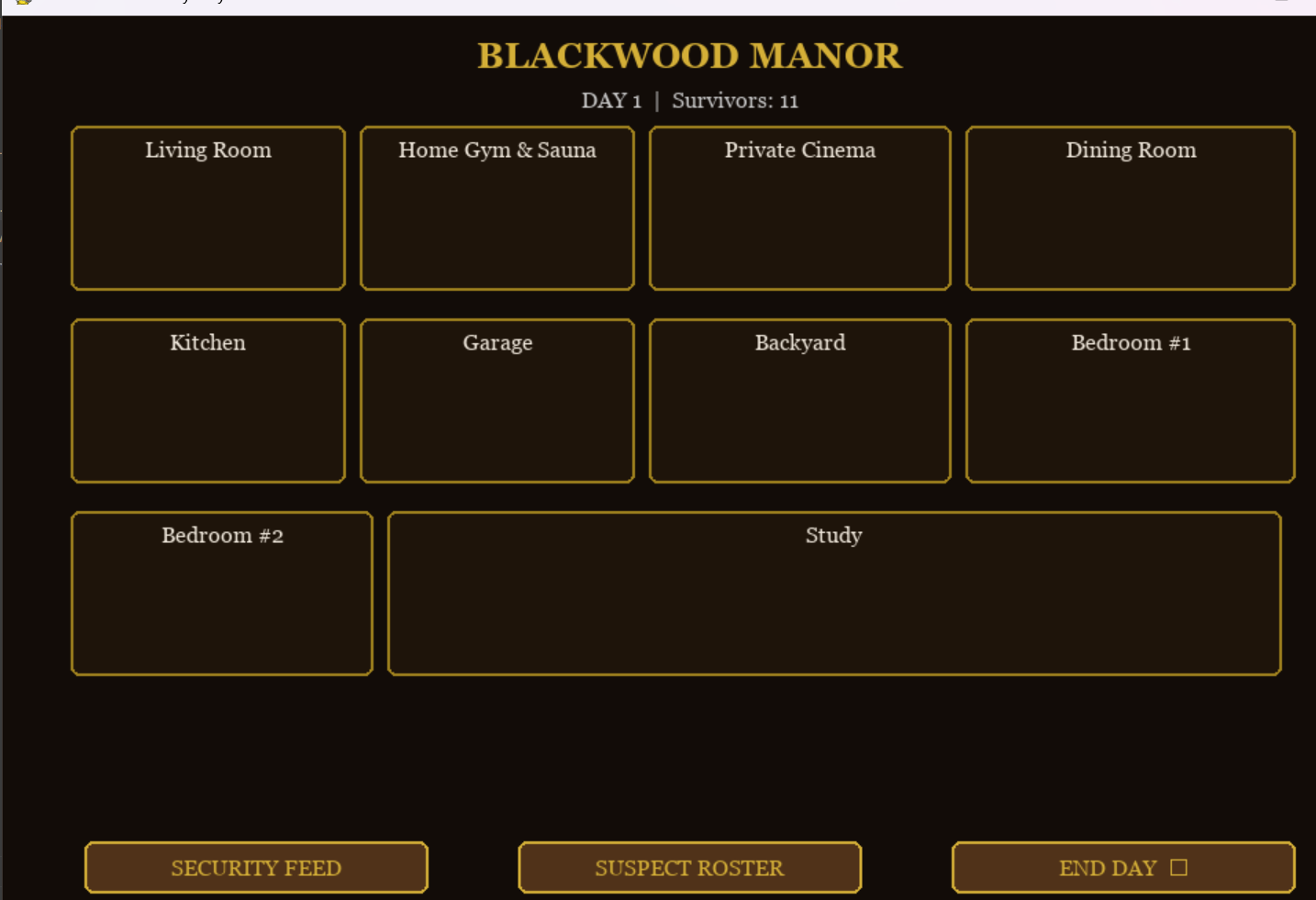
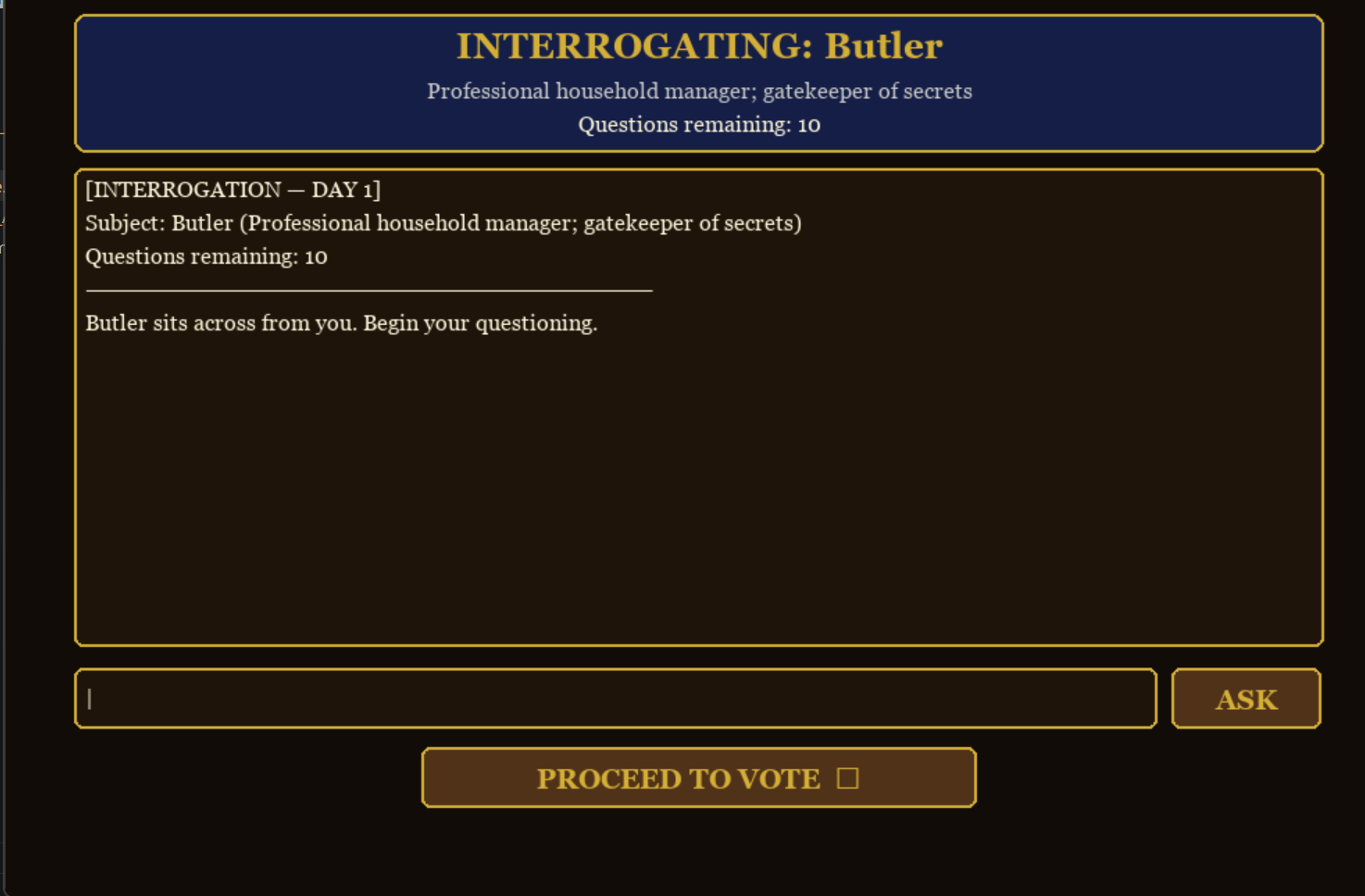
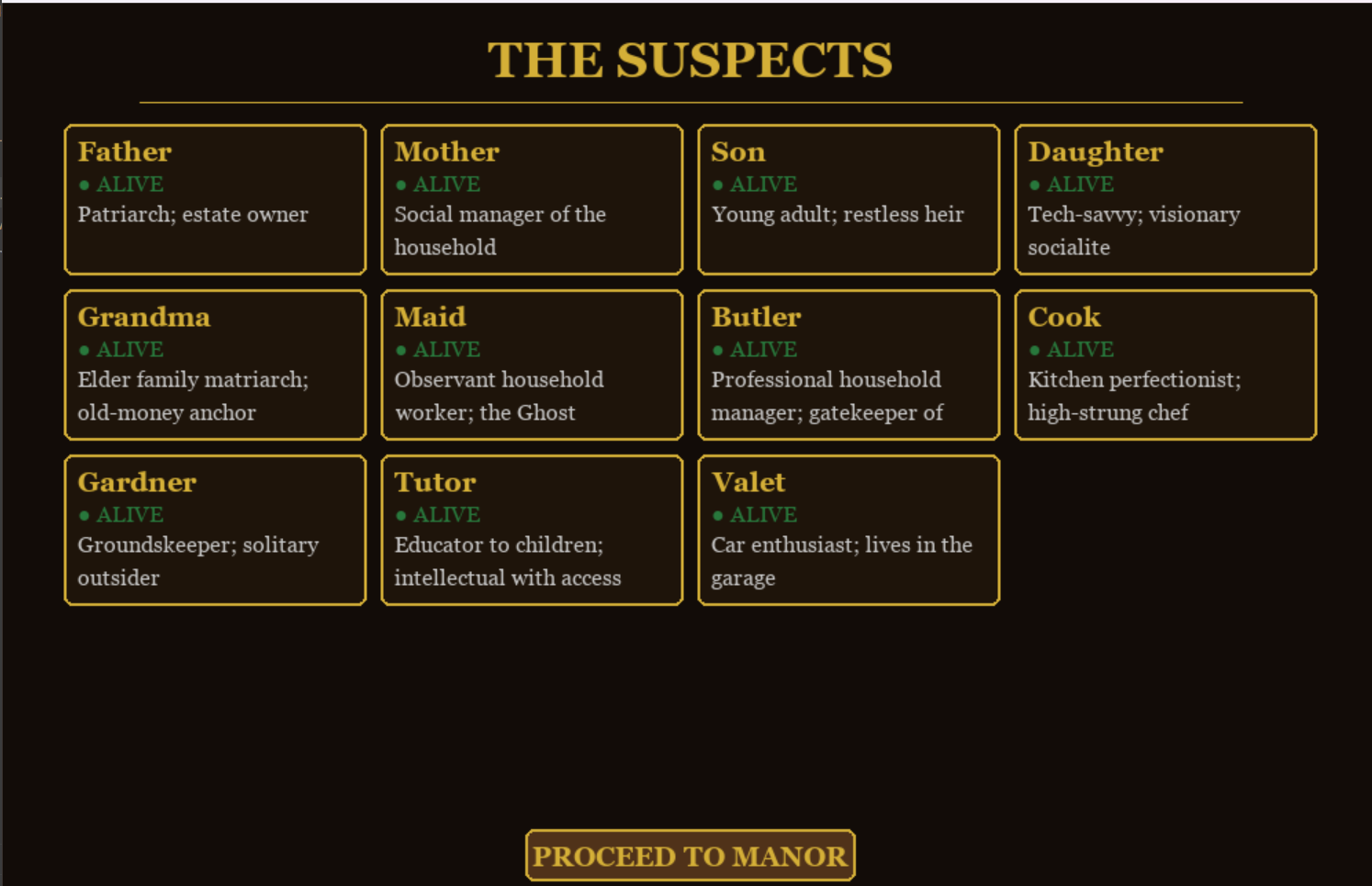
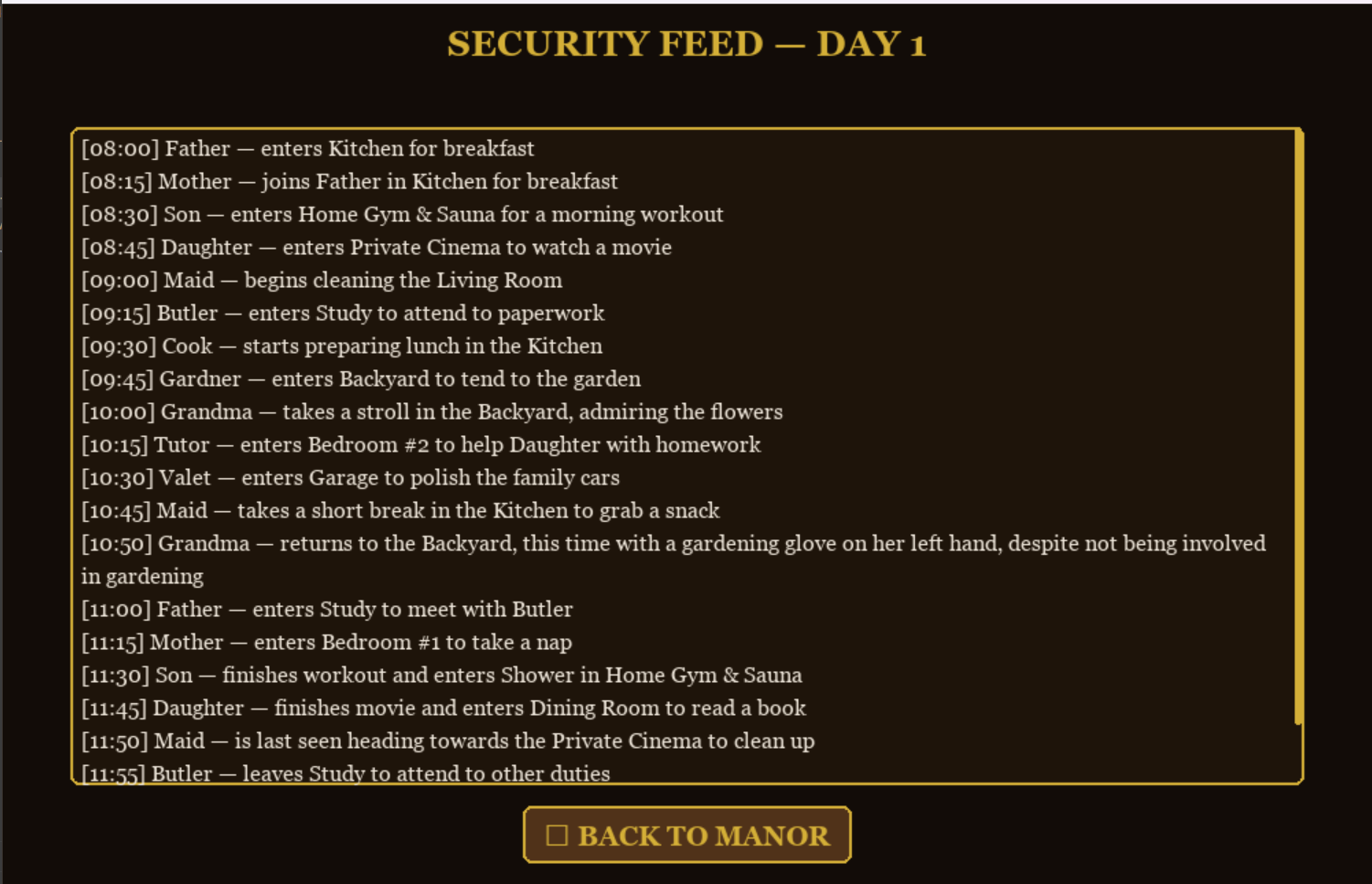
This is a playable Murder Mystery style game which lets the player take on the role of a security guard and try to find the murderer within the manor before all the people are eliminated.
The game cycles through 7 days and 7 nights with a new murder being committed each night by the same killer. If the player does not successfully arrest the correct killer by the end of the 7 day period, then the killer would have escaped and the player loses. However, the player can win the game (and save the rest of the civilians) by successfully guessing and arresting the correct killer before the 7 day period.
How we built it
We built it using Pygame which provided us with a good basis to establish the graphics and visuals of the game. To design a game as appealing as possible, it was very important to us to consider the minor details such as the layout, the colour used and the different ways the player can interact with the game. These features and many more were one of the key reasons Pygame was so fundamental in the development of our game.
Another aspect of the game that Pygame perhaps was limited in implementing is the idea of AI models as our main narrator and ways the player can interact with the game. The AI model was chosen off GitHub and implemented with code sourced from the Decoded Workshop ran by HackMelbourne. This AI model acted as the story teller and brains of our game, deciding on the speech and personality of each character (based on prompts decided by us) as well as how the story should be played out. This makes our game unique and each playing experience to be very different from the next; maintaining a high level of engagement and entertainment.
Finally, by learning what serves as good prompts and bad prompts, we were able to enlist the help of various LLMs such as Claude and Cursor as a way to piece together some aspects of our game. This mainly included the aspect of combining the individual codes designed by us into a seamless and flowing game structure. Also, by using these LLMs, some tedious aspects of the game such as the screen ratio and layouts and colors can be decided and precisely implemented.
Challenges we ran into
Some challenges was the difficulty and complexity of the game as we are not experts at pygame or python itself and the time limit of 3 days is restricting
Accomplishments that we're proud of
The game is quite entertaining and the graphics and visuals are really engaging. The format of the game and the idea behind it is very interesting and challenging provided only 7 days are allowed before the player loses. We are most proud of the way the game is able to be played and ran.
We believe each story has a purpose and is of sufficient length that the player remains engaged and absorbed in the gameplay. Also, the implementation of the AI models went quite smoothly, without many major issues preventing the full gameplay that the final game depict.
What we learned
We learned some controls and functions of Pygame as well as the different ways we can incorporate and dictate AI models to be part of our games. This serves to be a good reminder of the different methods of utilising and manipulating different AI models to achieve the outcome we desire.
Pygame also was really fascinating to deep dive into and explore its various different capabilities and functions. Prompting other LLMs such as Claude and Cursor prove to be a valuable lesson in what can be a good prompting method and what may not be the best use.
What's next for WestWood Manor
As a whole, there are certainly improvements that can be made and perhaps even trying to improve some aspects of the gameplay or graphics as we agree that it is a bit lacking with limited player movements throughout the game. Perhaps this can be finalised through a player movement section of the game before transitioning to the main storyline, maybe an exploration section that allows the player to move into different rooms and search for evidence.
GitHub Link: https://github.com/dani3ll1u3745-sudo/Hackiethon-2026.git
TeamMembers: Daniel Liu Jia Xuan - gmail: [email protected] student id: 1898787
Ray Cho - gmail: [email protected] student id: 1896791
Jason You - gmail: [email protected] student id: 1896099


Log in or sign up for Devpost to join the conversation.