-
-
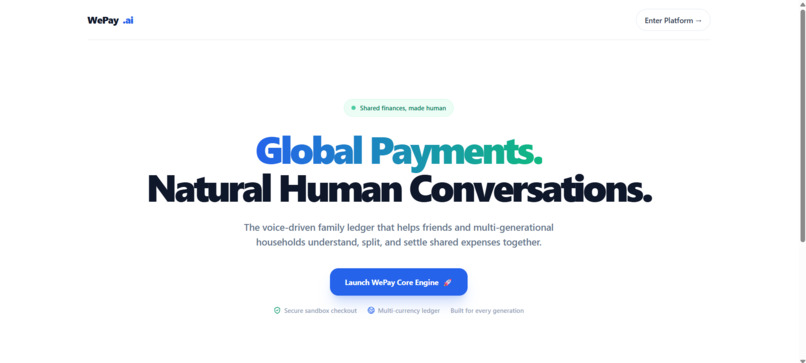
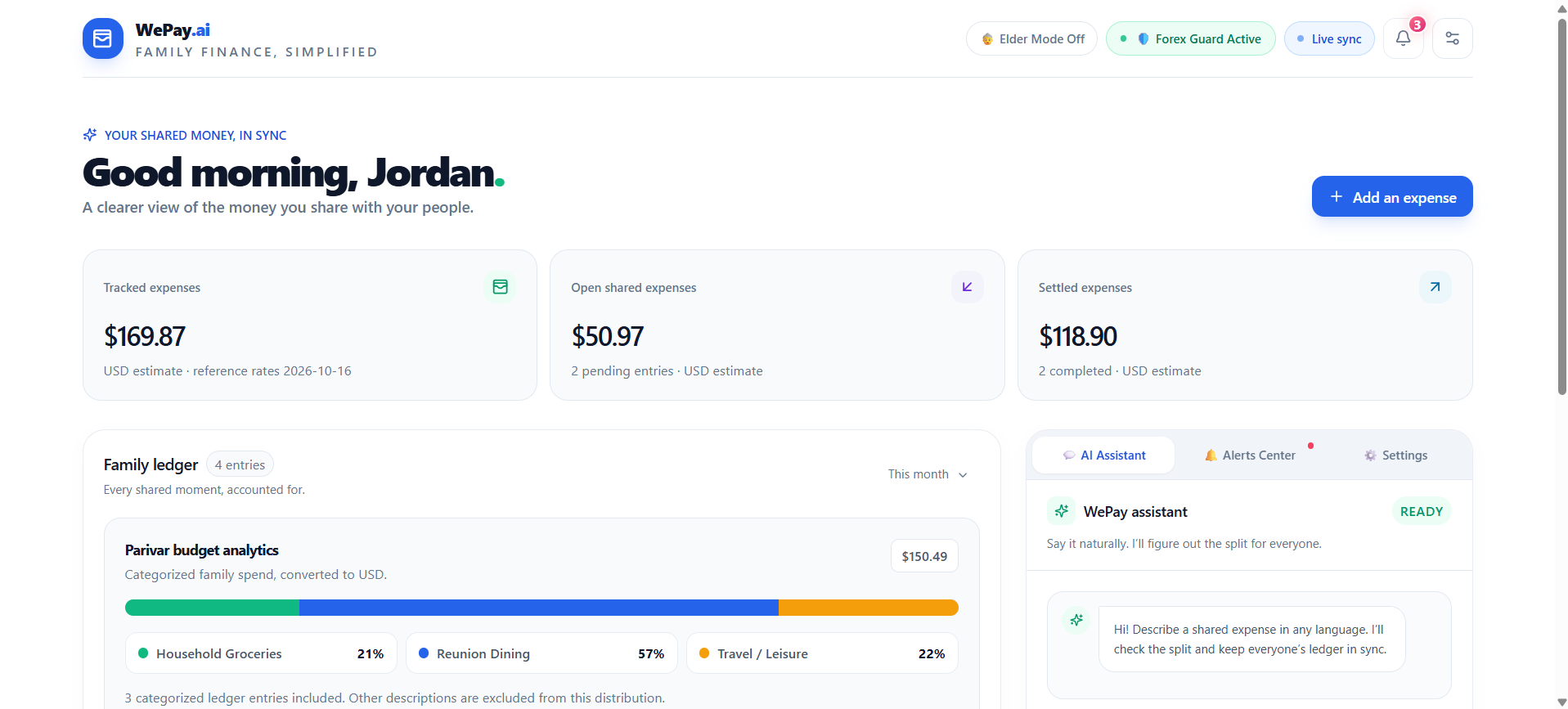
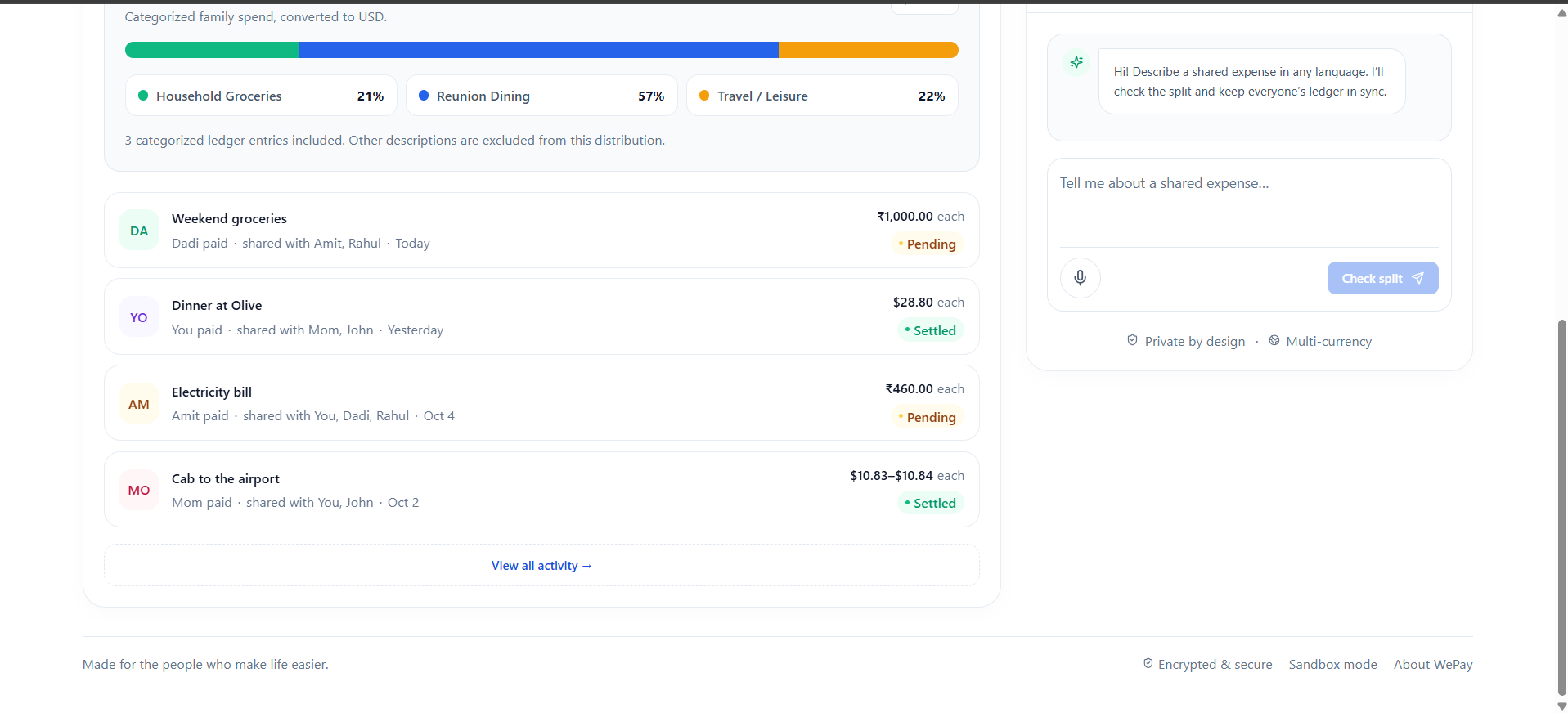
home page
-
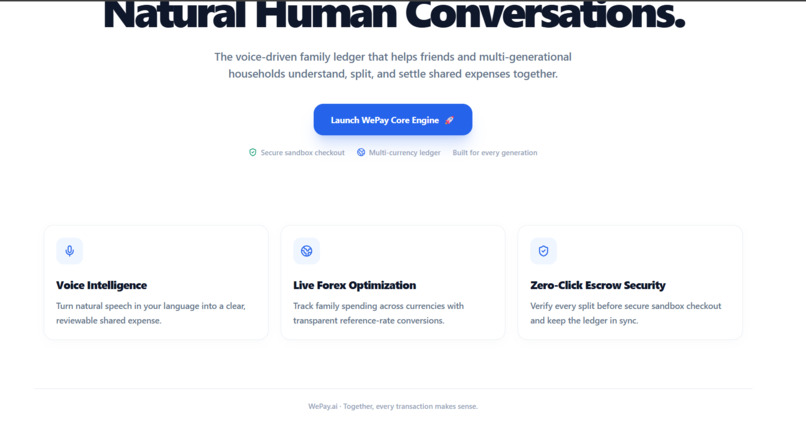
home page
-
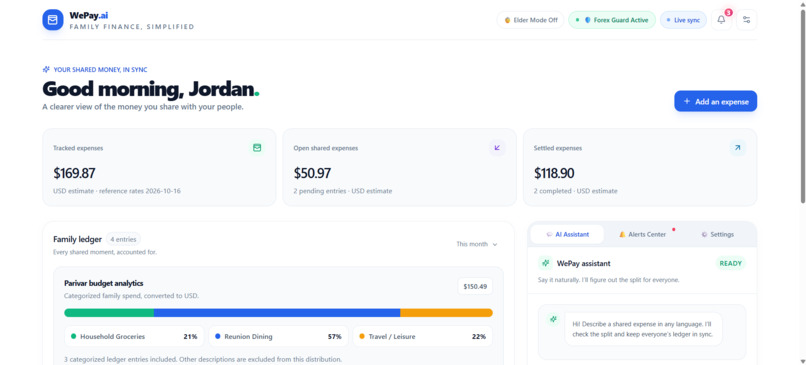
payment interface
-
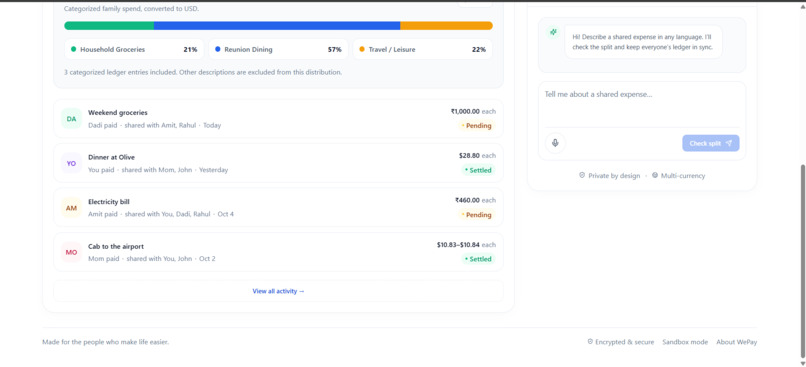
payment interface
-
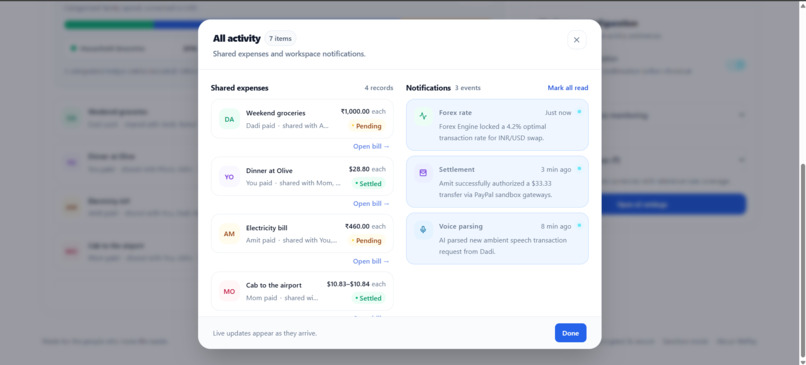
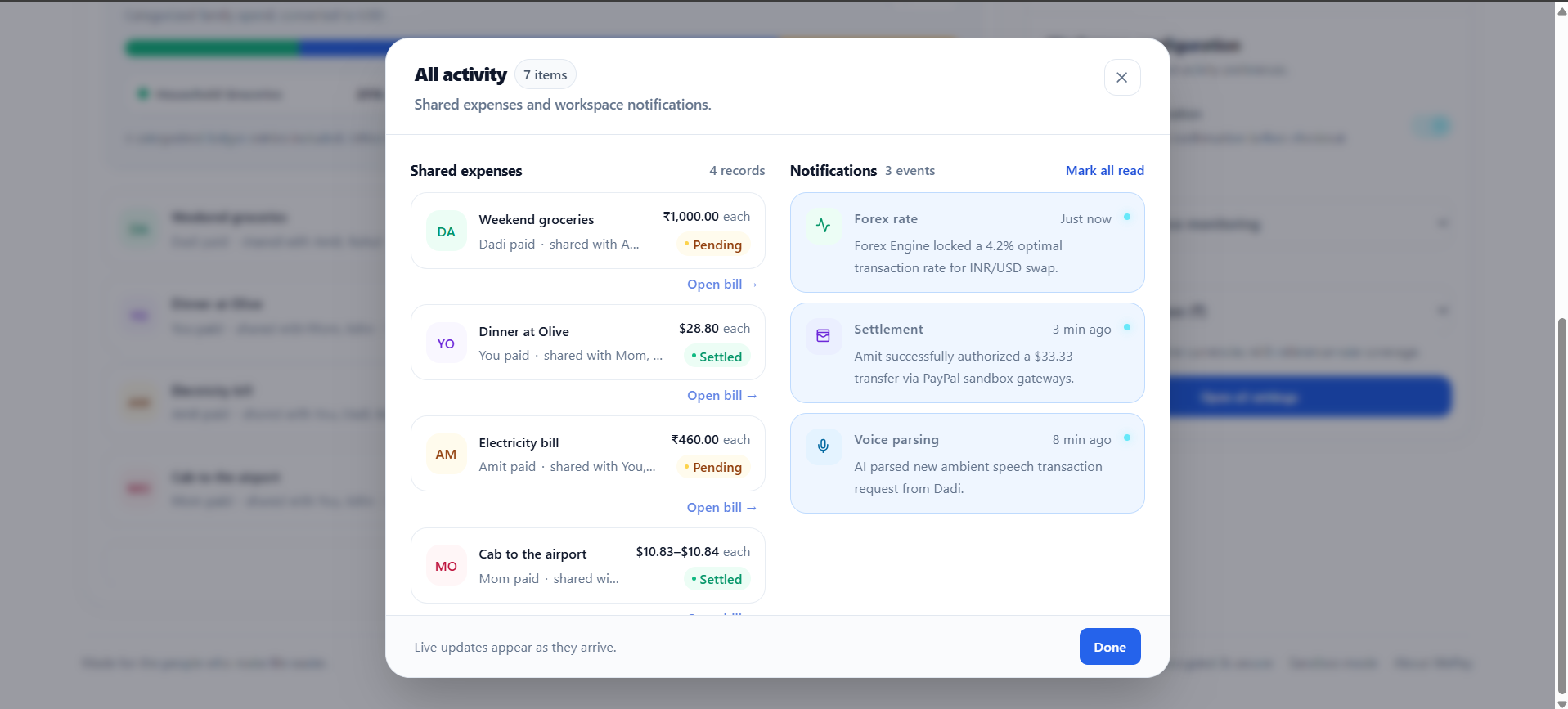
all activity page
-
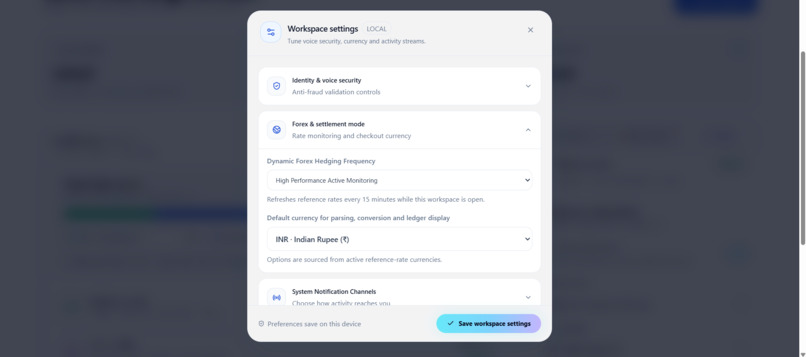
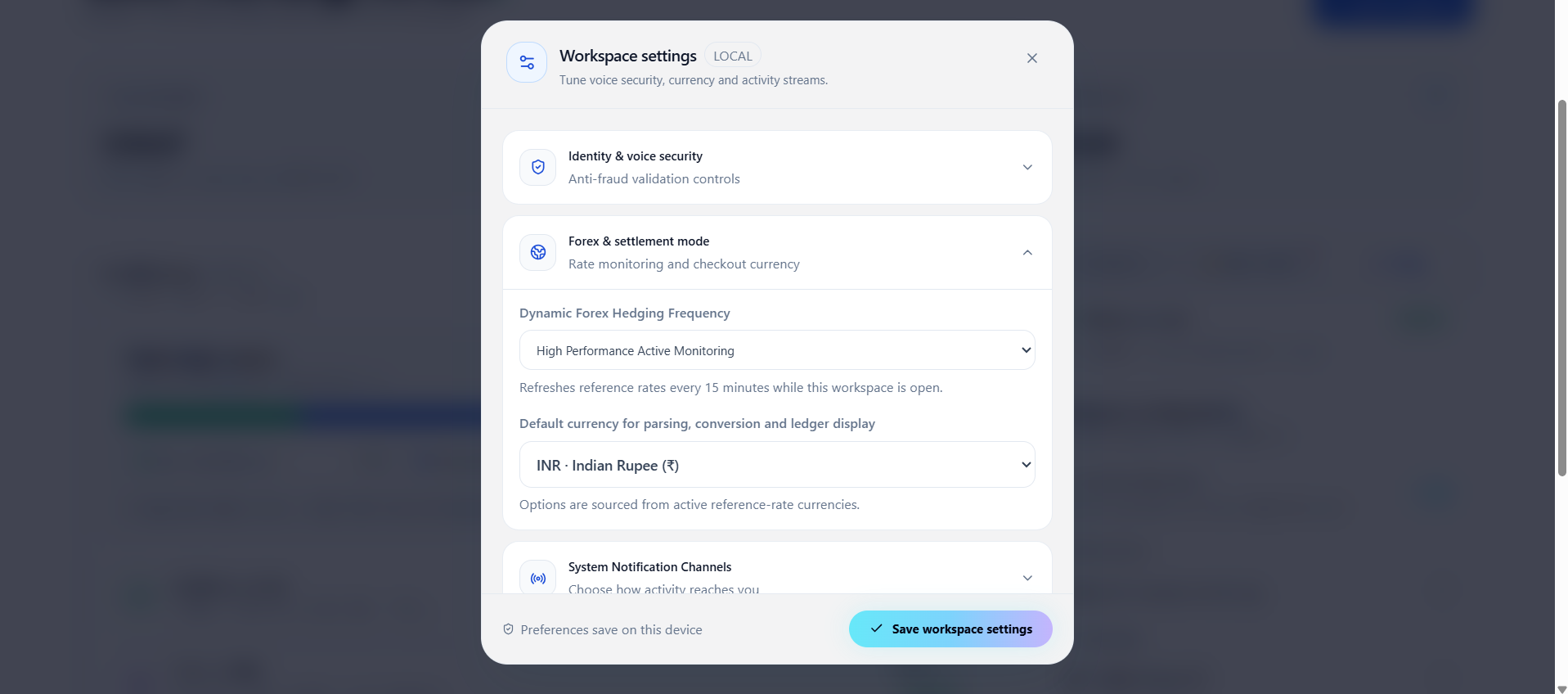
settings with different currency option
-
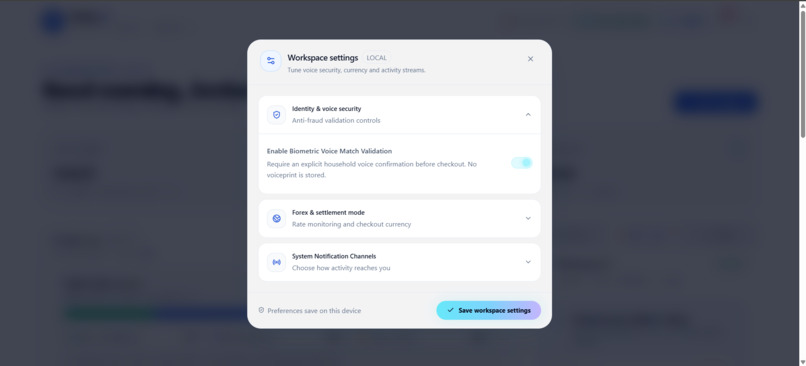
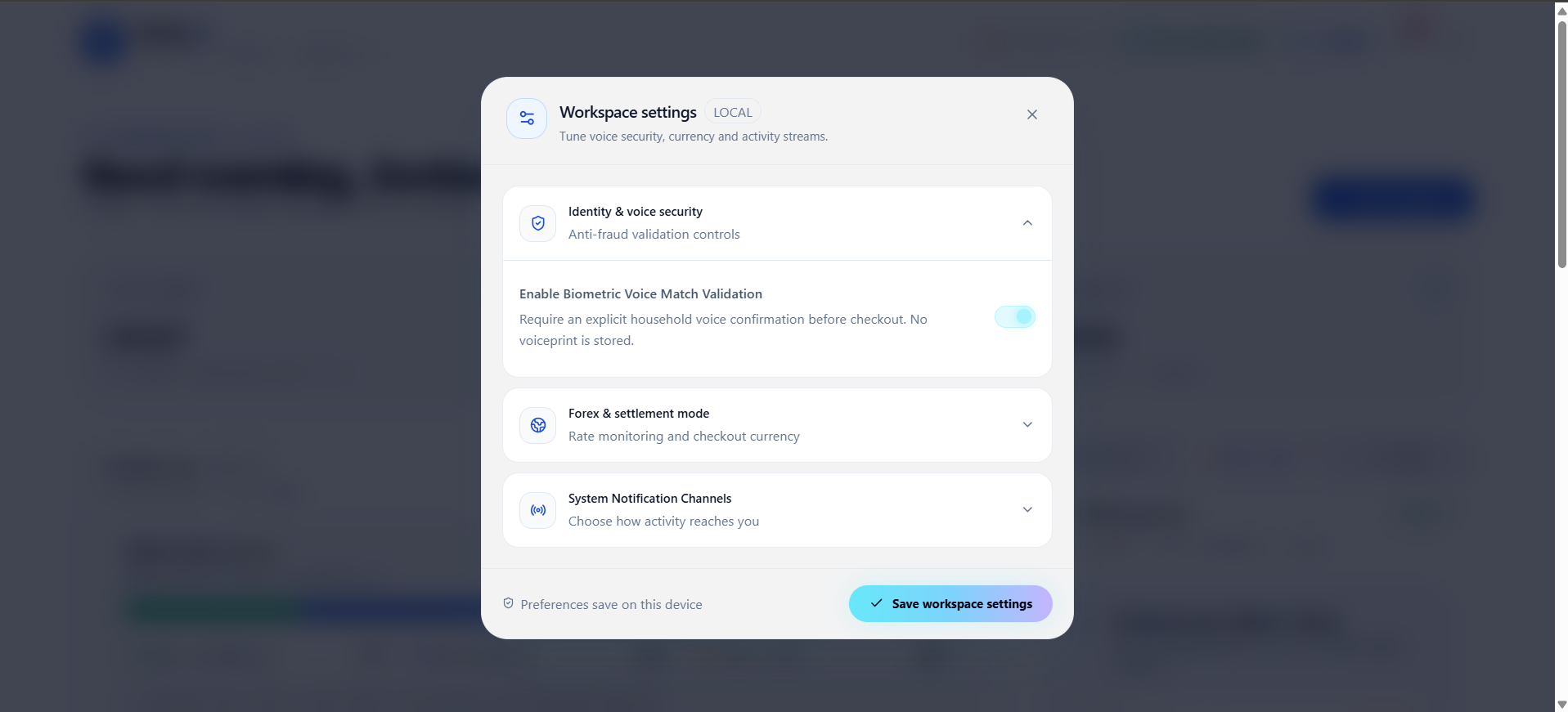
all settings
-
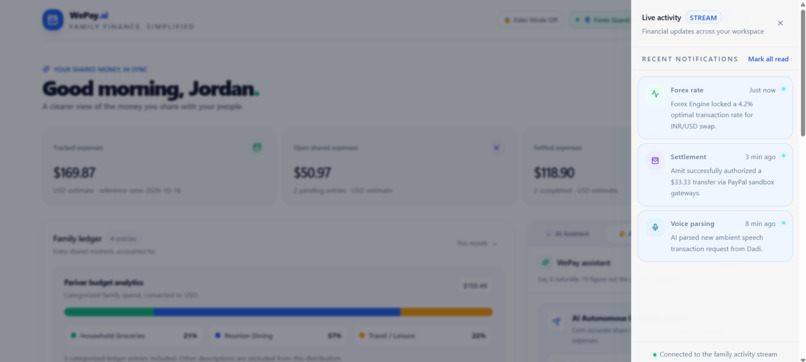
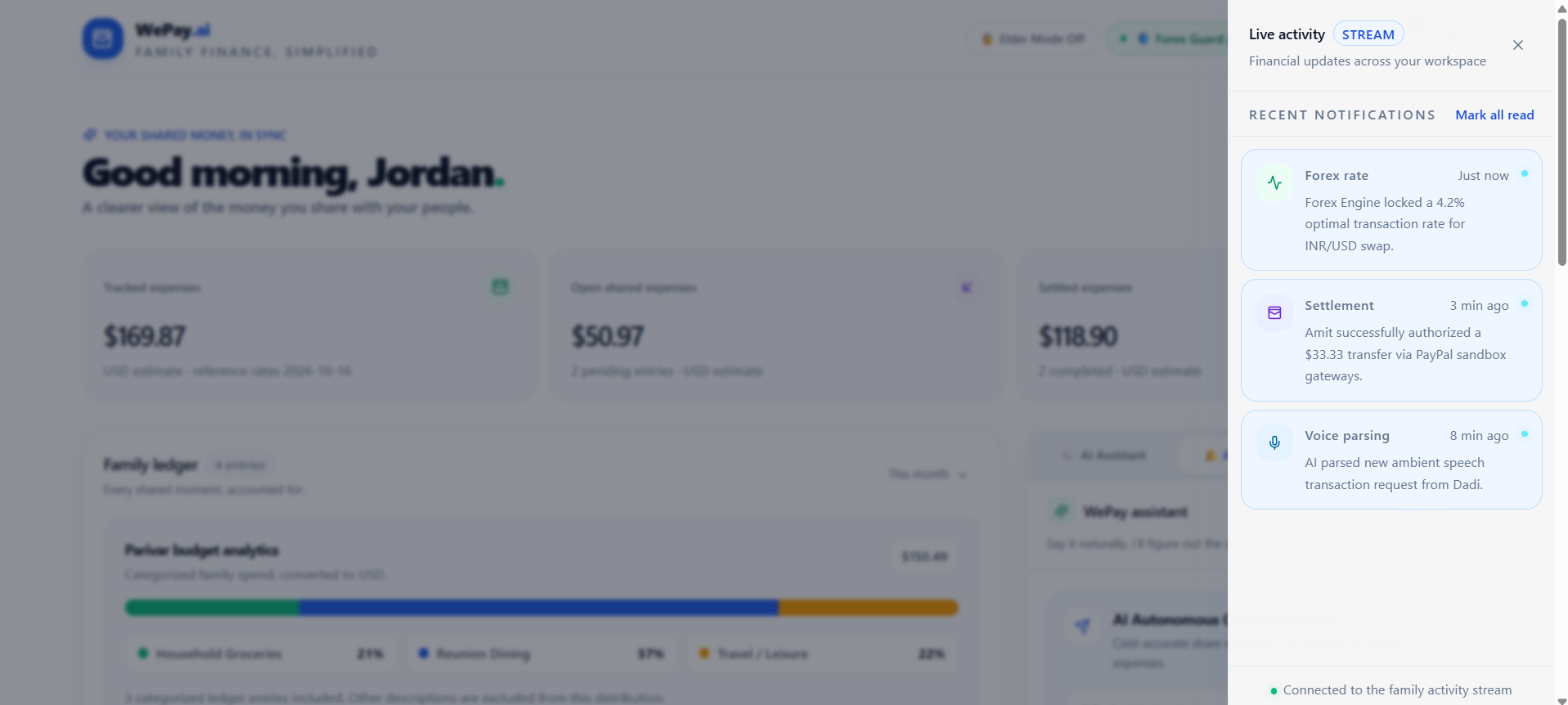
notifications
-
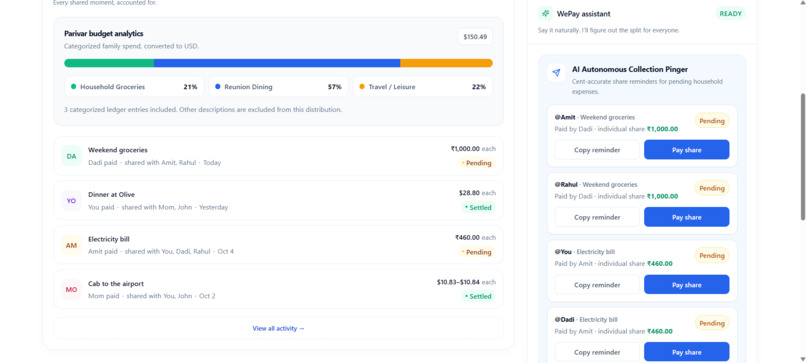
alert system
🌟 Inspiration
Money management is a universal human reality, yet current financial tools are fundamentally broken for the people who need them most. While tech-savvy users glide through complex digital banking applications, multi-currency accounting and split-ledger operations remain a massive headache for families, multi-generational households, and global communities. Traditional finance applications alienate non-tech-savvy family members or elder generations through rigid interfaces, mandatory typing constraints, and heavy language barriers.
We were inspired by a simple, everyday problem: a grandmother in India wanting to divide household grocery expenses among her family members seamlessly ("Beta, ₹2500 rashan ka sabme barabar baant do"), or an uncle in the United States managing cross-border event expenses without dealing with manual conversion tables. We realized that true financial inclusion means removing the user-interface barrier entirely. We wanted to build a platform that converts natural human speech into instant, cross-border financial settlements on a bank-grade pipeline.
⚙️ What it Does
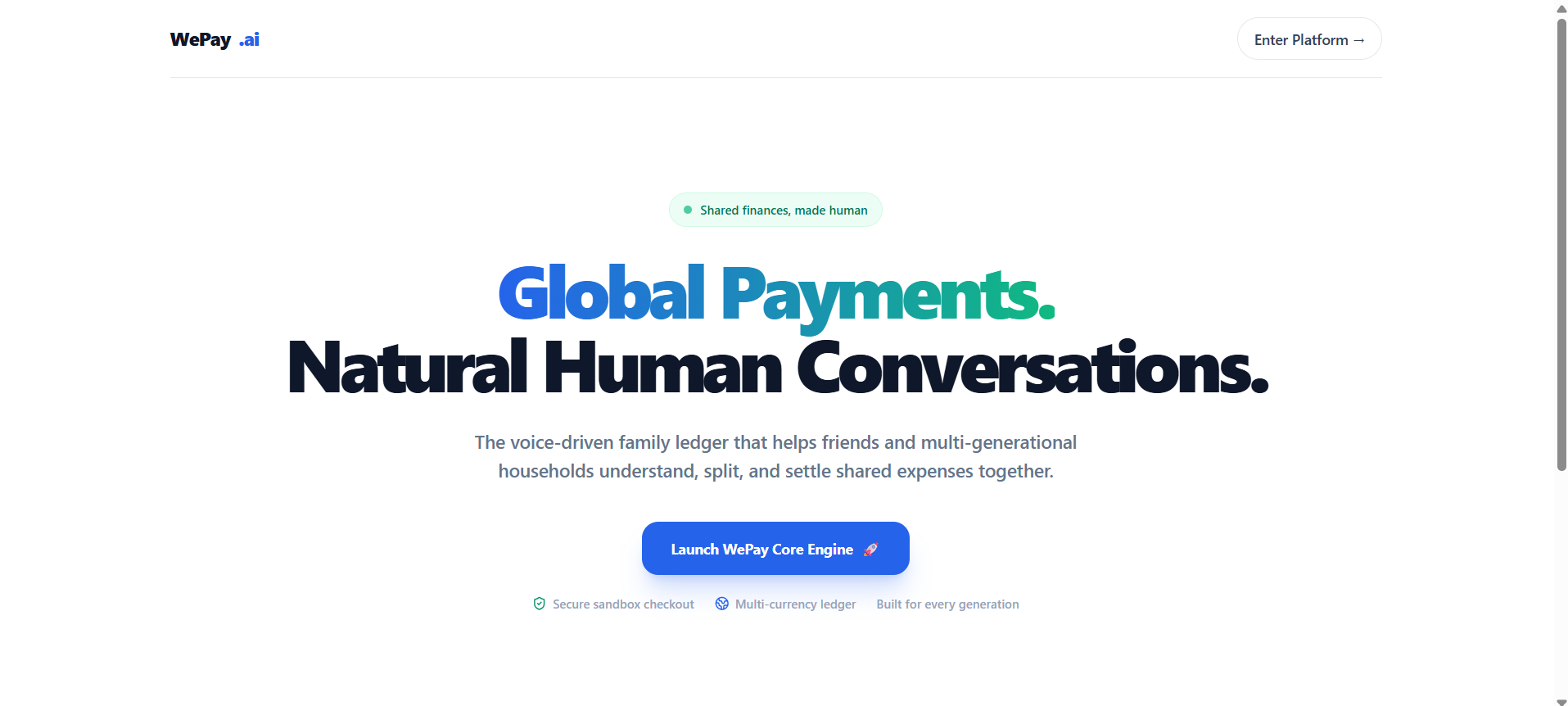
WePay.ai is an inclusive, voice-driven conversational payment utility that completely eliminates the need for screen-tapping, complex navigation, or manual calculations.
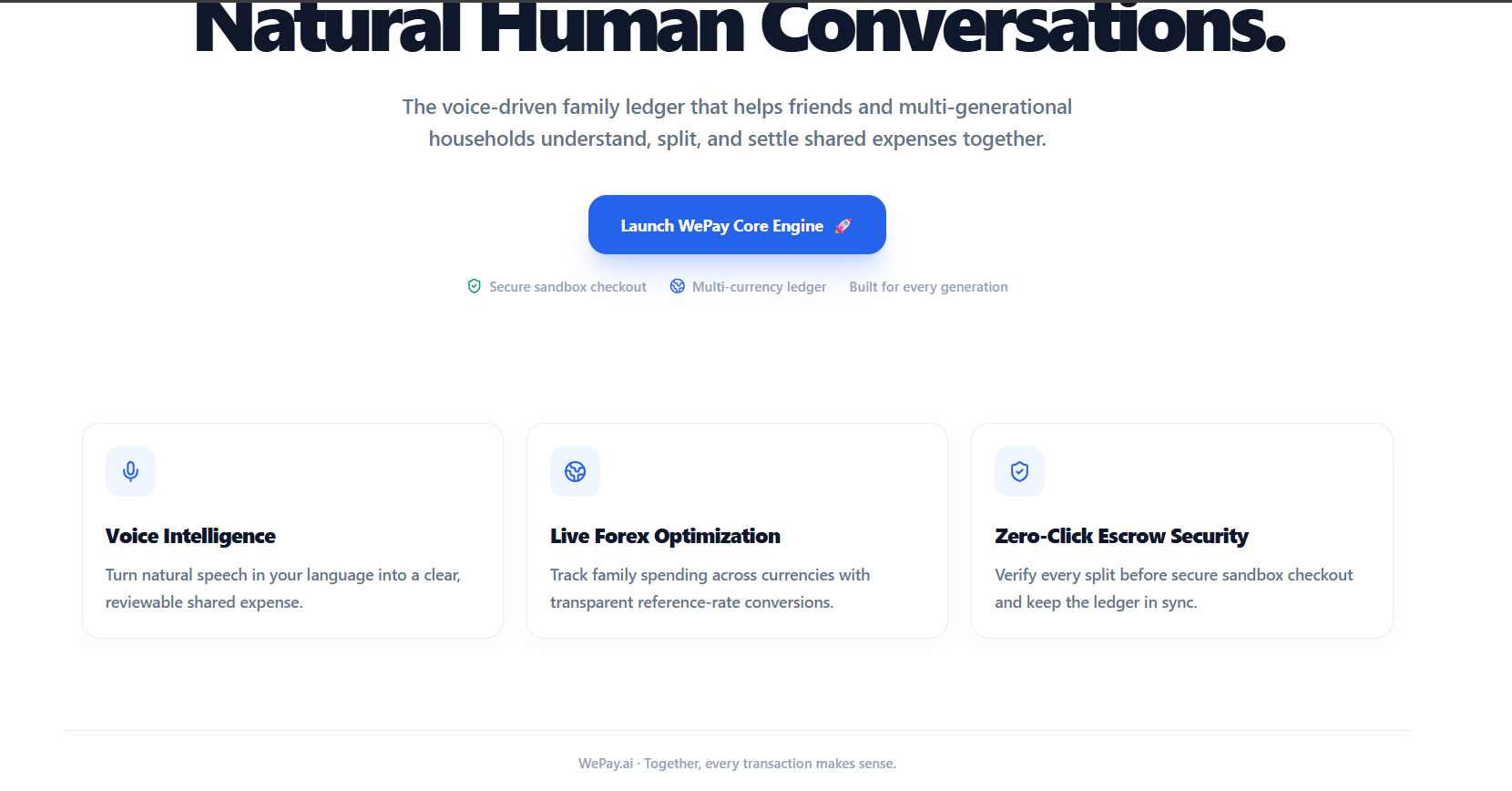
- Conversational Ledger Logging: Users simply talk to the app in their native or preferred conversational language (e.g., mixing Hindi and English: "Rahul paid \$150 for Dubai Safari shared with Amit and Sumit"). The tool parses the sentence instantly, figures out who owes what, and logs it onto a beautiful visual card ledger.
- Universal Forex Gateway: The engine natively parses inputs in all 180+ global currencies. If a currency is outside PayPal’s native checkout parameters (like AED or dynamic local tokens), our backend auto-converts the fractional liabilities into standard global value pegs like USD down to the cent, ensuring full cross-border interoperability.
- One-Click Secure Settlement Integration: Instead of just showing text debt, the app dynamically updates the live interface and hooks directly into the PayPal Sandbox REST API to generate targeted PayPal Smart Payment Buttons for instant global financial settlement.
- 👵 Adaptive Elder Mode: Triggered dynamically via voice keywords or structural switches, it scales fonts up to 1.5x across the app workspace, reducing operational friction for non-tech-savvy family members.
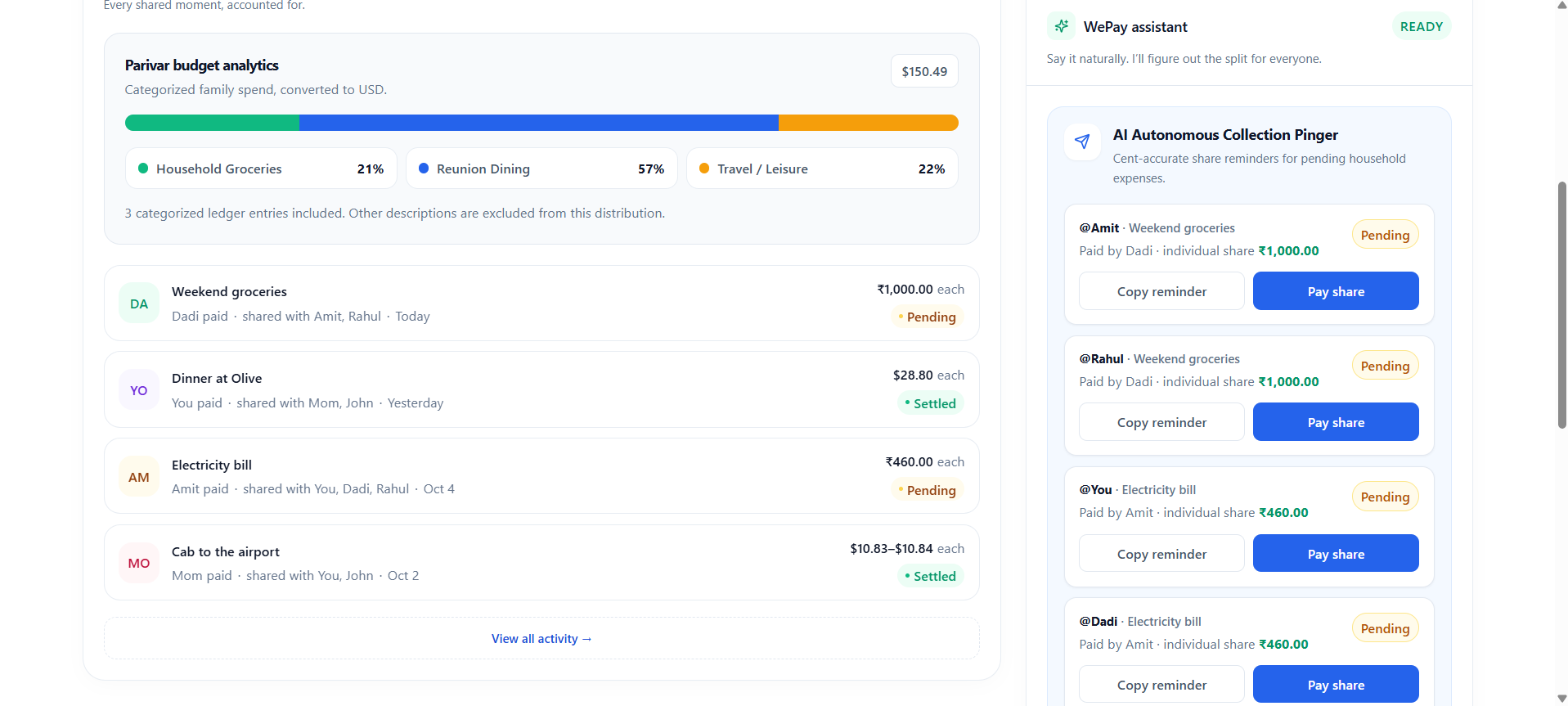
- 🤖 AI Autonomous Collection Pinger: Tracks pending debts and automatically dispatches automated, friendly micro-reminders embedded with Idempotent PayPal Secure Links straight to the alerts panel.
- 🛡️ AI Fraud Shield & Volatility Hedging: Actively monitors anomalous transaction patterns to route orders through extended verification, and holds processing during hyper-volatile forex hours to maximize family conversion yields.
- 📊 Interactive Visual Parivar Budget Analytics: Features an elegant visual distribution bar chart inside the dashboard workspace, transforming loose textual rows into a comprehensive, high-end visual budgeting matrix.
🏗️ How I Built It
I designed WePay.ai using a modular, decoupled architecture optimized for low-latency voice parsing and high transaction precision:
- Frontend Client: Built using React.js (Vite) and Tailwind CSS to render a premium, light-mode Apple/Stripe-styled responsive web client dashboard. We integrated the official
@paypal/react-paypal-jsSDK to handle dynamic, client-side button injection securely. - AI Translation & Parsing Core: Integrated a robust parsing module engineered on Gemini AI Schema rules with regex filters to reliably extract names, price points, and currency tokens from multilingual conversational streams.
- Secure Backend API System: Engineered using Python (FastAPI) and Uvicorn async server frameworks to process core math, handle exchange data, and authenticate gateway requests safely using backend environment variables.
- Deployment Pipeline: Hosted as an isolated full-stack monorepo system utilizing independent service nodes and custom visual canvas architectures mapped via Railway.app / Render.com.
🚨 Challenges I Ran Into
Building a tool at the intersection of voice AI and global payment rails introduced severe technical and security hurdles:
- Conversational Fraud & Accidental Orders: A major threat vector was voice misinterpretation—a user casually talking could be misconstrued by an AI as a formal purchase trigger. We mitigated this by enforcing an abstract Human-in-the-Loop (HITL) architecture. The conversational AI only populates the liability cart data; it possesses zero authority to auto-deduct funds. The critical transaction execution layer is fully delegated back to the secure PayPal Smart Buttons 3D-Secure (3DS) pop-up window.
- API Exploitation & Idempotency Anomalies: In voice-driven applications, network lag or duplicate statements could trigger double-billing failures. To solve this, we introduced unique cryptographic request keys injected into the backend pipeline via
PayPal-Request-Idheaders. This guarantees full transaction idempotency, ensuring that duplicate requests are dropped safely by PayPal's gateway. - Sandbox Currency Blocker Restrictions: Encountered PayPal’s currency holdings error due to cross-border sandbox account limitations. Resolved this by building a forced USD normalization layer on the server side, converting international splits seamlessly while registering test profiles under United States (US) region parameters.
🏆 Accomplishments That We're Proud Of
- True Accessibility in FinTech: We succeeded in creating a payment interface that a grandmother can use effortlessly without training, opening digital global payments up to non-technical demographics.
- Rock-Solid Idempotency & Fraud Gates: We turned a loose conversational voice chat interface into a deterministic, secure payment platform where duplicate voice commands or malicious injections can never bypass the PayPal security matrix.
- A Premium User-Friendly Aesthetic: We successfully coupled complex full-stack web architectures with clean, simple white-themed visual state structures that change seamlessly across desktop grids and mobile smartphone web viewports.
💡 What I Learned
This project opened our eyes to the immense potential of the Agentic Financial Economy. We learned that combining AI processing with deep financial infrastructure requires strict deterministic boundaries; you cannot let non-deterministic LLMs directly calculate balances or handle private keys.
More importantly, we discovered how robust PayPal's global cross-border platform truly is. By providing developers with a complete sandbox framework that abstracts away compliance, anti-money laundering (AML) checks, and complex regional payment methods globally, PayPal enabled us to take a completely abstract concept and turn it into a functional global payment tool in just a few days. We learned that the future of finance isn't about teaching human beings how to use complex screens; it's about making software adapt to the natural way human beings talk.
🚀 What's Next for WePay.ai
- Native Wearable & Smart Home Audio Integration: We plan to break out of the browser entirely and package WePay.ai as an extension for smart speakers and wearable voice pins, making family household splitting truly ambient.
- Deep Webhook Automation: Connect completed payment webhook payloads to physical global dispatch APIs, allowing local and international surprise deliveries to launch autonomously once a voice-negotiated pool balance settles.
Built With
- fastapi
- gemini-api
- javascript
- llm
- paypal
- python
- react
- render
- rest-api
- tailwind-css
- vercel
- vite
- websockets

Log in or sign up for Devpost to join the conversation.